On this page
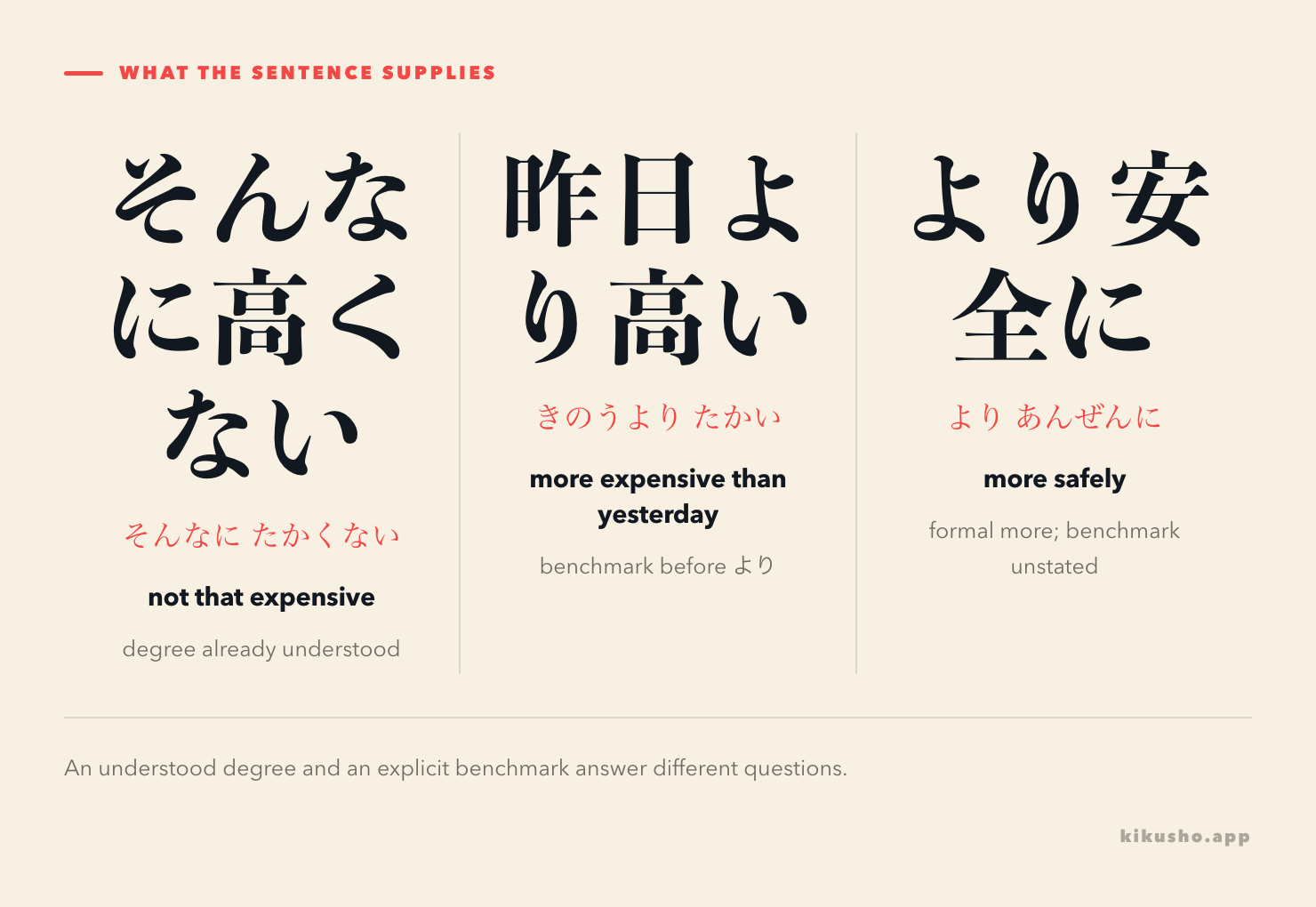
Use そんなに when the conversation already supplies a degree, roughly “that much” or “to that extent.” Use より when you mark a benchmark and say that something goes beyond it, or when formal wording simply asks for “more.”
Compare two comments about a hotel:
このホテルはそんなに高くないです。
この ホテルは そんなに たかくないです。
This hotel is not that expensive.
このホテルは駅前のホテルより安いです。
この ホテルは えきまえの ホテルより やすいです。
This hotel is cheaper than the hotel by the station.
The first answer pushes back on an understood idea of “expensive.” The second names a specific hotel as the comparison standard.
The test that decides
Ask what information the sentence must supply:
- Is the degree already shown, mentioned or imagined? Put そんなに before the verb or adjective.
- Must the sentence name what the result exceeds? Put that benchmark immediately before より.
- Does a notice or instruction only mean “more carefully,” “safer” or “faster”? Bare より can mean “more,” though conversation often prefers もっと.
| Form | What it points to | Basic attachment | Example |
|---|---|---|---|
| そんなに | an understood degree | そんなに + verb/adjective | そんなに急がない |
| Benchmark + より | an explicit standard | noun/plain clause + より | 去年より多い |
| より + description | a higher degree, benchmark unstated | より + adjective/adverb | より安全に |
Bunpro’s そんなに reference treats it as an adverb before verbs and adjectives, while its より reference identifies より as the marker for the comparison standard. Both are independent of Kikusho’s inventory source.
そんなに points back to a degree
そんなに belongs to the こ・そ・あ・ど system. The そ points toward something associated with the listener or already active in the conversation. The word does not name a number or a second object. It treats a degree as understood.
A:このかばん、二万円だったよ。
B:そんなに高かったの?
A: This bag cost ¥20,000.
B: Was it really that expensive?
The price in A’s sentence supplies the degree that B reacts to. An affirmative predicate is therefore possible. そんなに高かったの? asks whether the price really reached that surprising level.
Negative sentences are especially common because speakers often correct an assumption:
駅からそんなに遠くないです。
えきから そんなに とおくないです。
It is not that far from the station.
This does not compare two named routes. It says the distance falls below the degree of “far” that the listener may have imagined. Tokyo University of Foreign Studies lists そんなに among degree expressions related to negative あまり in its degree-adverb reference. The two are close, but そんなに more clearly points back to a degree in the situation.
The same adverb can modify actions:
そんなに急がなくても、間に合います。
そんなに いそがなくても、まにあいます。
Even if you do not hurry that much, you will make it in time.
It can also precede a な-adjective predicate: そんなに静かではありません, “It is not that quiet.” There is no な between そんなに and 静か because 静か is serving as the predicate, not modifying a following noun.
より puts the benchmark into the sentence
より follows the item used as the standard. Tokyo University of Foreign Studies states this directly in its case-particle reference: 佐藤さんは鈴木さんより年上です makes Suzuki the benchmark for Sato’s age.
The benchmark can be a person, thing, time or ordinary standard:
| Benchmark | Sentence | Meaning |
|---|---|---|
| 去年, last year | 今年は去年より暑いです | This year is hotter than last year. |
| いつも, usual | 今日はいつもより早く起きました | Today I got up earlier than usual. |
| この道, this route | あの道はこの道より安全です | That route is safer than this one. |
The Japan Foundation’s Irodori lesson likewise explains that N1より names the comparison target and may disappear only when context already makes it clear. Kikusho’s earlier N5 comparison lesson covers the full noun frames AはBより~ and BよりAのほうが~. The N4 step here is broader: the benchmark need not be a simple noun.
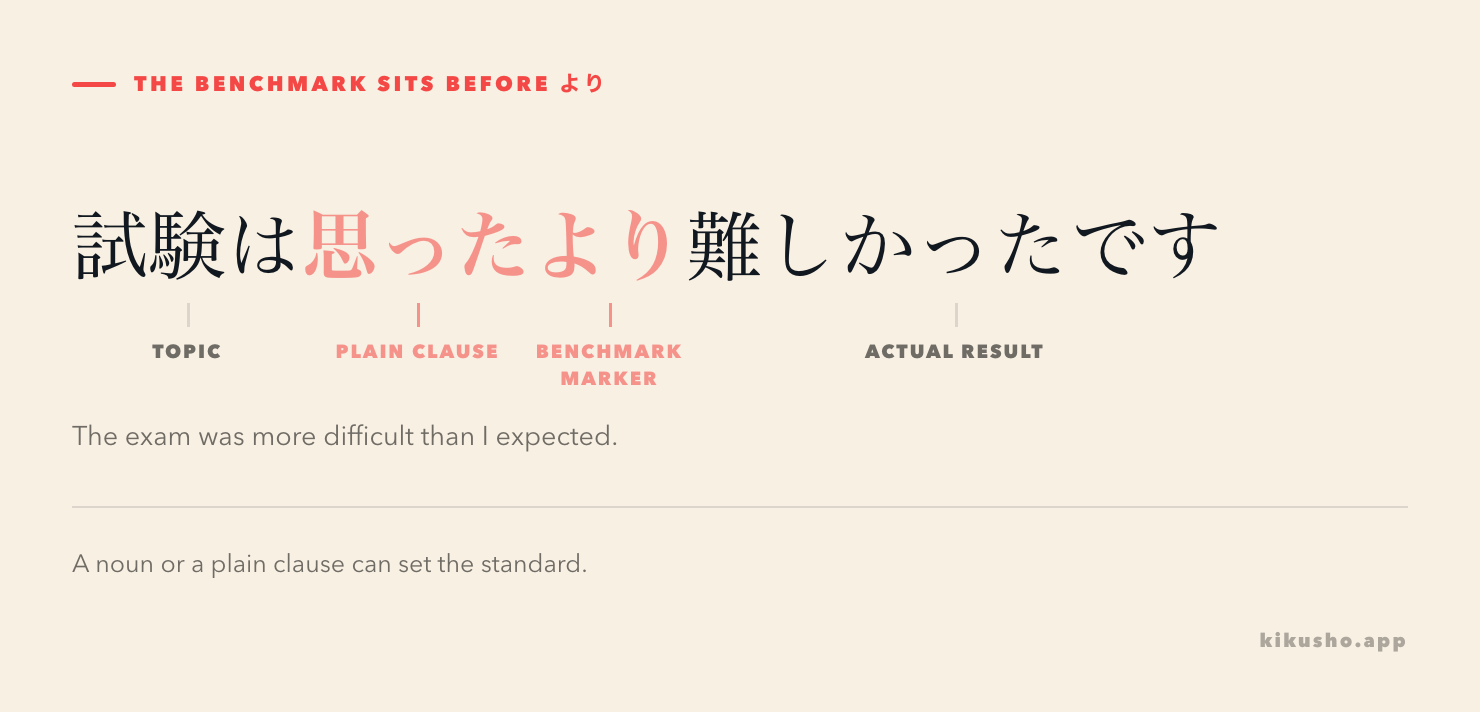
A plain clause can become the standard:
試験は思ったより難しかったです。
しけんは おもったより むずかしかったです。
The exam was more difficult than I expected.
思った is the plain past of 思う. The sentence compares the real difficulty with what the speaker had thought. No の or こと is required between the clause and より.
Actions can also be contrasted:
タクシーを待つより、歩くほうが早いです。
タクシーを まつより、あるくほうが はやいです。
Walking is faster than waiting for a taxi.
The first action is the benchmark; the second is selected with ほうが. The comparison concerns speed in this context, not a permanent claim about walking and taxis.
Bare より raises the degree without naming the benchmark
You will also meet より directly before a description:
より安全な方法を選びましょう。
より あんぜんな ほうほうを えらびましょう。
Let’s choose a safer method.
次はより丁寧に確認してください。
つぎは より ていねいに かくにんしてください。
Next time, please check more carefully.
The exact benchmark is recoverable as “than the present method” or “than before.” This compact use appears readily in guidance and writing. In relaxed conversation, もっと安全な方法 and もっと丁寧に often sound more ordinary. Japanese with Hikari’s より lesson makes the same より-versus-もっと register distinction.
Do not turn every English “more” into より. A request such as “Please speak more slowly” normally becomes もっとゆっくり話してください in conversation. Use より when the comparison frame is present or when the concise, somewhat formal “more” suits the setting.
The overlap changes what the listener must recover
Both forms can appear around the same property, but they leave different work for the listener.
この問題はそんなに難しくないです。
This problem is not that difficult.
The listener recovers a degree: perhaps someone called the problem extremely difficult.
この問題は前の問題より難しくないです。
This problem is not more difficult than the previous problem.
Now the sentence supplies a benchmark. The negative comparison does not necessarily mean the new problem is easy; it only denies that it exceeds the previous one in difficulty.
That distinction matters. そんなに高くない can reassure someone without quoting another price. 昨日より高くない compares with yesterday and leaves open whether both prices are high. The negative ending alone does not make the two structures equivalent.
When you capture a comparison in Kikusho, keep the phrase that fixes its scale. A card for 難しい is more useful with 思ったより難しい or そんなに難しくない than with the adjective alone, because the saved sentence preserves whether you named a benchmark or answered an assumed degree. Review the drafted example before saving; every field remains editable.
Practice
Complete all seven tasks before checking the shared explanations.
Question 1 — grammar choice. A friend says the station is extremely far. Reply “It is not that far” with 駅は__遠くないよ。
- ア. より
- イ. そんなに
- ウ. ほうが
- エ. いちばん
Question 2 — benchmark choice. Complete “Today is colder than yesterday”: 今日は昨日__寒いです。
- ア. そんなに
- イ. ほど
- ウ. より
- エ. まで
Question 3 — text grammar. Read: A:新しい部屋は家賃が高いですか。B:前の部屋より高いですが、そんなに高くないです。 Which statement is supported?
- ア. The new room is cheaper than the old room.
- イ. The new room is more expensive than the old room, but not extremely expensive.
- ウ. Both rooms have exactly the same rent.
- エ. B refuses to compare the rooms.
Question 4 — attachment. Choose the sentence meaning “The trip ended earlier than I expected.”
- ア. 旅行は思ったより早く終わりました。
- イ. 旅行は思ったそんなに早く終わりました。
- ウ. 旅行はより思った早く終わりました。
- エ. 旅行は思ったのよりに早く終わりました。
Question 5 — sentence composition. Arrange every piece to say “Walking is healthier than taking the bus”: 健康にいいです / バスに乗るより / 歩くほうが.
Question 6 — affirmative そんなに. Someone has said they want a camera badly. Which response asks “Do you want it that much?”
- ア. そんなに欲しいの?
- イ. より欲しくないの?
- ウ. そんなカメラに欲しいの?
- エ. カメラよりそんなの?
Question 7 — register and meaning. A workplace instruction says より丁寧に確認してください. What is the best interpretation?
- ア. Do not check it that carefully.
- イ. Check only after someone else.
- ウ. Please check more carefully.
- エ. The check was easier than expected.
Answers and explanations
Answer 1. イ. そんなに. The friend’s claim supplies the degree being corrected. より needs a benchmark or the formal “more” use; ほうが selects an alternative; いちばん ranks a group.
Answer 2. ウ. より. 昨日 is the benchmark, so 昨日より means “than yesterday.” そんなに would point to an understood degree rather than attach to 昨日. ほど would need a different negative-comparison frame, and まで marks an endpoint.
Answer 3. イ. 前の部屋より高い explicitly makes the old room the benchmark and says the new rent is higher. そんなに高くない then lowers the understood degree without cancelling that comparison. The passage gives no equal-price claim.
Answer 4. ア. 旅行は思ったより早く終わりました. The plain clause 思った is the benchmark: the actual finish was earlier than expected. The other choices insert そんなに or particles where they cannot connect the clause to the comparison.
Answer 5. バスに乗るより、歩くほうが健康にいいです。 The action バスに乗る comes before より as the benchmark. 歩くほうが selects walking, and 健康にいいです states the property being compared.
Answer 6. ア. そんなに欲しいの? Affirmative そんなに is natural because the previously expressed desire supplies a surprising degree. A negative is common with そんなに, but it is not required. The other choices do not form the requested degree question.
Answer 7. ウ. Please check more carefully. Bare より raises the degree of 丁寧に while leaving the earlier method or present standard implicit. The instruction is formal and affirmative; it does not contain the negative meaning in ア or the comparisons described by イ and エ.
Common questions
Does そんなに always need a negative ending?
No. そんなに often appears with a negative, as in そんなに高くない, not that expensive. It also works affirmatively when the degree itself matters: そんなに 欲しいの means do you want it that much?
What comes immediately before より in a comparison?
The benchmark comes before より. It can be a noun such as 昨日 in 昨日より寒い, or a plain clause such as 思った in 思ったより難しい, more difficult than I expected.
Can より mean more without naming a benchmark?
Yes. より安全な方法 and より丁寧に mean a safer method and more carefully. This use is common in formal guidance and writing; もっと is often more natural for a conversational request.