On this page
Aは〜が、Bは… places two items on one comparison line: “A is or does one thing, but B is or does another.” In 兄はコーヒーを飲みますが、妹は飲みません, the two は phrases identify the brother and sister being contrasted, while が joins the two clauses.
This N4 pattern makes a comparison explicit. It does more than insert “but”: the paired は markers tell the listener exactly which two people, things, times or places should be set against each other.
Build two complete comments around the contrast
The dependable shape is:
A + は + comment 1 + が、B + は + comment 2
平日は早く寝ますが、週末は遅くまで起きています。
へいじつは はやく ねますが、しゅうまつは おそくまで おきています。
I go to bed early on weekdays, but I stay up late on weekends.
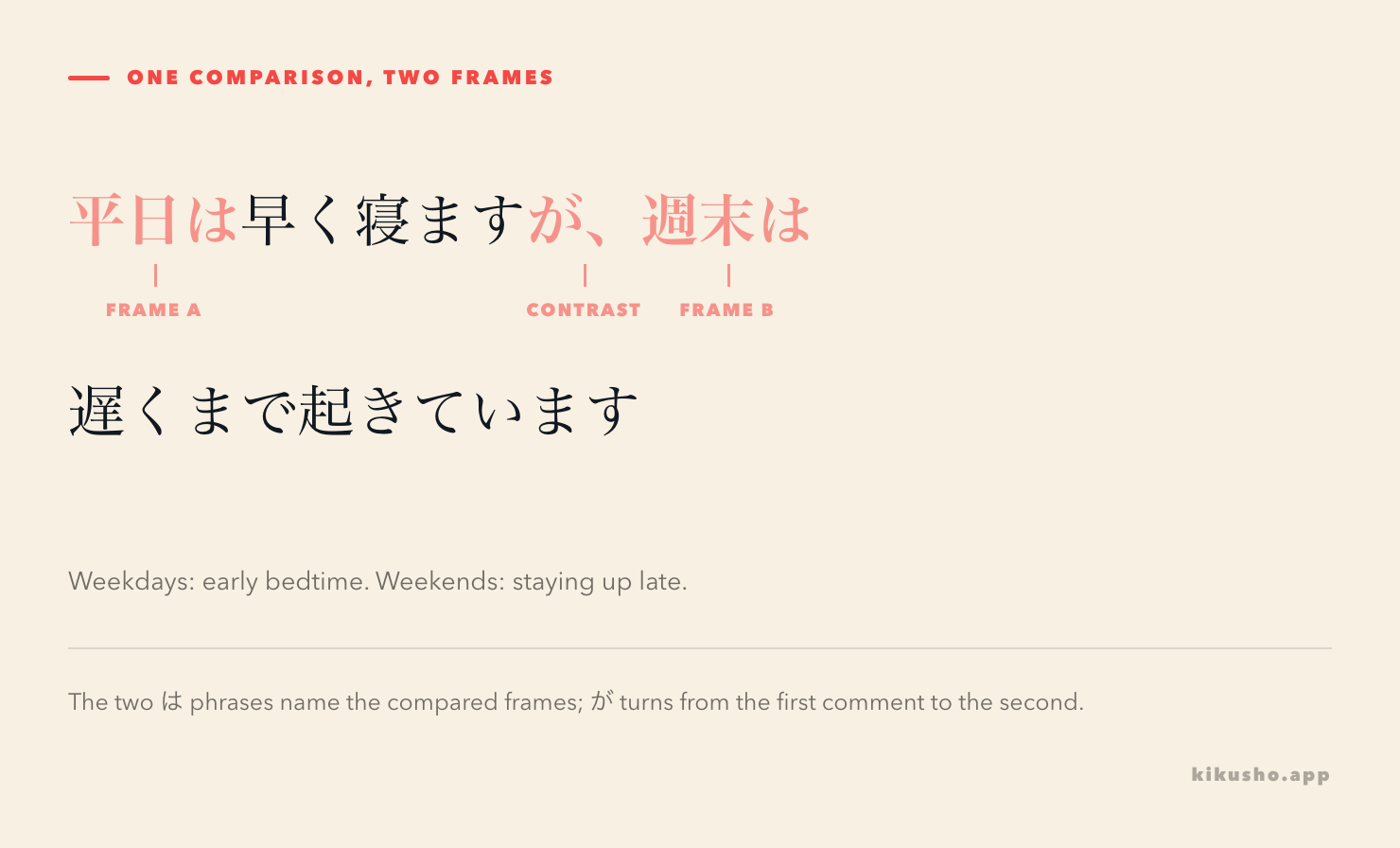
The two sides should share a sensible comparison axis. In the example, both sides tell us about sleeping habits, and 平日 and 週末 divide the same week. A sentence can compare people, objects, places, times or situations as long as the listener can see what is being measured.
| What is contrasted | Example | Meaning |
|---|---|---|
| people | 姉は泳げますが、私は泳げません。 | My older sister can swim, but I cannot. |
| things | このかばんは軽いですが、あのかばんは丈夫です。 | This bag is light, but that one is sturdy. |
| times | 朝は電車が空いていますが、夕方は混んでいます。 | Trains are uncrowded in the morning, but crowded in the evening. |
| places | 一階は静かですが、二階はにぎやかです。 | The first floor is quiet, but the second is lively. |
The comments do not need to be exact opposites. 軽い and 丈夫だ describe different properties, but the speaker can still compare the bags as two options. A random pair such as “this bag is light, but my brother studies Japanese” has no shared axis and makes が sound forced.
The が between the clauses means “but”
Japanese writes the connector with the same character as subject-marker が, but the jobs differ. A subject-marker follows a noun inside a clause. Conjunctive が follows a predicate and connects that clause to the next one.
私は猫が好きですが、弟は犬が好きです。
わたしは ねこが すきですが、おとうとは いぬが すきです。
I like cats, but my younger brother likes dogs.
This sentence contains three different particle jobs. 私は and 弟は mark the two people being compared. 猫が and 犬が belong inside the two 好き clauses. The が after 好きです connects the clauses. Reading the particle by position keeps these jobs separate.
In polite speech, add が after the polite predicate:
| Predicate | First clause |
|---|---|
| verb | 行きますが |
| い-adjective | 高いですが |
| な-adjective | 静かですが |
| noun | 学生ですが |
Plain verbs and い-adjectives attach directly to が: 行くが, 高いが. Plain affirmative nouns and な-adjectives use だが: 学生だが, 静かだが. Plain だが can sound written or firm. In everyday conversation, speakers often choose けど instead: 静かだけど、少し遠い. The paired は comparison works with either connector, but the assigned N4 construction uses が.
The connector can also soften a preface, as in すみませんが、駅はどこですか, “Excuse me, but where is the station?” That sentence does not compare two parallel items, so it is a different use of conjunctive が.
Contrastive は can replace が and を
The nouns before は are not automatically grammatical subjects. Contrastive は can take over a slot that would otherwise use が or を.
Start with two neutral statements:
兄が行きます。私は行きません。
My older brother will go. I will not.
Set the two people against each other and both take は:
兄は行きますが、私は行きません。
あには いきますが、わたしは いきません。
My older brother will go, but I will not.
Object を changes in the same way:
野菜は買いましたが、果物は買いませんでした。
やさいは かいましたが、くだものは かいませんでした。
I bought vegetables, but I did not buy fruit.
Without the contrast, those objects would be 野菜を買いました and 果物を買いませんでした. The は markers replace を and put the two shopping categories in parallel. The general は and が guide explains why topic marking and subject marking belong to different layers; this lesson concentrates on the explicit two-clause comparison.
に, で and から stay before は
Contrastive は behaves differently when the noun already carries に, で or から. These particles remain, and は follows them.
| Neutral phrase | Contrasted phrase | Example |
|---|---|---|
| 子どもが | 子どもは | 子どもは入れますが、大人は入れません。 |
| お茶を | お茶は | お茶は飲みますが、コーヒーは飲みません。 |
| 教室に | 教室には | 教室にはありますが、廊下にはありません。 |
| 電車で | 電車では | 電車では行けますが、徒歩では遠すぎます。 |
| 駅から | 駅からは | 駅からは近いですが、大学からは遠いです。 |
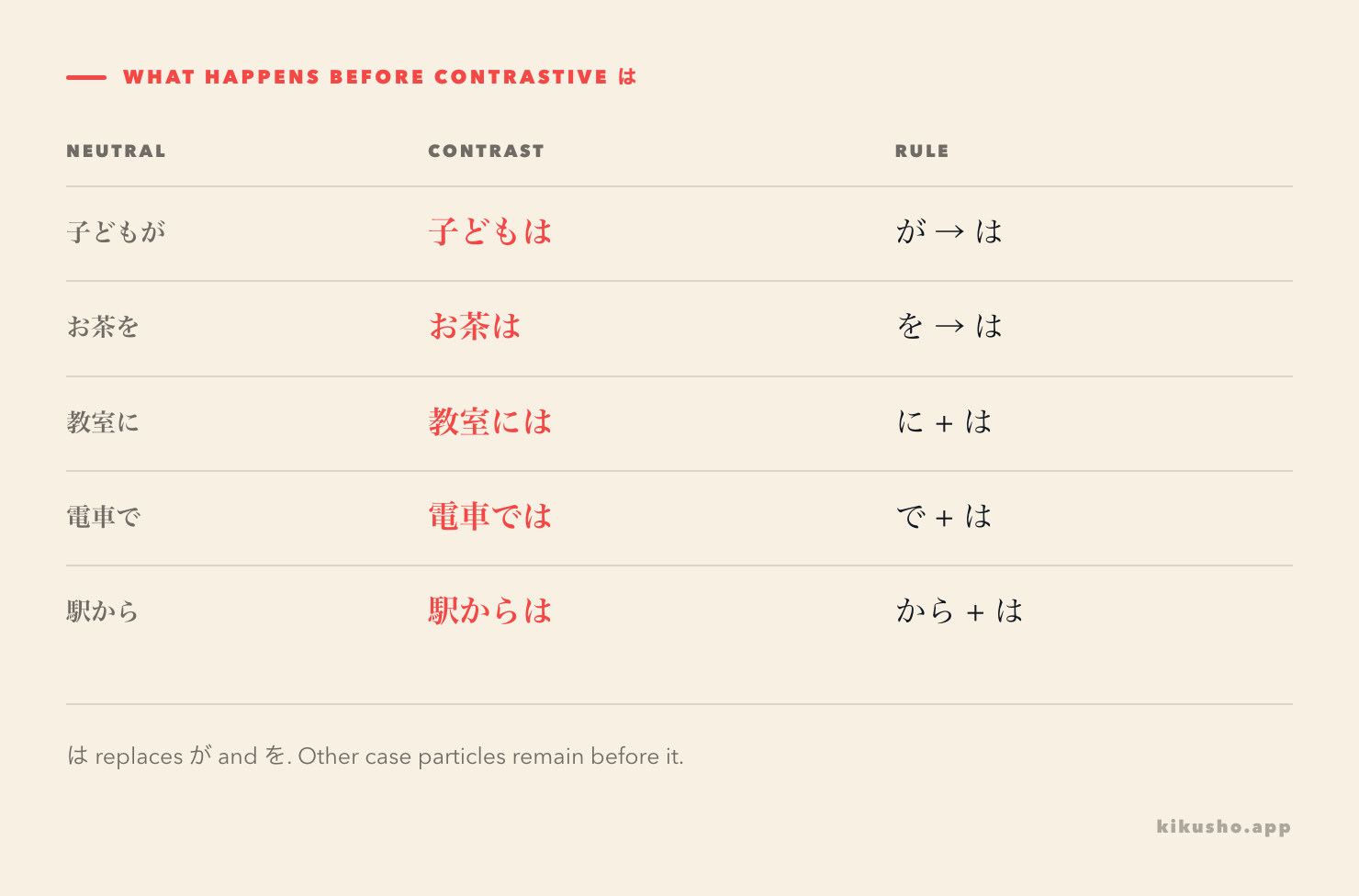
The combined forms are not decorative emphasis. 教室には keeps the location relationship supplied by に and adds the contrast with another location. 電車では keeps the means supplied by で and contrasts it with another way of traveling.
This rule also explains why a learner cannot mechanically replace every particle with は. 大学からは遠い needs から to preserve the point from which the distance is judged.
Repeated information can disappear from the second clause
Japanese usually omits material that the contrast already makes recoverable.
兄はコーヒーを飲みますが、妹は飲みません。
あには コーヒーを のみますが、いもうとは のみません。
My older brother drinks coffee, but my younger sister does not.
The second clause does not repeat コーヒーを. The listener carries it across the connector. Repeating it is grammatical, but often heavier than necessary.
A predicate can disappear when the paired items supply the missing comparison:
私は電車で行きますが、田中さんはバスで。
わたしは でんしゃで いきますが、たなかさんは バスで。
I will go by train, but Tanaka by bus.
This ending is natural in conversation because 行きます is easy to recover. In careful beginner production, keep the second predicate when the omission could point to several possibilities.
One side can also remain unspoken. 肉は食べません often suggests that some other food is possible, even when no second item appears. That is contrastive は working by implication. The full Aは〜が、Bは… pattern removes the guesswork and names both sides.
が marks a turn without requiring surprise
English often translates the connector as “but” or “however,” yet the Japanese sentence can state a calm comparison:
北海道は夏が涼しいですが、沖縄は冬も暖かいです。
ほっかいどうは なつが すずしいですが、おきなわは ふゆも あたたかいです。
Hokkaido has cool summers, while Okinawa is warm even in winter.
“While” fits because the sentence balances two regional facts. Nothing unexpected happened. Use “but” when English treats the second fact as a reversal, and “while” or “whereas” when it is a side-by-side difference.
For a new sentence that pushes against a previous statement, Japanese can use a sentence connector such as しかし or でも. The N4 sentence connector lesson compares those transitions. In the construction taught here, が sits at the boundary inside one sentence, and the paired は phrases carry the visible comparison.
Practice
Work through questions 1–7 first; every solution begins under the heading below them.
Question 1. Unlike his younger sister, the older brother cannot eat fish. Choose the particle: 妹は魚を食べますが、兄__食べられません。
- ア. は
- イ. が
- ウ. を
- エ. も
Question 2. Which sentence contrasts two direct objects and correctly replaces を with は?
- ア. 本を読みましたが、新聞を読みませんでした。
- イ. 本は読みましたが、新聞は読みませんでした。
- ウ. 本が読みましたが、新聞が読みませんでした。
- エ. 本には読みましたが、新聞には読みませんでした。
Question 3. Complete the location contrast: 教室にはコピー機がありますが、廊下__ありません。
- ア. は
- イ. には
- ウ. をは
- エ. がは
Question 4. Arrange the four fragments into one sentence meaning “I go to bed early on weekdays, but I stay up late on weekends.”
- 週末は
- 平日は
- 遅くまで起きています
- 早く寝ますが
Question 5. In 私は音楽が好きですが、弟はスポーツが好きです, which が joins the two clauses?
- ア. the が after 音楽
- イ. the が after 好きです
- ウ. the が after スポーツ
- エ. all three が particles
Question 6. Change the polite sentence into consistent plain style: この町は静かですが、隣の町はにぎやかです。
Question 7. Choose the complete particle set for the short notice.
この図書館は、平日__九時まで開いています(1)、土曜日__五時に閉まります。日曜日は休みです。
- ア. 平日は/(1) が/土曜日は
- イ. 平日が/(1) は/土曜日が
- ウ. 平日を/(1) が/土曜日を
- エ. 平日も/(1) を/土曜日も
Answers and explanations
Answer 1. ア. は. 妹 and 兄 are the two people being contrasted. も would mean that the brother also cannot eat fish, which conflicts with the first clause.
Answer 2. イ. 本は読みましたが、新聞は読みませんでした. Without contrast, the objects would take を: 本を読む and 新聞を読む. Contrastive は replaces を on both items.
Answer 3. イ. には. The copier exists in the classroom but not in the corridor. に keeps the location relationship, and は adds the comparison: 廊下にはありません.
Answer 4. 平日は早く寝ますが、週末は遅くまで起きています. 平日 and 週末 take the paired は markers. The polite predicate plus が ends the first clause, and the second clause supplies the different weekend habit.
Answer 5. イ, the が after 好きです. 音楽が and スポーツが place the liked things inside their respective clauses. The particle after the first predicate 好きです is the connector.
Answer 6. この町は静かだが、隣の町はにぎやかだ. A plain affirmative な-adjective uses だ. The first one becomes 静かだが, and the final one becomes にぎやかだ. In casual conversation, 静かだけど、隣の町はにぎやかだ is also natural, but it changes the assigned connector.
Answer 7. ア. 平日は/が/土曜日は. The notice compares weekday and Saturday hours, so both time expressions take は. 開いていますが joins the first schedule to the contrasting Saturday schedule. Sunday then adds a third time frame in a new sentence.
N4 placement and reference boundary
JLPT Sensei lists は〜が…は as N4 and gives the structure Noun 1 + は + clause + が + Noun 2 + は. Nihongo Kyoshi NET independently places the paired contrast at N4 and describes は as the marker used when setting two things or matters against each other.
The Japan Foundation's Akiko grammar notes supply the broader particle rule used in this lesson: contrastive は replaces が and を, follows particles such as に and から, and can imply an omitted comparison. Tofugu's independently authored guide to は also distinguishes contrastive は from subject focus, while its conjunctive が guide confirms the clause-linking use and its register alternatives.
These teaching references agree on the N4 placement for the paired classroom pattern. N4 here records that independent teaching consensus; it does not claim that the test maker has endorsed an itemized list containing this notation. The exercises above include grammar-form selection, sentence composition and text grammar without copying official questions.
When a comparison feels vague, write both は phrases before filling in either comment. If the two labels do not belong on the same line, the sentence needs a different connection. If they do, が can turn the line cleanly from the first item to the second.
Common questions
What does Aは〜が、Bは… mean?
It places A and B on the same comparison line: “A is or does X, but B is or does Y.” The connector が joins the clauses, while each は marks the item or setting being contrasted.
Is the が in Aは〜が、Bは… a subject marker?
The が between the two clauses is a conjunctive particle meaning “but” or marking a contrast. A clause may also contain subject-marker が, as in 私は猫が好きですが, so position and function both matter.
Does contrastive は replace another particle?
It replaces が and を: 兄が becomes 兄は, and パンを becomes パンは. With particles such as に, で and から, は normally follows them: には, では and からは.
Can the second clause omit repeated words?
Yes. In 兄はコーヒーを飲みますが、妹は飲みません, the second clause omits コーヒーを because the comparison makes it recoverable. Keep the repeated material when omission would make the comparison unclear.