On this page
Verb + 予定です reports an action as arranged or scheduled: 来週、東京へ出張する予定です means “I am scheduled to go on a business trip to Tokyo next week.” Use noun + の + 予定です when the scheduled item is a noun, as in 午後は会議の予定です.
予定(よてい) is a noun meaning a plan, arrangement or schedule. The construction can describe your own calendar, another person's plans, an organization's programme or an event expected to occur. It does not say who wanted the arrangement.
Put a plain verb or noun phrase before 予定です
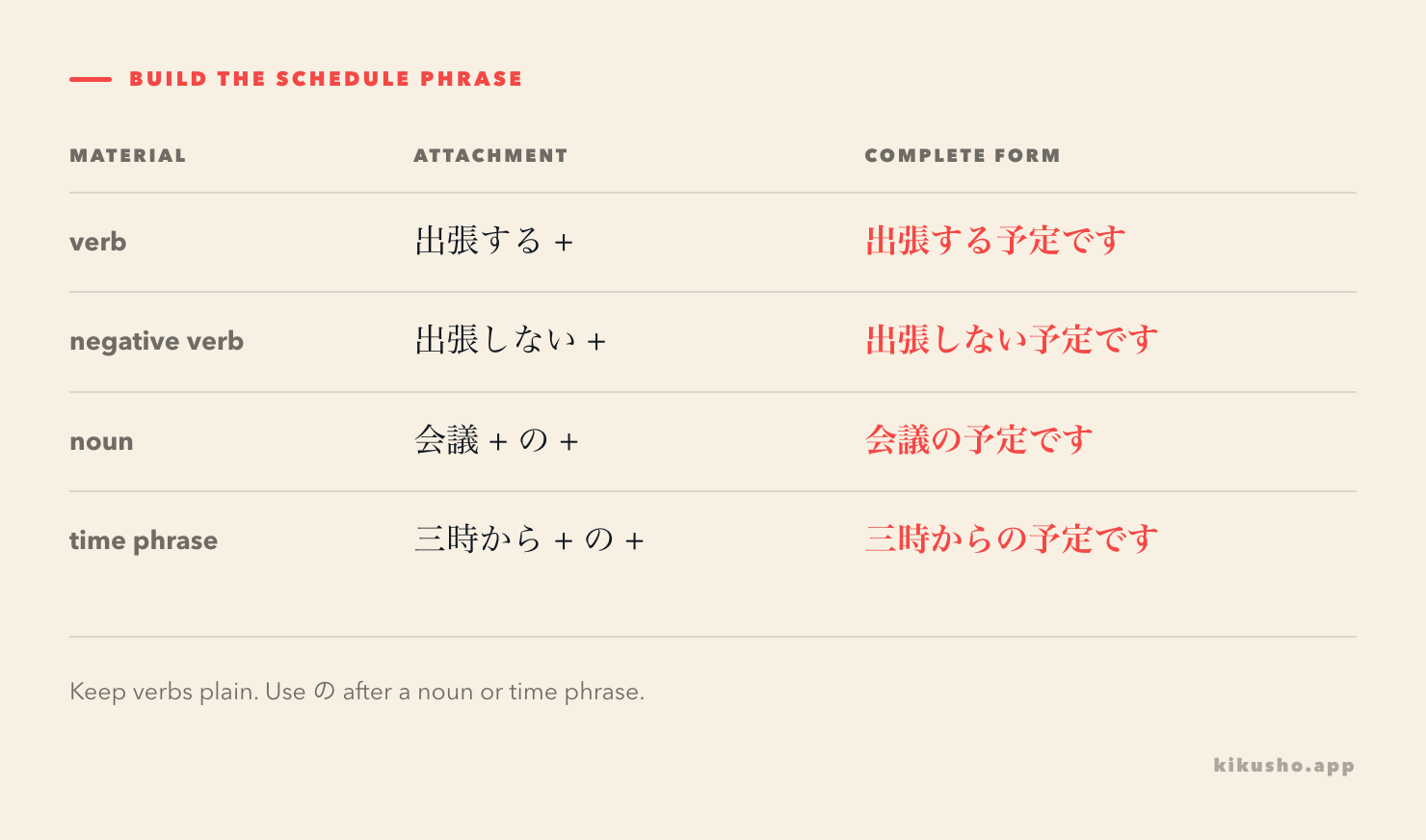
Four attachment shapes cover the useful N4 range:
| Material before 予定 | Pattern | Example | Meaning |
|---|---|---|---|
| affirmative action | V dictionary + 予定です | 来週出発する予定です | scheduled to leave next week |
| negative action | Vない + 予定です | 日曜日は営業しない予定です | scheduled not to open on Sunday |
| event noun | N + の + 予定です | 午後は会議の予定です | a meeting is planned for the afternoon |
| time phrase | time + の + 予定です | 会議は三時からの予定です | the meeting is scheduled from three |
The verb remains plain even when the sentence is polite:
来月、新しい支店を開く予定です。
らいげつ、あたらしい してんを ひらく よていです。
We are scheduled to open a new branch next month.
Use 開く予定です, not 開きます予定です. Politeness appears at the end in です. The plain ending is 予定だ, and the polite ending is 予定です. In ordinary conversation, 予定です is common even when the surrounding content is personal.
The noun pattern needs の because the noun modifies 予定: 会議の予定, “a meeting plan,” and 出張の予定, “a business-trip plan.” A time phrase can work in the same position: 十時からの予定, “scheduled from ten.”
予定 describes the arrangement rather than someone's resolve
A company can schedule your trip, a school can schedule an exam, and a cinema can schedule a release. The person or thing described does not need to possess an intention.
新しい図書館は来年開館する予定です。
あたらしい としょかんは らいねん かいかんする よていです。
The new library is scheduled to open next year.
最終電車は十一時に到着する予定です。
さいしゅうでんしゃは じゅういちじに とうちゃくする よていです。
The last train is scheduled to arrive at eleven.
Neither the library nor the train forms a personal decision. 予定 packages the opening or arrival as part of a timetable or prior arrangement.
The schedule can still belong to the speaker:
土曜日は友達と昼ご飯を食べる予定です。
どようびは ともだちと ひるごはんを たべる よていです。
I am planning to have lunch with a friend on Saturday.
The sentence points to an arrangement already made. It does not tell us whether the speaker proposed lunch, accepted an invitation or received the time from somebody else.
つもり brings the person's intention into view
Both forms can be translated “plan to,” but they make different facts central.
| Form | What it foregrounds | Example |
|---|---|---|
| V + 予定です | an arrangement or schedule | 来月、大阪へ出張する予定です。 |
| V + つもりです | the person's chosen intention | 来月、大阪へ旅行するつもりです。 |
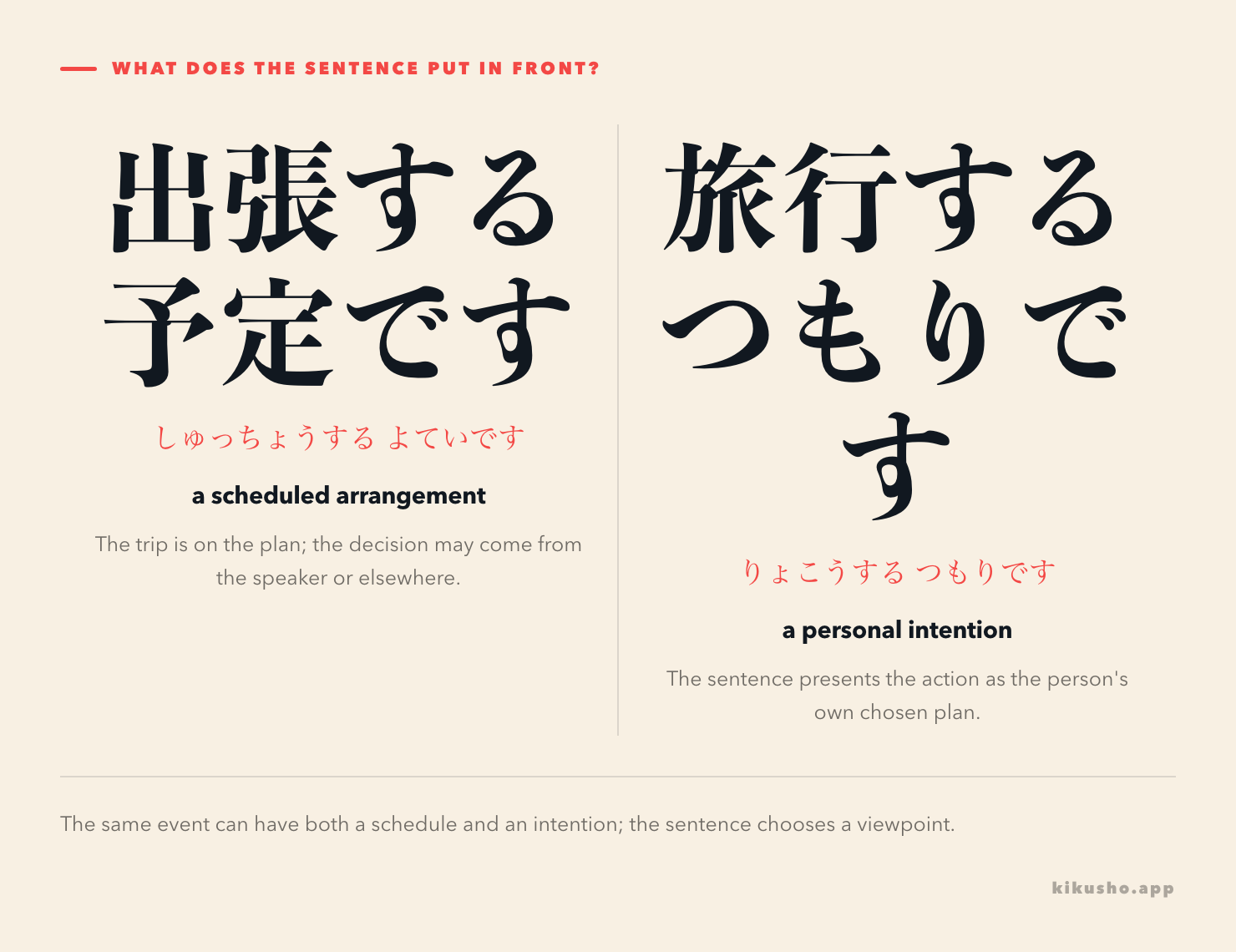
The distinction is a viewpoint, not a claim that work always uses 予定 and private life always uses つもり. A person may arrange their own holiday and say 旅行する予定です. They may also state a firm work-related resolve with つもり. Ask what the sentence is presenting: an entry on the plan, or a decision held in someone's mind?
The Japan Foundation's comparison of intention expressions makes the boundary precise: ~予定だ does not directly express will, and the schedule may or may not arise from the speaker's intention. Bunpro's independent 予定だ reference likewise contrasts a formal or concrete plan with つもり's personal intention.
For a decision made at the moment of speaking, the volitional form is often more natural: よし、今から電話しよう, “All right, I'll call now.” Calling it a 予定 suggests that the call was already arranged. The volitional lesson covers that immediate choice; the つもり lesson covers a personal plan held before the conversation.
Negative forms separate two different schedule claims
Put the negative inside the action when not doing it is itself the plan:
来週は出張しない予定です。
らいしゅうは しゅっちょうしない よていです。
The plan is not to take a business trip next week.
Negate the existence of the arrangement when no such plan is on the schedule:
来週は出張する予定はありません。
らいしゅうは しゅっちょうする よていは ありません。
There is no plan to take a business trip next week.
The practical outcome may match, but the claims differ. 出張しない予定です presents non-travel as a settled arrangement. 出張する予定はありません says that a trip arrangement does not exist. This parallels the difference between deciding not to do something and simply lacking a plan to do it.
You may also hear 予定ではありません, “it is not scheduled / that is not the plan.” Here ではありません negates the noun predicate at the end. Do not build a negative by putting polite ません before 予定: 出張しません予定です is not a valid attachment.
予定でした places the arrangement in the past
Change the final copula to describe an earlier schedule:
| Register | Non-past | Past |
|---|---|---|
| plain | 予定だ | 予定だった |
| polite | 予定です | 予定でした |
昨日は九時に出発する予定でした。
きのうは くじに しゅっぱつする よていでした。
We were scheduled to leave at nine yesterday.
This sentence records the earlier arrangement. It does not prove whether the departure occurred. A following clause supplies the outcome:
九時に出発する予定でしたが、電車が止まったので十時に出発しました。
くじに しゅっぱつする よていでしたが、でんしゃが とまったので じゅうじに しゅっぱつしました。
We were scheduled to leave at nine, but the train stopped, so we left at ten.
The change is stated by the second clause, not encoded inside 予定でした. In a conversation about a disrupted plan, listeners may expect such a change, but grammar and context should not be collapsed into one rule.
To ask about a schedule, conjugate the ending as a question:
いつ出発する予定ですか。
いつ しゅっぱつする よていですか。
When are you scheduled to leave?
This can ask about the listener, a group or a transport service. Because 予定 concerns an arrangement, it does not require access to another person's private thoughts.
A wish needs more than the word 予定
予定 fits a concrete plan, even if the exact time has not been announced. It becomes awkward when the speaker only expresses a hope, personality trait or effort with no arranged action.
いつか自分の店を開きたいです。
いつか じぶんの みせを ひらきたいです。
I would like to open my own shop someday.
Use 開く予定です only when a real opening plan exists. Likewise, もっと頑張る予定です sounds like effort has been placed on a schedule; もっと頑張るつもりです suits a personal resolve. 予定 is not a stronger synonym for every future-looking sentence.
The construction also does not guarantee completion. A scheduled train can be delayed, and an arranged event can be cancelled. To say that something occurred according to plan, add separate information such as 予定どおり, “as scheduled.” To say the plan changed, use 予定が変わりました; the change-verb lesson explains why 予定 takes が there.
When a notice or message says 午後三時から会議の予定です, keep the whole line. A card for 予定 alone loses both the event and its time. In Kikusho, you can capture the line from a photo, check the editable reading and explanation, and retain the の that connects the meeting to the schedule.
Practice
Answer questions 1–7 before moving to the solution section.
Question 1. Choose the correct attachment: 来週、京都へ__予定です。
- ア. 行く
- イ. 行きます
- ウ. 行って
- エ. 行き
Question 2. Complete the noun pattern: 午後は会議__予定です。
- ア. が
- イ. の
- ウ. を
- エ. だ
Question 3. Which sentence most directly says that no business-trip arrangement exists for next week?
- ア. 来週は出張しない予定です。
- イ. 来週は出張する予定はありません。
- ウ. 来週は出張した予定です。
- エ. 来週は出張しません予定です。
Question 4. Arrange the fragments into “The new library is scheduled to open next year.”
- 予定です
- 来年
- 新しい図書館は
- 開館する
Question 5. What does 八時に出発する予定でした establish by itself?
- ア. The departure definitely happened at eight.
- イ. The departure was cancelled.
- ウ. Leaving at eight was the earlier arrangement.
- エ. The speaker decided at that moment to leave.
Question 6. Change the plain sentence into polite Japanese: 電車は十時に到着する予定だ。
Question 7. Choose the pair that completes the short schedule report.
来週、支店へ(甲)予定です。会議は午前十時(乙)予定です。
- ア. 甲: 出張する/乙: からの
- イ. 甲: 出張します/乙: から
- ウ. 甲: 出張の/乙: からだ
- エ. 甲: 出張した/乙: からに
Answers and explanations
Answer 1. ア. 行く. A dictionary-form verb attaches directly to 予定です. 行きます is polite too early, 行って is the て-form, and 行き is the stem; none fits this construction.
Answer 2. イ. の. 会議 is a noun, so it modifies 予定 through の: 会議の予定です. Verbs attach without の, but the noun pattern requires it.
Answer 3. イ. 来週は出張する予定はありません. This denies the existence of a business-trip plan. ア presents not traveling as the plan, which may lead to the same outcome but makes a different claim. ウ uses a past verb before a future schedule, and エ puts polite ません before 予定.
Answer 4. 新しい図書館は来年開館する予定です. The scheduled action is 開館する, and its dictionary form sits directly before 予定です. 新しい図書館 is the topic; 来年 locates the planned opening.
Answer 5. ウ. Leaving at eight was the earlier arrangement. 予定でした marks the plan as past. Whether the departure happened, changed or was cancelled requires more context.
Answer 6. 電車は十時に到着する予定です. Keep the action in the plain dictionary form 到着する and change only the final copula from だ to polite です.
Answer 7. ア. 甲: 出張する/乙: からの. The verb uses its dictionary form: 出張する予定です. The time phrase modifies 予定 with の: 午前十時からの予定です. The other choices either place politeness before 予定 or break the noun-modifying connection.
N4 placement and checked scope
JLPT Sensei places 予定だ at N4 and records verb dictionary form and noun + の attachment. Bunpro independently labels it N4 and confirms the standard and polite endings, questions about schedules, and the contrast with つもり.
Nihongo NET's Japanese teaching reference also places the construction at N4 and treats it as a decided plan or schedule. The Japan Foundation comparison cited above supports the crucial limit: 予定 reports that a schedule exists without directly asserting whose will produced it.
The sources agree on the N4 study placement, and the curriculum records no level disagreement for this item. That consensus is an editorial allocation rather than an exhaustive list issued by the JLPT organisers. The exercises use grammar choice, sentence composition and text grammar to test the one assigned construction without treating every lexical use of 予定 as additional coverage.
A useful schedule sentence has three recoverable parts: the event, its time and the source of the arrangement. Once those are visible, 予定 no longer needs to masquerade as a stronger version of “want.” It becomes what it is: the name of the plan already in place.
Common questions
What does 予定だ mean in Japanese?
予定だ(よていだ)reports an action or event as planned, arranged or scheduled. 行く予定です means “I am scheduled to go” or “I plan to go,” with attention on the arrangement rather than on the speaker's resolve.
What form comes before 予定です?
Use a dictionary-form or ない-form verb directly before 予定です: 行く予定です and 行かない予定です. A noun takes の, as in 会議の予定です. Do not put ます before it.
What is the difference between 予定です and つもりです?
予定です presents a plan or schedule and need not be based on the speaker's will. つもりです presents the person's own intention. The same real event can have both an arrangement and a personal intention.
Does 予定でした mean the plan was cancelled?
No. 予定でした places the arrangement in the past. Context often introduces a later change, but the form alone does not say whether the scheduled action happened.