On this page
来週、試験があると聞きました passes on information: “I heard there is a test next week.” 来週、試験があると思います gives your own judgment: “I think there is a test next week.”
The clause before と can be identical. The final verb tells the listener where the claim comes from.
The rule in one sentence
Choose ~と聞いた when another source supplied the information; choose ~と思う when you present the clause as your own thought or judgment.
| Pattern | Information comes from | Basic meaning |
|---|---|---|
| plain clause + と聞いた | something the speaker heard or was told | I heard that X |
| plain clause + と思う | the speaker's own mind | I think that X |
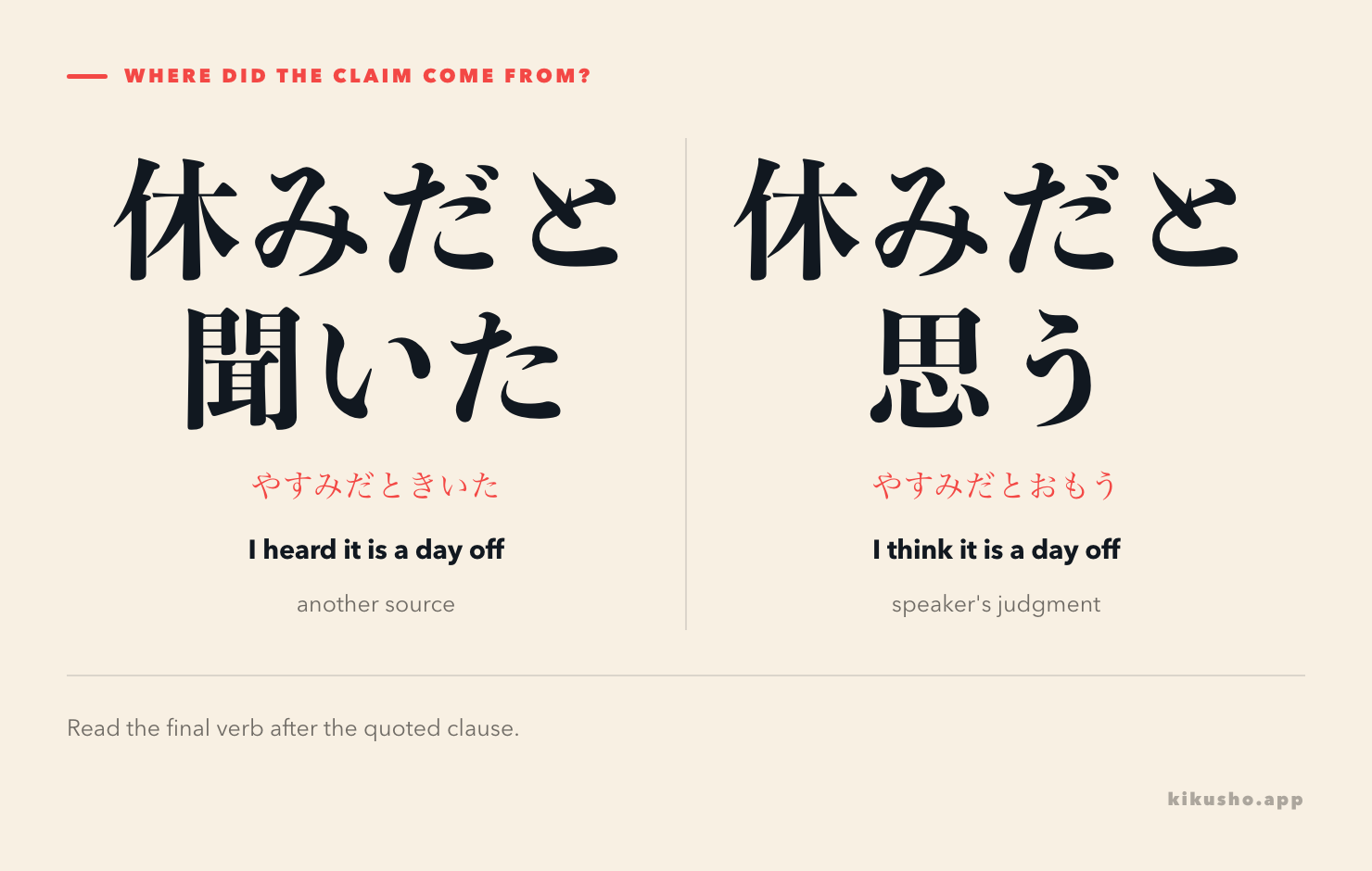
The と in both patterns is the quotation particle. It packages the preceding clause as the content of 聞く, “hear,” or 思う, “think.” These are indirect quotations: they report the content rather than promising the speaker's exact words.
Ask where the claim came from
Imagine somebody says 田中さんは来ない__. Before choosing the ending, ask what happened before this sentence.
- A classmate told the speaker about Tanaka: 田中さんは来ないと聞いた.
- The speaker looked at Tanaka's schedule and formed a judgment: 田中さんは来ないと思う.
That test is more reliable than translating both forms one word at a time. と聞いた marks a path by which information reached the speaker. と思う marks the speaker's stance toward a proposition.
The distinction does not tell you whether the proposition is true. A rumor can be reported with と聞いた, and a well-supported conclusion can end in と思う. Nor does と聞いた guarantee belief:
駅の近くに新しい店ができたと聞きましたが、本当ですか。
えきのちかくにあたらしいみせができたとききましたが、ほんとうですか。
I heard that a new shop opened near the station. Is that true?
The question 本当ですか leaves the heard claim open. By contrast, 新しい店は人気になると思います, “I think the new shop will become popular,” makes the prediction the speaker's own.
と聞いた is at home with an outside source
Use ~と聞いた after information received through speech or hearsay. The polite form is ~と聞きました.
山田さんは来月引っ越すと聞きました。
やまださんはらいげつひっこすとききました。
I heard that Yamada will move next month.
あの店は日曜日は休みだと聞いた。
あのみせはにちようびはやすみだときいた。
I heard that shop is closed on Sundays.
When the source matters, add it outside the quoted clause:
先生から、来週は授業がないと聞きました。
せんせいから、らいしゅうはじゅぎょうがないとききました。
I heard from the teacher that there is no class next week.
先生から names where the information came from. 先生に聞きました can also identify the person consulted, but because 人に聞く may mean “ask a person,” the surrounding context must show whether you mean “asked” or “heard from.”
The tense of 聞く records when you acquired the information. 聞いた/聞きました is natural because the hearing happened before you reported it. The tense inside the quote records the event itself:
| Sentence | Time inside the reported content |
|---|---|
| 来ると聞いた | I heard that someone will come. |
| 来たと聞いた | I heard that someone came. |
| 来ないと聞いた | I heard that someone will not come. |
This pattern is close to hearsay ~そうだ and ~らしい, but they are not interchangeable in every sentence. と聞いた explicitly presents the information as something the speaker heard. The evidence and likeness lesson shows why a form translated as “apparently” may organize the evidence differently.
と思う is at home with the speaker's judgment
Use ~と思う to state a belief, opinion, prediction or conclusion. Change the outer verb for register: と思う is plain, while と思います is polite.
この問題は少し難しいと思います。
このもんだいはすこしむずかしいとおもいます。
I think this question is a little difficult.
明日は雨が降らないと思う。
あしたはあめがふらないとおもう。
I think it will not rain tomorrow.
Politeness belongs on the final verb. 静かだと思います is a polite sentence because it ends in 思います; the quoted clause remains plain. 静かですと思います is not the standard indirect-quotation pattern.
思った moves the thought into the past:
その答えが正しいと思った。
そのこたえがただしいとおもった。
I thought that answer was correct.
と思っている often presents a view that someone continues to hold. It is especially useful when reporting another person's thought, because bare と思う normally sounds like the current speaker's judgment unless the syntax makes another thinker clear. The N4 vocabulary lesson on 思う, 考える and 気がする compares a held view, deliberate consideration and a hunch.
Do not confuse plain と思う with a volitional verb followed by the same words:
日本へ行くと思います。
I think someone will go to Japan.
日本へ行こうと思います。
I intend to go to Japan.
The second sentence contains 行こう, the volitional form. That form and its decision-making use belong to the ~ようと思う lesson.
Both patterns quote a complete plain clause
Build the content first. Then attach と聞いた or と思う.
| Predicate type | Complete plain clause | With と聞いた | With と思う |
|---|---|---|---|
| verb | 電車が遅れる | 電車が遅れると聞いた | 電車が遅れると思う |
| い-adjective | 値段が高い | 値段が高いと聞いた | 値段が高いと思う |
| な-adjective | この町は静かだ | この町は静かだと聞いた | この町は静かだと思う |
| noun | 明日は休みだ | 明日は休みだと聞いた | 明日は休みだと思う |
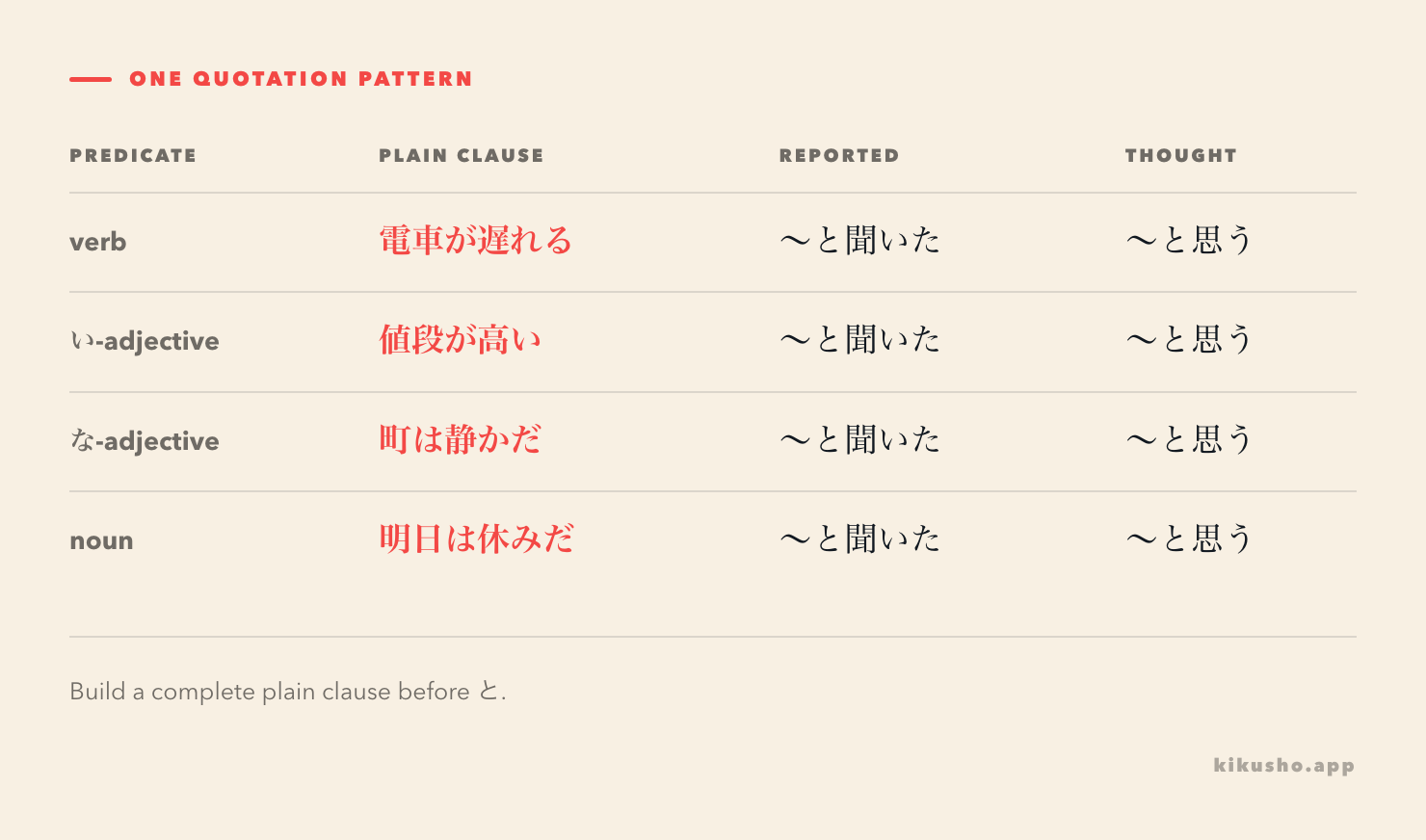
In careful standard Japanese, affirmative nouns and な-adjectives keep だ before the quotation particle: 休みだと, 静かだと. Verbs and い-adjectives attach directly: 行くと, 高いと. Do not add だ after an い-adjective, so 高いだと思う is wrong.
Casual speech sometimes drops だ after a noun or な-adjective. For dependable N4 production, learn the full clause first. It reveals why the two endings share the same attachment rules and prevents です from slipping inside an indirect quote.
Negation and tense also stay inside the quoted clause:
- 便利ではないと思う: I think it is not convenient.
- 便利だったと聞いた: I heard it was convenient.
- 試験はなかったと思う: I think there was no test.
A wrong ending changes responsibility
Suppose a coworker told you 会議は三時からです, “The meeting starts at three.” Reporting it as 会議は三時からだと聞きました keeps the source outside you. Saying 会議は三時からだと思います presents three o'clock as your own belief. The schedule might be identical, but your responsibility for the claim changes.
The reverse mistake can sound evasive. If you inspected a report and reached a conclusion, 問題はないと聞きました invents an outside source. 問題はないと思います owns the judgment.
Negative sentences introduce a second contrast:
山田さんは来ないと思う。
I think Yamada will not come.
山田さんは来ると思わない。
I do not think Yamada will come.
Both can lead to the same practical expectation, but the first directly embeds 来ない, “will not come.” The second negates 思う, “do not think.” At N4, choose the first when the negative event itself is what you want to report; recognize the second as a different scope rather than treating the two strings as mechanically identical.
When you meet either pattern in conversation, save the whole sentence rather than a bare ending. In Kikusho, a card built from 休みだと聞いた preserves both the noun predicate and its source. Check the drafted explanation before saving, then use the recording and offline reviews to recall whether the final verb reports received information or your own conclusion.
Practice
Answer all seven questions before opening the shared solution section.
Question 1. A friend told you that the library closes at six. Choose the best completion: 図書館は六時に閉まる__。
- ア. と思う
- イ. と聞いた
- ウ. を聞いた
- エ. だと思う
Question 2. You checked the sky and give your own prediction. Complete: 明日は雨が降る__。
- ア. と聞きました
- イ. だと聞きました
- ウ. と思います
- エ. を思います
Question 3. Choose the reliable standard attachment for “I heard that this town is quiet.”
- ア. この町は静かと聞きました。
- イ. この町は静かだと聞きました。
- ウ. この町は静かですと聞きました。
- エ. この町は静かなと聞きました。
Question 4. Arrange the three fragments into “I think tomorrow is a day off.”
- と思います
- 明日は
- 休みだ
Question 5. Which sentence reports a completed event that you learned from another person?
- ア. 山田さんが駅に着いたと聞きました。
- イ. 山田さんが駅に着くと思います。
- ウ. 山田さんが駅に着こうと思います。
- エ. 山田さんが駅に着いたと思いませんか。
Question 6. Choose the sentence that explicitly presents an intention to study in Japan.
- ア. 日本で勉強すると聞きました。
- イ. 日本で勉強すると思います。
- ウ. 日本で勉強しようと思います。
- エ. 日本で勉強したと思います。
Question 7. Read the short exchange and choose both endings.
A: 来週の試験は難しいですか。
B: 先生から、とても難しい(1)。でも、前の試験よりは簡単だ(2)。
- ア. (1) と思います/(2) と聞きました
- イ. (1) だと聞きました/(2) だと思います
- ウ. (1) と聞きました/(2) と思います
- エ. (1) だと思います/(2) だと聞きました
Answers and explanations
Answer 1. イ. と聞いた. The friend supplied the information, so the sentence reports something heard. 閉まる is a verb and attaches directly to と. ウ uses the object particle instead of the quotation particle, and エ adds だ after a verb.
Answer 2. ウ. と思います. The speaker forms a prediction from the sky and presents it as a personal judgment. 降る is a plain verb, so no だ is inserted. ア would say the information came from another source.
Answer 3. イ. この町は静かだと聞きました. 静か is a な-adjective predicate, so the complete plain affirmative clause is この町は静かだ. ア omits だ from the reliable standard pattern, ウ puts polite です inside the indirect quote, and エ uses the form that modifies a following noun.
Answer 4. 明日は休みだと思います. 休み is a noun predicate and keeps だ inside the quoted clause. と思います makes the whole sentence polite.
Answer 5. ア. 山田さんが駅に着いたと聞きました. 着いた places the arrival in the past, while 聞きました reports how the speaker obtained the information. イ predicts a future arrival; ウ puts a third person's subject before a first-person intention form; エ asks whether the listener shares the speaker's thought.
Answer 6. ウ. 日本で勉強しようと思います. しよう is the volitional form of する, so the sentence presents an intention. イ contains plain する and ordinarily states a belief or prediction. ア reports heard information, and エ means “I think [someone] studied in Japan.”
Answer 7. ウ. (1) と聞きました/(2) と思います. 先生から identifies the source for the first claim, and 難しい attaches directly because it is an い-adjective. The second claim is B's own comparison; 簡単 is a な-adjective, so it becomes 簡単だと思います. Options containing 難しいだ are ungrammatical.
Level evidence and review boundary
JLPT Sensei lists と聞いた as N4 and separately places と思う at N4. Its examples support the past and negative clauses used here.
Bunpro independently labels both と聞いた and と思う N4. Its structure tables distinguish direct attachment after verbs and い-adjectives from だと after nouns and な-adjectives. MLC Japanese Language School confirms the same と思う attachment contrast, while Wasabi's quotation lesson derives both patterns from complete plain clauses.
These independent teaching references agree on the N4 placement, so there is no recorded level conflict for the two assigned items. The official JLPT site describes N4 question types such as grammar-form selection, sentence composition and text grammar; it does not provide an exhaustive official grammar list. The three formats appear in the exercises above without reproducing official questions.
Common questions
What is the difference between と聞いた and と思う?
と聞いた reports information acquired from another source: “I heard that.” と思う presents the quoted clause as the current speaker's thought, belief or judgment: “I think that.”
What form comes before と聞いた and と思う?
Use a plain clause before the quotation particle と. Verbs and い-adjectives attach directly; affirmative noun and な-adjective predicates normally keep だ in careful standard Japanese.
Does と聞いた mean that the speaker believes the information?
No. と聞いた identifies heard information, but it does not show by itself whether the speaker accepts, doubts or rejects the claim.
Is と思う the same as ~ようと思う?
No. A plain clause plus と思う states a belief or judgment. A volitional verb plus と思う, such as 行こうと思う, presents an intention or decision.