On this page
Noun + がする reports a sound, smell, taste, or bodily sensation that reaches you. Use 音がする for a sound, においがする for a smell, and 味がする for a taste; the noun before が names what you perceive, and する carries tense and politeness.
This する does not mean that someone deliberately “does” a sound or smell. It presents the sensation as something that occurs or becomes perceptible: you notice it without making the act of listening, sniffing, or tasting the centre of the sentence.
The sensory event is the subject of がする
The core form is short:
sensory noun + が + する
外で大きな音がします。
そとで おおきな おとが します。
There is a loud sound outside. / I hear a loud sound outside.
English often chooses “I hear,” “it smells,” or “it tastes.” Japanese keeps the sensation itself in the が position. 大きな音 is the subject of します in the example; the perceiver is normally understood from context.
That structure explains why を is wrong when you are merely reporting what reaches your senses. 変な音をする can occur in a different construction where something produces or makes a strange sound, but 変な音がする is the ordinary way to say that you hear one.
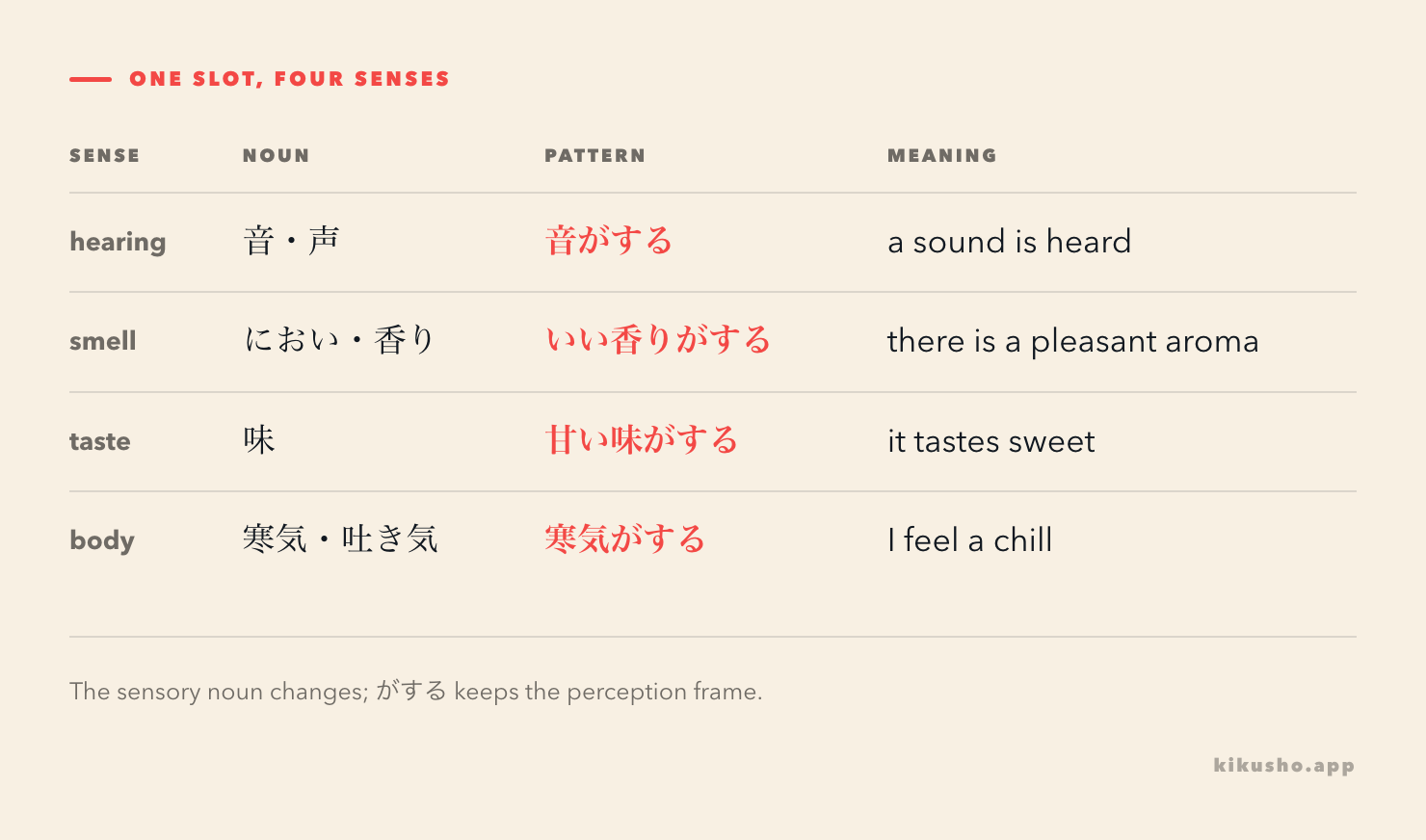
Sound, smell, taste, and physical feeling fill the same noun slot
The construction works with a bounded group of sensory nouns. It is not a rule that can be attached to any noun with the English verb “feel.”
| Sense | Common noun | Example | Meaning |
|---|---|---|---|
| hearing | 音(おと), 声(こえ) | 人の声がする | I hear a person's voice. |
| smell | におい, 香り(かおり) | いい香りがする | It has a pleasant aroma. |
| taste | 味(あじ) | 甘い味がする | It tastes sweet. |
| bodily sensation | 寒気(さむけ), 吐き気(はきけ) | 寒気がする | I feel a chill. |
風邪をひいたのか、少し寒気がします。
かぜを ひいたのか、すこし さむけが します。
Maybe I caught a cold; I feel a slight chill.
The bodily examples are sensations you experience, not general emotion words. うれしいがする is not the pattern for “I feel happy”; use うれしいです. For a hunch or impression, 気がする is a related fixed phrase discussed below.
A modifier tells the listener what kind of sensation arrived
Bare 音がする, “there is a sound,” can be useful when the mere presence of a noise matters. Taste and smell often need more information because 味がする or においがする alone leaves the obvious question: what kind?
Three modifier shapes are especially useful:
| Modifier | Example | What it supplies |
|---|---|---|
| adjective before the sensory noun | 変な音がする | the quality: a strange sound |
| noun + の before the sensory noun | レモンの味がする | the source or resemblance: a lemon taste |
| question word before the sensory noun | どんなにおいがしますか | the requested description: what kind of smell? |
このスープはカレーの味がします。
この スープは カレーの あじが します。
This soup tastes like curry.
赤ちゃんはミルクのにおいがしました。
あかちゃんは ミルクの においが しました。
The baby smelled of milk.
In these sentences, このスープは and 赤ちゃんは set the thing being described as the topic. The sensory noun still takes が. English may turn that topic into the subject of “taste” or “smell,” but the Japanese particles keep separate jobs.
から marks where the sensation comes from
When a sound or smell has a location, mark its apparent source with から.
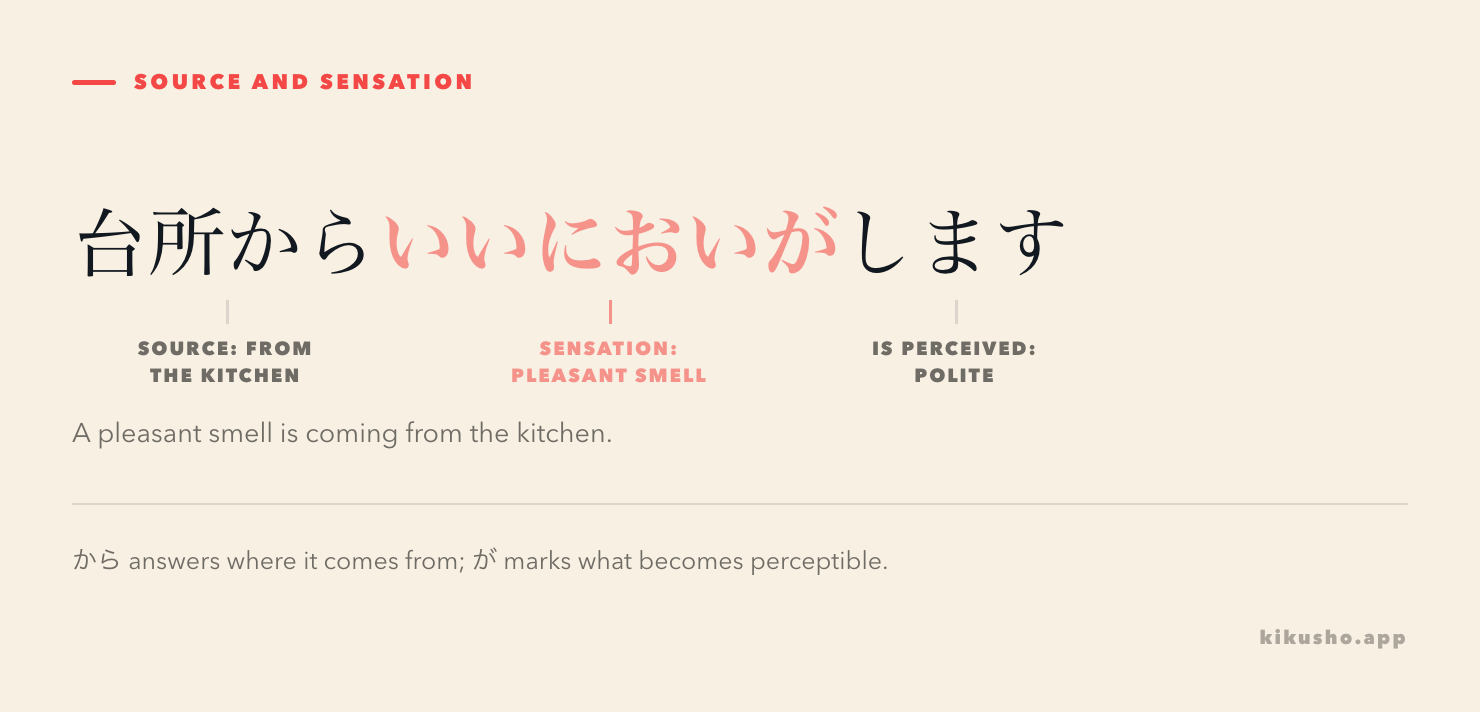
台所からいいにおいがします。
だいどころから いい においが します。
A pleasant smell is coming from the kitchen.
隣の部屋から人の声がしました。
となりの へやから ひとの こえが しました。
I heard a person's voice from the next room.
Do not replace source から with で merely because the event occurs somewhere. 外で音がする locates the sound event outside. 外から音がする presents outside as the direction or source from which the sound reaches you. In many scenes both descriptions are possible, but they answer different questions.
Active sensing uses 聞く, 嗅ぐ, or 味見する instead
がする reports perception without making your deliberate action central. When you intentionally direct a sense at something, use an action verb and mark its object with を.
| Perception that arrives | Deliberate action |
|---|---|
| 花のにおいがする。 A floral smell is present. | 花のにおいを嗅ぐ。 Smell the flower's scent. |
| 音がする。 A sound is heard. | 音を聞く。 Listen to the sound. |
| 甘い味がする。 It tastes sweet. | スープを味見する。 Taste the soup to check it. |
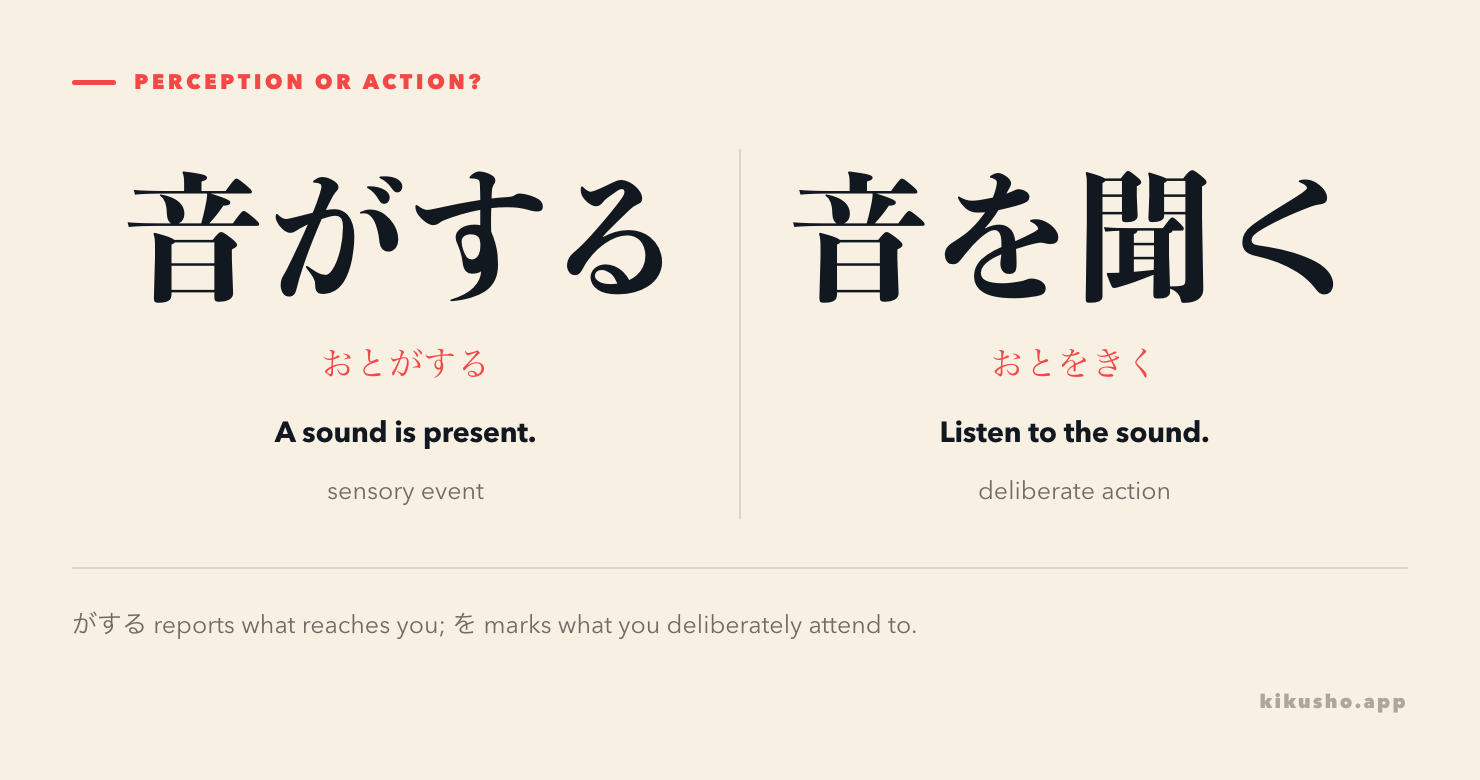
The contrast is about how the sentence presents the scene. Someone may be paying close attention and still say 音がする when the point is that a sound is present. Likewise, においを嗅ぐ does not guarantee that the smell was identified; it names the deliberate act of smelling.
This is also why translating がする with one English verb is unreliable. English reuses “smell” for spontaneous perception, an object's property, and active sniffing. Japanese distributes those scenes across においがする, におう, and においを嗅ぐ.
音がする and 聞こえる overlap without being identical
Both 音がする and 音が聞こえる can report an unplanned sound. The first presents the existence or occurrence of a sensory event. 聞こえる says that the sound is audible or reaches the ear.
廊下で変な音がする。
ろうかで へんな おとが する。
There is a strange sound in the corridor.
遠くから音楽が聞こえる。
とおくから おんがくが きこえる。
Music can be heard from far away.
The sentences could describe the same moment, but their focus differs. がする is at home with the category nouns 音, 声, におい, and 味. 聞こえる can directly take the content that is audible, such as 音楽 or 鳥の声. The lesson on ある and いる is useful background because English “there is a sound” resembles an existence sentence, although Japanese chooses がする for this perceptible event.
Sight does not normally join this sensory list. To say that a mountain is visible, use 山が見える. To say something looks like a mountain, use 山のように見える. 山の姿がする is not the visual counterpart of 音がする.
Conjugate する for time, politeness, and negation
The sensory noun and が stay in place while する changes like the ordinary irregular verb.
| Time and style | Example | Meaning |
|---|---|---|
| plain present | 音がする | There is a sound. |
| polite present | 音がします | There is a sound. |
| plain past | 音がした | There was a sound. |
| polite past | 音がしました | There was a sound. |
| plain negative | 音がしない | There is no sound. |
| polite negative | 音がしません | There is no sound. |
The past marks when the sensation was noticed: ドアの近くで変な音がしました, “There was a strange sound near the door.” It does not imply that someone deliberately made the sound.
In negative statements, は can replace が when the supposed sensation is contrasted or denied:
このスープはあまり味がしません。
この スープは あまり あじが しません。
This soup does not have much flavour.
もう変な音はしません。
もう へんな おとは しません。
The strange sound is no longer occurring.
The first keeps が inside the あまり~ない pattern. The second makes the strange sound the contrastive topic with は. Both are ordinary; do not treat Nはしない as a new verb pattern.
気がする extends the frame from the senses to an impression
気がする can mean “have a feeling” or “get the impression.” Its grammar resembles the sensory construction, but the material before 気 makes a proposition rather than a sound, smell, or taste.
前にもここへ来た気がします。
まえにも ここへ きた きが します。
I have a feeling I have been here before.
The sentence does not report a bodily sense called 来た. 来た modifies 気, and 気がする presents the impression. The focused comparison of 思う, 考える, and 気がする covers hunches and considered judgments. Keeping that phrase separate prevents this lesson from turning every use of する into one vague rule.
N4 is the shared teaching estimate for this form
JLPT Sensei and Bunpro both place sensory がする at N4. Bunpro also distinguishes it from 聞こえる, while the Japan Foundation's Akiko grammar notes teach 味/におい/音がする with examples in present and past contexts.
Daijisen's する entry records this intransitive use for a state or phenomenon that is naturally perceived, including 物音がする, においがする, 寒気がする, and 動悸がする. The JLPT does not publish an exhaustive current grammar list, so N4 is a useful study placement supported by independent references rather than an official promise about a particular test question.
A sensory sentence is most useful in Kikusho when you keep the noun's modifier. If a menu says ゆずの香りがする, capture the full phrase rather than a card for 香り alone. The drafted meaning and example remain editable before saving, so you can preserve the particular source, taste, or sound you met.
Practice: identify the sensation and the sensing action
Complete all seven questions before opening the answer section below.
Question 1 — choose the sensory construction
Complete the sentence: 隣の部屋から子どもの声__。
A. をします
B. がします
C. にします
D. でします
Question 2 — choose the deliberate action
You intentionally bring a flower close and smell its scent. Which sentence describes that action?
A. 花のにおいがします。
B. 花のにおいを嗅ぎます。
C. 花のにおいが聞こえます。
D. 花のにおいを見えます。
Question 3 — build a source sentence
Use 台所, カレー, におい, and から to write: “A curry smell is coming from the kitchen.”
Question 4 — build a taste sentence
Use このお菓子, レモン, 味, and がする to write: “This sweet tastes like lemon.”
Question 5 — change the time
Change 外で変な音がします into polite past Japanese.
Question 6 — interpret the contrast
Read the exchange:
A:何か音がしませんか。
B:はい。遠くから音楽が聞こえます。
What does A notice, and what extra information does B supply by using 聞こえる with 音楽?
Question 7 — follow the paragraph
Read the situation:
店に入ると、パンのいいにおいがしました。店員にすすめられたパンを少し食べると、チーズの味がしました。
Which sensation appeared first, which appeared second, and why are both clauses in the past?
Answers and explanations
Answer 1: B, 子どもの声がします. 声 is the sensory noun, so が marks the voice that reaches the speaker. から marks the next room as its source. を would belong to a deliberate action such as 声を聞く, not this perception report.
Answer 2: B, 花のにおいを嗅ぎます. 嗅ぐ names an intentional act of smelling and takes the scent as its object with を. A reports that a floral smell is present; C mixes smell with the auditory verb 聞こえる; D combines an object particle with the intransitive visual verb 見える.
Answer 3: 台所からカレーのにおいがします。 台所から marks the source. カレーの modifies におい to identify the kind of smell, and においが is the sensation that becomes perceptible.
Answer 4: このお菓子はレモンの味がします。 このお菓子は sets the sweet as the topic, レモンの identifies the flavour, and 味が fills the sensory noun slot before します.
Answer 5: 外で変な音がしました。 Keep 音が and conjugate only the final する: polite present します becomes polite past しました.
Answer 6: A notices the presence of an unidentified sound with 音がしませんか, “Don't you hear something?” B identifies the audible content as 音楽 and uses 聞こえます to say that music can be heard from far away. The two descriptions can refer to the same sensory event.
Answer 7: The smell of bread appears first, followed by the taste of cheese. Both predicates are しました because the narrator reports the sensations at two completed moments: entering the shop and then tasting the bread. The subject of each predicate is the sensory noun marked by が, while the experienced item is framed by 店に入ると and パンを少し食べると.
Common questions
What does がする mean in Japanese?
After a sensory noun, がする reports a sensation that you notice: 音がする means a sound is heard, においがする means there is a smell, and 味がする means something has a particular taste. The noun before が identifies the sensation, while する carries tense and politeness.
What nouns can come before がする?
Common nouns include 音 and 声 for hearing, におい and 香り for smell, 味 for taste, and physical sensations such as 寒気 and 吐き気. The noun usually has a modifier that identifies the kind or source of the sensation.
What is the difference between 音がする and 音を聞く?
音がする reports a sound that presents itself to your senses. 音を聞く describes directing attention to a sound or listening. The first makes the sensory event the subject; the second makes it the object of an action.
How do you make がする past or negative?
Conjugate する at the end: 音がした or 音がしました for the past, and 音がしない or 音がしません for the negative. In a contrastive negative, が often becomes は, as in もう音はしません, “There is no sound anymore.”