On this page
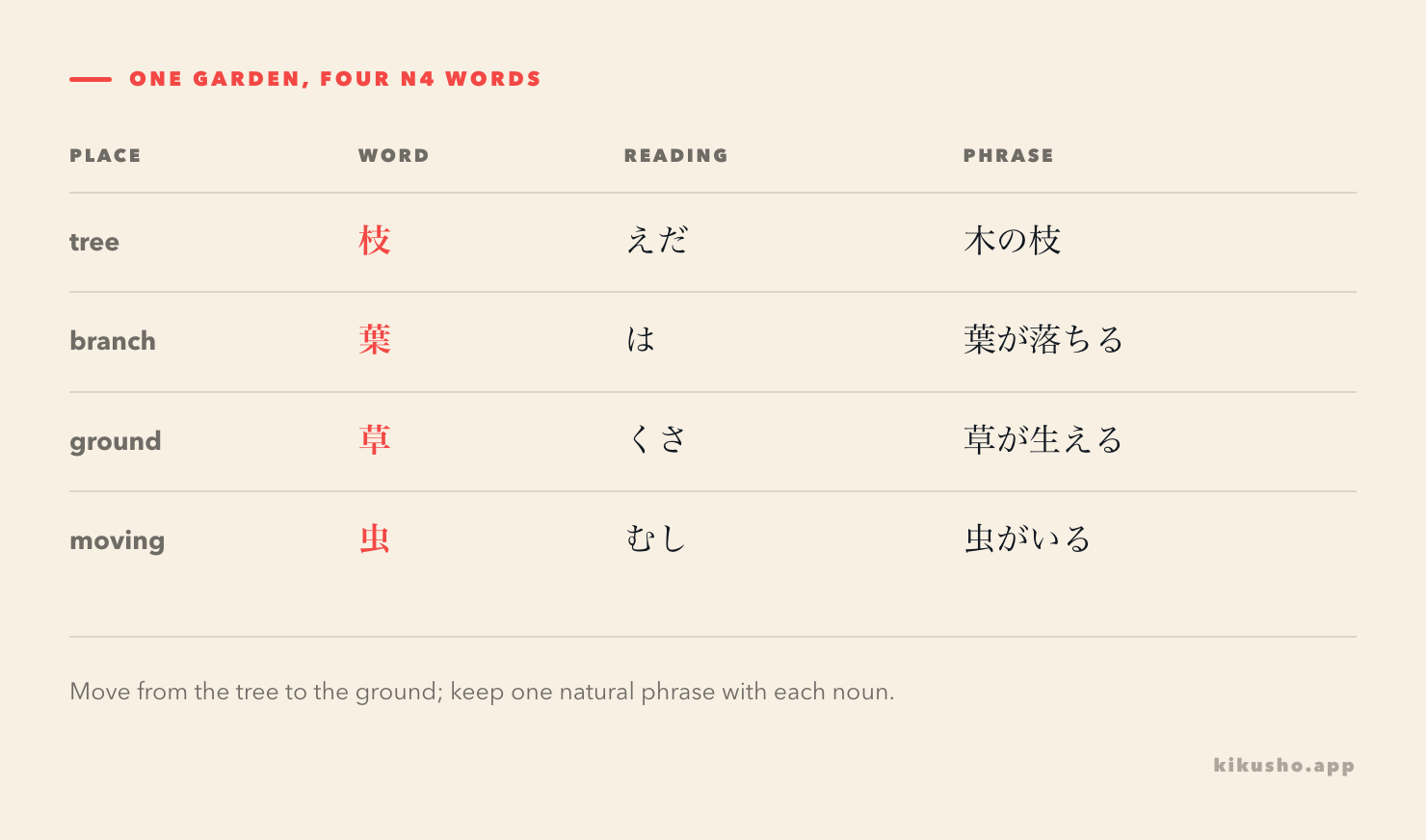
Picture one small garden from top to bottom. A 木の枝(きのえだ) carries a 葉(は), 草(くさ) grows below, and a 虫(むし) rests on the leaf. Those four nouns form this N4 set.
The scene turns separate translations into useful phrases: 枝を切る, 葉が落ちる, 草が生える and 虫がいる. It also extends the earlier N5 animals and plants lesson, which teaches the whole tree and flower before this lesson names smaller parts of the scene.
Four words in one garden scene
All four assigned items are nouns. Learn the reading and one partner phrase together.
| Place in the scene | Word | Reading | Sense and word class | Phrase to keep |
|---|---|---|---|---|
| On the tree | 枝 | えだ | branch, twig; noun | 木の枝, a tree branch |
| On the branch | 葉 | は | leaf; noun | 葉が落ちる, a leaf falls |
| On the ground | 草 | くさ | grass, weeds, herbaceous plant; noun | 草が生える, grass grows |
| Moving through the scene | 虫 | むし | insect, bug; noun | 虫がいる, there is a bug |
The readings and core meanings are supported by the dictionary entries for 枝, 葉, 草 and 虫. An independently produced plant vocabulary lesson from Japan's Organization for Technical Intern Training lists 草, 葉 and 枝 with these readings and gives 枝が伸びます as a model phrase. The Ministry of Education's Japanese-language lesson about trees likewise groups 葉 and 枝 as words for parts of a tree.
枝 connects the whole tree to its leaves
木 names the tree as a whole. 枝 names a branch or twig extending from its trunk or stem:
木の枝に鳥が止まりました。 きの えだに とりが とまりました。 A bird landed on a tree branch.
春になると、枝が伸びます。 はるに なると、えだが のびます。 When spring comes, the branches grow.
Use 枝を切る when someone cuts or prunes a branch. The particle changes because the branch is now the object of the action:
長い枝を切りました。 ながい えだを きりました。 I cut the long branch.
The Culture Agency's index to the official jōyō kanji readings records えだ for 枝 and gives 枝葉 as an example compound. For this lesson, keep the standalone noun and the transparent phrase 木の枝.
葉 is a leaf; 葉っぱ is the conversational form
葉(は) is the basic dictionary form. 葉っぱ(はっぱ) is common in conversation and keeps the same core meaning.
枝に緑の葉がついています。 えだに みどりの はが ついています。 Green leaves are attached to the branch.
秋になると、葉が落ちます。 あきに なると、はが おちます。 When autumn comes, the leaves fall.
When you count individual leaves as flat objects, 枚(まい) is a natural counter:
赤い葉を一枚拾いました。 あかい はを いちまい ひろいました。 I picked up one red leaf.
Do not assume the standalone reading は applies to every compound that contains 葉. Compounds can choose another reading, so learn each compound as a whole. The four assigned items here are the standalone nouns, and 葉が落ちる is the phrase to retain.
草 covers more than a neat lawn
草(くさ) can describe grass, weeds or herbaceous plants, depending on the scene. It does not only mean a carefully cut lawn.
庭に草が生えています。 にわに くさが はえています。 Grass is growing in the garden.
週末に庭の草を刈りました。 しゅうまつに にわの くさを かりました。 I cut the grass in the garden at the weekend.
The first sentence makes 草 the subject of 生える(はえる), “to grow.” The second makes it the object of 刈る(かる), “to mow or cut.” That subject-object change is more useful than memorising one English label.
草 and 木 divide plants by form in ordinary descriptions, but the boundary need not become a botany lesson. At N4, use 木 for a tree and 草 for the low grass or weeds you see on the ground.
虫 is broader than the strict English category insect
For a simple garden scene, translate 虫(むし) as “insect” or “bug”:
葉の上に小さい虫がいます。 はの うえに ちいさい むしが います。 There is a small bug on the leaf.
夏の夜は虫の声が聞こえます。 なつの よるは むしの こえが きこえます。 On summer nights, you can hear insects.
Everyday 虫 can cover some small crawling creatures that English would not classify scientifically as insects. Context normally resolves the intended creature. A specific name such as 蚊 for mosquito or 蜘蛛 for spider is more precise when the species matters; the assigned word 虫 keeps the scene general.
The Ministry of the Environment uses the words in a real nature context in its page about stick insects: the insects live in woods and grassland, resemble branches and eat leaves. That supports the ordinary scene without turning this vocabulary set into a list of species.
Plants take ある; insects take いる
The garden contains living plants and living insects, but basic Japanese does not give them the same existence verb. Plants normally take ある. Independently moving creatures take いる.
| What exists | Natural sentence | Existence verb |
|---|---|---|
| branches, leaves, grass | 庭に草があります。 | ある |
| insects and other animals | 葉の上に虫がいます。 | いる |
In a description of growth, Japanese may choose a more specific verb instead: 草が生えています tells you that grass is growing, while 草があります only tells you that it is present.
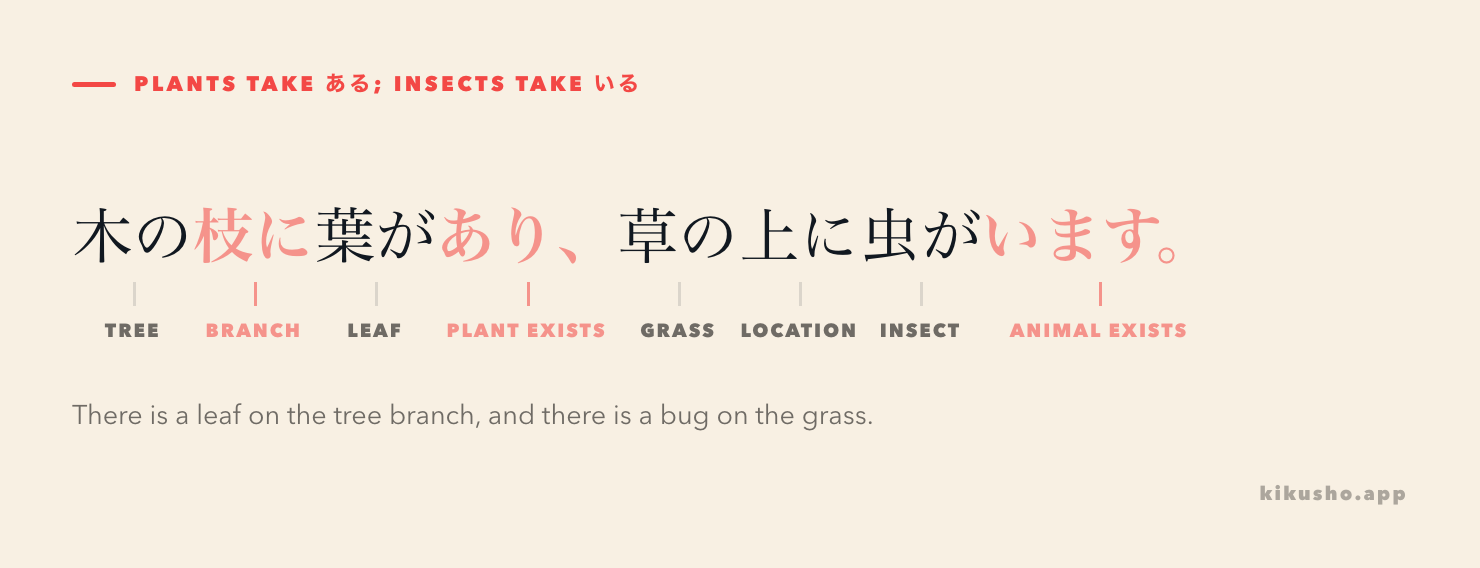
木の枝に葉があり、草の上に虫がいます。 きの えだに はが あり、くさの うえに むしが います。 There is a leaf on the tree branch, and there is a bug on the grass.
The full lesson on ある and いる covers the broader rule. In this set, the contrast simply gives each new noun a natural sentence frame.
Build one connected memory instead of four cards
Read the scene in a fixed direction: 枝 → 葉 → 虫 → 草. Then change one action at a time: 枝を切る, 葉を拾う, 虫を見る, 草を刈る. The image stays stable while the particles and verbs do useful work.
If you make Kikusho cards from a park photo or a short description, keep the partner phrase on the back. A card for 枝 becomes easier to use when it recalls 木の枝 or 枝を切る; a card for 草 becomes a sentence seed when it keeps 草が生える. The four words then return as one navigable place rather than four isolated translations.
No exhaustive official JLPT vocabulary list assigns every word to a level. Kikusho's dated reference inventory places all four items at N4, and its two compared observations agree, though both descend from the same source family. The independent WKWK Japan N4 animals and plants list also places 草 and 葉 at N4, while its cumulative N3 page includes 枝. That disagreement is a reminder to treat N4 as a study estimate rather than an official classification.
The N1 animals and plants follow-up shifts from identifying parts of a garden to reading reports about cultivation, animal care, reproduction and species.
Practice the garden scene
Garden check 1
The label on a branch reads 枝. Which pronunciation belongs to it?
- ア. えた
- イ. えだ
- ウ. は
- エ. くさ
Garden check 2
You hear くさ while looking at the ground. Which spelling fits?
- ア. 枝
- イ. 葉
- ウ. 草
- エ. 虫
Garden check 3
Which word means “leaf”?
- ア. 葉
- イ. 枝
- ウ. 草
- エ. 虫
Garden check 4
Which phrase naturally means “cut a branch”?
- ア. 枝が切る
- イ. 枝を切る
- ウ. 枝に切る
- エ. 枝で切る
Garden check 5
Complete both sentences: 庭に草が( )。葉の上に虫が( )。
- ア. います / あります
- イ. あります / います
- ウ. あります / あります
- エ. います / います
Garden check 6
In an ordinary garden description, what is the best basic translation of 虫?
- ア. root
- イ. flower
- ウ. insect or bug
- エ. tree trunk
Garden check 7
Which sentence matches this scene: “There is a leaf on the tree branch, and a bug is on the grass”?
- ア. 木の葉に枝があり、虫の上に草がいます。
- イ. 木の枝に葉があり、草の上に虫がいます。
- ウ. 草の枝に虫があり、葉の上に木がいます。
- エ. 虫の枝に草がいて、木の上に葉があります。
Trace 枝 → 葉 → 虫 → 草 once more. Fix all seven choices, then reveal the panel below.
Answers and explanations
Solution 1
イ. えだ. 枝 is read えだ and means a branch or twig. 葉 is は, and 草 is くさ.
Solution 2
ウ. 草. 草 is read くさ. 枝 is a branch, 葉 is a leaf, and 虫 is an insect or bug.
Solution 3
ア. 葉. The standalone noun 葉 is read は and means “leaf.” 枝 is the branch that can carry it.
Solution 4
イ. 枝を切る. The branch is the object being cut, so it takes を. 枝が切る would make the branch the agent doing the cutting.
Solution 5
イ. あります / います. Grass is a plant and normally takes ある. A bug is an independently moving creature and takes いる.
Solution 6
ウ. insect or bug. That is the useful basic meaning in this scene. Everyday 虫 can extend beyond the strict scientific category, but it does not mean a root, flower or tree trunk.
Solution 7
イ. 木の枝に葉があり、草の上に虫がいます. 木の枝 identifies the tree branch, 葉 takes あり as a plant part, and the moving insect takes います. The other choices reverse the relationships or use いる for a tree.
Common questions
What is the difference between 木 and 枝?
木(き)names the whole tree or wood as a material. 枝(えだ)is a branch or twig growing from a trunk or stem. Use 木の枝 for “a tree branch” and 枝を切る for “cut a branch.”
What is the difference between 葉 and 葉っぱ?
Both can mean “leaf.” 葉(は)is the basic headword and appears easily in compounds. 葉っぱ(はっぱ)is a common conversational form. A flat leaf can be counted with 枚, as in 葉を一枚拾う.
Does 虫 only mean insect?
In a basic N4 scene, 虫(むし)means an insect or bug. Everyday Japanese can use it more broadly for small creatures such as worms, so its range does not always match the strict scientific category “insect.”
Do plants use いる or ある?
Plants normally take ある, while independently moving animals and insects take いる. You can therefore say 庭に草があります and 葉の上に虫がいます.