On this page
Picture one small park: 犬(いぬ) and 猫(ねこ) are near a 木(き), a 鳥(とり) is above them, and a 花(はな) is beginning to 咲く(さく). Those six concrete words plus the category noun 動物(どうぶつ) form this seven-item N5 set.
The scene also exposes a useful split. The animals います, while the tree and flower あります. The flower then becomes the subject of its own action in 花が咲きます.
Seven words in one outdoor scene
Each row includes the assigned spelling and reading. Keep the phrase in the last column with the word because it shows what kind of sentence the word enters.
| Place in the scene | Japanese | Reading | Meaning and word class | Phrase to keep |
|---|---|---|---|---|
| Pet | 犬 | いぬ | dog; noun | 犬がいます, there is a dog |
| Pet | 猫 | ねこ | cat; noun | 猫が好きです, I like cats |
| In the sky | 鳥 | とり | bird; noun | 鳥が飛びます, a bird flies |
| Category | 動物 | どうぶつ | animal; noun | 動物の名前, the animal's name |
| Plant | 木 | き | tree; wood; noun | 木があります, there is a tree |
| Plant part | 花 | はな | flower, blossom; noun | 赤い花, a red flower |
| Plant action | 咲く | さく | bloom, flower; intransitive godan verb | 花が咲きます, a flower blooms |
The long vowel in どうぶつ matters: どう is two beats, followed by ぶつ. 咲く ends in く and conjugates like 書く: 咲きます, 咲いて, 咲いた.
動物 is the category; 犬, 猫 and 鳥 name members
動物 is a general category word. When you know the kind of animal, the specific noun gives more information:
あの動物は何ですか。
あの どうぶつは なんですか。
What is that animal?
犬です。
いぬです。
It is a dog.
The noun does not change to mark plural. 犬がいます can mean that there is a dog or that there are dogs when the number is not important. Add a number and counter only when the count matters.
犬 and 猫 often enter beginner sentences with 好き, 飼う or いる. The particles depend on the partner:
| What you mean | Natural phrase | Why |
|---|---|---|
| like dogs | 犬が好きです | 好き takes the liked thing with が |
| keep a cat | 猫を飼っています | 飼う is a transitive verb |
| a cat is present | 猫がいます | 猫 is the animal that exists |
The verb 飼う(かう), “keep or raise an animal,” is not one of the seven assigned items, but it is a useful partner. Bunpro's N5 entry for 飼う gives 猫を二匹飼う and 犬を飼う as ordinary examples.
Animals use いる; trees and flowers use ある
English “living thing” suggests one biological group, but the basic Japanese existence verbs divide the scene differently:
| Noun | Existence sentence | Verb |
|---|---|---|
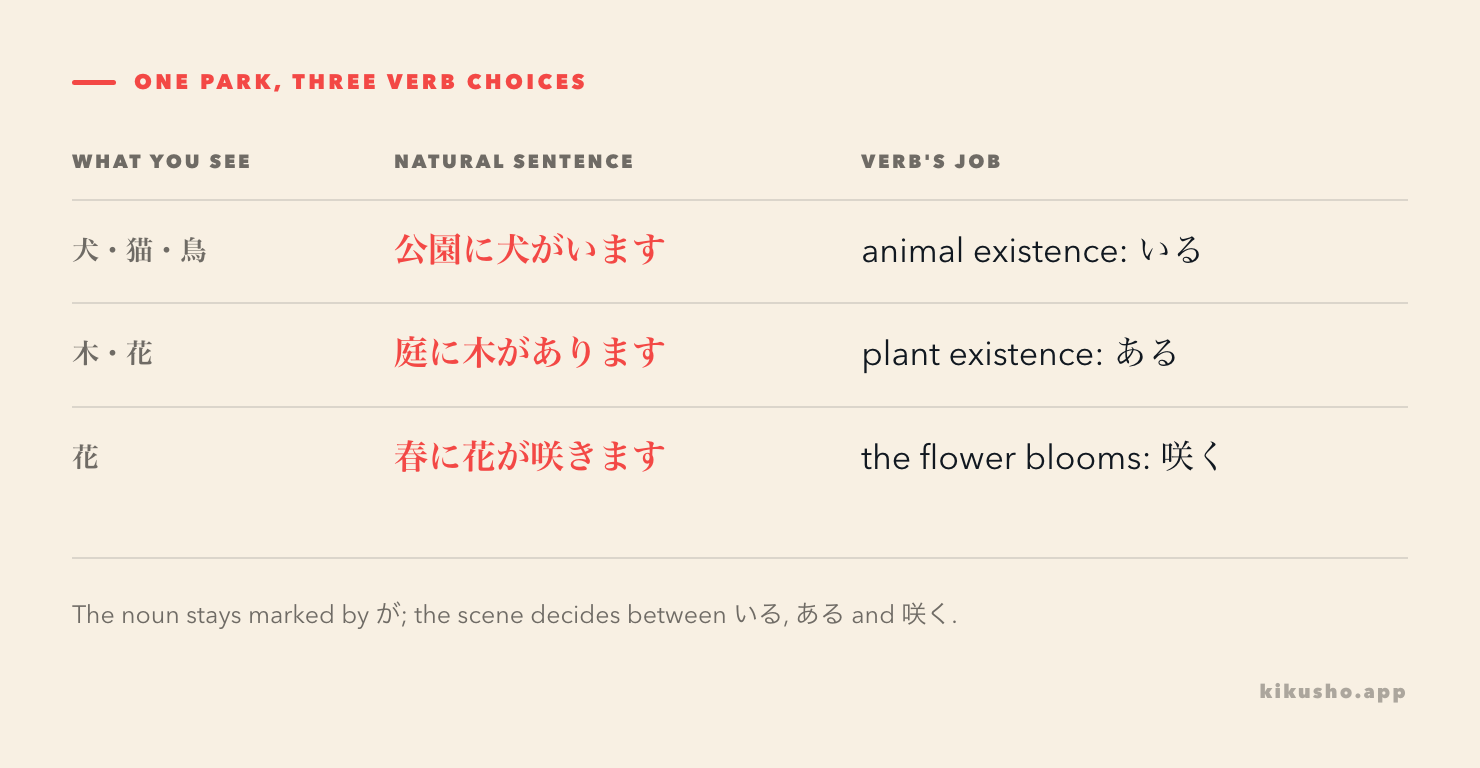
| 犬, 猫, 鳥, 動物 | 公園に犬がいます。 | いる, for people and animals |
| 木, 花 | 庭に木があります。 | ある, for things and plants |
木の下に猫がいます。
きの したに ねこが います。
There is a cat under the tree.
The cat takes います, while the tree would take あります. Tokyo University of Foreign Studies gives exactly this beginner contrast with 木があります and 犬がいます. Its fuller location pattern also contrasts 公園に木があります with 家に犬がいます.
This is a practical language distinction, not a claim that plants are lifeless. The core test is independent movement in an ordinary scene. The full lesson on ある and いる covers people, possession and less literal cases; here the split only helps these seven nouns settle into a sentence.
花 is the subject that 咲く describes
咲く is intransitive. The flower opens by itself in the sentence, so the flower takes が:
春に花が咲きます。
はるに はなが さきます。
Flowers bloom in spring.
庭に白い花が咲いています。
にわに しろい はなが さいています。
White flowers are blooming in the garden.
The first sentence uses 咲きます for a regular event. The second uses 咲いています for flowers currently in bloom. Daijisen defines 咲く as a flower bud opening and gives 大輪の花が咲く as its central pattern. Bunpro also places 咲く at N5, identifies it as an intransitive godan verb and begins with 花が咲く.
Do not build the basic sentence as 花を咲く. The object particle would present 花 as the object of a transitive action, but 咲く does not take that role. At this level, make 花が咲く one unit.
木 can stand in the park or become a material
木 has two everyday senses. It can name a standing tree, or it can name wood as a material. The surrounding grammar tells you which one is active:
公園に大きい木があります。
こうえんに おおきい きが あります。
There is a big tree in the park.
この机は木でできています。
この つくえは きで できています。
This desk is made of wood.
The first sentence locates a tree. In the second, 木で identifies the material. 木の机 is the shorter noun phrase “wooden desk.” Daijisen's 木 entry records both the plant and material senses, with 木を植える and 木の机 as examples.
The lesson on noun + の explains why 木の机 can express material even though の is often introduced through possession. Keep き separate from もく in 木曜日(もくようび): the assigned standalone noun is read き.
鳥 usually means the bird you see
In the core N5 sense, 鳥 is a bird:
木の上に鳥がいます。
きの うえに とりが います。
There is a bird in the tree.
鳥が空を飛んでいます。
とりが そらを とんでいます。
A bird is flying in the sky.
Food creates an extra reading decision. Dictionaries record とり for a bird and, in some contexts, a chicken or its meat. NINJAL's 鳥・鶏 entry separates 鳥 as the general word for a bird from 鶏 as chicken, including the food compound 鶏肉. In beginner writing, use 鳥 for the animal and 鶏肉 or とり肉 when you clearly mean chicken meat.
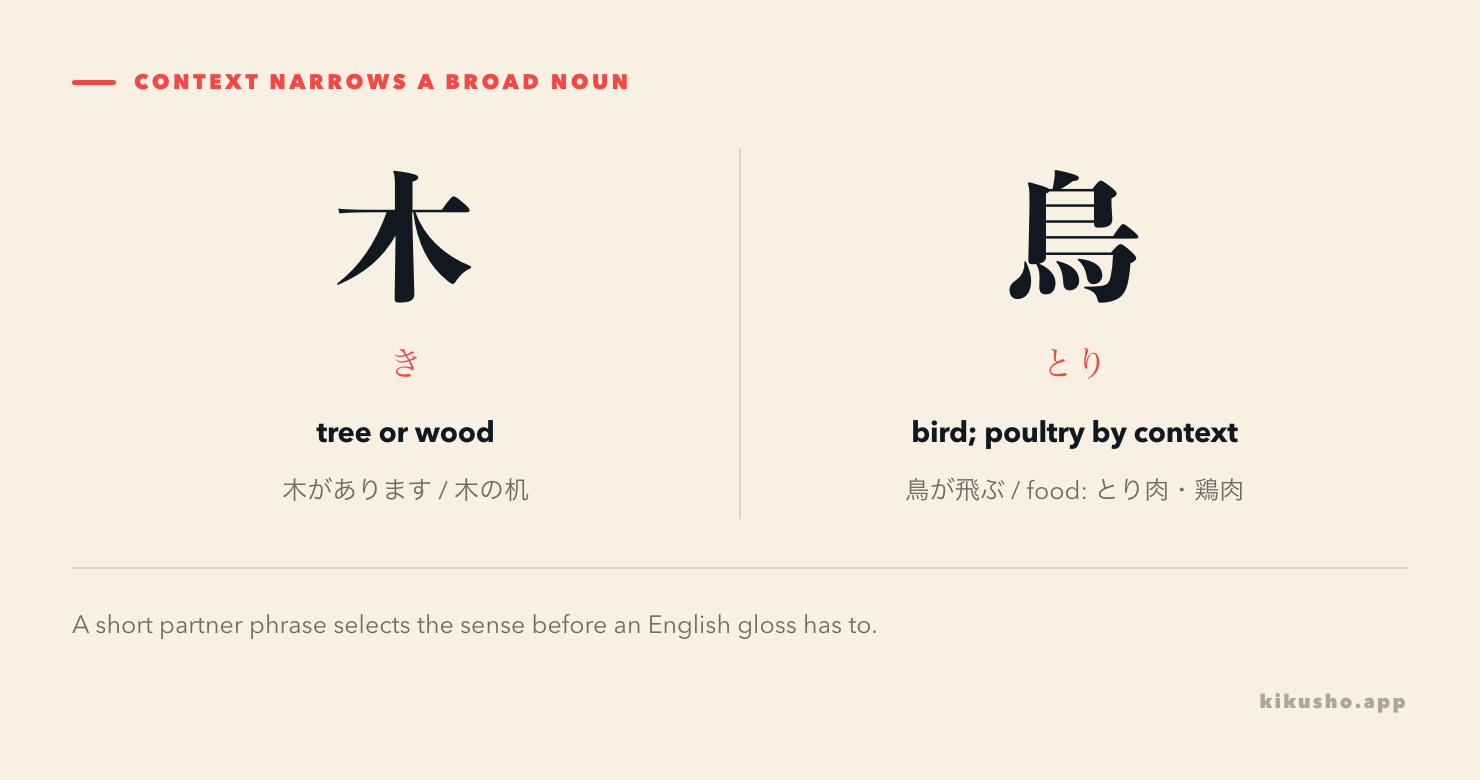
That keeps 鳥を見ました, “I saw a bird,” distinct from とり肉を食べました, “I ate chicken.” Bunpro's 鳥 entry confirms the N5 bird sense while also recording the poultry sense that context can activate.
Let one scene carry all seven words
Read the park from ground to sky:
公園に大きい木があります。木の下に犬と猫がいます。木の上には鳥がいます。近くに赤い花が咲いています。私は動物も花も好きです。
こうえんに おおきい きが あります。きの したに いぬと ねこが います。きの うえには とりが います。ちかくに あかい はなが さいています。わたしは どうぶつも はなも すきです。
There is a big tree in the park. A dog and a cat are under it. A bird is in the tree. Red flowers are blooming nearby. I like both animals and flowers.
If you capture a park sign, pet notice or flower label in Kikusho, keep the smallest phrase that preserves the word's job. 猫がいます, 木があります and 花が咲いています look similar, but each ends with the verb the noun naturally needs in that scene.
Practice the scene before checking the explanations
Item 1
Read 動物. Which option gives its full pronunciation?
- A. どうもの
- B. とうぶつ
- C. どうぶつ
- D. どうもつ
Item 2
Choose the kanji that spells ねこ, “cat.”
- A. 猫
- B. 犬
- C. 鳥
- D. 花
Item 3
Which word is the general category that includes dogs, cats and birds?
- A. 木
- B. 動物
- C. 花
- D. 咲く
Item 4
Complete both sentences: 公園に犬が( )。公園に木が( )。
- A. あります / います
- B. います / あります
- C. 咲きます / います
- D. あります / 咲きます
Item 5
Which sentence naturally means “Flowers bloom in spring”?
- A. 春に花を咲きます。
- B. 春に花が咲きます。
- C. 春に花がいます。
- D. 春を花に咲きます。
Item 6
In この机は木でできています, what does 木 mean?
- A. Thursday
- B. a flower
- C. wood as a material
- D. an animal
Item 7
You saw a feathered animal flying above a tree. Which sentence fits?
- A. 木の上に鳥がいました。
- B. 木の上に花がいました。
- C. 鳥の上に木が咲きました。
- D. 木の上に動物がありました。
Item 8
Read the passage: 庭に木があります。木の下に猫がいます。白い花も咲いています。 Which summary is accurate?
- A. A cat is under a tree, and white flowers are blooming in the garden.
- B. A bird is eating chicken under a wooden desk.
- C. A dog is planting a tree beside the house.
- D. The cat and flowers are both described with あります.
Answers and explanations
Answer 1
C. どうぶつ. The first half has the long vowel どう, and 物 is voiced to ぶつ in this word. The other choices shorten the first part or change one of the consonants.
Answer 2
A. 猫. 猫 is read ねこ. 犬 is いぬ, 鳥 is とり, and 花 is はな.
Answer 3
B. 動物. 動物 is the category noun “animal.” 犬, 猫 and 鳥 name particular kinds within that category. 木 and 花 belong to the plant side of the scene, while 咲く is a verb.
Answer 4
B. います / あります. A dog is an animal and normally takes いる. A tree is a plant and normally takes ある. Both nouns take が as the thing located in the park.
Answer 5
B. 春に花が咲きます. 咲く is intransitive, so the flower that blooms is the subject marked by が. Choice A incorrectly treats 花 as its object; C uses the animal existence verb; D assigns the particles no natural roles.
Answer 6
C. wood as a material. The construction 木でできています says that the desk is made of wood. A standing tree would appear in a context such as 公園に木があります. Thursday is 木曜日, read もくようび.
Answer 7
A. 木の上に鳥がいました. 鳥 names the bird, いました is the past of the animal existence verb, and 木の上に locates it above or in the tree. Flowers do not take いる, and the other sentences reverse the scene or choose ある for an animal.
Answer 8
A. A cat is under a tree, and white flowers are blooming in the garden. 木 takes あります, 猫 takes います, and 花 is the subject of 咲いています. The passage mentions no bird, dog, desk or food.
Common questions
Do animals and plants both use いる in Japanese?
No. People and animals normally use いる, as in 犬がいます. Trees, flowers and other plants normally use ある, as in 木があります. The beginner rule follows whether the thing moves independently, rather than the scientific distinction between living and non-living things.
What particle does 咲く take?
The flower that blooms is the subject, so it takes が: 花が咲きます. 咲く (さく)is an intransitive godan verb. 花を咲く is not the basic pattern.
Does 木 mean a tree or wood?
木(き)can mean a standing tree or the material wood. Context separates them: 公園に木があります describes a tree in a park, while 木の机 or 木で作った机 describes a wooden desk.
Does 鳥 mean bird or chicken?
鳥(とり)ordinarily means bird. Dictionaries also record poultry or chicken in food contexts, where 鶏肉 or the kana spelling とり肉 makes the intended meaning clearer. Learn 鳥が飛ぶ as the basic N5 use.