On this page
ある(aru) describes the presence of objects, plants and abstract things; いる(iru) describes the presence of people and animals. Their polite forms, あります(arimasu) and います(imasu), fill the same sentence patterns, while the noun and the way you view it decide which verb belongs there.
Both can translate as “there is,” “there are” or “have.” The useful distinction is Japanese animacy, rather than an English translation or a test of whether something is moving at this instant.
First identify what you are saying is present
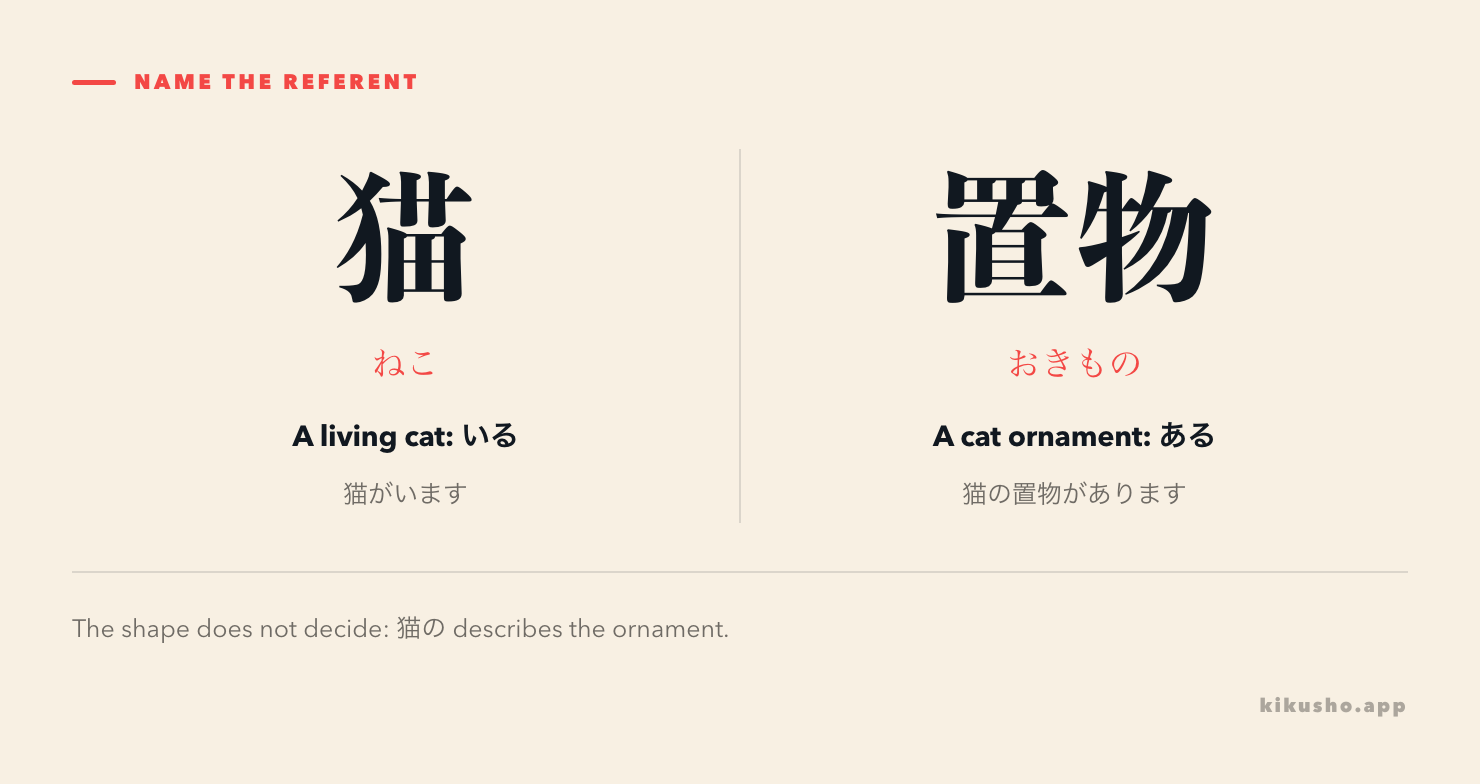
In 猫がいます, “There is a cat,” 猫 is the being whose presence you assert. In 猫の置物があります, “There is a cat ornament,” the whole phrase names an ornament. The cat shape does not make the ornament a living cat.
| Referent and reading | Ordinary polite pattern | Meaning |
|---|---|---|
| 本(ほん) | 本があります | There is a book / there are books. |
| 木(き) | 木があります | There is a tree / there are trees. |
| 質問(しつもん) | 質問があります | I have a question / questions. |
| 猫(ねこ) | 猫がいます | There is a cat / there are cats. |
| 友達(ともだち) | 友達がいます | A friend is here / friends are here. |
| 猫の置物(ねこのおきもの) | 猫の置物があります | There is a cat ornament. |
JLPT Sensei lists があります/がある and がいます/がいる at N5. Bunpro independently places both at N5. This lesson teaches those two existence constructions; the level is a study-list estimate, since the JLPT publishes no exhaustive grammar syllabus.
Plants take ある; resting people and animals keep いる
A tree is alive, but ordinary Japanese says この公園には大きな木があります, “There is a big tree in this park.” Growth does not put 木 into the same grammatical class as a person or animal. Iori Hamada's university lesson explicitly includes plants with あります.
Conversely, 外に犬がいます(そとにいぬがいます) means “There is a dog outside,” even if the dog is asleep. You do not inspect its current activity and switch to あります when it lies down. いる locates the dog; another verb would tell you what it is doing.
The basic classes are reliable for ordinary beginner sentences. The machinery cases come later because they involve how a speaker presents the thing, rather than a new list of nouns that always demand one verb.
Put に after the place and が after what exists
To introduce something at a location, use these parallel frames:
| Frame | Complete example | Translation |
|---|---|---|
| place に thing が あります | 駅の近くに銀行があります。 | There is a bank near the station. |
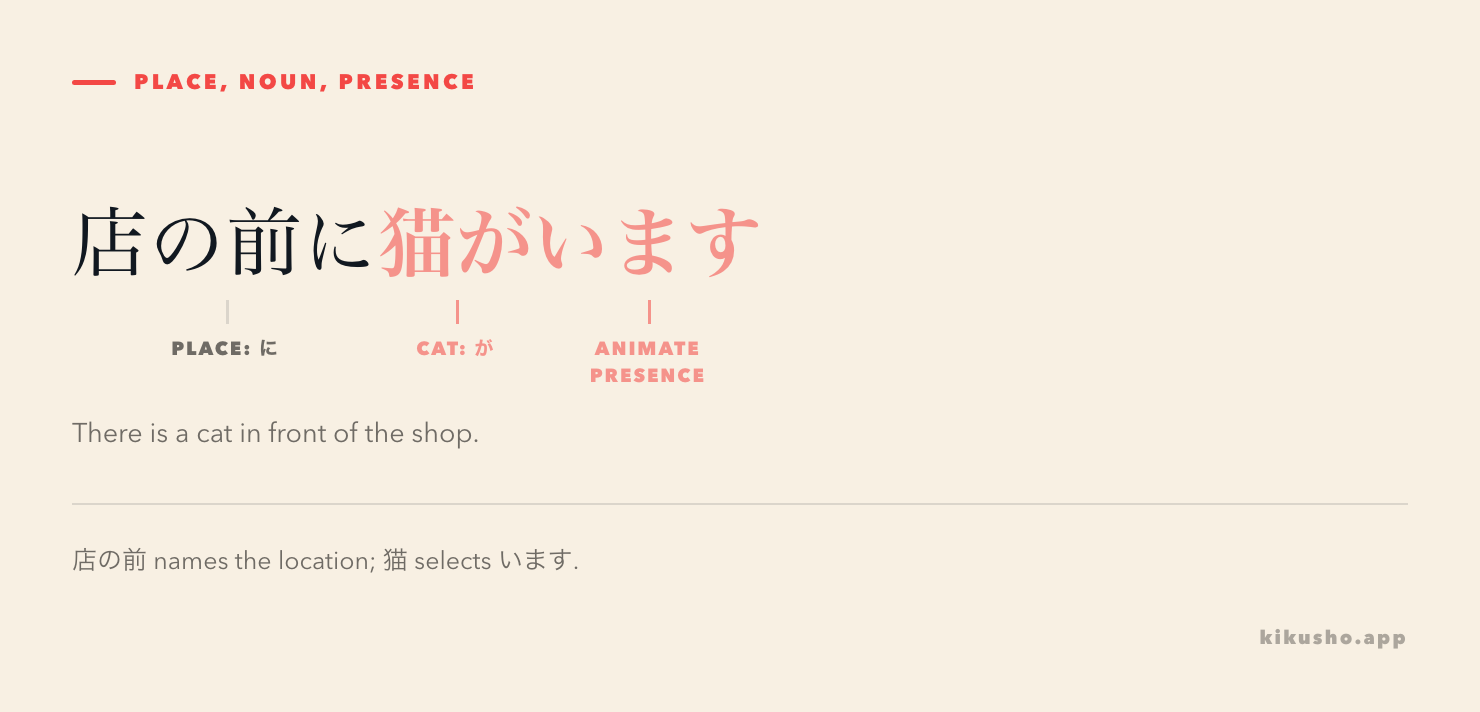
| place に person/animal が います | 店の前に猫がいます。 | There is a cat in front of the shop. |
Here 銀行(ぎんこう) and 猫 choose the verb, while 駅の近く(えきのちかく) and 店の前(みせのまえ) supply locations. The TUFS location lesson verifies these frames and the topic version below.
For a noun already under discussion, noun は place に verb locates that topic: 傘は玄関にあります(かさはげんかんにあります), “The umbrella is in the entrance hall.” Compare 傘はどこにありますか, “Where is the umbrella?” The change to は does not change 傘 into an animate noun.
The location-word lesson explains の inside 駅の近く and 店の前. The に versus で lesson covers the wider location distinction. These verbs do not take a direct object: 猫をいます is not the standard existence pattern. を marks a different noun role.
Negative and past forms preserve the split
Both verbs have ordinary polite forms, but ある has an irregular plain negative:
| Form | Objects and plants | People and animals |
|---|---|---|
| Plain nonpast | ある | いる |
| Polite nonpast | あります | います |
| Plain negative | ない | いない |
| Polite negative | ありません | いません |
| Plain past | あった | いた |
| Polite past | ありました | いました |
| Plain past negative | なかった | いなかった |
| Polite past negative | ありませんでした | いませんでした |
Bunpro's ある explanation checks ある as a godan verb and ない, rather than あらない. Its いる explanation checks いる as an ichidan verb. The ます-form lesson explains those groups.
昨日、店の前に猫がいました, “There was a cat in front of the shop yesterday,” keeps いる's class in the past. 今日は猫がいません, “There is no cat today,” keeps it in the negative. Absence does not turn the cat into a thing.
“Have” and “an event takes place” use the same nouns
Context can make an existence sentence express possession or a relationship. 質問があります can mean “I have a question,” and 姉がいます(あねがいます) can mean “I have an older sister.” With the person understood from the conversation, these lines do not need an English-style separate verb for “have.” Hamada's existence lesson treats both possession and family relationships.
The noun still decides: a question uses あります; a sister uses います. 時間がありません(じかんがありません), “I don't have time,” is another practical ある sentence.
Events also take ある: 月曜日に会議があります(げつようびにかいぎがあります), “There is a meeting on Monday.” The meeting is an event, although people attend it.
Be careful with the location rule here. An event happening somewhere uses で: 明日、学校で会議があります, “There is a meeting at school tomorrow.” TUFS explicitly distinguishes event-location で from the に that locates an object or person. 学校に先生がいます locates a teacher; 学校で会議があります says an event takes place there.
Vehicles and robots depend on how they are presented
For an ordinary parked object, 車があります describes a car's presence or availability. You may also hear タクシーがいます when a taxi is presented as an active vehicle with a driver. The engine does not establish a universal noun rule: the speaker's focus and the expectation of movement matter.
Tofugu's independently authored existence guide distinguishes vehicles considered as objects from vehicles viewed as mobile, and applies the same contextual distinction to robot vacuums. ロボットがあります can describe a machine as equipment; ロボットがいます can present it as mobile or personified. The TUFS existence lesson separately includes operating buses and robots among extensions of います.
These are possible readings, not a reason to mark one robot sentence wrong without its situation. Learn the ordinary noun classes first, then attach an encountered exception to its scene.
When you paste a line into Kikusho, record what the speaker was pointing at with it. A note such as “robot moving around the room” makes ここにいる intelligible later. A cropped phrase containing only “robot = いる” loses the evidence that made the speaker's choice sensible. You can edit the drafted card's register and nuance note before keeping it.
An English “is” can also identify rather than locate
これは猫です means “This is a cat”: it identifies something. ここに猫がいます means “There is a cat here”: it asserts presence. The です and だ lesson covers identification and noun predicates. Do not append です to いる or ある to make them polite; use います and あります.
Also separate the independent existence verbs from verb + ている/てある. Those are constructions about an action or resulting state, treated in the ている versus てある lesson. This page's noun-class test does not replace that lesson's choice of construction.
Practise the noun, the frame and the context
Question 1: choose the verb. Complete the ordinary polite sentence 庭に木が___: “There is a tree in the garden.”
- ア. います
- イ. あります
- ウ. です
- エ. いません
Question 2: compose a sentence. Arrange 猫 / 店の前 / います / が / に into a standard polite sentence introducing a cat in front of the shop. Begin with the location.
Question 3: make the sentence negative. Give the plain negative and polite negative of 時間がある: “I have time.”
Question 4: identify the referent. A shelf holds a ceramic cat ornament. Complete 棚に猫の置物が___ to state what is there now, using the ordinary object reading. Explain what chooses the verb.
- ア. います
- イ. ありました
- ウ. あります
- エ. いました
Question 5: read the message. Read 昨日、店の前に猫がいました。今日は猫がいません。 Translate both lines, then say whether the second line means the cat does not exist anywhere or is absent from the location under discussion.
Question 6: choose the location particles. Complete 学校__先生がいます。明日、学校__会議があります。 The first line locates a teacher; the second announces tomorrow's meeting at school.
- ア. で / に
- イ. に / に
- ウ. で / で
- エ. に / で
Question 7: explain the two readings. One person lists ロボットがあります as equipment; another says ロボットがいます while tracking a mobile robot. Must one sentence be wrong? Explain the contextual difference.
Answers and explanations
Answer 1. イ. あります: 庭に木があります(にわにきがあります). A tree uses ある in ordinary existence statements. Being biologically alive does not select いる for a plant. です identifies or describes a predicate rather than completing this existence frame.
Answer 2. 店の前に猫がいます。 店の前 is the location, so it takes に; 猫 is what you introduce, so it takes が and the animate existence verb います. の stays inside the location phrase. The requested order begins with the place and introduces the cat.
Answer 3. Plain: 時間がない。 Polite: 時間がありません。 ある's plain negative is the irregular ない. 時間があらない is incorrect; 時間がいない would choose the existence verb for a person or animal instead of time.
Answer 4. ウ. あります: 棚に猫の置物があります(たなにねこのおきものがあります). The referent is 置物, an ornament, qualified by 猫の. It is not a living cat. ありました would put its presence in the past, which this question does not ask for.
Answer 5. “There was a cat in front of the shop yesterday. There is no cat today.” The second sentence continues the location established in the first: the cat is absent from that setting today. It does not claim that cats, or that particular cat, have ceased to exist. いました and いません are the past affirmative and nonpast negative of the same animate verb.
Answer 6. エ. に / で. 学校に先生がいます locates a person. 明日、学校で会議があります names where a meeting takes place. An event keeps ある but uses で for its venue, so the physical-presence location rule cannot be applied without checking the noun's meaning.
Answer 7. Both can fit. ある presents the robot as equipment; いる can present it as a mobile or personified participant. The context licenses the second reading. A noun such as ロボット does not impose one verb for every scene, and the equipment example does not prohibit いる elsewhere.
Common questions
What is the difference between ある and いる?
For ordinary existence statements, use ある for objects, plants and abstract things, and いる for people and animals. Their polite forms are あります and います. Vehicles and robots can take いる when viewed as mobile or animate, so the distinction depends on the referent and its context.
Why do Japanese plants take ある even though they are alive?
Plants belong with ある in ordinary Japanese existence sentences. The split is grammatical animacy, not a biological living-versus-dead test. A tree normally takes あります; a sleeping cat still takes います.
What are the negative forms of ある and いる?
The plain negatives are ない and いない. Do not form あらない from ある. The polite negatives are ありません and いません; the polite past negatives are ありませんでした and いませんでした.
Which particles go with あります and います?
To introduce something at a location, use place に noun が あります or います. To locate an established topic, use noun は place に あります or います. An event taking place somewhere can instead use place で event があります.