On this page
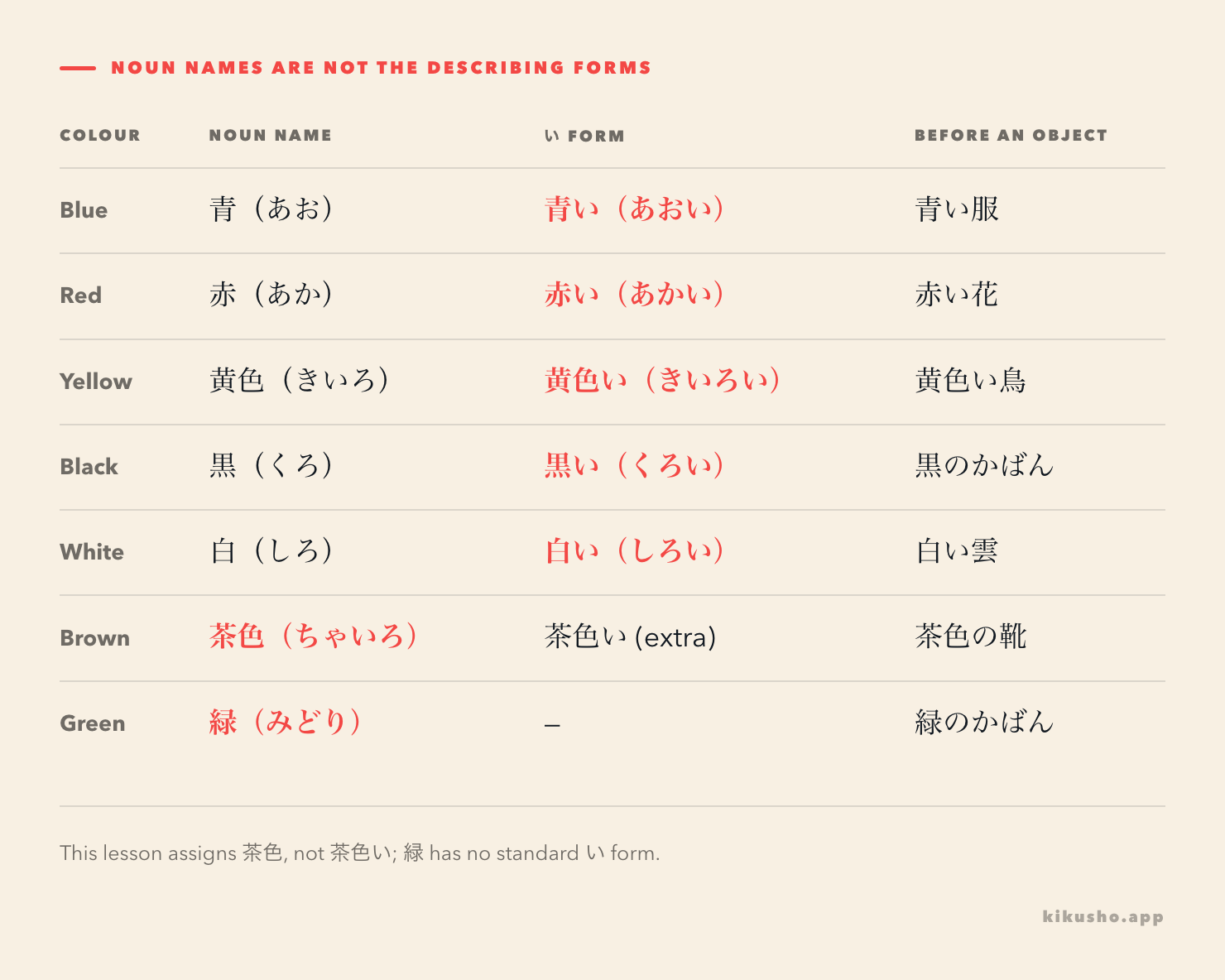
In this N5 colour set, 青い, 赤い, 黄色い, 黒い and 白い are い-adjectives that can touch a noun directly. 緑 and the assigned 茶色 are taught as colour nouns: put の between the colour and the object, as in 緑のかばん or 茶色の靴. The colour names 青, 赤, 黄色, 黒 and 白 are nouns too, so a familiar colour can have both a noun form and an adjective form.
Ask what job the colour word is doing
Are you naming a colour, describing an object's hue, or identifying a colour option among several? This question settles the form more reliably than an English word such as "red." In 「好きな色は何ですか」, "What is your favourite colour?", 赤です names red. In 赤い花, "a red flower," 赤い describes the flower directly. In 赤のボールペン, "a red ballpoint pen," the noun 赤 identifies a colour of pen and needs の.
The independently authored J's Language School colour lesson checks the name-answer 赤です, adjective phrases such as 黒いかばん, and noun-colour phrases such as 茶色のかばん. The NINJAL 赤 entry independently gives 赤のボールペン and links the noun to 赤い. These pages check actual constructions; the "N5" label describes Kikusho's dated reference inventory, not an official exhaustive JLPT word list.
Thirteen assigned words: five paired forms, two further colour nouns, and 色
Keep the two forms of one colour as two vocabulary items. The table gives each assigned headword, reading, part of speech and a phrase in the sense taught here.
| Meaning | Colour-name noun, reading | い-adjective, reading | Phrase that shows the job |
|---|---|---|---|
| Blue | 青(あお), noun: blue | 青い(あおい), い-adjective: blue | 青の絵の具, blue paint / 青い服, blue clothes |
| Red | 赤(あか), noun: red | 赤い(あかい), い-adjective: red | 赤のボールペン, a red pen / 赤い花, a red flower |
| Yellow | 黄色(きいろ), noun: yellow | 黄色い(きいろい), い-adjective: yellow | 黄色の木の葉, yellow leaves / 黄色い鳥, a yellow bird |
| Black | 黒(くろ), noun: black | 黒い(くろい), い-adjective: black | 黒のかばん, a black bag / 黒い服, black clothes |
| White | 白(しろ), noun: white | 白い(しろい), い-adjective: white | 白の絵の具, white paint / 白い雲, white clouds |
| Brown | 茶色(ちゃいろ), noun: brown | 茶色い exists outside these thirteen assigned items | 茶色の靴, brown shoes |
| Green | 緑(みどり), noun: green | No standard 緑い | 緑のかばん, a green bag |
| Colour itself | 色(いろ), noun: colour | Not a colour adjective | 好きな色, a favourite colour |
The NINJAL entries for 青, 黄色, 白, 茶色, 緑 and 色 check those readings, noun senses and several of the phrases. Its 青い entry gives 青い服; its 赤い entry gives 赤い花. The school lesson checks the remaining basic forms and the way they enter a sentence. 茶色い is mentioned to prevent a false "brown has no adjective" rule, but only the noun 茶色 receives coverage credit on this page.
The い form describes hue without の
When the colour is doing ordinary descriptive work, 青い空 is "a blue sky" and 白い雲 is "white clouds." 黒い服 is black clothing. The adjective sits immediately before the noun. In a complete polite sentence, 空は青いです says "The sky is blue"; the final い stays before です. The NINJAL 青い entry gives 青い空 and 青い服, and the 白い entry gives 白い雲.
This is why 青の空 is not the safe everyday translation of "blue sky." The Japanese applied-linguistics analysis observes that naturally coloured skies and clouds normally take the adjective form, while noun-plus-の becomes useful in particular contrasts or colour selections. That is a preference tied to context, not a ban on every noun-colour phrase.
A colour noun names the shade and uses の before an object
青 names the colour blue; 色(いろ) means "colour" itself. A colour-name answer can be 赤です or 白です after a question about favourite colours. To carry a noun colour in front of an object, use の: 緑のかばん, 茶色の靴, 赤のボールペン. Before です, the colour noun does not need の: このかばんは緑です, "This bag is green." The J's Language School lesson gives both noun answers and green-bag predicates; the NINJAL 茶色 entry gives 茶色の靴.
The N5 の lesson explains why a noun joins another noun with の. A colour noun uses that same link. The extra い in 赤い is part of a different adjective word; putting の after it as 赤いのかばん does not make "a red bag." 赤いの alone means "the red one," with の replacing a missing object.
黒いかばん and 黒のかばん can both point to the same bag
At a shop, several bags may share one model and differ by colour. 黒いかばん describes a black bag; 黒のかばん can identify the black version among those options. Both can point to that same bag. The noun form does not become an error just because 黒い exists. The Japanese applied-linguistics article gives precisely this bag-choice overlap and cautions that the difference is a tendency, not a rigid one-to-one meaning switch.
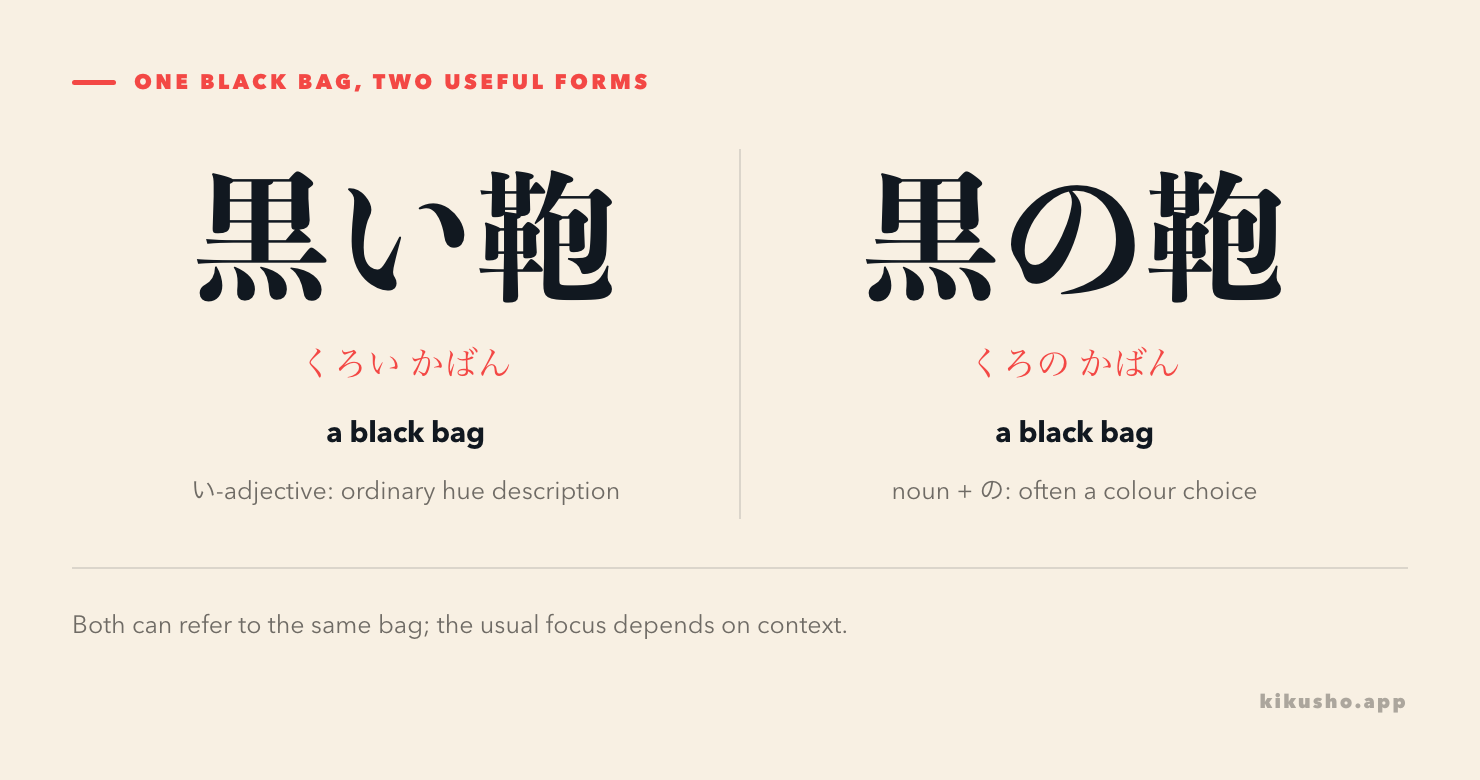
This overlap is easiest to understand with a familiar manufactured item. It is less useful as a licence to write noun-plus-の everywhere. 青い空 remains the usual way to describe the sky's hue. When you name a shade or choose a product colour, the noun form comes forward; when you simply describe what you see, the adjective form often comes first.
黄色, 茶色 and 緑 stop a mechanical "add い" rule
黄色(きいろ) is a noun ending in 色, and 黄色い(きいろい) is a separate established い-adjective. The NINJAL 黄色 entry lists both. 茶色(ちゃいろ) is the brown noun assigned here; 茶色い(ちゃいろい) also exists in Japanese, as the NINJAL dictionary records. It is not one of this lesson's thirteen inventory items. 緑(みどり) has no standard 緑い: say 緑のかばん or かばんは緑です. Adding い freely to every colour name would invent a word.
The written shape is only a clue. Learn the noun and its available adjective as separate items, then keep a phrase beside each. 黄色の木の葉 and 黄色い鳥 show both yellow forms; 茶色の靴 and 緑のかばん show the noun-plus-の route. The NINJAL linguistic explanation explicitly recognises 黄色い and 茶色い as adjective formations, while the applied-linguistics analysis notes the absence of standard 緑い.
A shop phrase gives a colour card its grammar
When you meet a colour on a label or hear it while choosing clothes, keep the object beside it. A card for 黒いかばん records the adjective and the bag; a card for 黒のかばん records the colour-name noun and its の. Kikusho can draft a card from the spoken phrase, a photo or text. Check the reading, meaning and example, including the い or の, before saving; the card is then available for offline review. A card headed only "black" loses the construction you needed in the shop.
The previous N5 adjective-pairs lesson shows why a noun keeps an adjective's sense steady. Here the noun also tells you which form of the colour word you used.
Try the forms in context
Question 1. A label says 青い服. How do you read the colour adjective 青い? a) あおい b) あお c) あかい d) くろい.
Question 2. Which spelling is the い-adjective meaning "white" in white clouds? a) 白 b) 白い c) 黒い d) 赤い.
Question 3. You are describing the ordinary blue hue of the sky, not choosing a colour option. Which phrase is the natural one? a) 青い空 b) 青の空 c) 青な空 d) 青いの空.
Question 4. You ask for a green bag. Which phrase uses the colour noun 緑 before かばん? a) 緑のかばん b) 緑いかばん c) 緑なかばん d) 緑ですかばん.
Question 5. Asked 「好きな色は何ですか」, which answer names the colour noun "red"? a) 赤です b) 赤いです c) 青です d) 緑です.
Question 6. You have the assigned noun 茶色 and want brown shoes using that noun with の. Which phrase does that? a) 茶色の靴 b) 茶色な靴 c) 茶色い靴 d) 黄色の靴.
Question 7. A rack holds black bags. Which two phrases can both identify a black bag, though one is an adjective phrase and the other noun-plus-の? a) 黒いかばん / 黒のかばん b) 黒いかばん / 緑のかばん c) 黒いかばん / 白いかばん d) 黒のかばん / 赤いかばん.
Answer key: seven colour-form decisions
Answer 1. a) あおい. あお reads the noun 青 without い; あかい reads 赤い, red; くろい reads 黒い, black. The final い is part of the assigned adjective word.
Answer 2. b) 白い. 白 is the colour-name noun, while 黒い and 赤い mean black and red. White clouds are 白い雲, with the adjective touching 雲.
Answer 3. a) 青い空. 青い describes the sky's hue directly. 青の空 is an unnatural default for the ordinary blue sky; 青な treats the colour noun as a な-adjective, and 青いの空 adds a stand-in の before a noun that is still present.
Answer 4. a) 緑のかばん. 緑 is a noun and の connects it to the bag. 緑い is not a standard colour adjective; な is not the link used here; です cannot sit between the colour and かばん.
Answer 5. a) 赤です. The question asks for a colour name, so answer with the noun 赤. 赤い is the describing adjective; 青 and 緑 name different colours. An object's red hue could be 赤いです in a different sentence, but it is not the noun asked for here.
Answer 6. a) 茶色の靴. It uses the assigned noun 茶色 with の. 茶色い靴 is also valid Japanese, but it uses the separate adjective 茶色い rather than the requested noun-plus-の construction; 茶色な is not this construction, and 黄色の靴 is yellow.
Answer 7. a) 黒いかばん / 黒のかばん. Both can indicate a black bag. The first directly describes hue; the second often selects the black colour option. The other pairs change one bag to green, white or red, so they cannot both paraphrase "black bag."
Common questions
Why are 青 and 青い both translated as blue?
青(あお) is a noun naming the colour; 青い(あおい) is an い-adjective describing something blue. 青い服 describes blue clothing directly, while 青の絵の具 names blue paint as a colour choice.
Can I say 茶色い as well as 茶色の?
Yes. 茶色い(ちゃいろい) is an established い-adjective, though this thirteen-item N5 lesson assigns only the noun 茶色(ちゃいろ). 茶色の靴 uses that noun with の; 茶色い靴 uses the separate adjective.
Can 緑 take い in standard Japanese?
No. 緑(みどり) is a colour noun. Say 緑のかばん before a noun or かばんは緑です as a predicate. 緑い is not the standard adjective form.
Does the の in 赤いの mean the same thing as the の in 赤のかばん?
No. 赤のかばん links the colour noun 赤 to かばん. 赤いの means "the red one": の stands in for a missing noun after the adjective 赤い.