On this page
Four N4 words are enough to build the centre of an overnight sightseeing plan: choose what to 見物する, decide where to 泊まる, make a 予約, and recognise a 旅館. The useful work lies in the boundaries: seeing one attraction is narrower than tourism, an overnight stay is not simply stopping, and a ryokan is a kind of lodging rather than the Japanese word for every hotel.
The exact records are 見物(けんぶつ), 泊まる(とまる), 予約(よやく) and 旅館(りょかん). Learn them with their particles and actions, because a four-word list without 何を見物する, どこに泊まる and 何を予約する will not carry a real conversation.
Four records take a trip from attraction to overnight stay
| Headword | Grammar and selected sense | Natural pairing |
|---|---|---|
| 見物(けんぶつ) | noun and する verb: viewing a sight or event for enjoyment | お寺を見物する, visit and look around a temple |
| 泊まる(とまる) | intransitive godan verb: stay or lodge overnight | 旅館に泊まる, stay at a ryokan |
| 予約(よやく) | noun and する verb: an advance booking or arrangement | 部屋を予約する, reserve a room |
| 旅館(りょかん) | noun: a Japanese-style inn | 温泉旅館, hot-spring inn |
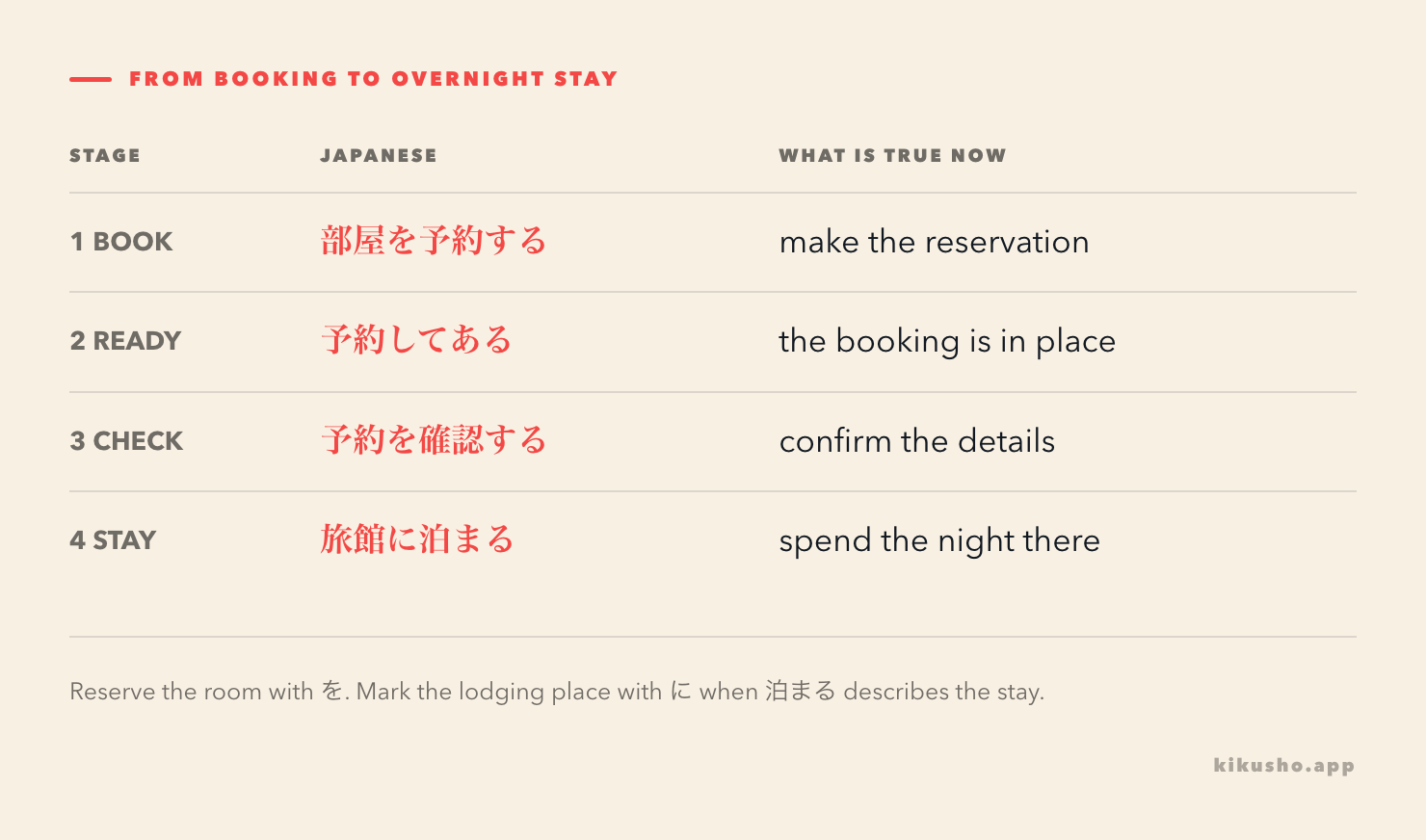
The sequence is not fixed by grammar, but it is fixed by planning. You 見物する an attraction, 予約する lodging before arrival, and 旅館に泊まる overnight. The place you stay is marked with に; the attraction and the thing reserved normally take を.
見物 focuses on the thing you go to see
見物(けんぶつ) means seeing and enjoying a notable place, performance, event or scene. It works as a noun and with する. The dictionary entry includes visiting famous places and enjoying events, along with secondary senses such as spectators and something worth seeing.
午前中は京都のお寺を見物しました。
ごぜんちゅうは きょうとの おてらを けんぶつしました。
In the morning, I visited and looked around a temple in Kyoto.
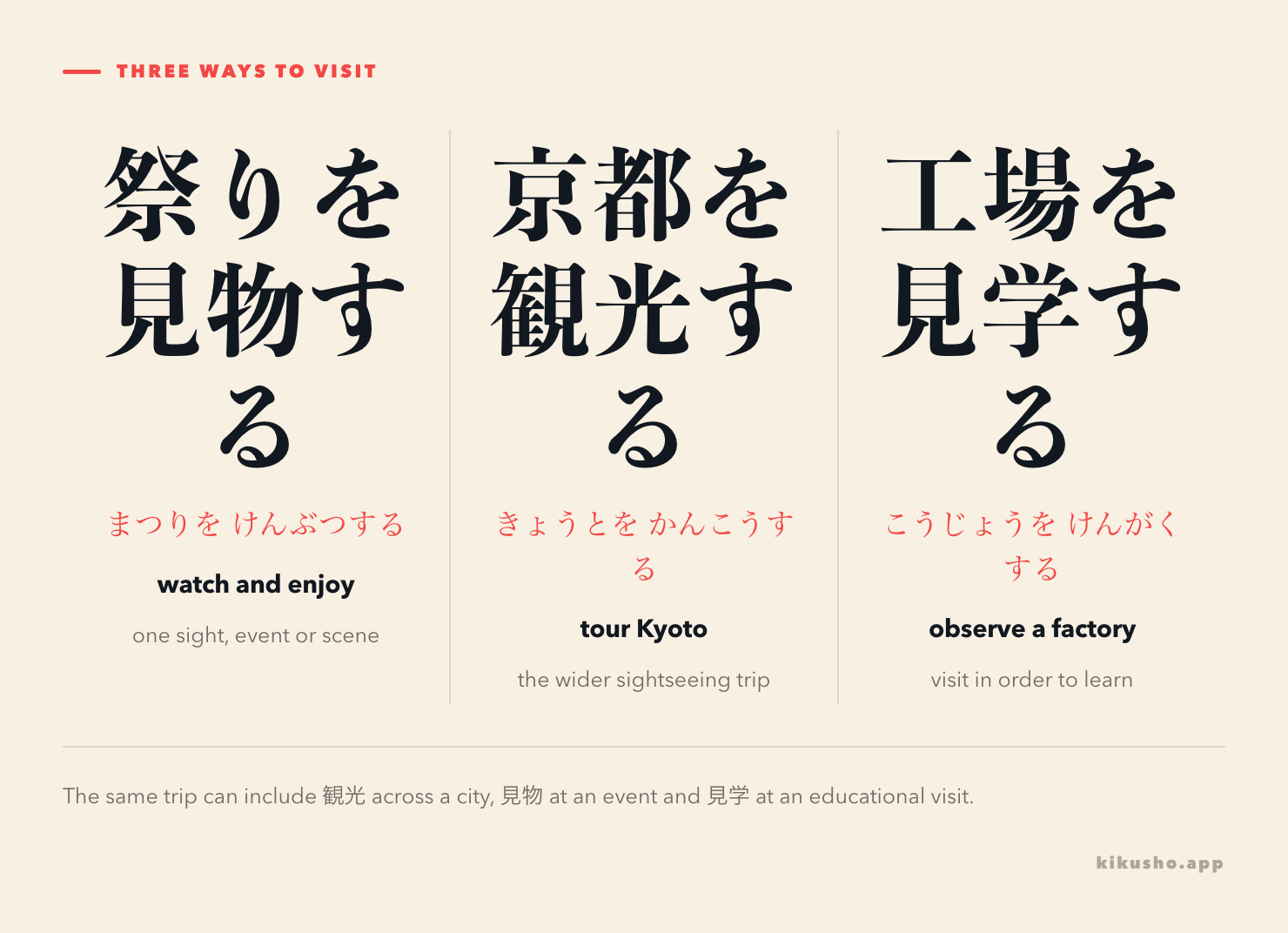
The thing viewed takes を: 城を見物する, tour a castle; 祭りを見物する, watch a festival; 工場を見物する, look around a factory as a visitor. 見物に行く instead treats the viewing as the purpose of going.
観光(かんこう) is broader. It can describe sightseeing across a city, tourism as an activity, or the tourism industry in 観光業. A visitor may 京都を観光する and, within that day, 寺や庭園を見物する. 見学 has another emphasis: observing a place or activity to learn about it, as in a school visit to a factory.
泊まる means spending the night at a place
泊まる(とまる) is an intransitive godan verb for spending the night away from home or lodging somewhere. The lodging place commonly takes に:
今夜は駅の近くの旅館に泊まります。
こんやは えきの ちかくの りょかんに とまります。
Tonight I will stay at a ryokan near the station.
The 泊まる definition gives the overnight-stay sense and also a ship remaining in port. For travel, keep ホテルに泊まる, 友達の家に泊まる and 一晩泊まる as separate useful shapes: place, host and duration.
Its godan forms are 泊まります, 泊まって, 泊まった, 泊まらない and potential 泊まれる. Do not conjugate it like an ichidan verb: 泊まて and 泊まない are not standard forms.
The sound とまる has several spellings. 電車が止まる means a train stops moving; 旅館に泊まる means a traveller stays overnight. Both are intransitive, so context and kanji decide the action. This spelling contrast matters when a listening question gives you only the sound and the sentence supplies the clue.
予約 describes an arrangement made before it is needed
予約(よやく) is an advance booking or arrangement, and 予約する is to reserve. The dictionary definition begins with making an agreement beforehand. Travel supplies several objects:
- 旅館を予約する: reserve a ryokan
- 部屋を予約する: reserve a room
- 二泊分を予約する: book two nights
- 予約を変更する: change a reservation
- 予約をキャンセルする: cancel a reservation
来月の旅行のために、二人部屋を予約しました。
らいげつの りょこうの ために、ふたりべやを よやくしました。
I reserved a room for two for next month's trip.
At reception, 予約があります means “I have a reservation.” 予約しました reports your past action. 予約してあります focuses on the useful present result: the booking has been made and is in place. Tomoshi's N4 check-in practice uses that last form in a realistic front-desk introduction.
Do not confuse 予約 with 約束(やくそく). A 予約 secures a room, seat, table, service or appointment in advance. A 約束 is a promise or personal agreement, such as meeting a friend at six. Some appointments can be described through either idea in different contexts, but a hotel booking is plainly 予約.
旅館 is a Japanese-style inn, with details that vary
旅館(りょかん) is commonly a Japanese-style inn. The dictionary entry contrasts the usual Japanese-style lodging sense with ホテル and with smaller private 民宿. The characters are transparent after you know them: 旅, journey, and 館, a building or establishment.
Tatami rooms, futon bedding, baths, yukata and meals are common associations, but they are not a checklist that every property must satisfy. The Japan National Tourism Organization's ryokan guide describes properties ranging from traditional inns to modern and urban establishments. It says meals and hot-spring baths are frequent features, while also noting that some inns offer stays without meals.
温泉のある旅館を予約して、二泊しました。
おんせんの ある りょかんを よやくして、にはくしました。
I reserved a ryokan with a hot spring and stayed for two nights.
Use ホテル when the accommodation calls itself a hotel. Use 民宿 for a smaller, often family-run guesthouse. Use 旅館 when the Japanese-style inn category is the point. The labels can coexist in a varied modern market, so the property's own name and description are better evidence than one room feature.
One two-day plan connects all four records
京都でお寺と庭園を見物するため、駅の近くの旅館を予約しました。その旅館に二泊して、朝早くから町を歩く予定です。
きょうとで おてらと ていえんを けんぶつする ため、えきの ちかくの りょかんを よやくしました。その りょかんに にはくして、あさ はやくから まちを あるく よていです。
To visit temples and gardens in Kyoto, I reserved a ryokan near the station. I plan to stay there for two nights and walk around town from early morning.
The object changes as the plan advances. The sights take を with 見物する. The lodging takes を when it is the object of 予約する, then に when it becomes the place where the traveller 泊まる. That particle change reflects a change in role, not an irregular rule.
The N4 map-and-route lesson supplies 案内 and nearby route language, while the N4 rail lesson handles the trains used to reach the inn. Together they let a learner move from reservation to arrival without turning this four-word lesson into a general phrasebook.
The exact search results included current N4 travel lists from JP YoKoSo, Japanese Journey and Japanese Compass, plus practical hotel dialogue. They confirm recurring interest and independently place these words in N4 study material. The two Kikusho baseline files descend from the same Tanos/Waller source and therefore provide one evidence family, not two independent votes. The JLPT publishes no exhaustive current vocabulary list, so N4 remains an editorial study estimate.
When you save a hotel line in Kikusho, keep the argument that makes the word usable. 旅館 alone names an inn; 旅館に泊まる records the place particle; 旅館を予約してあります records both the booking and its prepared result.
Complete the trip before opening the explanations
1 — Read the inn word. How is 旅館 read?
- ア. りょけん
- イ. りょうかん
- ウ. りょかん
- エ. たびかん
2 — Choose the overnight spelling. Which word completes the sentence?
今夜はホテルに__予定です。
- ア. 止まる
- イ. 泊まる
- ウ. 留まる
- エ. 見物する
3 — Mark the lodging place. Which particle completes the sentence?
駅の近くの旅館__泊まりました。
- ア. を
- イ. で
- ウ. に
- エ. と
4 — Choose the attraction verb. You went to a festival to watch and enjoy it. Which sentence fits?
- ア. 祭りを見物しました。
- イ. 祭りに泊まりました。
- ウ. 祭りを予約しました。
- エ. 祭りが旅館でした。
5 — Report the prepared booking. Which sentence naturally tells reception that the reservation has already been made?
- ア. 予約してあります。
- イ. 予約が泊まります。
- ウ. 見物して止まります。
- エ. 旅館が予約します。
6 — Separate 見物 from 観光. Which statement is accurate?
- ア. 見物 can focus on one sight or event; 観光 can describe the wider tour or tourism activity.
- イ. 見物 means only making a hotel booking.
- ウ. 観光 means spending one night in a ryokan.
- エ. The two words can never appear in the same trip.
7 — Put the trip in order. Which sequence is logical?
- ア. 旅館に泊まる → 部屋を予約する → 寺を見物する
- イ. 寺を予約する → 旅館を見物する → 部屋に泊まる
- ウ. 部屋を予約する → 寺を見物する → 旅館に泊まる
- エ. 旅館を止まる → 見物に予約する → 部屋が泊まる
8 — Read the whole message. What has the traveller arranged?
京都の寺を見物するため、駅前の旅館を二泊分予約してあります。
- ア. A two-night ryokan booking near the station for a temple visit in Kyoto.
- イ. A two-hour train stop before cancelling a temple tour.
- ウ. A restaurant booking inside Kyoto Station for two people.
- エ. A promise to work at a ryokan without staying there.
Answers and explanations
The route begins with one reading and ends with the complete booking message.
1. Choose ウ, りょかん. 旅館 is a Japanese-style inn. The other readings do not match the assigned word.
2. Choose イ, 泊まる. The hotel and 今夜 select the overnight-stay spelling. 止まる would describe stopping movement or activity.
3. Choose ウ, に. The lodging place takes に in 旅館に泊まる. With 予約する, the same inn can take を because it becomes the thing booked.
4. Choose ア. 祭りを見物する means watch and enjoy the festival. The other verbs assign roles that a festival cannot fill in this context.
5. Choose ア. 予約してあります says someone made the booking beforehand and its result remains ready now.
6. Choose ア. 見物 centres a particular thing worth seeing, while 観光 can cover the larger sightseeing trip or tourism activity.
7. Choose ウ. A traveller can reserve the room first, visit the temple during the trip, and stay at the ryokan. The particles and meanings in the other sequences conflict.
8. Choose ア. 寺を見物するため gives the purpose, 駅前の旅館を identifies what was booked, and 二泊分予約してあります says a two-night stay is already arranged.
Common questions
What is the difference between 見物 and 観光?
見物(けんぶつ) focuses on going to see and enjoy a particular attraction, event or scene. 観光(かんこう) is the broader activity or industry of sightseeing and tourism. A traveller can 観光する in Kyoto and お寺を見物する during that trip.
What is the difference between 泊まる and 止まる?
Both are read とまる. 泊まる means stay overnight or lodge, as in 旅館に泊まる. 止まる means stop moving or cease, as in バスが止まる. The kanji and context select the meaning.
Is a 旅館 just any hotel in Japan?
旅館(りょかん) commonly means a Japanese-style inn. Tatami rooms, futon bedding, baths and meals are frequent features, but individual properties differ. ホテル is the ordinary label for a hotel, especially a Western-style one.
How do you say you have a reservation in Japanese?
予約があります means you have a reservation. At reception, 予約してあります says the booking has already been made and remains in place. To make one, use 部屋を予約する or 旅館を予約する.