On this page
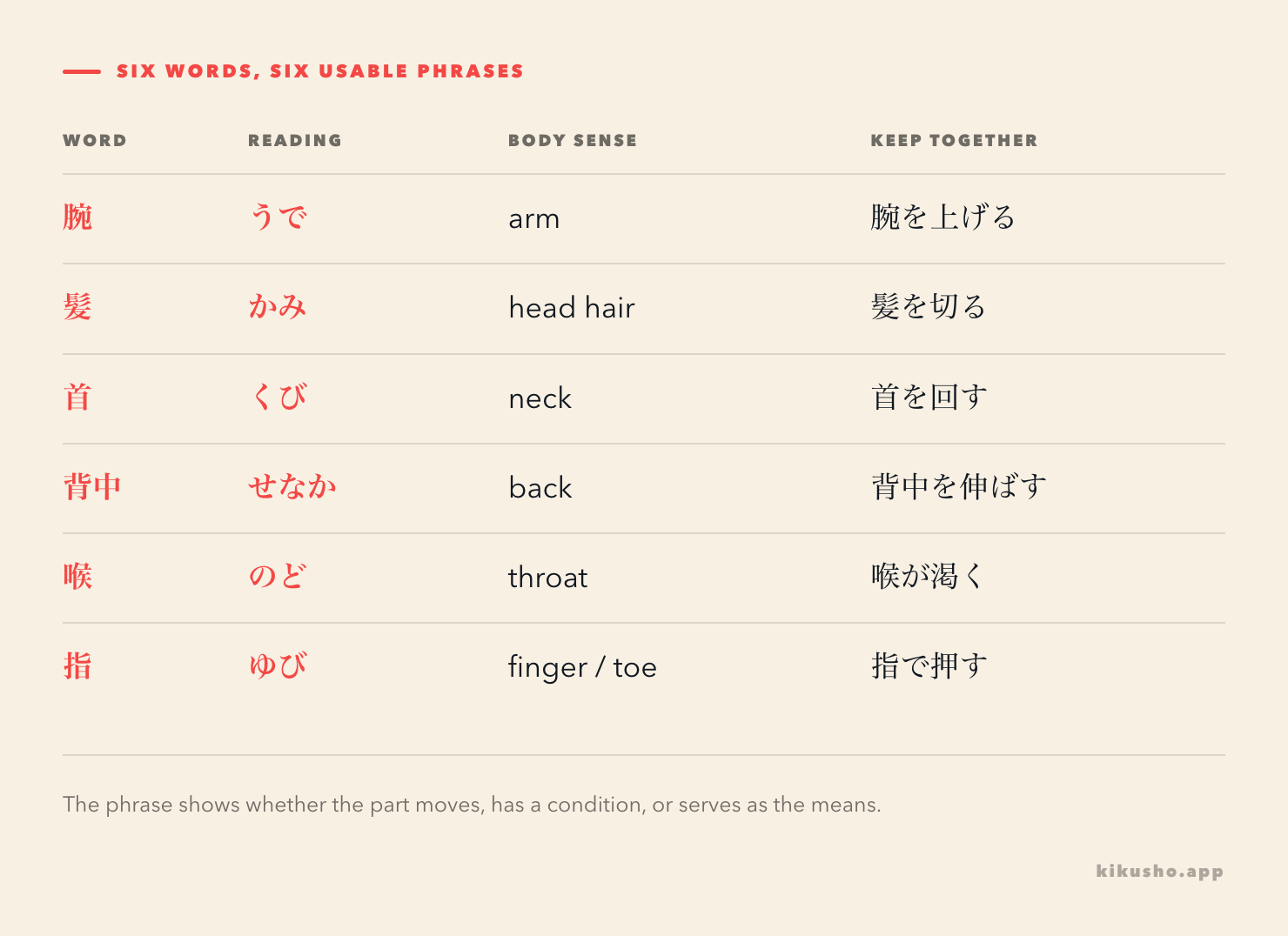
腕、髪、首、背中、喉 and 指 are read うで、かみ、くび、せなか、のど and ゆび. These six N4 body nouns become useful when you keep their boundaries and their usual partners: raise an arm, cut hair, turn your neck, stretch your back, feel thirsty in your throat and press with a finger.
Six words locate a part before they describe an action
The words belong together because a short Japanese sentence often names the body part first, then tells you its state or movement. The noun can take が when it is sore or dry, and を when someone moves it or acts on it. Learning only six English labels would hide those patterns and several important boundaries.
| Assigned word | Reading | Part of speech and body sense | Phrase to keep together |
|---|---|---|---|
| 腕 | うで, ude | noun; arm | 腕を上げる: raise an arm |
| 髪 | かみ, kami | noun; hair on the head | 髪を切る: cut one's hair |
| 首 | くび, kubi | noun; neck | 首を回す: turn or rotate the neck |
| 背中 | せなか, senaka | noun; back of the torso | 背中を伸ばす: stretch or straighten the back |
| 喉 | のど, nodo | noun; throat | 喉が渇く: feel thirsty |
| 指 | ゆび, yubi | noun; finger or toe | 指で押す: press with a finger |
The Japan Foundation's Irodori body-word list independently gives 腕, 背中 and 指 with these readings and identifies 指 as “finger / toe.” A Japanese health-care training sheet from the Ministry of Health, Labour and Welfare labels 首, 喉, 腕, 指 and 背中 on front and side views of the body. Those sources verify the body meanings; the six-item N4 grouping comes from Kikusho's dated study inventory.
腕 and 指 connect the body to an action
腕(うで) is the arm. In a movement instruction, it can be the object marked by を:
両腕をゆっくり上げてください。
りょううでをゆっくりあげてください。
Please raise both arms slowly.
両腕(りょううで) means both arms. You can also say 右の腕 or 左の腕 when the side matters. Kotobank's 腕 entry records both the physical arm and the extended sense of ability or skill. That is why 腕がいい料理人 means a skilled cook; it does not describe the cook's anatomy. In the example above, 上げる and 両 make the physical reading unmistakable.
指(ゆび) needs a little more context than English “finger.” The word can refer to a digit of the hand or foot. Specify 手の指 for a finger and 足の指 for a toe when the scene does not decide for you. Shogakukan's bilingual entry makes that two-way scope explicit.
このボタンを指で押してください。
このボタンをゆびでおしてください。
Please press this button with your finger.
Here で marks the means used to press. A button and the hand action make “finger” the natural English translation. Compare 指を切りました, “I cut my finger,” where 指 is the body part affected and takes を. If the injury were on a toe, 足の指を切りました would remove the ambiguity.
髪 names head hair, while 毛 is the wider category
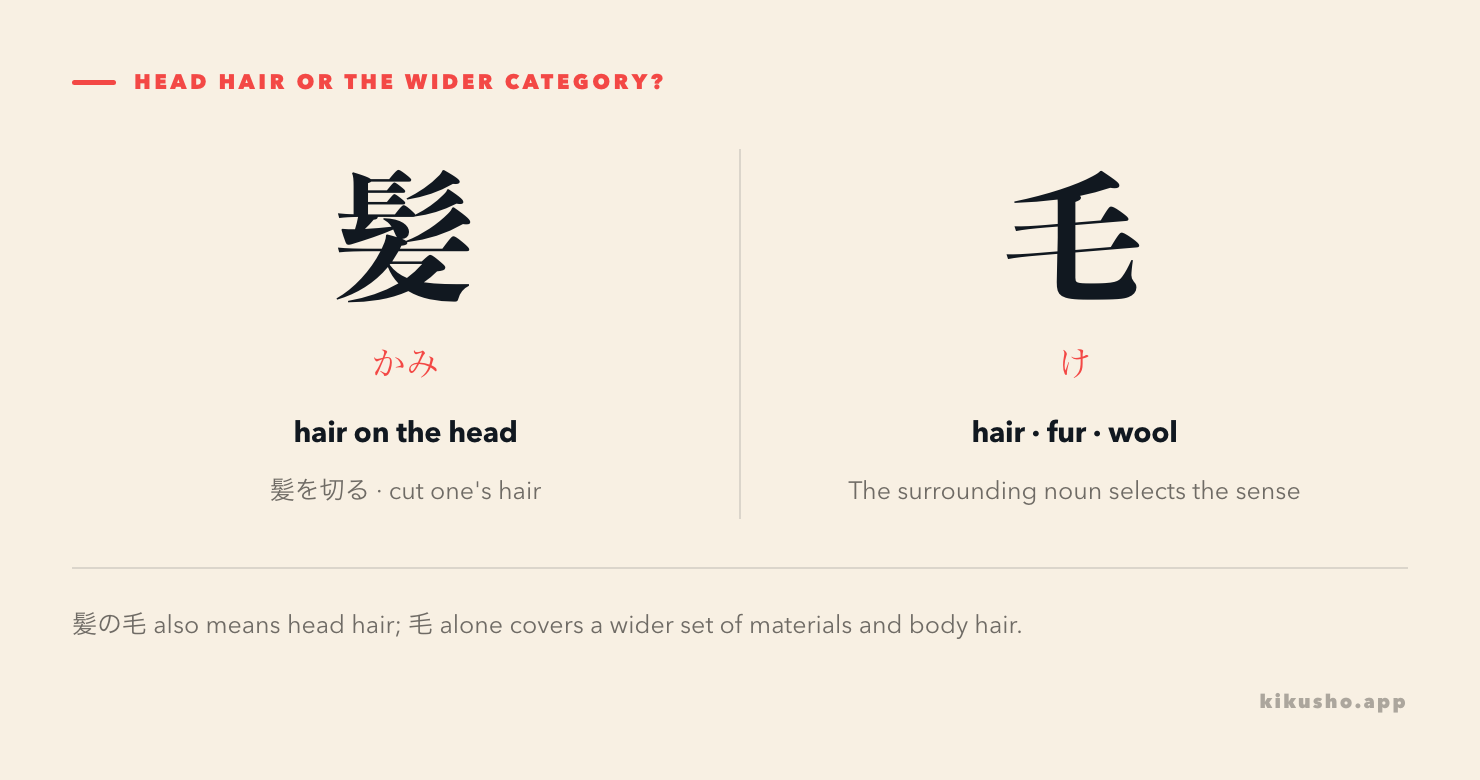
髪(かみ) means the hair on a person's head. It can be long or short, and it can be the object of cutting, washing, drying or tying:
- 髪が長い: have long hair
- 髪を切る: cut one's hair
- 髪を洗う: wash one's hair
- 髪を結ぶ: tie one's hair
暑かったので、髪を短く切りました。
あつかったので、かみをみじかくきりました。
Because it was hot, I had my hair cut short.
The subject can be the person whose hair changed even when a hairdresser did the cutting. The sentence reports the result from that person's point of view; it does not require the speaker to have held the scissors.
髪の毛(かみのけ) also means hair on the head. The final 毛(け) has a wider range by itself: human body hair, animal fur and wool can all be 毛. The N4 clothes and fabrics lesson shows those context-dependent 毛 senses. Use 髪 or 髪の毛 when the head-hair meaning matters.
首, 喉 and 背中 mark different regions
首(くび) is the neck, the outer region joining the head and torso. 喉(のど) is the throat, the internal passage and the area you describe when swallowing, speaking or feeling thirsty. The health ministry diagram above labels both separately, so translating both as a vague area below the head loses a useful distinction.
右を見て、首をゆっくり回しました。
みぎをみて、くびをゆっくりまわしました。
I looked right and slowly turned my neck.
たくさん歩いたので、喉が渇きました。
たくさんあるいたので、のどがかわきました。
I walked a lot, so I became thirsty.
The fixed everyday phrase is 喉が渇く. Literally it presents the throat as becoming dry, while natural English usually says “become thirsty.” Digital Daijisen's entry for 喉が渇く confirms that meaning. For soreness, use 喉が痛い. Everyday notices and messages often write the word in hiragana as のど, but the assigned kanji reading remains のど.
背中(せなか) is the back of the torso. It is not automatically the same region as 腰(こし), the waist or lower back. The side-view labels in the ministry sheet place 背中 above 腰.
長く座っていたので、背中を伸ばしました。
ながくすわっていたので、せなかをのばしました。
I had been sitting for a long time, so I stretched my back.
For a pain report, 背中が痛い identifies the back as the sore part. Use 腰が痛い when the pain is specifically around the waist or lower back. The words can refer to neighbouring areas, but they do not collapse into one label.
The same noun changes particles with the predicate
The body noun does not choose one permanent particle. Its role in the sentence does:
| What the sentence does | Pattern | Example |
|---|---|---|
| describes a condition | body part + が + predicate | 喉が渇きました |
| moves or acts on a part | body part + を + verb | 首を回しました |
| uses a part as the means | body part + で + verb | 指で押しました |
The earlier N5 body and pain lesson introduces 頭が痛い and other short symptom phrases. This N4 set adds finer body regions and more kinds of action. The nouns remain concrete, but a stored phrase tells you whether the sentence describes the part, moves it or uses it.
A connected scene can carry all six without turning into a list:
長く机に向かっていたので、首と背中が痛くなりました。腕を上げて伸びをし、指をゆっくり動かしました。髪が顔にかかったので結び、水を飲んで乾いた喉を潤しました。
ながくつくえにむかっていたので、くびとせなかがいたくなりました。うでをあげてのびをし、ゆびをゆっくりうごかしました。かみがかおにかかったのでむすび、みずをのんでかわいたのどをうるおしました。
After sitting at my desk for a long time, my neck and back began to hurt. I raised my arms, stretched, and slowly moved my fingers. My hair fell over my face, so I tied it back, then drank water to moisten my dry throat.
Each noun keeps the role created by its predicate. 首 and 背中 take が with 痛くなる; 腕 and 指 take を with movement verbs; 髪 takes が as the thing that falls across the face; 喉 is the object of 潤す. You do not need that whole paragraph on one card. One sentence that preserves the useful pairing is enough.
N4 is a study placement, not an official word list
All six entries have N4 placements in Kikusho's September 2026 reference inventory, with no recorded level disagreement. Its two baseline files descend from the same Waller/Tanos material, so their agreement is one source family rather than two independent votes. The current Amiko N4 health and body list independently includes all six with these readings and body meanings, while the Japan Foundation and health ministry sources above verify their practical use.
The official JLPT FAQ explains that the organisers no longer publish an exhaustive vocabulary specification. Treat N4 as a useful study location, then learn the reading, sense and phrase that make each word usable.
Eight questions before the answer block
This set moves from recognition to sentence use. Record all eight choices before revealing the explanations.
Question 1 — retrieve the whole-word sound. In the pain report 背中が痛いです, choose the reading of 背中.
ア. はいちゅう
イ. せなか
ウ. せちゅう
エ. はいなか
Question 2 — recover the kanji. The prompt gives のど, “throat.” Which written word matches it?
ア. 首
イ. 腕
ウ. 喉
エ. 指
Question 3 — context. Complete the movement instruction: 両( )をゆっくり上げてください。
ア. 髪
イ. 喉
ウ. 背中
エ. 腕
Question 4 — meaning in context. What does 喉が渇きました report?
ア. I became thirsty.
イ. I cut my hair.
ウ. I turned my neck.
エ. I hurt my finger.
Question 5 — boundary. Which phrase specifically means “a toe”?
ア. 手の指
イ. 足の指
ウ. 指の手
エ. 腕の指
Question 6 — usage. Choose the natural sentence for “Please press this button with your finger.”
ア. このボタンが指を押してください。
イ. このボタンを指が押してください。
ウ. このボタンを指で押してください。
エ. このボタンで指を押してください。
Question 7 — word scope. In which sentence does 髪 have its taught meaning?
ア. 猫の髪がソファーにつきました。
イ. 髪を短く切りました。
ウ. 毛の髪でセーターを作りました。
エ. 足の髪が痛いです。
Question 8 — body region. A person points to the rear of the torso above the waist and says it hurts. Which sentence best matches that location?
ア. 首が痛いです。
イ. 喉が痛いです。
ウ. 背中が痛いです。
エ. 指が痛いです。
Answers and explanations
Answer 1. イ, せなか. 背中 is the back of the torso. The distractors try to assemble character readings, but the assigned word must be recalled as the whole reading せなか.
Answer 2. ウ, 喉. 喉 is read のど. 首 is くび, 腕 is うで and 指 is ゆび. The neck and throat are neighbouring regions, but their spellings and readings remain distinct.
Answer 3. エ, 腕. 両腕を上げる means to raise both arms. 両 supplies “both,” 腕 names the arms and を marks them as the object of 上げる. The other nouns do not fit this ordinary movement instruction.
Answer 4. ア. 喉が渇く is the Japanese phrase used for becoming thirsty. A literal image of the throat becoming dry supports the phrase, but the natural report in English is thirst. The other choices describe unrelated body actions.
Answer 5. イ, 足の指. 指 can cover a digit of the hand or foot, and 足 specifies the foot, giving “toe.” 手の指 specifies a finger. The other two sequences do not name an ordinary body part.
Answer 6. ウ. このボタンを marks the button being pressed, while 指で marks the finger as the means. A and B misassign the grammatical roles. D says to press the finger using the button, reversing the intended action.
Answer 7. イ. 髪を短く切りました uses 髪 for hair on the head. Animal fur is 猫の毛, wool is a sense of 毛 in the right clothing context, and hair is not the ordinary name for a painful part of the foot.
Answer 8. ウ, 背中が痛いです. 背中 identifies the back of the torso. 首 is the neck, 喉 the throat and 指 a finger or toe. If the speaker pointed lower around the waist, 腰 could be the more precise word, but that is not the location described here.
Review the set in both directions. From the kanji, retrieve the reading and one phrase; from a scene, choose the body region and particle. That second route prevents six accurate translations from becoming six nouns you still cannot place in a sentence.
Common questions
Does 指 mean a finger or a toe?
指(ゆび)can mean a finger or a toe. Use 手の指 when you need to specify a finger and 足の指 for a toe. In a sentence about pressing a button, the hand action usually makes “finger” clear without that extra phrase.
What is the difference between 髪 and 毛?
髪(かみ)means the hair on a person's head. 毛(け)is broader and can mean human body hair, animal fur or wool. 髪の毛 also means hair on the head.
What is the difference between 背中 and 腰?
背中(せなか)is the back of the torso. 腰(こし)is the waist or lower-back area. A speaker may use either in a pain report depending on the actual site, so the two words are not interchangeable labels for every back pain.
Can 腕 mean skill as well as arm?
Yes. 腕(うで)names the arm in a physical sentence such as 腕を上げる. It can also mean skill or ability in expressions such as 腕がいい. This lesson practises the body sense while flagging the extension.