On this page
銀行, 公園, 交差点, 交番, 大使館, 橋, 町, 村 and 郵便局 are nine N5 words that let you describe a route through a Japanese town. Learn each reading with one action or location phrase, and the list becomes a usable map rather than nine isolated labels.
The nine words on the map
| Japanese | Reading | Word class and core sense | Phrase to remember |
|---|---|---|---|
| 銀行 | ぎんこう | noun: bank | 銀行でお金を下ろす, withdraw money at a bank |
| 公園 | こうえん | noun: park | 公園を散歩する, walk in a park |
| 交差点 | こうさてん | noun: intersection | 交差点を右に曲がる, turn right at the intersection |
| 交番 | こうばん | noun: police box; local police post | 交番で道を聞く, ask the way at a police box |
| 大使館 | たいしかん | noun: embassy | 大使館に行く, go to an embassy |
| 橋 | はし | noun: bridge | 橋を渡る, cross a bridge |
| 町 | まち | noun: town; built-up area | 静かな町, a quiet town |
| 村 | むら | noun: village | 小さい村, a small village |
| 郵便局 | ゆうびんきょく | noun: post office | 郵便局で手紙を出す, mail a letter at a post office |
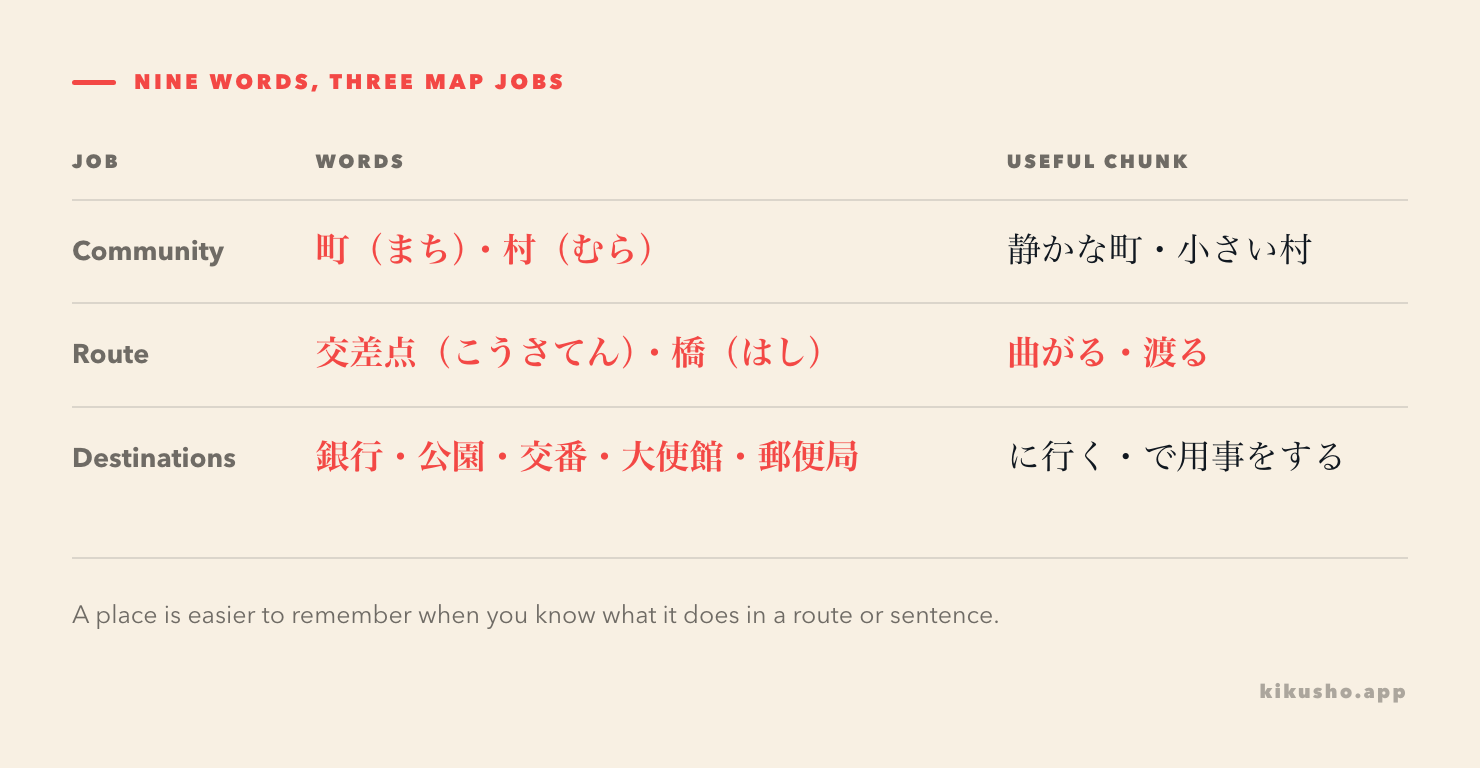
These are all place nouns, but they do different work in a sentence. A 町 or 村 names the wider community. A 橋 and 交差点 shape a route. The other five are destinations where you can do something.
The Japan Foundation's Irodori town lesson uses 銀行 and 公園 in beginner directions, including 銀行はどこですか and 公園の近くです. An independently written N5 place-word reference from Shigure no Machi gives the same readings for the full nine-word set. These sources support the language; the N5 label remains an editorial study placement because the exam maker publishes no complete official word list.
Start with the community: 町 and 村
町(まち) is a town, or the area of streets, homes and shops that you experience as a town:
この町には大きい公園があります。
この まちには おおきい こうえんが あります。
There is a large park in this town.
村(むら) is a village, usually a smaller community in a rural setting:
祖父は山の近くの村に住んでいます。
そふは やまの ちかくの むらに すんでいます。
My grandfather lives in a village near the mountains.
The contrast is useful for ordinary description, but do not use population alone as a perfect rule. 町 and 村 also occur in official municipality names, where their status follows Japanese administration. At N5, the practical pair is 町, town, and 村, village.
Follow the route: 交差点 and 橋
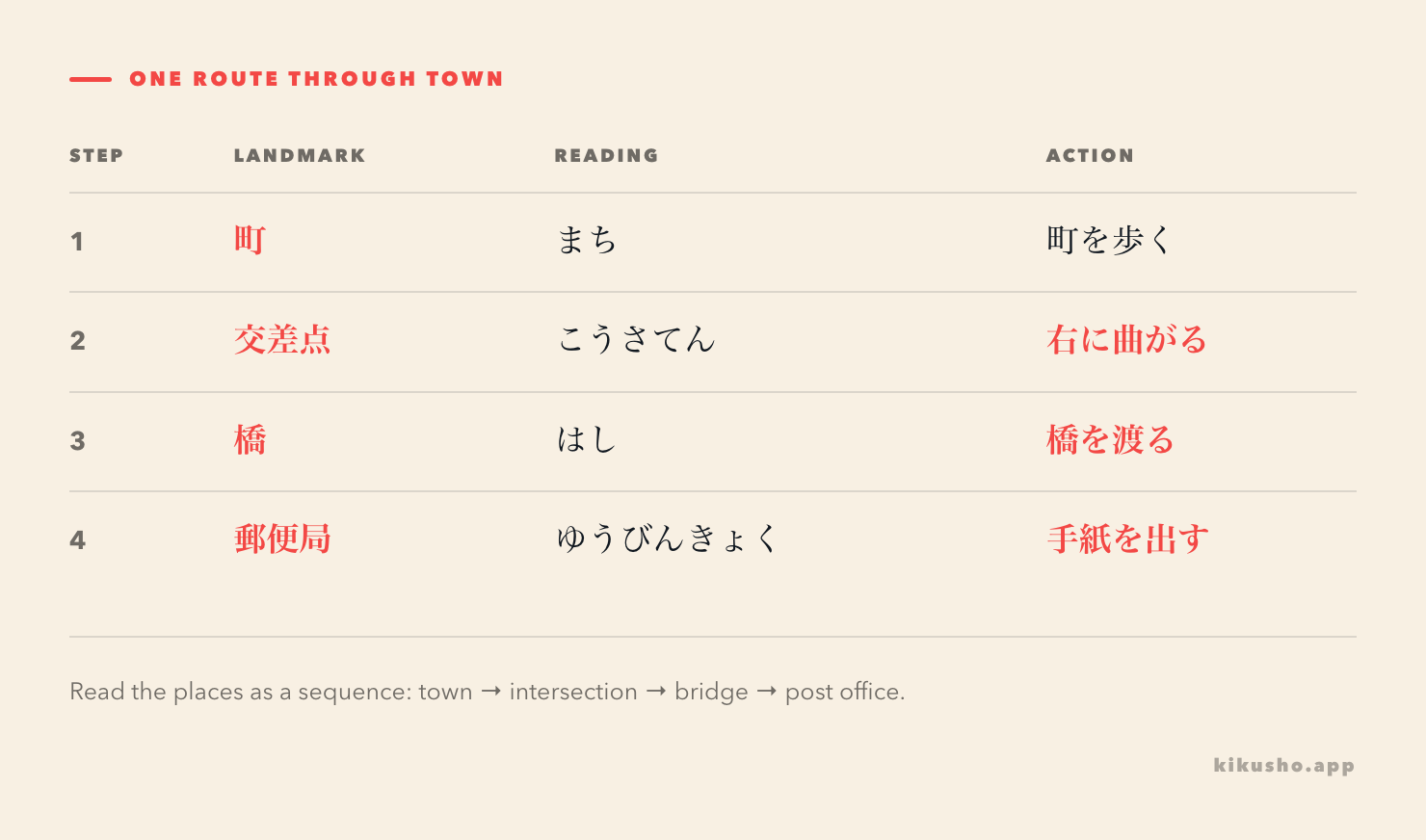
交差点(こうさてん) is an intersection, where roads cross. It frequently appears with a turning instruction:
次の交差点を左に曲がってください。
つぎの こうさてんを ひだりに まがって ください。
Please turn left at the next intersection.
The particle を marks the point along the route where you turn. It is the same route-marking use found in 道を歩く, “walk along a road.”
橋(はし) means bridge. The useful route phrase is 橋を渡る(はしをわたる), “cross a bridge”:
橋を渡って、まっすぐ行きます。
はしを わたって、まっすぐ いきます。
Cross the bridge and go straight.
In kana, はし can also represent 箸, chopsticks. Pitch accent can distinguish the words in many varieties of Japanese, but context already does most of the work for a beginner: 橋を渡る means cross a bridge, while 箸で食べる means eat with chopsticks.
Three everyday stops: 銀行, 公園 and 郵便局
銀行(ぎんこう) is a bank. Use 銀行に行く for the destination and 銀行でお金を下ろす for an action performed there:
午前、銀行でお金を下ろしました。
ごぜん、ぎんこうで おかねを おろしました。
I withdrew money at the bank in the morning.
公園(こうえん) is a park. Activities such as walking, playing and eating happen there with で, while a route through the park can take を:
- 公園で昼ご飯を食べる: eat lunch in the park
- 公園を散歩する: walk through or around the park
- 公園の近く: near the park
郵便局(ゆうびんきょく) is a post office. It contains 郵便, mail, and 局, an office or bureau in this compound. Japan Post's official location finder consistently labels post-office locations 郵便局 alongside ATMs and postboxes.
郵便局でこの手紙を出します。
ゆうびんきょくで この てがみを だします。
I will mail this letter at the post office.
Notice the long vowels in ぎんこう, こうえん and ゆうびんきょく. Do not shorten こう to こ when reading them aloud.
Two places for help: 交番 and 大使館
交番(こうばん) is a neighbourhood police box or small local police post. It is not simply another name for a large police station. The Tokyo Metropolitan Police uses 交番 in official names and describes locations such as 数寄屋橋交番 beside a park and intersection.
交番で駅までの道を聞きました。
こうばんで えきまでの みちを ききました。
I asked for the way to the station at a police box.
大使館(たいしかん) is an embassy. The country name normally comes before it:
- 日本大使館: the Japanese embassy
- フランス大使館: the French embassy
- 大使館に行く: go to the embassy
An embassy and a police box can both be places to seek help, but their roles are different. 交番 is local policing and neighbourhood assistance. 大使館 represents a country abroad and handles consular or diplomatic matters.
One walk uses all nine words
Read this short route once for the general meaning, then again for the place words:
私の町は大きくありません。駅の前の交差点を右に曲がると、銀行と交番があります。公園の先の橋を渡ると、郵便局があります。大使館はそこから少し遠いです。祖母の村には銀行も大使館もありません。
わたしの まちは おおきく ありません。えきの まえの こうさてんを みぎに まがると、ぎんこうと こうばんが あります。こうえんの さきの はしを わたると、ゆうびんきょくが あります。たいしかんは そこから すこし とおいです。そぼの むらには ぎんこうも たいしかんも ありません。
My town is not large. If you turn right at the intersection in front of the station, there is a bank and a police box. Cross the bridge beyond the park and there is a post office. The embassy is a little far from there. My grandmother's village has neither a bank nor an embassy.
This passage gives each noun a job. The intersection tells you where to turn, the bridge tells you what to cross, and the buildings become landmarks or destinations. For a fuller treatment of 前, 近く, 右 and 左, continue with the N5 location and direction words lesson.
When you save a real sign or map in Kikusho, keep the full phrase that made the word useful. 郵便局 alone tests a label; 郵便局で手紙を出す also preserves the action and particle. If に and で still compete in your sentences, the guide to location particles separates destinations, existence and action sites.
Why this set sits at N5
All nine map labels sit in the N5 section of Kikusho's September 2026 reference inventory. Its two broad vocabulary snapshots come from the same Tanos/Waller source family, so they count as one placement tradition rather than two independent votes. A separate N5 place list includes the same words, and no source disagreement is recorded for this set.
The JLPT does not release an exhaustive current vocabulary syllabus. N5 therefore describes a practical point at which to study these common town words, not an official promise that every word will appear on a test.
Practice: finish all six questions before opening the answers
1 · Find the post office reading
Which reading matches 郵便局?
A. ゆうびんきょく
B. ゆびんきょうく
C. ゆうべんきょく
D. ゆうびんきょくう
2 · Turn at the right landmark
You want to say “turn right at the intersection.” Which sentence fits?
A. 交番を右に曲がります。
B. 交差点を右に曲がります。
C. 公園を右に聞きます。
D. 橋で右を渡ります。
3 · Ask the local police
Which place is a neighbourhood police box?
A. 銀行
B. 大使館
C. 交番
D. 郵便局
4 · Cross one feature
Complete the sentence: __を渡って、まっすぐ行ってください。
A. 村
B. 銀行
C. 橋
D. 大使館
5 · Mail the letter
Which sentence means “I mailed a letter at the post office”?
A. 郵便局に手紙がありました。
B. 郵便局で手紙を出しました。
C. 郵便局を手紙にしました。
D. 郵便局から手紙を聞きました。
6 · Read the route
Read: 公園の先の橋を渡ると、銀行があります。 Which description is correct?
A. The bank is before the park, beside an intersection.
B. Cross the bridge beyond the park and you will find a bank.
C. Ask at the police box for a bridge inside the bank.
D. The village and the park are across from an embassy.
Answers and explanations
1 · The post office: A, ゆうびんきょく. 郵便 is ゆうびん and 局 is きょく in this compound. Keep the long ゆう at the beginning.
2 · The turning point: B, 交差点を右に曲がります. 交差点 is the intersection where the turn happens. 交番 is a police box, and the other choices combine the wrong action with the place.
3 · The police box: C, 交番. A 交番 is a small local police post. 銀行 is a bank, 大使館 is an embassy and 郵便局 is a post office.
4 · The crossing: C, 橋. 橋を渡る means cross a bridge. The verb 渡る naturally supplies the clue even when the English noun is hidden.
5 · The post-office action: B. で marks the post office as the place of the action, and 手紙を出す means mail or send a letter. The other sentences do not express that event.
6 · The complete route: B. 公園の先 places the bridge beyond the park. 橋を渡ると says that after crossing it, there is a bank.
Keep the route chunks together: 交差点を曲がる, 橋を渡る, 交番で道を聞く and 郵便局で手紙を出す. The action makes the place word easier to retrieve and gives its particle somewhere to attach.
Common questions
What nine N5 town words does this lesson teach?
The nine assigned words are 銀行(ぎんこう), 公園(こうえん), 交差点(こうさてん), 交番(こうばん), 大使館(たいしかん), 橋(はし), 町(まち), 村(むら) and 郵便局(ゆうびんきょく).
What is the difference between 町 and 村?
町(まち)usually refers to a town or the built-up area where people live and shop. 村(むら)is a village, usually a smaller rural community. Their exact administrative meanings depend on a place name and local government.
What is a 交番 in Japan?
A 交番(こうばん)is a neighbourhood police box or small local police post. It is a useful place to ask for directions or report a lost item.
How do you say post office and embassy in Japanese?
Post office is 郵便局(ゆうびんきょく)and embassy is 大使館(たいしかん). Use 郵便局で for an action at the post office and 大使館に for movement to an embassy.
Are these words officially N5 vocabulary?
The JLPT does not publish an exhaustive official vocabulary list. Kikusho's dated reference inventory places these nine spelling-reading records at N5, and the sources consulted show no level disagreement for this set.