On this page
Five N4 Japanese preparation and organisation words cover three moments: getting ready with 準備・用意・支度, clearing what remains with 片付ける, and replacing what no longer works with 取り替える. The three preparation nouns overlap, but each one puts a different part of the work in focus.
Five words take a task from readiness to completion
| Word | Reading | Word class | Core meaning | Phrase to remember |
|---|---|---|---|---|
| 片付ける | かたづける, katazukeru | transitive ichidan verb | tidy; put away; finish or deal with | 部屋を片付ける: tidy the room |
| 支度 | したく, shitaku | noun; suru verb | concrete preparation; getting ready | 出かける支度をする: get ready to go out |
| 準備 | じゅんび, junbi | noun; suru verb | broad preparation; readiness | 発表の準備をする: prepare for a presentation |
| 取り替える | とりかえる, torikaeru | transitive ichidan verb | exchange; replace | 電池を取り替える: replace a battery |
| 用意 | ようい, yōi | noun; suru verb | make something ready; provide | 資料を用意する: prepare the materials |
Kikusho's September 2026 inventory places all five spelling-and-reading records at N4 without a level disagreement. Its two baseline files inherit the same Waller/Tanos list, while Japanesetest4you supplies a separately published headword comparison. A current N4 vocabulary guide also includes 準備 and 片付ける. The JLPT does not publish an exhaustive current word list, so the level is a study guide rather than a guarantee about one exam.
準備 covers the process, 用意 supplies what is needed, and 支度 gets daily life ready
Use 準備(じゅんび) as the widest of the three. It can include collecting materials, planning, practising and arranging people or space. It also works with things that are not physical.
- 旅行の準備をする: prepare for a trip
- 試験の準備をする: prepare for an exam
- 心の準備をする: prepare mentally
- 準備ができる: be ready; have the preparations completed
来週の発表の準備を始めました。
らいしゅうの はっぴょうの じゅんびを はじめました。
I started preparing for next week's presentation.
Use 用意(ようい) when the sentence brings necessary things or conditions into a ready-to-use state. The object often names what another person will receive or use.
- 資料を用意する: prepare the materials
- 席を用意する: arrange a seat
- お茶を用意する: get tea ready
- 必要な物を用意する: prepare the necessary items
お客さんのために、いすを六つ用意しました。
おきゃくさんの ために、いすを むっつ よういしました。
We prepared six chairs for the guests.
Use 支度(したく) for concrete acts of getting oneself or daily life ready. Clothes, meals, departure and bedtime are its most familiar territory.
- 出かける支度をする: get ready to go out
- 朝の支度をする: get ready in the morning
- 食事の支度をする: prepare a meal
- 寝る支度をする: get ready for bed
子どもたちは学校へ行く支度をしています。
こどもたちは がっこうへ いく したくを しています。
The children are getting ready to go to school.
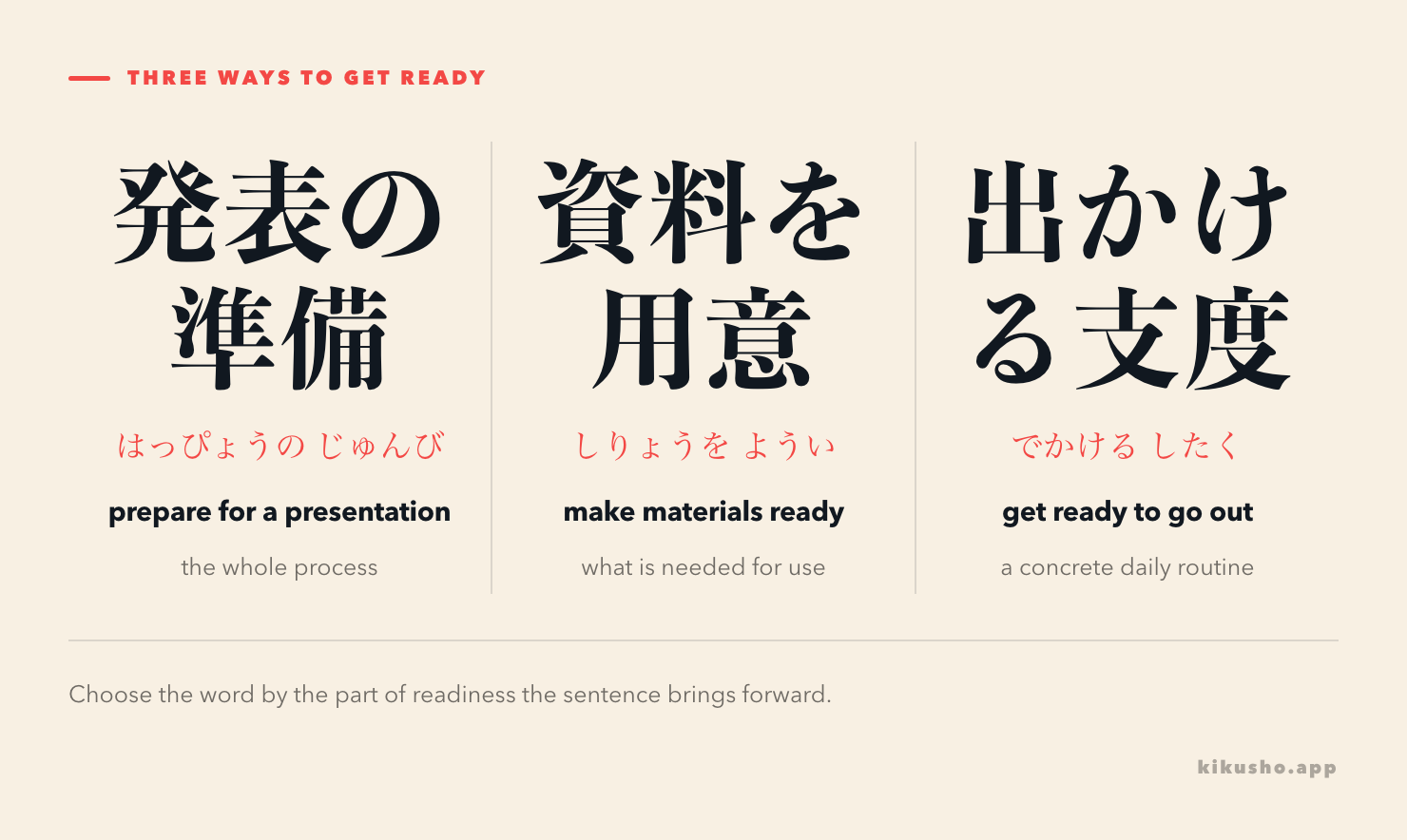
The dictionary usage note for 準備 confirms both the overlap and the tendency. 大会の準備 can include running the whole organisation; 用意 emphasises arranging what will be needed; 支度 names concrete action such as getting a meal ready. These are tendencies, not walls. 食事の準備, 食事の用意 and 食事の支度 can all be natural because a meal has a process, necessary items and hands-on work.
The object tells you whether 片付ける means tidy or finish
片付ける(かたづける) first gives scattered objects a proper place. The object may be the place being made tidy or the things being put away.
- 部屋を片付ける: tidy the room
- 机の上を片付ける: clear the desk
- おもちゃを片付ける: put the toys away
- 食事の後を片付ける: clear up after the meal
遊んだ後で、おもちゃを箱に片付けてください。
あそんだ あとで、おもちゃを はこに かたづけて ください。
After playing, please put the toys away in the box.
The same verb can present a task or problem as something cleared from the list.
- 宿題を片付ける: finish the homework
- 仕事を片付ける: get the work done
- 問題を片付ける: deal with a problem
昼休みの前に、この仕事を片付けましょう。
ひるやすみの まえに、この しごとを かたづけましょう。
Let's finish this work before the lunch break.
The dictionary entry records both “put things neatly in place” and “finish or handle a task.” At N4, the room, toy, homework and work patterns are the useful core. Other dictionary senses are strongly context-dependent and do not belong in an everyday model sentence.
取り替える requires an old place and a new occupant
取り替える(とりかえる) removes one item and puts another in its role. A simple object with を is enough when the replacement is obvious.
- 電池を取り替える: replace a battery
- 電球を取り替える: replace a light bulb
- シーツを取り替える: change the sheets
- 不良品を取り替える: exchange a defective product
時計が止まったので、電池を取り替えました。
とけいが とまったので、でんちを とりかえました。
The clock stopped, so I replaced the battery.
When both things matter, mark the old item with を and the new one with と.
古い電池を新しいものと取り替えました。
ふるい でんちを あたらしい ものと とりかえました。
I replaced the old battery with a new one.
The same pattern handles an exchange at a shop: 小さかったので、大きいのと取り替えてください, “It was too small, so please exchange it for a larger one.” The dictionary examples use 取り替える for currencies, defective goods, light bulbs and printer cartridges.
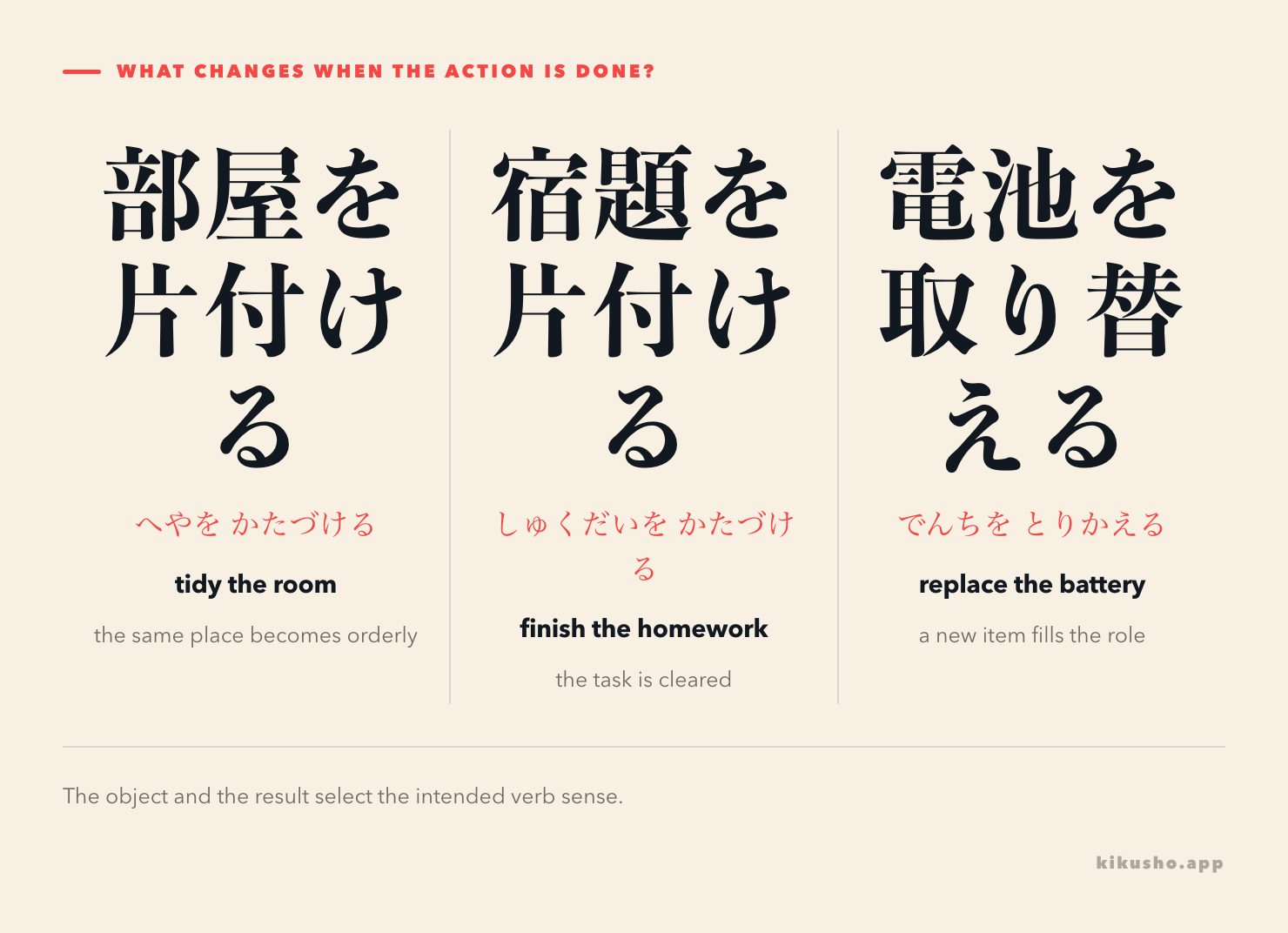
The difference is visible in the result. After 机を片付ける, the same desk is orderly. After 電池を取り替える, a different battery occupies the same place.
One meeting uses all five words in their natural roles
明日の説明会の準備をしています。資料といすはもう用意しました。机の上を片付け、時計の古い電池も新しいものと取り替えました。あとは服を着替えて、出かける支度をするだけです。
あしたの せつめいかいの じゅんびを しています。しりょうと いすは もう よういしました。つくえの うえを かたづけ、とけいの ふるい でんちも あたらしい ものと とりかえました。あとは ふくを きがえて、でかける したくを するだけです。
I am preparing for tomorrow's information session. The materials and chairs are already ready. I cleared the desk and replaced the clock's old battery with a new one. All that remains is to change clothes and get ready to leave.
The meeting is the whole 準備 project. Materials and chairs are 用意 because they must be available for use. The desk is 片付ける because its contents need order; the battery is 取り替える because a new object takes the old one's place. Personal departure is 支度.
The related ~ておく lesson adds the grammar for doing these actions in advance: 資料を用意しておく, 部屋を片付けておく and 電池を取り替えておく. If you save the meeting paragraph in Kikusho, keep the object with each verb. The noun alone will not remind you whether Japanese sees a whole process, an available item or a daily routine.
Practice all five words before opening the answers
1 · Kanji reading. How is 片付ける read?
- かたつける
- かたづける
- かたづえる
- へんづける
2 · Orthography. Choose the kanji for じゅんび.
- 準備
- 順美
- 準美
- 純備
3 · Kanji reading. How is 支度 read?
- しど
- したび
- したく
- しどく
4 · Whole process. A school is planning a festival, assigning roles and practising performances. Which noun fits the whole project best?
- 支度
- 準備
- 用意
- 片付け
5 · Ready for use. Complete the sentence.
会議の前に、全員の資料を( )しました。
- 用意
- 支度
- 片付け
- 取り替え
6 · Daily routine. Which phrase most naturally means “get ready for bed”?
- 寝る支度をする
- 寝る電池を取り替える
- 寝る机を片付ける
- 寝る資料を用意する
7 · Tidy or finish. What does 宿題を片付けた mean here?
- I exchanged the homework.
- I prepared a seat for the homework.
- I finished the homework.
- I got dressed for the homework.
8 · Replacement. The printer no longer works because its cartridge is empty. Which action fits?
- カートリッジを支度する
- カートリッジを取り替える
- カートリッジを片付け終わる
- カートリッジを準備になる
9 · Old and new. Choose the natural sentence.
- 古い電池が新しいものを取り替えました。
- 古い電池を新しいものと取り替えました。
- 古い電池に新しいものが取り替えました。
- 古い電池で新しいものを取り替えました。
10 · Paraphrase. Which description is closest to 資料を用意しました?
- The materials were made ready for use.
- The materials were thrown away.
- The materials replaced the meeting.
- The materials got dressed to leave.
11 · Meaning in context. Choose the best word.
お客さんが帰ったので、テーブルの上を( )。
- 取り替えました
- 支度しました
- 片付けました
- 準備になりました
12 · Usage. Only one version has a natural word combination. Choose it.
- 明日の試験に向けて心の準備をしています。
- 明日の試験の心を取り替えています。
- 明日の試験の心を片付けています。
- 明日の試験の支度が電池です。
Answers and explanations
- かたづける. The middle sound is づ, even though modern pronunciation is close to ず.
- 準備. 準 is read じゅん and 備 is read び in this compound.
- したく. 支度 means concrete preparation or getting ready.
- 準備. Planning, roles and rehearsal belong to the entire preparation process. 用意 would focus more narrowly on making needed things or conditions ready.
- 用意. 資料を用意する means to make the materials ready for the people who will use them. 支度 is not the normal choice for office documents.
- 寝る支度をする. Bedtime is a concrete daily routine, a central use of 支度.
- I finished the homework. A task as the object selects the finish-or-deal-with sense of 片付ける. A room or toys would select the tidying sense.
- カートリッジを取り替える. The empty cartridge leaves and another one takes its role, so replacement is the intended action.
- 古い電池を新しいものと取り替えました. The old item takes を; the new item introduced as its replacement takes と.
- The materials were made ready for use. 用意 focuses on having what is needed available. It does not mean discard, replace or get dressed.
- 片付けました. After guests leave, clearing the top of the table is a normal physical use of 片付ける.
- 明日の試験に向けて心の準備をしています. 心の準備 is mental readiness. The other choices assign physical replacement, tidying or battery vocabulary to 心 and 支度.
Completion changes either the arrangement or the item
These words become easier when you picture the result. 準備・用意・支度 move something toward readiness. 片付ける leaves the same place or task in a settled state. 取り替える preserves the role but changes the object that fills it. That result is often enough to recover the right word before you translate.
Common questions
What is the difference between 準備 and 用意?
準備(じゅんび) can cover the whole process of getting ready, including plans, practice and organisation. 用意(ようい) focuses more often on making the required things or conditions ready for use. They overlap in ordinary phrases such as 食事の準備 and 食事の用意.
When is 支度 more natural than 準備?
支度(したく) is especially natural for concrete daily routines such as getting dressed to go out, getting ready for bed or preparing a meal. 準備 is wider and also works for projects, events, study and mental readiness.
Does 片付ける only mean to tidy a room?
No. 片付ける(かたづける) can mean to put objects away or make a place tidy, and it can also mean to finish or deal with a task or problem. The object shows which sense is intended.
How do you use 取り替える?
Use 取り替える(とりかえる) when one thing is exchanged or replaced by another: 電池を取り替える means replace a battery, and 古い電池を新しいものと 取り替える explicitly names the old and new items.