On this page
あらかじめ(予め) places an action before a known later event so that you are prepared. 案の定(あんのじょう) comes after the event and says the actual result matched an earlier prediction. One changes what you do in advance; the other evaluates what happened afterward.
混雑を予想し、あらかじめ切符を買っておいた。
こんざつを よそうし、あらかじめ きっぷを かっておいた。
Expecting crowds, I bought the ticket beforehand.
会場へ行くと、案の定、入口には長い列ができていた。
かいじょうへ いくと、あんのじょう、いりぐちには ながい れつが できていた。
When I reached the venue, sure enough, there was a long line at the entrance.
The same expectation can motivate both sentences. Before the visit, it produces preparation. After arrival, reality confirms it.
This lesson verifies inventory items g-f376c3565b58, 案の定, and g-069354977afd, あらかじめ. コトバンク defines 案の定 as an adverb meaning that events turned out as thought, while goo’s comparison places it among expressions that judge an already realized event as matching a prediction. Bunpro notes its frequent association with undesirable outcomes. For あらかじめ, コトバンク describes action taken before something begins, and ARC Tokyo Japanese Language School distinguishes preparation from mere sequence. The separate JLPT Sensei entries classify 案の定 and あらかじめ as N1; Kikusho's retained inventory contains no competing level observation for either one.
Put the two adverbs on a timeline
| Stage | Speaker’s knowledge | Adverb | Function |
|---|---|---|---|
| Before event X | X is expected or scheduled | あらかじめ | perform preparation before X |
| Event X happens | the outcome becomes real | — | observe what happened |
| After outcome | result matches the earlier prediction | 案の定 | mark the match as expected |
台風に備えて、あらかじめ窓を補強した。
たいふうに そなえて、あらかじめ まどを ほきょうした。
We reinforced the windows beforehand in preparation for the typhoon.
夜になると、案の定、風が強くなった。
よるに なると、あんのじょう、かぜが つよくなった。
When night came, the wind became stronger, just as expected.
あらかじめ belongs to the plan. 案の定 belongs to the report.
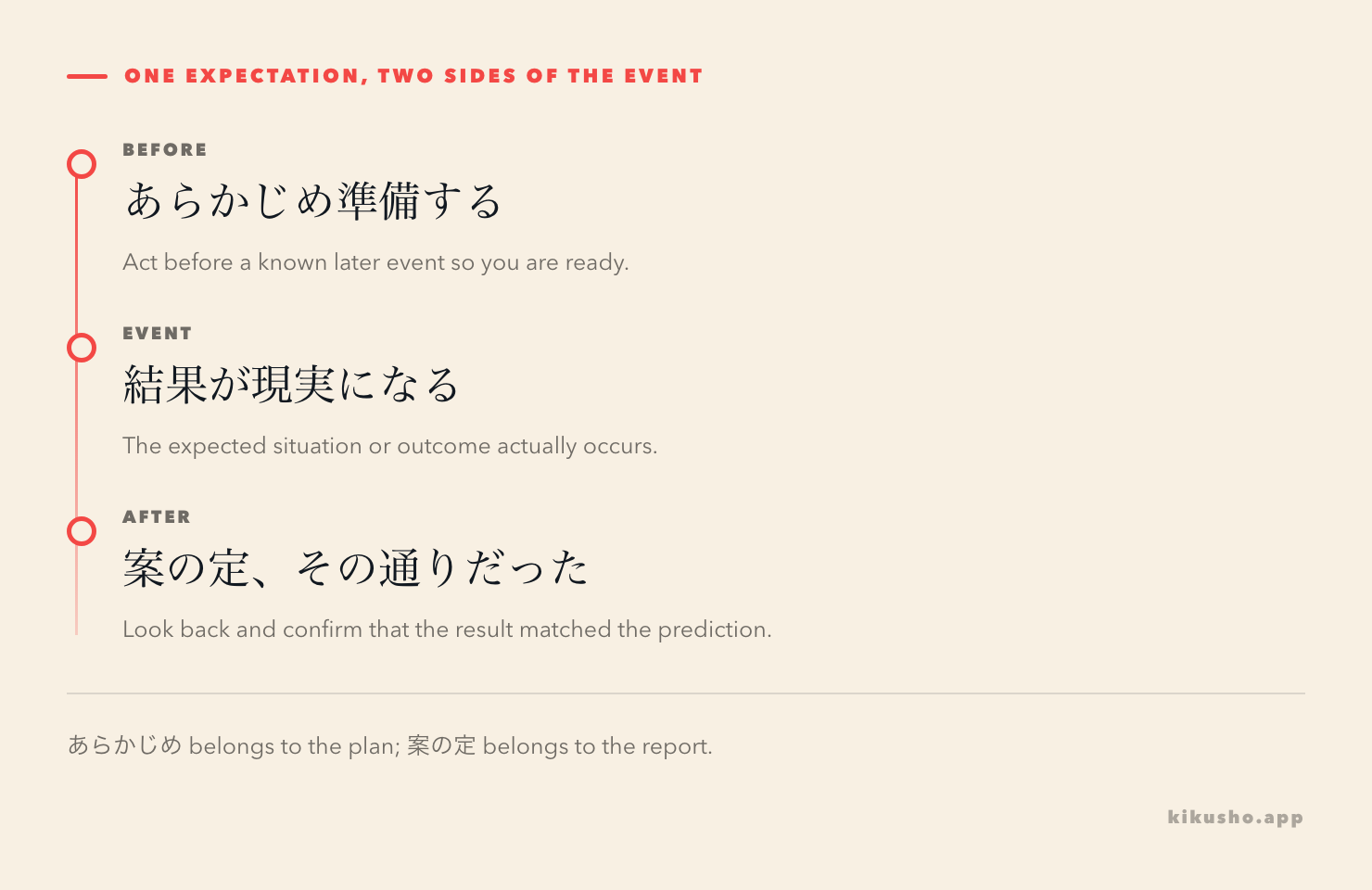
案の定 needs a result and a prior expectation
案の定 is a sentence adverb. It commonly appears before the clause reporting the outcome:
準備が足りないと思っていたが、案の定、発表はうまくいかなかった。
じゅんびが たりないと おもっていたが、あんのじょう、はっぴょうは うまく いかなかった。
I thought the preparation was insufficient, and sure enough, the presentation did not go well.
彼なら合格すると思っていた。案の定、最高得点で合格した。
かれなら ごうかくすると おもっていた。あんのじょう、さいこう とくてんで ごうかくした。
I expected him to pass. Sure enough, he passed with the highest score.
The second example is positive. Negative outcomes are common because people often voice warnings, suspicions and fears, but negativity is not part of the grammar itself.
The prediction need not be stated in the previous sentence:
案の定、彼は約束の時間に現れなかった。
あんのじょう、かれは やくそくの じかんに あらわれなかった。
As expected, he did not show up at the promised time.
The adverb asks the listener to recover an earlier expectation from shared context. Without any plausible prior prediction, it sounds ungrounded.
Compare 予想通り:
予想通り、売上は増加した。
Sales increased as predicted.
案の定、売上は増加した。
Sure enough, sales increased.
Both can report a match. 予想通り is transparent and works in neutral analytical prose. 案の定 more readily evokes the speaker’s “I thought so” reaction. It can sound conversational, evaluative or faintly resigned.
あらかじめ builds preparation into the earlier action
あらかじめ modifies an action performed before a reference event:
参加する場合は、あらかじめ担当者に連絡してください。
さんかする ばあいは、あらかじめ たんとうしゃに れんらくして ください。
If you plan to participate, please contact the person in charge beforehand.
質問をあらかじめ共有していただければ、詳しい資料を用意できます。
しつもんを あらかじめ きょうゆうして いただければ、くわしい しりょうを よういできます。
If you share the questions in advance, we can prepare detailed materials.
事故が起きた場合の対応を、あらかじめ決めておく必要がある。
じこが おきた ばあいの たいおうを、あらかじめ きめておく ひつようが ある。
The response to a possible accident needs to be decided in advance.
It works especially well with verbs such as 知らせる, 確認する, 決める, 予約する, 用意する, 調べる and 断る. These actions reduce later delay, surprise or trouble.
The reference event can remain implicit when context supplies it:
必要な書類はあらかじめコピーしてあります。
ひつような しょるいは あらかじめ コピーしてあります。
The necessary documents have been copied in advance.
The sentence assumes some later meeting, submission or procedure for which the copies will be needed.
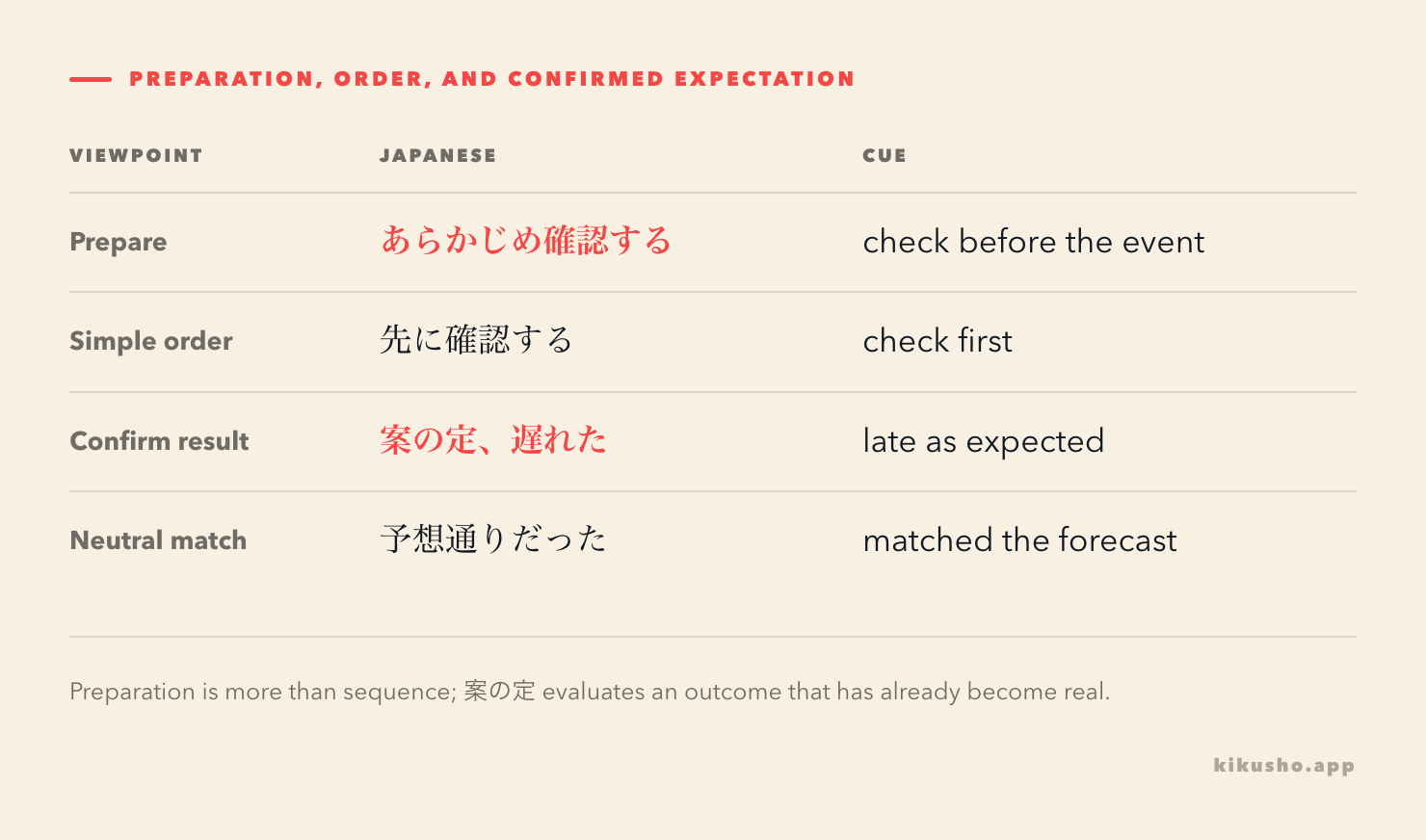
あらかじめ is more than simply 先に
先に orders two actions. あらかじめ presents the earlier action as preparation for a later situation.
私が先に会議室に入り、田中さんが後から入った。
I entered the meeting room first, and Tanaka entered later.
This is sequence. Entering first need not prepare anything.
会議の前に、資料をあらかじめ机の上に置いた。
Before the meeting, I placed the materials on the desks in advance.
Placing the materials serves the later meeting. 前もって expresses a similar preparatory relation and is often more conversational; あらかじめ fits instructions, notices and procedural writing particularly well.
The kana spelling is the safest default. 予め is a recognized spelling, but modern general prose often uses あらかじめ.
ておく names the preparatory handling
あらかじめ and ~ておく often reinforce each other:
あらかじめ必要な情報を調べておく。
Check the necessary information in advance.
The adverb locates the action before the reference event. ておく presents the action as handling a future need or preserving the resulting state. Either can appear alone:
必要な情報を調べておく。
Check the information for later.
必要な情報をあらかじめ調べる。
Check the information in advance.
The ておく lesson separates preparation from deliberate leaving and completion uses.
Do not use 案の定 for a future guess
Before the outcome is known, use a prediction form:
明日は雨が降るだろう。
It will probably rain tomorrow.
明日は雨が降るはずだ。
It should rain tomorrow.
After rain actually begins:
案の定、雨が降り出した。
Sure enough, it started to rain.
はずだ expresses an expectation based on reasons; 案の定 confirms the result. The はず and べき lesson separates reasoned expectation from obligation.
Likewise, あらかじめ cannot by itself mean “I expected rain.” It requires an advance action:
雨に備えて、あらかじめ傘を用意した。
I prepared an umbrella beforehand in case of rain.
One situation can contain both
店が混むと思い、あらかじめ席を予約した。着いてみると、案の定、店は満席だった。
みせが こむと おもい、あらかじめ せきを よやくした。ついてみると、あんのじょう、みせは まんせきだった。
Expecting the restaurant to be crowded, I reserved a seat beforehand. When I arrived, sure enough, it was full.
The expectation causes preparation, and the later result validates the expectation. This gives a reliable three-part frame:
- Prediction: 店が混むと思った。
- Preparation: あらかじめ席を予約した。
- Confirmation: 案の定、満席だった。
If the sentence lacks an advance action, do not insert あらかじめ. If the result has not occurred, do not insert 案の定.
Practice: before the event or after the result?
Question 1 — preparation. Complete the instruction.
面接の場所までの道順を( )確認しておいてください。
A. 案の定
B. あらかじめ
C. 結局
D. やはり
Question 2 — confirmed result. The speaker predicted a delay, and the train actually arrived late.
遅れると思っていたが、( )、電車は二十分遅れて到着した。
A. あらかじめ
B. 先に
C. 案の定
D. 事前に
Question 3 — positive outcome. Which sentence shows that 案の定 can confirm a welcome result?
- 案の定、応援していた選手が優勝した。
- 案の定、来週の試合に備えて練習する。
- あらかじめ、選手が優勝した。
- あらかじめ、結果が予想と一致した。
Question 4 — sequence or preparation. Which sentence merely says “I went first,” without presenting preparation?
A. あらかじめ申込書を書いた。
B. あらかじめ連絡先を確認した。
C. 私が先に入り、友達が後から入った。
D. 案の定、友達も入った。
Question 5 — arrange the preparation. Reconstruct the sentence with every part. Which option belongs at ★?
混雑すると ___ ___ ★ ___ 。
A. 買っておいた
B. あらかじめ
C. 思ったので
D. 切符を
Question 6 — connected text. Fill both numbered gaps with the only sequence that follows time correctly.
担当者は停電の可能性があると考え、( ① )予備の電源を用意した。その夜、( ② )地域全体が停電した。
- ①案の定 ②あらかじめ
- ①あらかじめ ②案の定
- ①先に ②事前に
- ①案の定 ②やはり先に
Question 7 — produce the timeline. Write three short sentences about expected rain: one prediction, one preparatory action with あらかじめ, and one confirmed result with 案の定.
Answers and explanations
1. Advance check
B. あらかじめ. Checking the route is performed before the interview so that the later trip goes smoothly.
2. Realized delay
C. 案の定. The train has arrived and its delay matches the earlier prediction. The three alternatives locate something before another event rather than evaluating the realized result.
3. Welcome confirmation
1. The supported athlete’s victory confirms the speaker’s expectation. The result is positive, showing that 案の定 has a tendency toward bad news rather than a negative requirement.
4. Simple order
C. 先に orders the two entries. A and B present advance preparation; D evaluates the friend’s entry as expected.
5. Composed preparation
The order is C → B → D → A, so ★ is D. 切符を.
混雑すると思ったので、あらかじめ切符を買っておいた。
Because I expected crowds, I bought the ticket in advance.
The prediction supplies the reason, and あらかじめ plus ておいた marks the preparation.
6. Prepared power
2: ①あらかじめ, ②案の定. The backup power is prepared before the possible outage. Later, the actual outage confirms the expectation.
7. One possible timeline
明日は雨が降ると思う。
あらかじめ傘をかばんに入れておいた。
翌朝、案の定、雨が降り出した。
The first sentence predicts, the second prepares, and the third reports the confirming result. Other answers work if they preserve that order.
Review the transition, not two translations
Put both adverbs on one card:
混むと思ったので、あらかじめ予約した。案の定、店は満席だった。
Expecting crowds, I reserved in advance. Sure enough, the restaurant was full.
Hide the adverbs and ask two different questions. Which action happened early to prepare? Which expression judged the later result? The answers cannot trade places because their viewpoints occupy opposite sides of the event.
Kikusho can then schedule the full transition rather than isolated glosses: expectation, advance action, realized outcome. That sequence makes beforehand and sure enough easier to retrieve when a longer JLPT passage states the prediction several lines before the result.
Common questions
What is the difference between 案の定 and あらかじめ?
あらかじめ describes an action taken before a known later event, usually as preparation. 案の定 comments afterward that the result matched an earlier expectation or prediction.
What does 案の定 mean?
案の定 means “just as expected,” “sure enough” or “as feared.” It presents an actual result as confirmation of what the speaker had predicted.
Does 案の定 always describe a bad result?
No. It frequently accompanies undesirable results, which can give it an “as feared” tone, but positive and neutral outcomes are possible when they confirm a prior expectation.
What does あらかじめ mean?
あらかじめ means “beforehand” or “in advance.” It usually modifies a preparatory action such as informing, checking, deciding or arranging something before a later event.