On this page
Tomorrow's train may have no signal, so you download the map tonight: 地図をダウンロードしておく means “download the map now so it is ready later.” ~ておく follows a verb's て-form and usually marks a preparatory act; in other contexts it can mean taking a provisional step or leaving a result as it is.
This page teaches the assigned N4 grammar construction ておく, inventory item g-de8f9b9af083. Japan Foundation Irodori Lesson 6, Bunpro and JLPT Sensei place the preparation use at N4. These are teaching estimates: the JLPT organizers do not publish an exhaustive grammar syllabus. You need to know the verb's て-form first; verb groups and the ます-form provide the earlier verb foundation.
Add おく to the て-form, not to the dictionary form
Build verb て-form + おく. The first verb names what you do; おく carries the sentence's tense and politeness. A verb whose て-form ends in で keeps that sound before おく. Irodori Lesson 6 explicitly gives this attachment, and Tofugu's original grammar guide independently confirms both ておく and でおく.
| Dictionary verb | て-form | With おく | Sense in context |
|---|---|---|---|
| 書く (かく, write) | 書いて | 書いておく | Write it ahead of time |
| 読む (よむ, read) | 読んで | 読んでおく | Read it ahead of time |
| 見る (みる, look) | 見て | 見ておく | Look at it beforehand |
| する (do) | して | しておく | Get it done beforehand |
書いておきます is polite, 書いておいた is plain past, and 書いておいて can appear in a request. 書いておく is not 書くおく: do the first verb's て-form change before adding the auxiliary. The useful past form matters when you report that preparation is already complete: 昨日、地図をダウンロードしておきました (きのう、ちずを ダウンロードしておきました) says “I downloaded the map yesterday in advance.”
Preparation names an act you choose before a later need
明日の旅行のために、地図をダウンロードしておきます (あしたの りょこうの ために、ちずを ダウンロードしておきます) means “I'll download the map ahead of tomorrow's trip.” The map will be useful later. 明日の会議の前に、資料を読んでおきます (あしたの かいぎの まえに、しりょうを よんでおきます) says “I'll read the documents before tomorrow's meeting.” The benefit need not be named every time; a listener can often infer it from the scene.
In this preparatory pattern, you choose and carry out the action. The Japan Foundation's lesson specifies controllable verbs for the advance-purpose use. 出発前に飲み物を買っておく (しゅっぱつまえに のみものを かっておく) works because someone decides to buy a drink; a change that simply happens to an object is not the same deliberate preparation. This limit concerns the basic advance-purpose pattern, not every possible use of ~ておく.
An unadorned 地図をダウンロードします reports that you'll download a map. 地図をダウンロードしておきます adds that you intend to get the task done for a later need. It does not promise the task has already happened: present ~ておく can state an intention, while past ~ておいた reports the act as completed. Bunpro's N4 lesson describes this “do it and leave it until later” nuance.
For now can be a provisional step
とりあえず、メールだけ送っておきます (とりあえず、メールだけ おくっておきます) means “I'll send just an email for now.” The speaker handles an immediate step while more may follow; there need not be a scheduled future event. とりあえず、この案をメモしておこう (とりあえず、この あんを メモしておこう) says “Let's jot this idea down for now.” The volitional おこう suggests the step; とりあえず makes the provisional reading clear.
Tofugu's ておく guide explains this “for now” use separately from advance preparation. It is still the same て-form + おく construction. Context changes what is being left in place: a task handled now, a record to return to, or an arrangement you have not yet decided to revise. Translating every ~ておく as “in preparation for tomorrow” would misread these sentences.
Leave a result as it is when it should stay that way
The door is already open and you want it to remain open: ドアは開けておいてください (ドアは あけておいてください) means “Please leave the door open.” The form can ask someone to keep the result of an action in place. ドアを開けてください merely asks someone to open the door; it does not make staying open the point.
This “leave as is” reading appears in Tofugu's guide. It need not be a plan for a later event. You can also use このままにしておく (このままに しておく) to leave a situation as it is. The current state and the surrounding request decide the reading; the construction alone does not tell you whether the speaker prepared something or simply left it alone.
In casual speech, ~ておく becomes ~とく or ~どく
When a て-form ends in て, ておく can contract to とく. When it ends in で, でおく can become どく. Irodori Lesson 6 gives both changes, and Bunpro notes that the contractions are common in casual conversation but not in formal business speech.
| Verb | Full form | Casual spoken form |
|---|---|---|
| 買う (かう) | 買っておく | 買っとく (かっとく) |
| 読む (よむ) | 読んでおく | 読んどく (よんどく) |
| 見る (みる) | 見ておく | 見とく (みとく) |
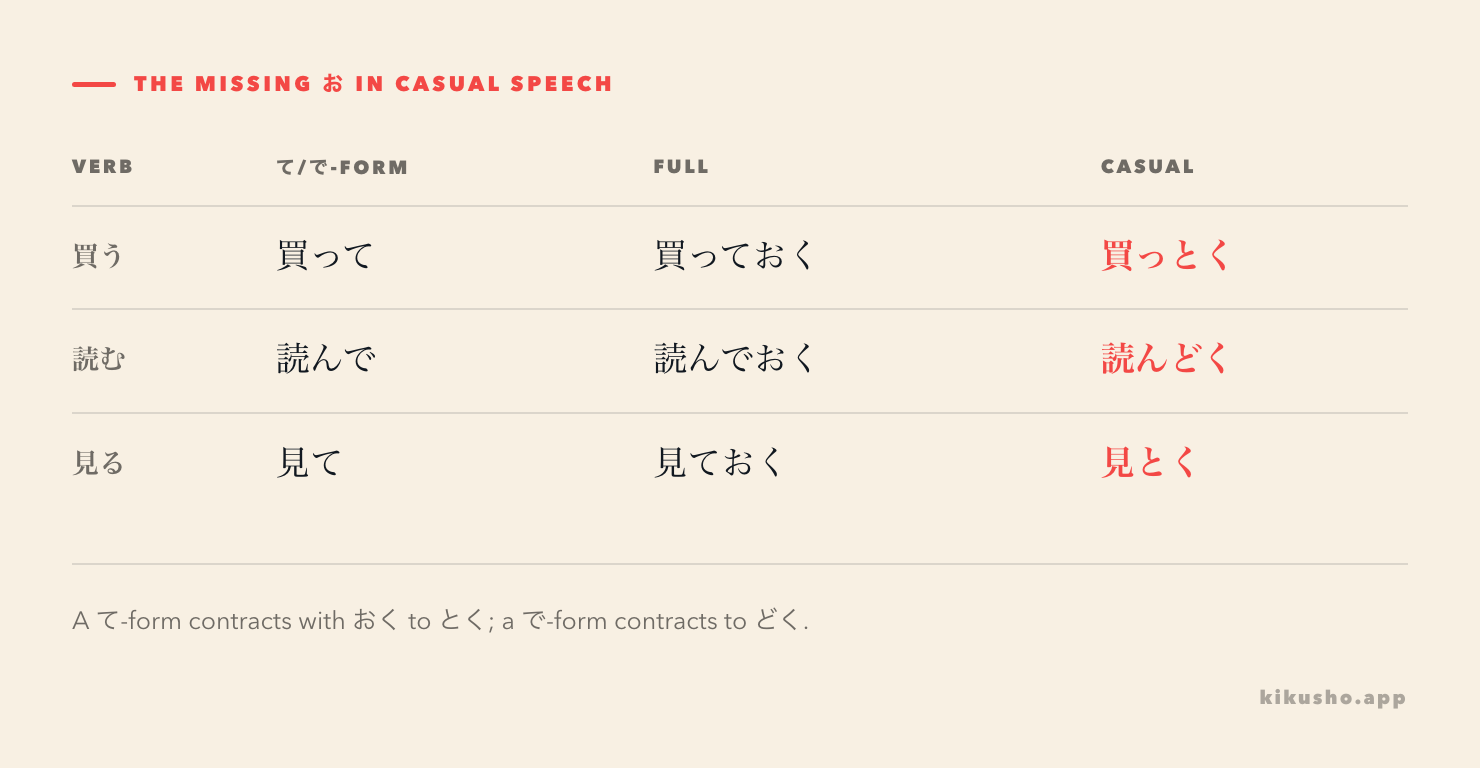
明日の会議の前に、資料を読んどく is the casual version of 資料を読んでおく. The meaning remains; the register changes. Tofugu confirms the 読んどく and 見とく forms. If you already recognise other regular spoken contractions, listen for とく or どく at the end of the action rather than hunting for a separate verb おく.
~てある reports the prepared state rather than the act
Compare 申込書に名前を書いておきました (もうしこみしょに なまえを かいておきました), “I wrote my name on the application form in advance,” with 申込書に名前が書いてあります (もうしこみしょに なまえが かいてあります), “The name is written on the application form.” The first presents what someone did for a later need; the second points at the result that is there now. The action can be true in both sentences, but the focus and the particle around 名前 change.
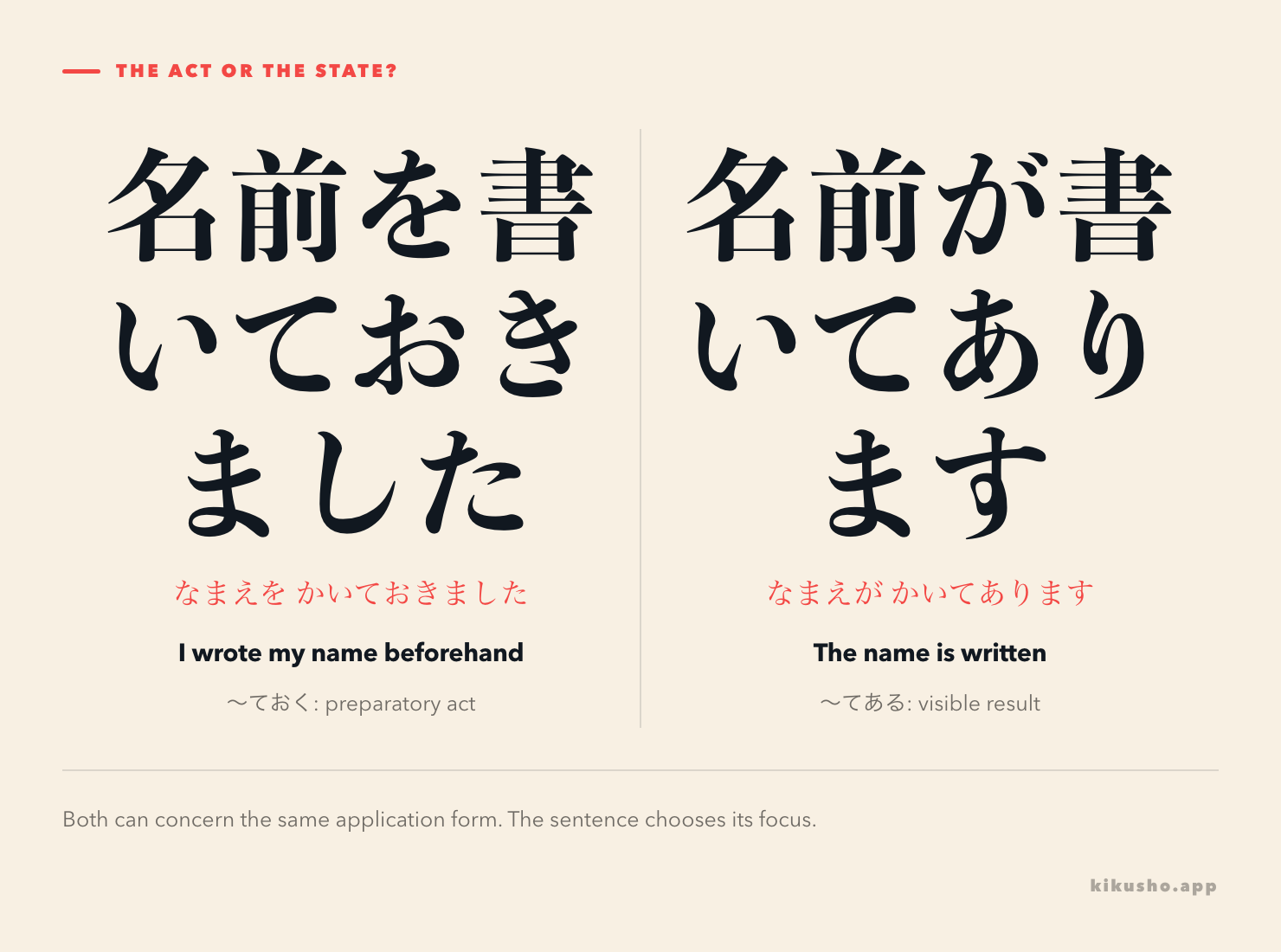
Tofugu's comparison and Bunpro's related ~てある explanation support the act-versus-state distinction. The existing ている versus てある lesson takes the resultative side further. Do not swap ~ておく for ~てしまう simply because a task is finished: ~てしまう can foreground completion or regret, while ~ておく tells you why something was done or left in place.
If you hear 読んどく before a meeting, keep the whole phrase when capturing it in Kikusho. The card's example sentence can preserve both the planned action and its casual ending; when it returns for offline review, expand どく → でおく before deciding what the speaker intended.
Practice: identify the use and complete the form
Try all six questions before reading the answers below.
Question 1 — grammar choice. You intend to print the documents tonight so they are ready for tomorrow's meeting. Which sentence marks the act as preparation?
- A. 今夜、資料を印刷しておきます。
- B. 今夜、資料を印刷します。
- C. 今夜、資料を印刷してしまいます。
Question 2 — grammar choice. A door is already open. You want someone to leave it open. Which request fits?
- A. ドアは開けておいてください。
- B. ドアを開けてください。
- C. ドアが開いています。
Question 3 — sentence composition. An offline map is now on your phone for tomorrow's trip. Write one polite-past sentence with 地図をダウンロードする and 明日の旅行のために to describe what you did ahead of time.
Question 4 — sentence composition. Say casually that you will read the documents before tomorrow's meeting. Use 資料を読む, 明日の会議の前に, and the contracted form of ~でおく.
Question 5 — text grammar. Complete a note about having filled in an application form in advance: 申込書に名前を__。 Use 書く and make the sentence polite past with ~ておく.
Question 6 — text grammar. Compare 申込書に名前を書いておきました and 申込書に名前が書いてあります. Which sentence reports the preparatory act, and which reports the state visible now?
Answers and explanations
Answer 1. A, 今夜、資料を印刷しておきます。 “I'll print the documents tonight in advance.” 印刷する → 印刷しておく → 印刷しておきます marks the intended preparation. B states the plan to print without marking its later purpose. C can mean getting the printing finished, but ~てしまう foregrounds completion rather than preparation; the prompt asks for the form that marks the latter.
Answer 2. A, ドアは開けておいてください。 With the door already open, this asks for the open state to be kept. B asks someone to open it, which is unnecessary in the given scene and does not make the continuing state the point. C is a report about the door, not a request.
Answer 3. One model answer is 明日の旅行のために、地図をダウンロードしておきました。 (あしたの りょこうの ために、ちずを ダウンロードしておきました), “I downloaded the map in advance for tomorrow's trip.” する → しておく → しておきました supplies the polite past ending; the purpose phrase identifies the later need.
Answer 4. 明日の会議の前に、資料を読んどく。 (あしたの かいぎの まえに、しりょうを よんどく), “I'll read the documents before tomorrow's meeting.” 読む → 読んでおく → 読んどく keeps the voiced で → ど contraction. 読んとく loses the voicing and is not the form asked for; 読んでおく is correct in meaning but is the uncontracted form.
Answer 5. 書いておきました completes 申込書に名前を書いておきました。 (もうしこみしょに なまえを かいておきました), “I wrote my name on the application form beforehand.” 書く → 書いて → 書いておく → 書いておきました changes the first verb before adding the auxiliary, then puts the auxiliary in polite past.
Answer 6. 申込書に名前を書いておきました reports what someone did in advance; 名前を is the thing written. 申込書に名前が書いてあります reports the result still present; 名前が identifies what is there. Both can describe the same application form, but ~ておく presents the act and ~てある presents its arranged state.
Common questions
How do you form ~ておく?
Put the first verb in its て- or で-form and add おく: 書く becomes 書いておく, and 読む becomes 読んでおく. おく carries tense and politeness, as in 書いておいた or 書いておきます.
Does ~ておく always mean preparing for tomorrow?
No. It often marks an action done ahead of a later need, but it can also mark a provisional step for now or leaving a result in place. Context tells you which one the speaker means.
What do ~とく and ~どく mean in conversation?
They are casual contractions of ~ておく and ~でおく. 買っておく becomes 買っとく, and 読んでおく becomes 読んどく. Use the full form in formal speech.
How is ~ておく different from ~てある?
~ておく presents the act of doing or leaving something for later. ~てある describes the current state produced by an intentional act. 書いておきました reports the act; 書いてあります presents its result.