

On this page
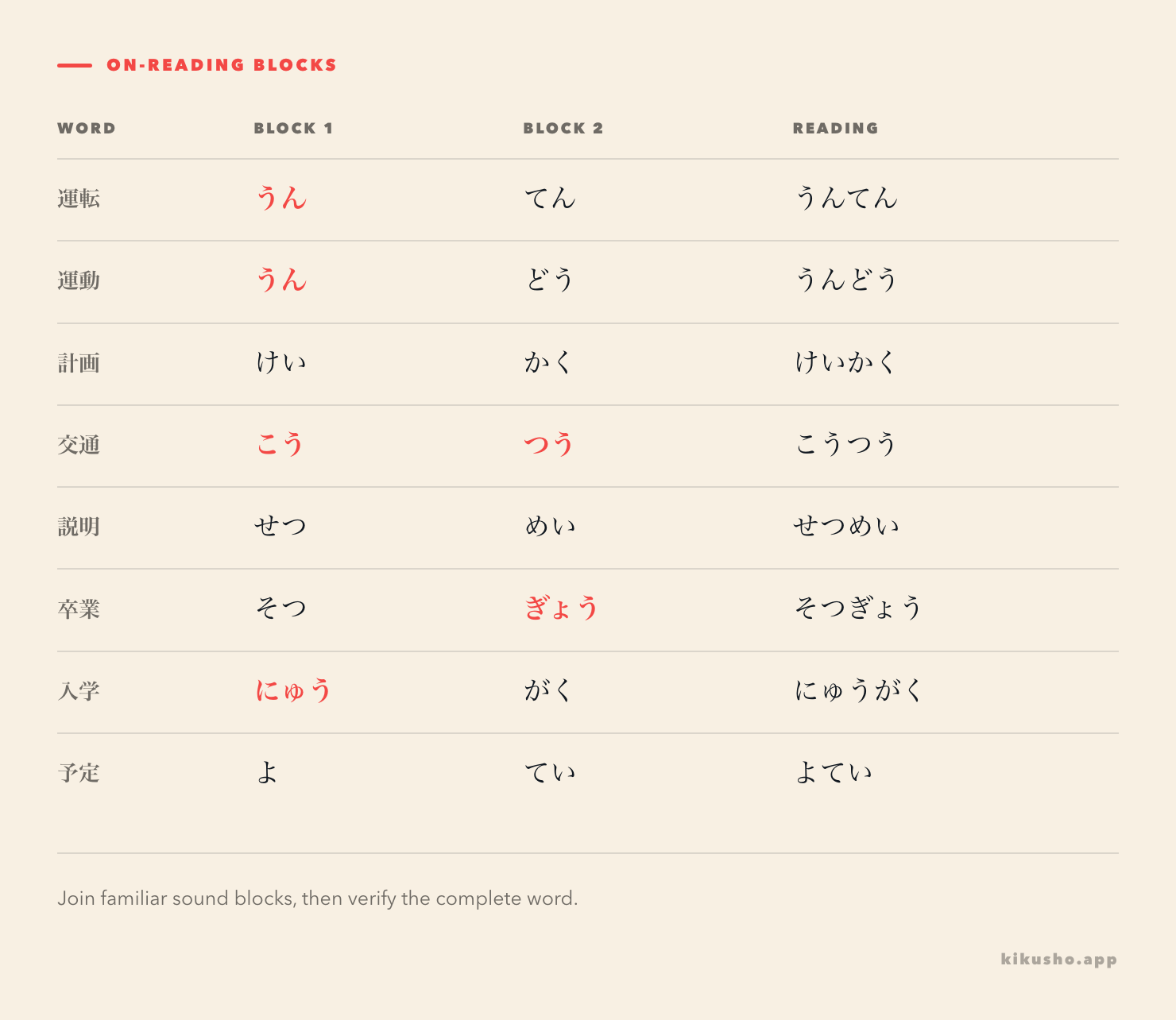
Two-kanji compounds often use on-readings, the readings historically borrowed from Chinese. For these ten N4 words, that tendency gives you a practical method: split the word into two sound blocks, join them, and watch for long vowels or a small っ at the boundary.
It is a prediction tool, not a promise. Japanese also has kun-kun, mixed, and whole-word readings. Learn the complete word after making your first guess.
Ten words, twenty reusable sound blocks
The Agency for Cultural Affairs on-kun index lists official readings in katakana for on and hiragana for kun. Its entries include ウン for 運 and オン for 音, with 運動 and 発音 as examples. In the table below, every component uses the on-reading layer.
| Word | First block | Second block | Complete reading | Meaning |
|---|---|---|---|---|
| 運転 | 運(うん) | 転(てん) | うんてん | driving; operation |
| 運動 | 運(うん) | 動(どう) | うんどう | exercise; movement |
| 計画 | 計(けい) | 画(かく) | けいかく | plan |
| 交通 | 交(こう) | 通(つう) | こうつう | traffic; transportation |
| 出発 | 出(しゅつ) | 発(はつ) | しゅっぱつ | departure |
| 説明 | 説(せつ) | 明(めい) | せつめい | explanation |
| 卒業 | 卒(そつ) | 業(ぎょう) | そつぎょう | graduation |
| 入学 | 入(にゅう) | 学(がく) | にゅうがく | school admission; enrolment |
| 発音 | 発(はつ) | 音(おん) | はつおん | pronunciation |
| 予定 | 予(よ) | 定(てい) | よてい | plan; schedule |
The inventory assigns this set to N4 vocabulary. Published JLPT materials do not provide an exhaustive official vocabulary list, and one source in Kikusho's inventory also places 運転 at N3. Treat the level as a study placement rather than a claim about an official boundary.
Repeated kanji give you a second word almost free
運 contributes うん to both 運転 and 運動:
毎日、車を運転します。 I drive a car every day.
週末に公園で運動します。 I exercise in the park on weekends.
The shared sound is reliable here, but the words do different jobs. Kanjipedia records 運転 as うんてん, covering both driving and the operation of machinery. 運動 is movement or exercise. Remember 車を運転する and 公園で運動する, not just two English infinitives.
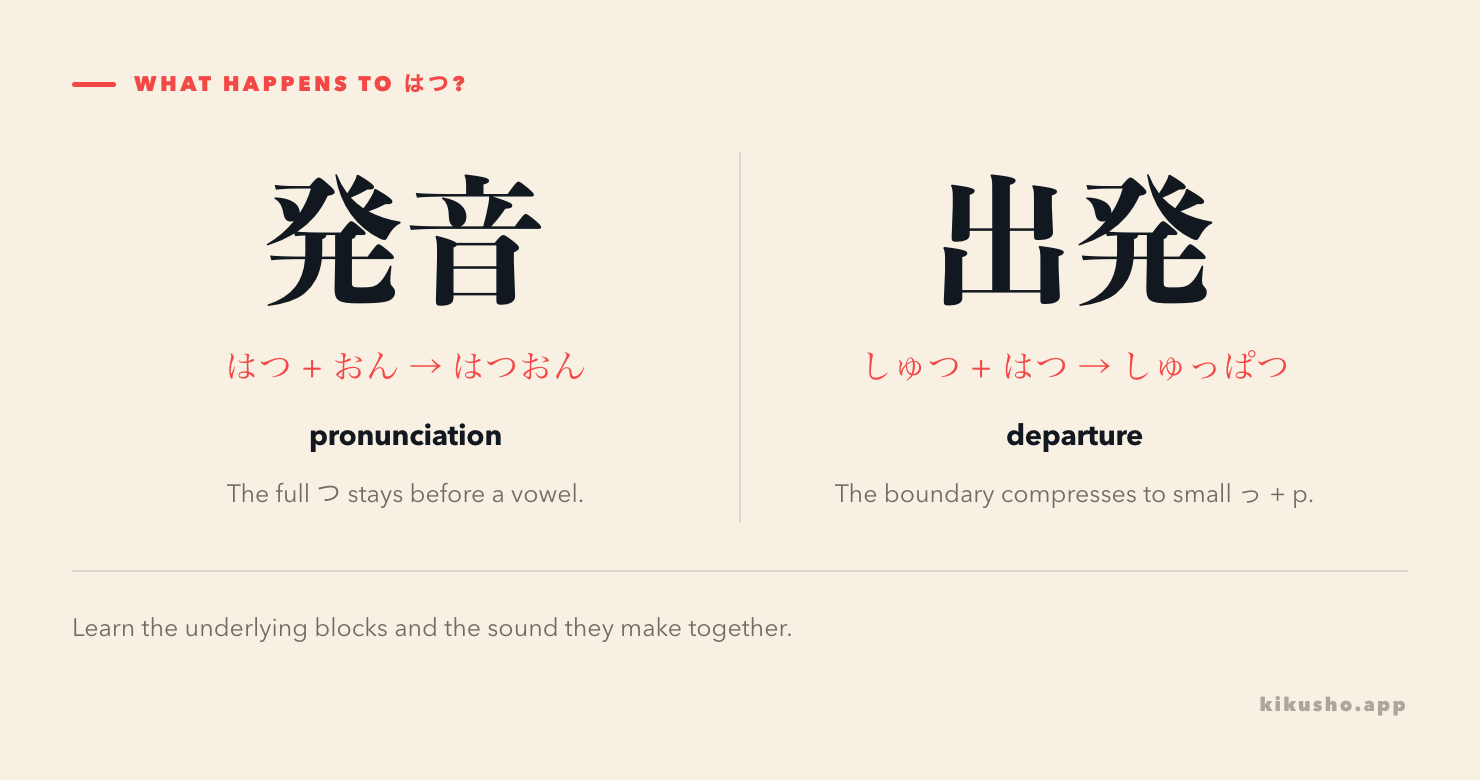
発 gives another useful pair. In 発音, the blocks join without changing:
この言葉の発音は難しいです。 The pronunciation of this word is difficult.
The sequence is はつ + おん, so you hear はつおん. When 発 follows 出, however, the boundary changes the sound.
出発 compresses つ into a small っ
If you simply concatenate the two dictionary blocks, 出(しゅつ)+ 発(はつ)would produce しゅつはつ. The actual word is しゅっぱつ. The final つ compresses into a small っ, and the following h sound becomes p.
電車は七時に出発します。 The train departs at seven.
Kotobank gives 出発 as しゅっぱつ, with departure and setting out as its central senses. This small-っ process also appears in familiar words such as 学校(がっこう)and 一回(いっかい). It is not the same process as rendaku, which voices the first consonant of a following element.
Long vowels belong inside the block
Three words in the set contain a long vowel written with う:
- 交(こう)+ 通(つう)= 交通(こうつう)
- 卒(そつ)+ 業(ぎょう)= 卒業(そつぎょう)
- 入(にゅう)+ 学(がく)= 入学(にゅうがく)
Do not throw away those う kana when you say the word. こう is one block, not a clipped こ, and にゅう is not にゅ. Stretching the vowel slightly helps keep 交通 apart from an imagined こつう and 入学 apart from にゅがく.
日本は交通が便利です。 Transportation is convenient in Japan.
姉は去年、大学を卒業しました。 My older sister graduated from university last year.
四月に高校に入学しました。 I entered high school in April.
Kanjipedia reads 卒業 as そつぎょう and contrasts it with 入学. The particles differ in natural chunks: 学校を卒業する uses を for the institution completed, while 学校に入学する uses に for the institution entered. The school and work vocabulary lesson gives these transitions a wider life-stage context.
Four regular joins still need complete words
The remaining readings join cleanly:
- 計(けい)+ 画(かく)= 計画(けいかく)
- 説(せつ)+ 明(めい)= 説明(せつめい)
- 予(よ)+ 定(てい)= 予定(よてい)
- 運(うん)+ 転(てん)= 運転(うんてん)
That does not mean that the kanji blocks supply a safe English definition by themselves. A reading prediction gets you to the sound; usage still belongs to the whole word.
旅行を計画しています。 I am planning a trip.
先生が文法を説明しました。 The teacher explained the grammar.
明日は予定があります。 I have plans tomorrow.
計画, 説明, and 予定 are nouns. Add する when you need a verb: 計画する, 説明する, 予定する. In ordinary conversation, however, 予定がある and 旅行の予定です often sound more natural than forcing every occurrence into a する verb.
Predict first, verify the word second
The useful habit has three steps:
- Mark the boundaries between kanji.
- Try the on-reading block you already know for each character.
- Verify the complete word, including long vowels and sound changes.
This method turns a familiar kanji into a clue. It does not replace learning vocabulary. The broader lesson on why one kanji has several readings explains where on- and kun-readings came from, along with mixed readings and whole-word exceptions.
The Japan Foundation's Irodori study guide takes the same word-level approach: read a kanji word, check its meaning in a sentence, and use it. That sequence is stronger than memorising every possible sound for an isolated character.
Practice: make ten predictions before checking
Question 1. Read 運転. Which option matches?
a) うんどう b) うんてん c) よてい d) こうつう
Question 2. Which word is read けいかく?
a) 計画 b) 交通 c) 説明 d) 発音
Question 3. Which pair shares the first reading block うん?
a) 計画 and 交通 b) 卒業 and 入学 c) 運転 and 運動 d) 出発 and 発音
Question 4. Choose the correct reading of 出発.
a) しゅつはつ b) しゅはつ c) しゅっはつ d) しゅっぱつ
Question 5. Which word contains two long-vowel blocks, こう and つう?
a) 交通 b) 入学 c) 卒業 d) 予定
Question 6. Choose the best completion: 先生が文法を__しました。(The teacher explained the grammar.)
a) 運動 b) 発音 c) 説明 d) 交通
Question 7. Choose the natural particle: 去年、大学__卒業しました。
a) が b) を c) に d) で
Question 8. Choose the natural particle: 四月に高校__入学しました。
a) に b) を c) が d) と
Question 9. Which sentence means “I have plans tomorrow”?
a) 明日は予定をします。 b) 明日は予定が説明します。 c) 明日は予定があります。 d) 明日は予定に運動します。
Question 10. Which split correctly predicts 発音?
a) は + つおん b) はつ + おん c) はっ + ぽん d) しゅつ + おん
Stop here until your answer sheet contains ten choices. The solutions begin below.
Explanations for all ten answers
Answer 1: b) うんてん. 運 contributes うん and 転 contributes てん. 運動 begins with the same block but ends in どう.
Answer 2: a) 計画. 計 is けい and 画 is かく in this word, producing けいかく, “plan.”
Answer 3: c) 運転 and 運動. Both begin with 運(うん). Their second blocks, てん and どう, distinguish the readings and meanings.
Answer 4: d) しゅっぱつ. 出(しゅつ)and 発(はつ)meet at a sound boundary. The final つ compresses to small っ and the following h becomes p.
Answer 5: a) 交通. 交 is こう and 通 is つう. Both blocks contain a long vowel written with う.
Answer 6: c) 説明. 説明する means “to explain.” 文法 is the thing explained and takes を.
Answer 7: b) を. 学校を卒業する is the natural chunk for graduating from a school. Here を marks the institution whose course is completed.
Answer 8: a) に. 学校に入学する marks the school entered with に. The same direction is visible in the meaning “enter a school.”
Answer 9: c) 明日は予定があります. 予定がある is the usual way to say that you have plans. Option a is grammatically possible in a suitable scheduling context, but it does not naturally express the intended sentence here.
Answer 10: b) はつ + おん. 発 supplies はつ and 音 supplies おん. Before the vowel at the start of おん, the つ remains a full-sized つ.
Use the blocks to make a first prediction, then keep the verified reading, meaning, and sentence together as one vocabulary item.
Common questions
Do two-kanji Japanese compounds always use on-readings?
No. Two-kanji compounds often use on-readings, but mixed readings and whole-word readings are common enough that you still need to learn the word. Treat the pattern as a useful first prediction rather than a rule that overrides a dictionary.
Why is 出発 read しゅっぱつ instead of しゅつはつ?
The final つ of しゅつ compresses to a small っ before the following h sound, which surfaces as p: しゅっぱつ. This is a sound adjustment at the boundary between the two on-reading blocks.
Are words such as 運転 and 説明 nouns or verbs?
They are nouns that can combine with する. 運転 means driving or operation, while 運転する means to drive or operate. 説明 is an explanation, while 説明する means to explain.