On this page
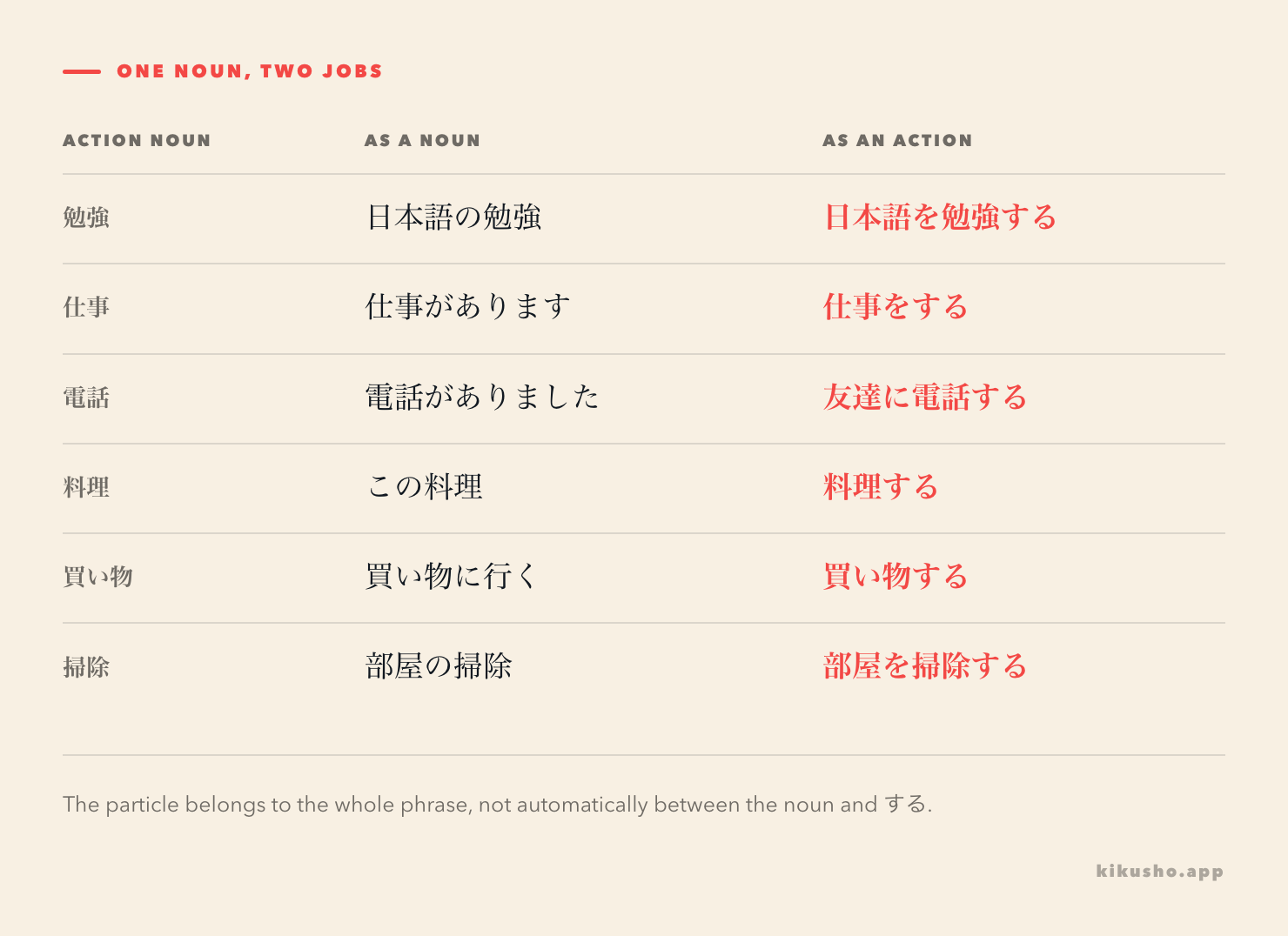
A beginner list gives 電話(でんわ) as “telephone.” In conversation, 友達に電話します means “I call a friend.” する lets many action nouns serve as verbs, and its ending supplies the tense and politeness. The thirteen assigned N5 entries below show that pattern, along with places where the noun keeps its own particle or meaning.
Why these nouns belong together
勉強 can name study; 勉強する means to study. The same pair appears in 掃除/掃除する (cleaning/to clean) and 旅行/旅行する (a trip/to travel). IMABI's original lesson on する verbs explains this action-noun pattern and warns that する does not attach freely to every noun. It also includes コピーする, so the pattern is not restricted to two-kanji compounds. 日本語NET's independently written beginner-teacher verb list gives the actual beginner forms for ten of this lesson's entries, including 買い物します, 結婚します, 掃除します, and the distinct 仕事をします.
These are thirteen assigned spelling-and-reading records, not a promise that every noun has just one English translation. Kanji Pedia's original entries for 掃除, 質問, and 料理 check senses and readings independently of the verb list. The level labels come from reference lists; the JLPT does not give an exhaustive official word syllabus.
The thirteen action nouns
| Assigned noun and reading | Noun sense; action sense | A useful partner |
|---|---|---|
| 買い物(かいもの) | shopping or purchases; to shop | 買い物する; 買い物に行く |
| 結婚(けっこん) | marriage; to get married | 結婚する |
| コピー(こぴー) | a copy; to copy | コピーする |
| 散歩(さんぽ) | a stroll; to stroll | 散歩する; 散歩に行く |
| 仕事(しごと) | work or a job; to do work | 仕事をする |
| 質問(しつもん) | a question or inquiry; to ask a question | 先生に質問する |
| 洗濯(せんたく) | laundry or washing; to wash clothes | 服を洗濯する |
| 掃除(そうじ) | cleaning or sweeping; to clean | 部屋を掃除する |
| 電話(でんわ) | a telephone or a call; to call | 友達に電話する |
| 勉強(べんきょう) | study or learning; to study | 日本語を勉強する |
| 料理(りょうり) | cooking or a prepared dish; to cook | 料理する |
| 旅行(りょこう) | travel or a trip; to travel | 旅行する; 旅行に行く |
| 練習(れんしゅう) | practice; to practise | 練習する; 練習をする |
The rows remain selectable because you may want to save the written noun and its reading, then the whole phrase. Shogakukan's dictionary entry for 買い物 distinguishes shopping from purchases; Kanji Pedia on 料理 distinguishes cooking from the finished food. Its entries for 洗濯, 仕事, 旅行, and 練習 verify the headword readings and everyday senses. The katakana コピー is read with the same sounds written こぴー in the inventory; ordinary Japanese prints the word in katakana.
The pattern: the noun changes jobs
When the noun joins する directly, change only the ending: 勉強する → 勉強します → 勉強した → 勉強しない. The N5 verb-group lesson gives the irregular する forms in full. Here, 日本語を勉強します means “I study Japanese”; 日本語 is what you study, marked by を. 部屋を掃除します means “I clean the room”; 部屋 is what you clean. 先生に質問します asks the teacher, and 友達に電話します calls the friend. Kanji Pedia records 先生に質問する and 部屋を掃除する; 日本語NET's teaching script uses 友達に電話します.
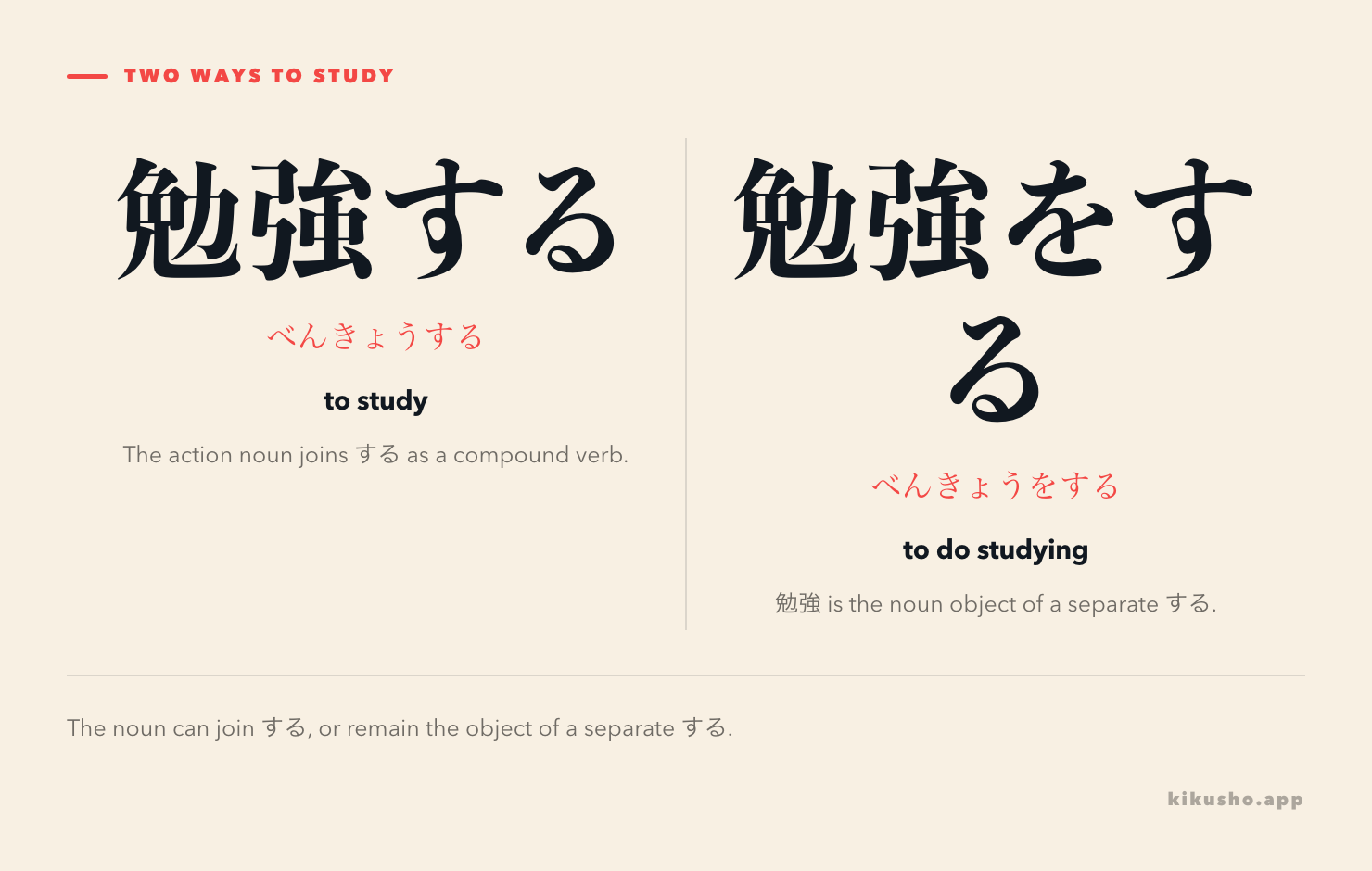
The same activity can sometimes appear with the action noun as the object of a separate する. Compare 日本語を勉強する with 日本語の勉強をする: the first uses the compound verb, while the second says “do Japanese study.” 日本語を勉強をする is not the combination to make; it marks both 日本語 and 勉強 with を in this simple clause. IMABI's する conjugation lesson gives both good structures and marks the doubled を version wrong. The lesson on の explains why 日本語の勉強 is one noun phrase. 練習(を)する also permits both forms in IMABI's original account; that does not mean every noun does.
The two that break a quick rule
仕事 is the useful brake on a “delete を” habit. The beginner-teacher list gives 仕事をします. You can say 仕事があります when work is scheduled, or 仕事をします when doing it. The entry teaches the established noun phrase 仕事をする rather than assuming that all thirteen rows are identical compounds. Kanji Pedia's する entry gives 仕事をする as an ordinary example.
電話 is a second brake: the noun can point to the device or the call, while 電話する means to call. In 友達に電話します, に marks the person reached, not the noun's connection to する. The N4 lesson on 電話をかける teaches another established call expression; you need not force every telephone sentence through one verb. 料理 has a similar noun/action split: 料理 can be the dish you see on a menu or the work of preparing it. 料理します means “I cook,” as a 日本語NET teacher note confirms.
The dated N5 reference inventory places all thirteen rows here, but 練習 has a recorded level disagreement. JapaneseTest4You lists it under N5 and again under N3; its linked flashcard is labelled N3. Kanji Pedia confirms the reading and practice sense, while the page's level remains a reference-list estimate, not a settled boundary.
Which ones you will meet this month
A timetable says 仕事 or 旅行 as nouns. A friend says 旅行します or 買い物に行きます as actions. In a class, 質問 can be a question on paper or 先生に質問する an action aimed at the teacher. On a menu, 料理 usually means a dish, even though 料理する means to cook. Reading the particle and the ending preserves the difference that a one-word gloss misses.
If you hear 友達に電話しました, paste the whole clause into Kikusho rather than filing only 電話. Check the drafted reading and meaning before saving it: the recipient, the action and the past ending then stay together on a card you can review offline. Kikusho keeps what you meet; it does not choose an official exam syllabus for you.
Check yourself
Question 1: reading. Write the hiragana reading of 結婚 in 結婚する.
Question 2: spelling in context. You are doing laundry, not making a choice. Which spelling matches せんたく here?
- A. 洗濯
- B. 選択
- C. 掃除
- D. 練習
Question 3: two ways to study. Write “I study Japanese” with 勉強します as the verb and 日本語 as its object. Then rewrite it with 日本語の勉強 as the object of します.
Question 4: person reached. Complete 友達__電話します to mean “I call a friend.”
- A. に
- B. を
- C. で
- D. の
Question 5: noun or action. In この料理はおいしいです, does 料理 name the food or the action of cooking? Give the reading of 料理 too.
Question 6: work. Use the assigned noun 仕事 as the object of する. Write a polite clause meaning “I do work today.”
Answers and explanations
Answer 1. けっこん. 結婚(けっこん) names marriage; 結婚する means “to get married.” The noun keeps its reading when する joins it.
Answer 2. A, 洗濯. 洗濯(せんたく) is laundry or washing clothes. 選択 has the same reading but means selection or choice; 掃除 is cleaning a place, and 練習 is practice.
Answer 3. 日本語を勉強します and 日本語の勉強をします. In the first, を marks the language as the object of the compound verb. In the second, の makes 日本語の勉強 one noun phrase and を marks that phrase as the object of します. Do not combine the two object patterns as 日本語を勉強をします.
Answer 4. A, に: 友達に電話します. に points to the person called. を would make 友達 the direct object of an action that does not take them that way; で marks a place or means, and の would connect nouns rather than mark the person reached.
Answer 5. It names the food, read りょうり. この料理 is “this dish”; 料理します would mean “I cook.” The preceding この and the following adjective frame it as a noun here.
Answer 6. 今日は仕事をします is one polite model. 仕事(しごと) is the work being done, marked with を; します supplies the action. 今日は仕事があります would say there is work scheduled, rather than that you do it.
When you meet another noun that looks like an activity, check the established phrase before adding する. The difference may be a particle, a recipient, or the thing the noun names when no verb follows it.
Common questions
What is a する verb?
An action noun can join する to form a verb, as in 勉強する, to study. The ending changes like する: 勉強します, 勉強した and 勉強しない.
Do I always put を between the noun and する?
No. 日本語を勉強する treats 勉強する as the verb, whereas 日本語の勉強をする treats 日本語の勉強 as the object of する. Some activity nouns allow both patterns; 仕事をする is a safe beginner model for work.
Does every noun become a verb if I add する?
No. The combination must be an established expression. 買い物 and コピー can join する, but other nouns need a particle or a different verb.