On this page
Use しかし when the next sentence contrasts with the first, それから when it is the next equal step or item, and そして when it continues the thread with added or culminating information. The three words all connect complete thoughts, but the relationship they ask the reader to build is different.
Match the connector to the relationship
| Connector | Reading | Main relationship | Natural translation |
|---|---|---|---|
| しかし | しかし | contrast or limitation | but; however |
| それから | それから | next step, later event, or equal item | and then; after that; and |
| そして | そして | continuing addition or important endpoint | and; and then |
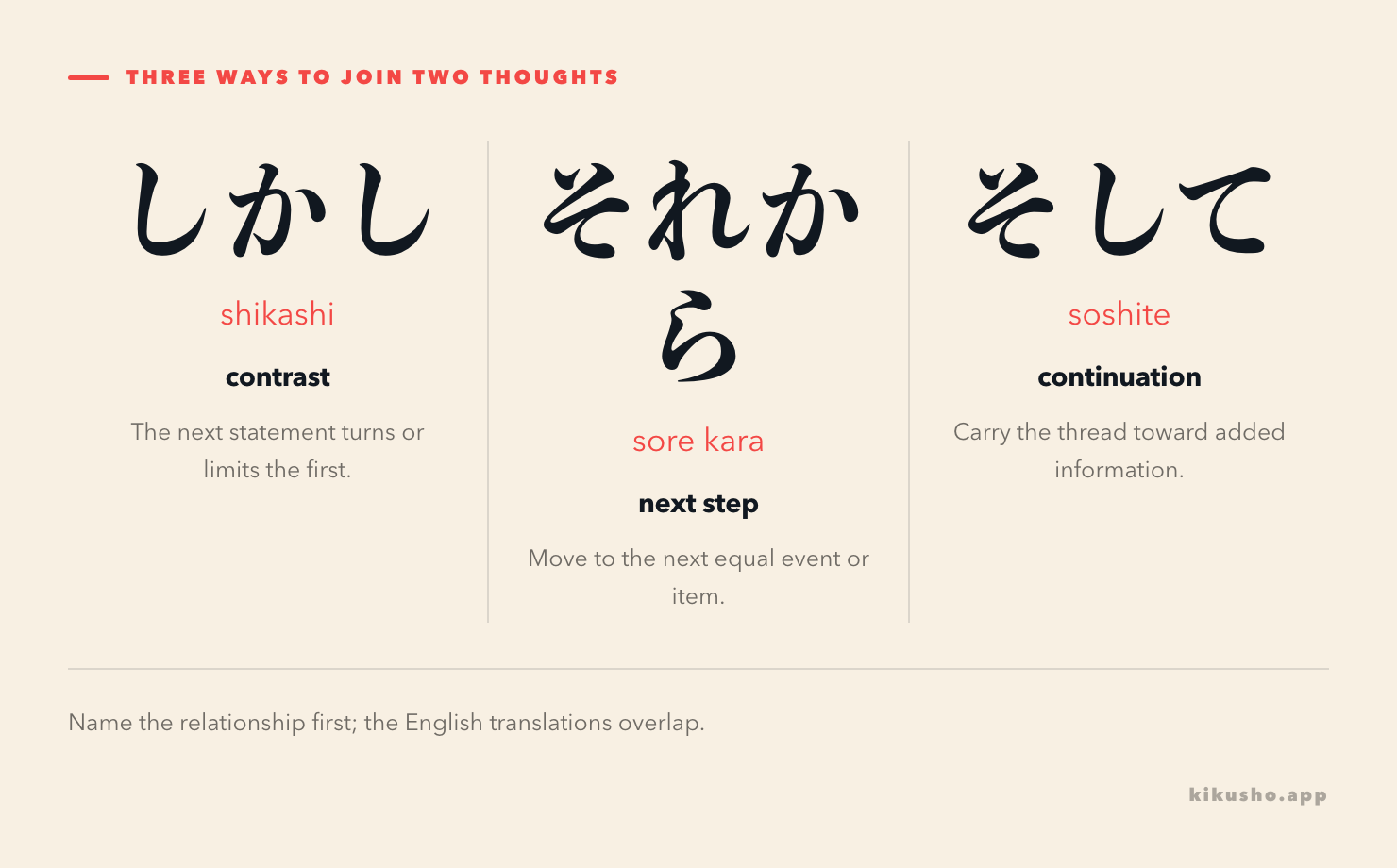
These are independent conjunctions. A dependable beginner pattern is sentence。connector、sentence。 The comma makes the boundary easy to read, though short Japanese sentences do not require one mechanically.
The translations overlap because English “and” and “then” leave much of the relationship to context. Japanese lets you tell the reader whether to reverse an expectation, move to the next step, or carry one thread forward.
しかし reverses or limits the first statement
しかし tells the reader that the next statement goes against an expectation created by the first, or places a limit on it.
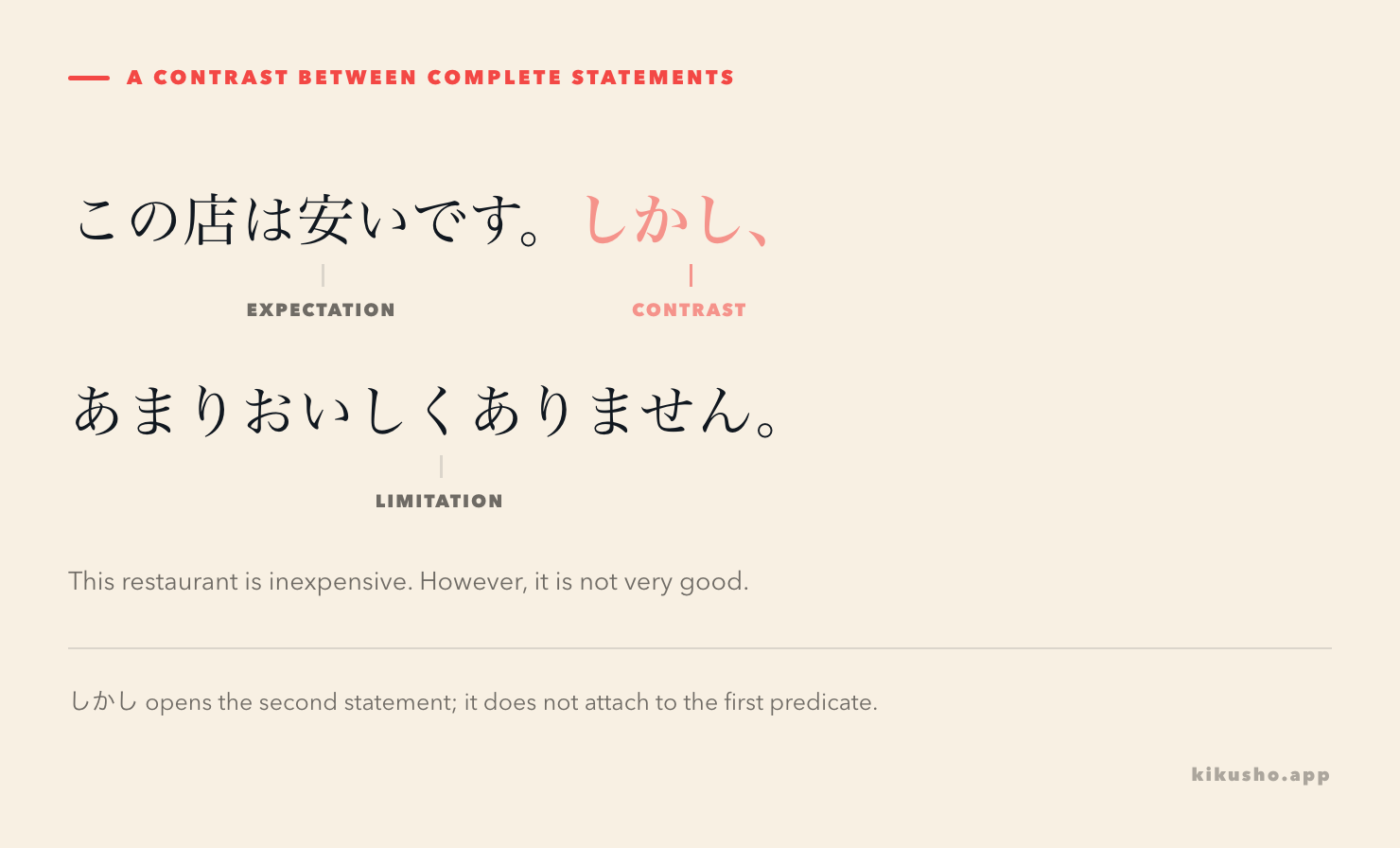
この店は安いです。しかし、あまりおいしくありません。 This restaurant is inexpensive. However, it is not very good.
The low price can create a positive expectation. The second sentence changes the direction with an unfavourable fact.
日本語は難しいです。しかし、おもしろいです。 Japanese is difficult. However, it is interesting.
The difficulty remains true; しかし does not cancel it. It adds a fact that qualifies the conclusion someone might draw from it. The Japanese dictionary entry for しかし describes it as a conjunction that introduces opposition or contrast with the preceding matter, and it can appear at the start of this second sentence.
In everyday conversation, でも often performs the same broad job with a lighter, more conversational feel. しかし sounds deliberate and orderly, so it is common in explanations, presentations, and written passages, though it is not restricted to writing.
Do not confuse sentence-initial しかし with a clause ending. In 高いけど、買います, けど attaches directly to 高い and joins two clauses inside one sentence. In 高いです。しかし、買います, the first sentence is already complete and しかし opens the next one. The lesson on けど, けれど, and けれども develops that attachment difference.
それから moves to the next equal step
それから makes a boundary after the first event and advances to what happened next.
朝ご飯を食べました。それから、学校へ行きました。 I ate breakfast. After that, I went to school.
The order is explicit: breakfast first, school second. The Japan Foundation's Irodori materials teach それから for stating what happened next in chronological order. This makes it a natural choice for routines, directions, and accounts of a day.
駅で切符を買います。それから、電車に乗ります。 I will buy a ticket at the station. Then I will board the train.
それから can also add an equal item rather than a later action:
パンと牛乳、それから卵を買いました。 I bought bread and milk, and also eggs.
Each item belongs at the same level in the list. The National Institute for Japanese Language and Linguistics notes that それから can coordinate equal items or events and can be repeated as a sequence grows. The から in the form makes the boundary—“from that point”—easy to feel.
One further use is “since then”:
一年前に日本に来ました。それから、日本語を勉強しています。 I came to Japan one year ago. Since then, I have been studying Japanese.
The first event establishes a point in time, and the second situation continues from that point. For clause-level patterns such as 前に and 後で, see how to put actions in order.
そして carries the thread forward
そして continues from the previous statement and adds information that belongs to the same developing thread.
母は料理をしました。そして、父は皿を洗いました。 My mother cooked. And my father washed the dishes.
The events may occur in that order, but そして does not make “after that” its central message. It presents the father's action as the continuation of the same scene.
毎日練習しました。そして、ついに試合に勝ちました。 I practised every day. And finally, I won the match.
Here the second statement is the endpoint toward which the account has been moving. The same NINJAL explanation says that そして carries the preceding context forward, and that the later content often has greater weight. This tendency also explains why repeating そして for every item sounds less natural than repeating それから in a step-by-step list.
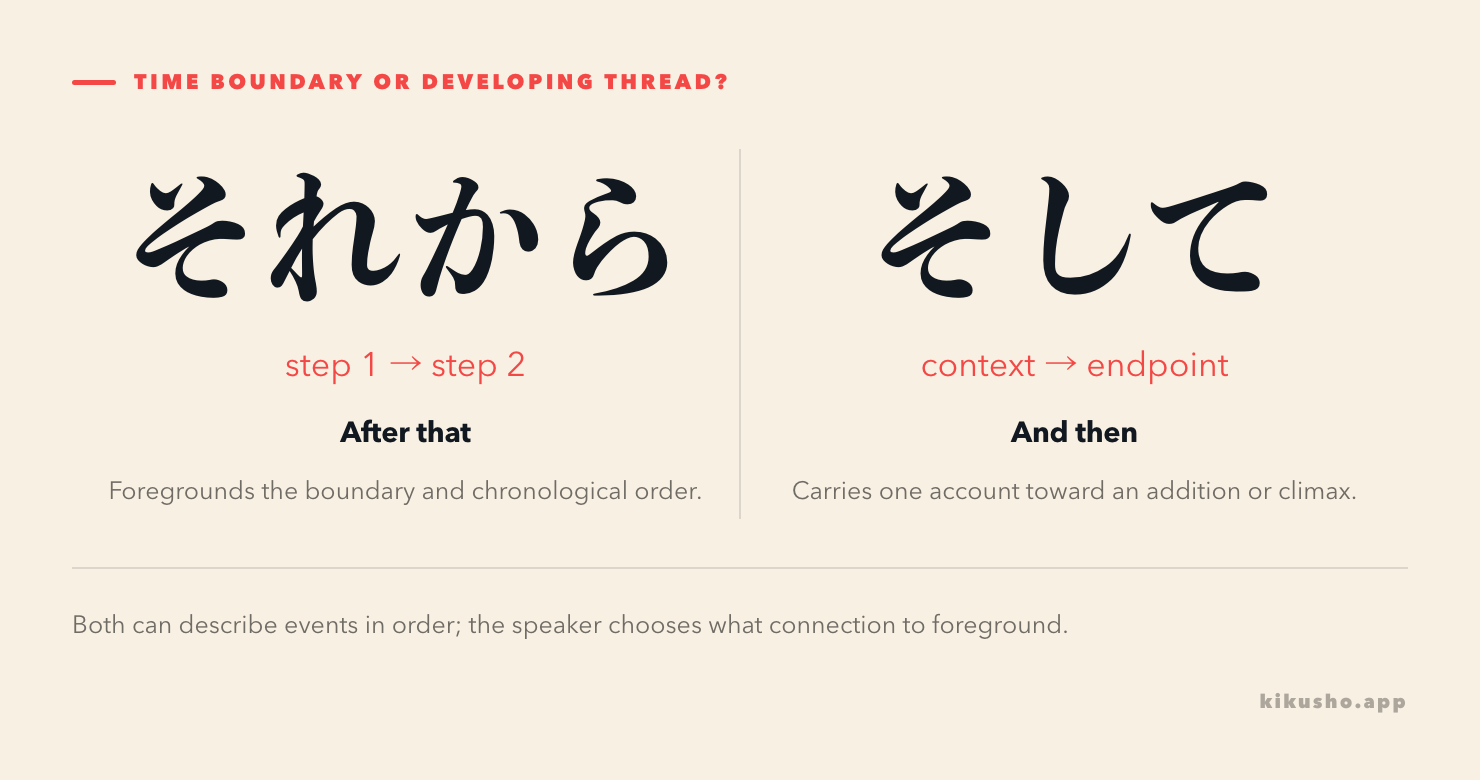
Compare one pair:
部屋を掃除しました。それから、買い物に行きました。 I cleaned the room. After that, I went shopping.
The speaker foregrounds the time order.
部屋を掃除しました。そして、きれいな部屋で友達を待ちました。 I cleaned the room. And then I waited for my friend in the clean room.
The second sentence continues and completes one small story. The actions still have an order, but the narrative connection matters more than an explicit “from there, next.”
Addition is not the same as cause
そして and それから organize events; neither one actively marks the first event as the cause of the second. Use それで when the second statement is presented as a result.
財布を忘れました。それで、昼ご飯を買えませんでした。 I forgot my wallet. Because of that, I could not buy lunch.
Compare a chronological continuation:
財布を家に取りに戻りました。それから、会社へ行きました。 I went home to get my wallet. After that, I went to work.
The events happen in order, but the first does not grammatically function as the stated reason for the second. The N4 connector comparison separates this result relationship from すると, それに, and だから as well.
A three-question decision
When two complete sentences need a bridge, ask in this order:
- Does the second statement oppose or limit the first? Use しかし.
- Is the point that this is the next equal event, later step, or list item? Use それから.
- Does the second statement continue the same thread, often toward a significant addition or endpoint? Use そして.
Context sometimes permits both それから and そして. The difference is the speaker's framing: それから draws the boundary between steps, while そして draws the line that joins them into one developing account. That is why memorising both as “and then” is insufficient, but the choice does not require a rigid ban.
Kikusho works well for this kind of distinction because the useful unit is a whole pair of sentences, not an isolated translation. Save the example that made the choice clear, keep the connector in context, and review the relationship the next time the card appears.
Test the relationship before opening the explanations
Question 1
Which word tells the reader to reverse the first expectation? この店は小さいです。__、いつも人がたくさんいます。
a) それから b) しかし c) そして d) それで
Question 2
Choose the connector that explicitly advances a routine. シャワーを浴びます。__、朝ご飯を食べます。
a) しかし b) そして c) それから d) でも
Question 3
Choose the connector that carries the story to its important endpoint. 三年間、毎日勉強しました。__、日本の大学に入りました。
a) そして b) しかし c) それから d) それで
Question 4
Put the chunks in the best order to make two sentences meaning “I bought vegetables. After that, I made curry.”
- カレーを作りました
- 野菜を買いました
- それから
Question 5
Choose the connector and explain the relationship. 雨がたくさん降りました。__、試合は中止になりました。
a) それで b) それから
Question 6
A speaker is listing equal purchases and expects to add more items. Which connector fits best? ノート、鉛筆、__消しゴムを買いました。
a) そして b) それから c) しかし
Question 7
Which sentence uses a connector between two complete statements rather than attaching けど to the first clause?
a) この本は長いけど、おもしろいです。 b) この本は長いです。しかし、おもしろいです。
Stop here until you have chosen all seven answers. The explanations follow in one block.
Answers and explanations
Answer 1
b) しかし. A small restaurant may be expected to hold few people, but the second statement reverses that expectation by saying it is always crowded.
Answer 2
c) それから. The routine presents breakfast as the next step after the shower. The chronological boundary is the point of the connection.
Answer 3
a) そして. Entering the university is the significant endpoint of the three-year effort. そして carries the account toward that culminating information.
Answer 4
2 → 3 → 1: 野菜を買いました。それから、カレーを作りました。 Both statements are complete, and それから opens the second as the next action.
Answer 5
a) それで. The cancellation is presented as the result of the heavy rain. それから would merely place one event after the other and would leave the causal relationship unstated.
Answer 6
b) それから. The notebook, pencil, and eraser are equal items in one expandable list. それから naturally adds the next item at the same level.
Answer 7
b) この本は長いです。しかし、おもしろいです。 The first statement ends with です, and independent conjunction しかし begins the contrasting statement. In a), けど attaches directly to the plain clause この本は長い.
Keep the distinction compact: しかし turns, それから steps, and そして continues. That relationship will usually choose the connector more reliably than an English word will.
Common questions
What is the difference between それから and そして?
それから explicitly advances to the next equal item or event and often means “after that.” そして carries the preceding thread into added information and can lead toward a conclusion or important endpoint. Both can describe a sequence, but only それから makes the time boundary explicit.
Can しかし begin a sentence?
Yes. しかし is an independent conjunction, so it commonly follows a full stop and begins the contrasting statement. A comma after it is common but not grammatically required in every short sentence.
Is そして the same as それで?
No. そして adds or continues information; it does not by itself say that the first event caused the second. それで presents the second statement as a result of the first.