

On this page
A room goes dark. 電気が消えました (でんきが きえました) says “The light went out”; 電気を消しました (でんきを けしました) says “Someone switched off the light.” Japanese uses two different verbs where English often uses one: the intransitive member presents the thing changing, and the transitive member presents an action affecting it.
This page teaches the assigned N4 construction 他動詞と自動詞 (たどうし と じどうし, transitive and intransitive verbs), inventory item g-adb5cdceef24. JLPT Sensei and Bunpro place the paired-verb lesson at N4. The Japan Foundation's Irodori Lesson 12 independently explains the event-versus-action contrast. These are teaching placements, not an official exhaustive syllabus: the JLPT organizers do not publish one. You should already know how が marks the subject; here the affected object commonly takes を.
The changed thing becomes a subject or an object
For a paired change, ask what your sentence presents. 電気が消えた reports the event: 電気 is the subject marked が, and 消える (きえる) has no direct object. 電気を消した presents an action: 電気 is the direct object marked を, and 消す (けす) is the verb for switching it off. The person who did it can be named, as in 私が電気を消した, or understood from context. Tofugu's independent guide defines the two kinds by whether the verb takes a direct object; Irodori describes the action or event brought into focus.
| Same change | Intransitive: thing が | Transitive: thing を |
|---|---|---|
| A meeting begins | 会議が始まる (かいぎが はじまる) | 会議を始める (かいぎを はじめる) |
| A light goes out | 電気が消える (でんきが きえる) | 電気を消す (でんきを けす) |
| A key falls | 鍵が落ちる (かぎが おちる) | 鍵を落とす (かぎを おとす) |
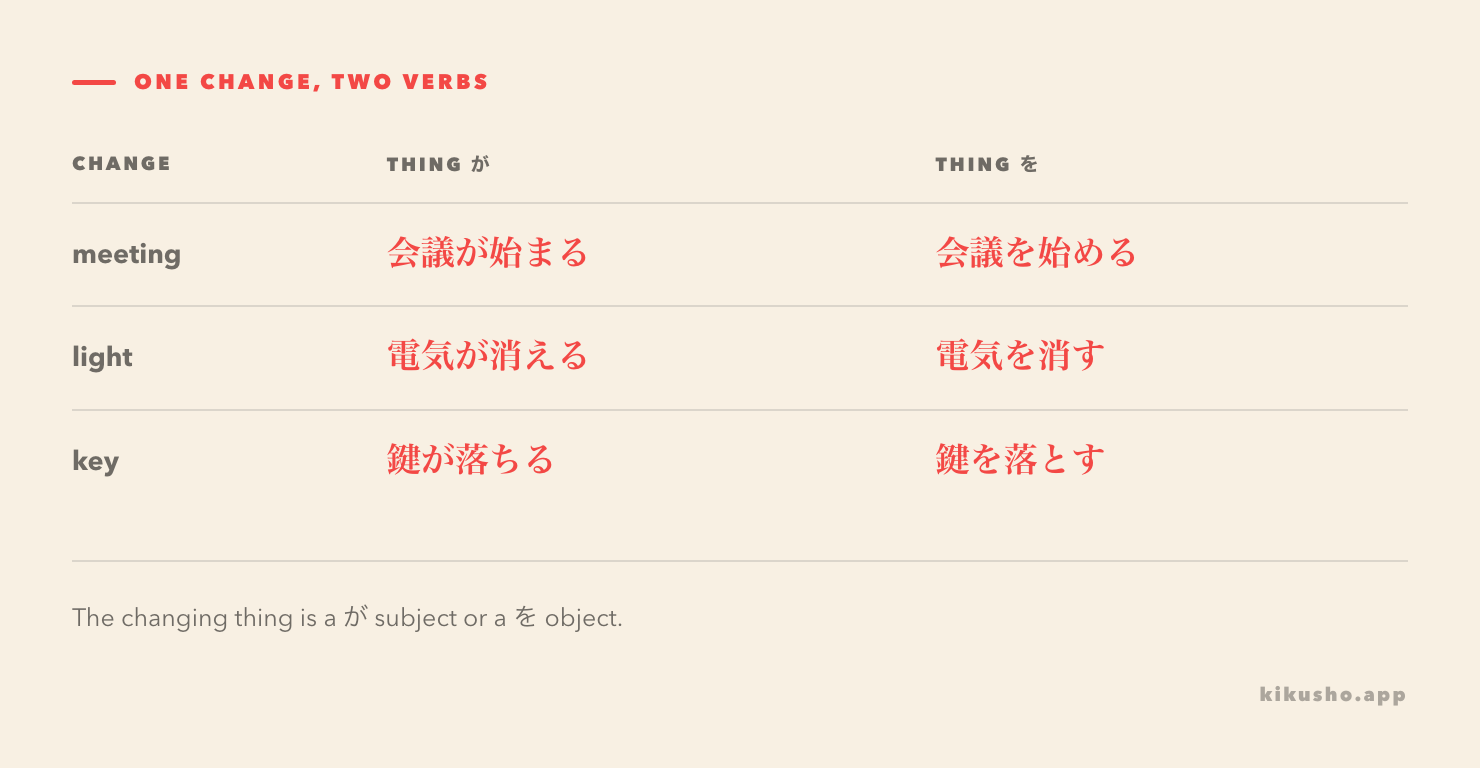
The table is a way to read the sentences, not a rule that converts one verb ending mechanically into the other. 始まる/始める and 落ちる/落とす change differently. Bunpro's N4 pairs give 落とす/落ちる, and JLPT Sensei gives 始める/始まる; Tofugu confirms 消す/消える. Learn the entire word, reading and typical noun beside it. The contrast is neutral in register: 始まります and 始めます are polite versions of the two verbs, not a change in transitivity.
One scene can be described both ways
At the start of a meeting, 会議が始まりました (かいぎが はじまりました) reports “The meeting began.” 司会者が会議を始めました (しかいしゃが かいぎを はじめました) says “The moderator started the meeting.” Both could be true of the same moment. The first sentence says nothing about who started it; the second identifies a doer and the affected meeting.
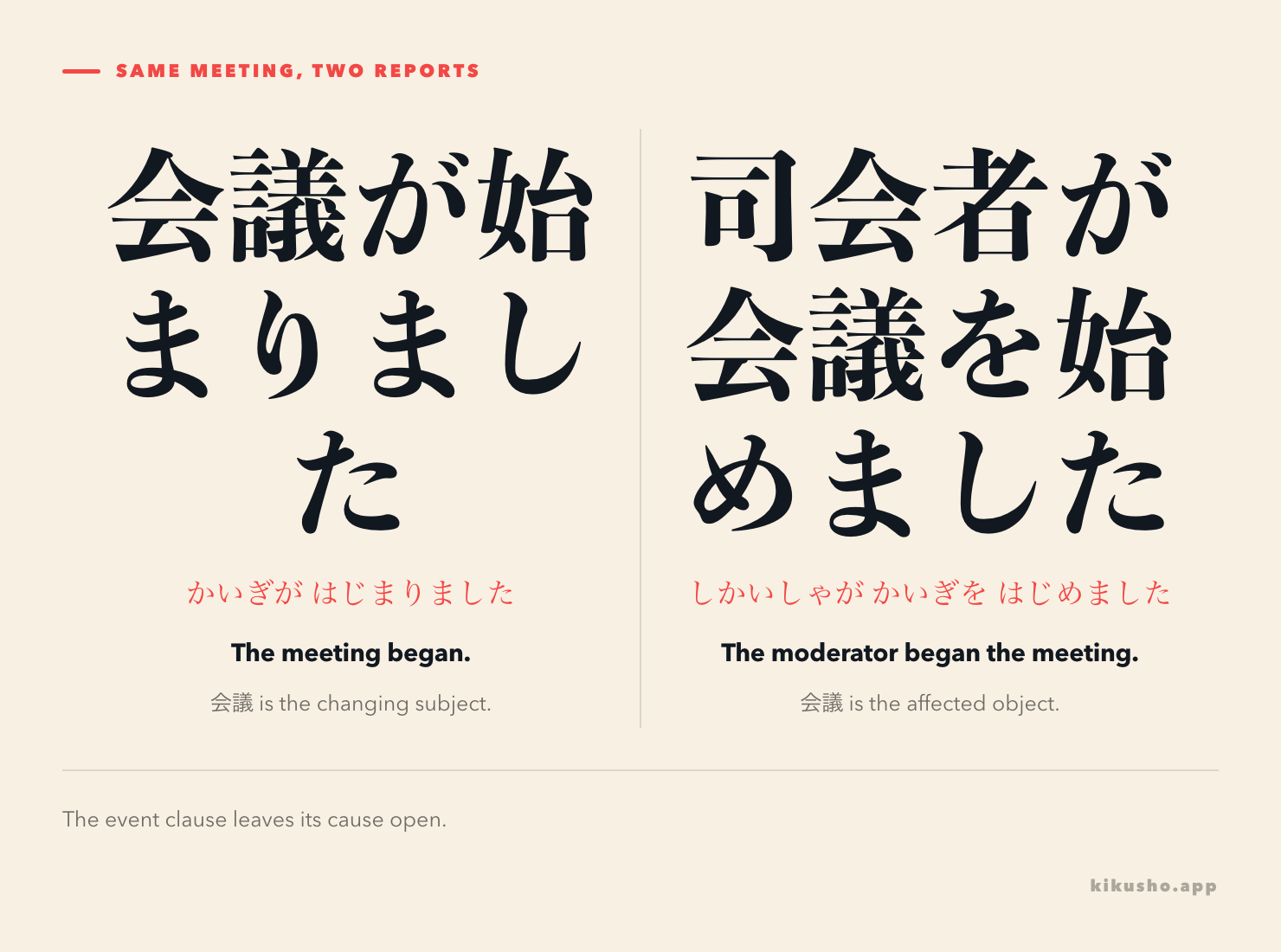
鍵が机から落ちました (かぎが つくえから おちました) means “The key fell from the desk.” 弟が鍵を落としました (おとうとが かぎを おとしました) means “My younger brother dropped the key.” The intransitive sentence leaves the cause open. It is possible that my brother knocked the key off the desk and that both reports describe the same fall. Neither verb alone establishes fault or politeness.
The Japan Foundation pairs 入る/入れる when an ingredient goes into food or a cook adds it. That same participant shift appears here with keys, meetings and lights. The five Japanese verb families teach 入る/入れる as vocabulary with a destination に; this grammar page keeps the focus on the subject-versus-object decision across several pairs.
An event sentence is not an alibi
Suppose a caretaker presses the light switch and the room goes dark. You can say 係の人がスイッチを押しました。電気が消えました (かかりの ひとが スイッチを おしました。でんきが きえました): “The caretaker pressed the switch. The light went out.” A person plainly caused the change, but the second sentence still uses the intransitive 消える to report what happened to the light. 電気が消えました does not claim that nobody did anything.
Likewise, 電気を消しました has a transitive object even if the person is left unnamed. It does not, by itself, confess blame or say whether switching off the light was a mistake. The reported action and the moral judgement are separate. Tofugu also distinguishes these pairs from passive voice; an intransitive event is not a covert accusation or an automatic passive sentence.
Particles help, but they cannot classify a verb alone
In these basic paired examples, thing が + intransitive verb and thing を + transitive verb keep the two views clear. But a transitive verb can appear without its object when the listener already knows what was affected. 昨日読みました (きのう よみました, “I read it yesterday”) still uses the transitive 読む, even though the book is not repeated. A sentence can also have 私が as the actor of a transitive verb; が is not an “intransitive particle.” Tofugu explains this omitted-object case.
Nor is every を a direct object. 道を歩く (みちを あるく) means “walk along a road”; 道 is a path, and 歩く is intransitive in that use. The change-verb vocabulary lesson explains the analogous 階段を上がる path use and why suffixes alone cannot reveal a verb's type. First decide the role of the noun and the meaning of the verb. Then select the member of the actual pair.
When you capture 電気が消えた from a story in Kikusho, keep the sentence rather than only 消える. The generated card can retain the noun and particle that tell you which view the story chose; check its reading and meaning before saving it, and recall that contrast during offline review.
Practice: decide whose change the sentence presents
Answer all six questions before reading the explanation block.
Question 1 — grammar choice. The meeting began on time. You want to report the event without naming who began it. Select the clause that does only that.
- A. 会議が始まりました。
- B. 会議を始まりました。
- C. 会議が始めました。
Question 2 — grammar choice. You switched the light off yourself and want to report your action. Which sentence marks the light as the direct object?
- A. 私が電気が消しました。
- B. 私が電気を消しました。
- C. 私が電気を消えました。
Question 3 — sentence composition. Compose “The key fell from the desk” in polite past, with 鍵, 机から and the intransitive 落ちる.
Question 4 — sentence composition. Compose “My younger brother dropped the key” in polite past, with 弟, 鍵 and the transitive 落とす.
Question 5 — text grammar. Read: 係の人がスイッチを押しました。電気が消えました。 What did the second sentence report, and does its intransitive verb rule out a human cause?
Question 6 — text grammar. Read: 司会者が会議を始めました。会議が始まりました。 Which sentence names the moderator's action, and which describes what happened to the meeting? Identify the different roles of 会議.
Answers and explanations
Answer 1. A, 会議が始まりました。 The meeting is the changing subject marked が, and 始まる reports that it began. B pairs the intransitive verb with an object を for the meeting; C uses transitive 始める without an object and marks the meeting as a would-be acting subject.
Answer 2. B, 私が電気を消しました。 私が names the actor; 電気を is the direct object affected by 消す. A stacks two が phrases while giving the light no を object for 消す. C marks 電気 as an object with を but uses the intransitive 消える.
Answer 3. 鍵が机から落ちました。 (かぎが つくえから おちました), “The key fell from the desk.” 鍵が is the subject that fell; 机から marks where it fell from. 落ちる → 落ちました supplies polite past. Nothing in this sentence establishes why it fell.
Answer 4. 弟が鍵を落としました。 (おとうとが かぎを おとしました), “My younger brother dropped the key.” 弟が is the doer, 鍵を is the object, and 落とす → 落としました gives polite past. 鍵が落ちました could report the resulting fall but would leave the brother's action out.
Answer 5. 電気が消えました reports that the light went out. It does not deny a human cause. The previous sentence explicitly says the caretaker pressed the switch, so both an action and its resulting event are present in this short text.
Answer 6. 司会者が会議を始めました names the moderator's action: 会議 is the direct object marked を. 会議が始まりました reports that the meeting began: 会議 is the changing subject marked が. Both statements can describe the same start, while only the first names the doer.
Common questions
What is the difference between a transitive and an intransitive verb?
A transitive verb can act on a direct object, as in 電気を消す, “switch off the light.” An intransitive verb has no direct object for that change, as in 電気が消える, “the light goes out.” Japanese often has two different verbs for these two clause structures.
Does 電気が消えた mean nobody turned the light off?
No. It reports that the light went out without saying what caused it. A person could have turned it off; 電気を消した presents that person's action.
Are endings enough to identify every transitive-intransitive pair?
No. 始まる and 始める form one pair, but endings are only clues. Memorize each actual verb, reading and example pattern; 消える and 消す do not follow that same ending change.
Does が always mean the verb is intransitive?
No. が may mark the person acting in a transitive sentence, while the object is omitted because the context supplies it. A route marked を can also accompany an intransitive motion verb; examine the noun's role.