
On this page
Use 開く(あく) when a door or shop becomes open, 開ける(あける) when someone opens it, 止まる(とまる) when movement stops, and 始まる(はじまる) when an event begins. These four assigned N5 words cover opening, stopping and starting; 終わる(おわる) supplies the later completion point and already has its own linked lesson.
One morning at a museum makes the roles visible. The entrance opens, a staff member opens a window, the tour bus stops outside, and the guided visit begins. The English verbs are simple, but Japanese changes the verb and particle according to whether the sentence reports an event or someone's action.
Four core verbs on one opening-day schedule
| Word | Reading | Basic frame | Meaning |
|---|---|---|---|
| 開く | あく | ドアが開く | the door opens |
| 開ける | あける | ドアを開ける | open the door |
| 止まる | とまる | バスが止まる | the bus stops |
| 始まる | はじまる | 見学が始まる | the visit begins |
Three verbs report what happens to their subject and naturally use が in these basic frames. 開ける acts on an object, so the opened thing takes を.
開く reports that something becomes open
開く(あく) is an intransitive godan verb. A door, window, gate or shop is the subject that changes from closed to open.
八時五十分に入口のドアが開きます。
はちじ ごじゅっぷんに いりぐちの ドアが あきます。
The entrance door opens at 8:50.
The polite form is 開きます(あきます), not あくます. Change the final く to き before ます: 開く → 開きます → 開きました.
この店は九時に開きます。
この みせは くじに あきます。
This shop opens at nine.
Kanjipedia's entry for 開く(あく) gives both central uses: a closed thing opens, and an inactive business begins operating. In 店が開く, the shop is presented as becoming open for business; the sentence does not name the worker who unlocked it.
開ける presents someone's opening action
開ける(あける) is a transitive ichidan verb. Someone removes a cover or barrier so that a door, window, lid, bag or container is open.
係の人が窓を開けます。
かかりの ひとが まどを あけます。
A staff member opens the window.
係の人が names the actor, 窓を marks the affected object, and 開けます names the action. The actor can be omitted when it is already clear:
暑いですから、窓を開けてください。
あついですから、まどを あけて ください。
It is hot, so please open the window.
The National Institute for Japanese Language and Linguistics entry identifies 開ける as transitive, pairs it with intransitive 開く, and supplies examples with windows, doors, gates, drawers and shops. Its verb-pattern database likewise records a subject with が and the opened object with を.
Because 開ける is an ichidan verb, remove る before ます: 開ける → 開けます → 開けました.
The particle reveals the view of the same scene
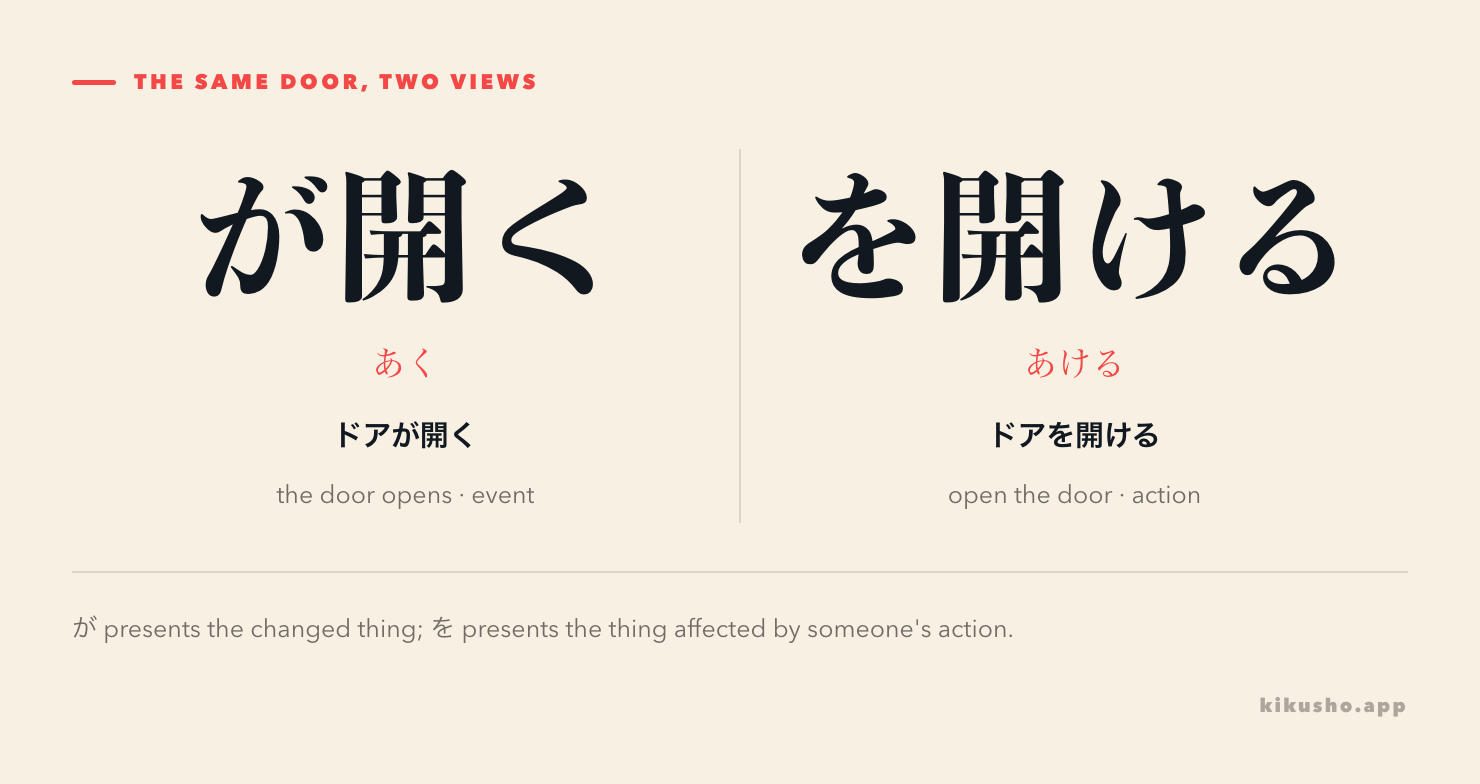
These two sentences can describe the same opening:
ドアが開きました。
ドアが あきました。
The door opened.
係の人がドアを開けました。
かかりの ひとが ドアを あけました。
A staff member opened the door.
The first sentence reports the change and leaves the cause unstated. It does not claim that the door opened by magic or automatically. The second sentence presents the person's action. The transitive and intransitive pairs lesson develops this event-versus-action choice with several verb pairs.
For a beginner, store the full frames ドアが開く and ドアを開ける. Memorizing only “open” removes the particle clue that selects the correct verb.
One spelling, two readings: 開く can also be ひらく
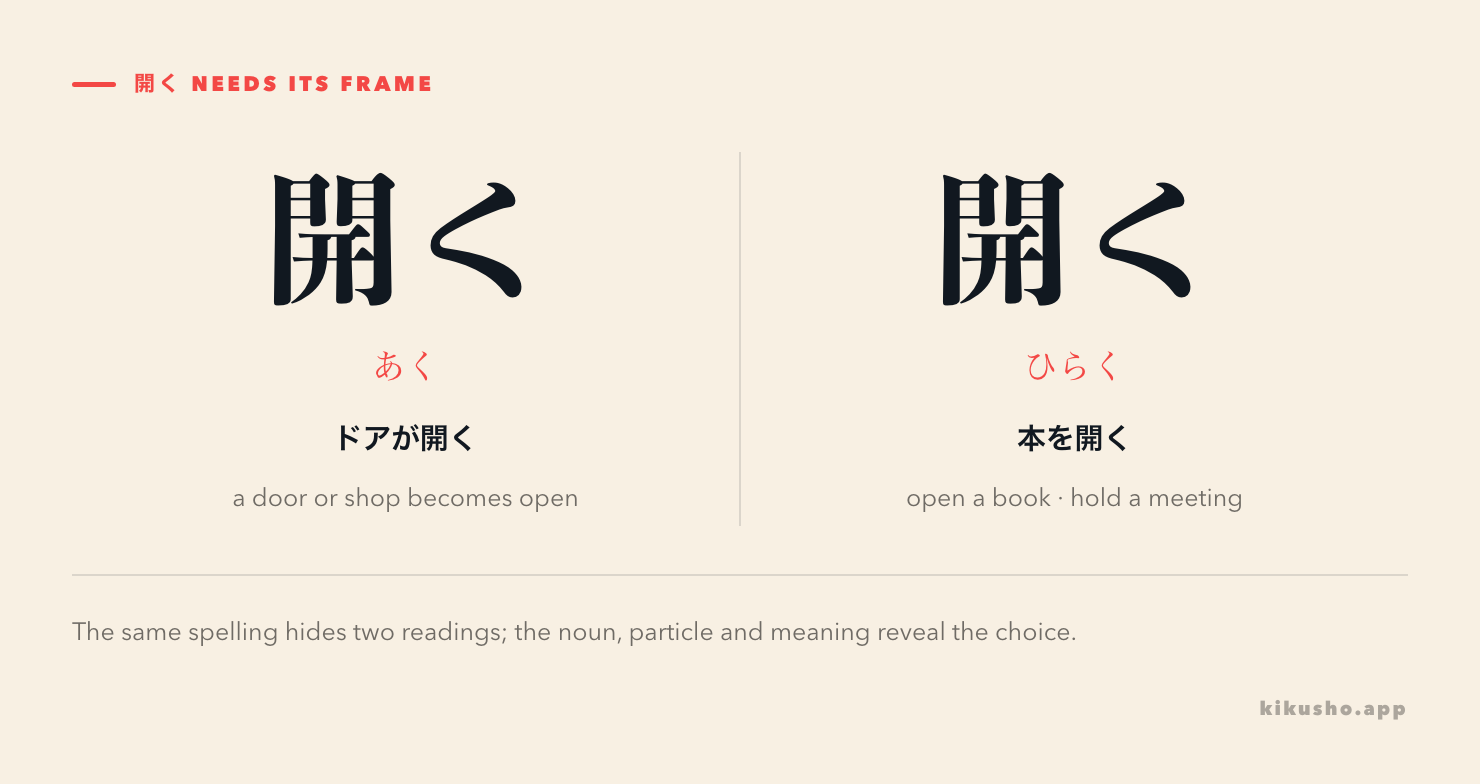
The assigned word in this lesson is 開く(あく), “to become open.” The same spelling 開く also has the reading ひらく in different frames.
本を開きます。
ほんを ひらきます。
I open the book.
来週、会議を開きます。
らいしゅう、かいぎを ひらきます。
We will hold a meeting next week.
The difference is not visible in the kanji alone. A door or shop becoming open strongly supports あく. A person opening a book, spreading something out, establishing something or holding a meeting supports ひらく. The dictionary entry for 開く(ひらく) covers that broader reading, while the dictionary usage note for 開ける contrasts removing a cover with spreading open a book.
止まる reports that movement or operation stops
止まる(とまる) is an intransitive godan verb. A vehicle, machine, clock, flow or continuing process is the subject that comes to a stop.
九時前に見学バスが入口で止まります。
くじまえに けんがくバスが いりぐちで とまります。
The tour bus stops at the entrance before nine.
時計が止まりました。
とけいが とまりました。
The clock stopped.
Shogakukan's 止まる entry begins with a moving thing ceasing to move and extends the word to operations and flows that cease. The polite forms are 止まります and 止まりました.
Contrast the transitive partner 止める(とめる):
- バスが止まる: the bus stops.
- 運転手がバスを止める: the driver stops the bus.
At N5, follow the noun role rather than trying to guess whether a person caused the event. A driver can cause the bus to stop, while バスが止まりました still presents the bus's change.
始まる reports that an event begins
始まる(はじまる) is an intransitive godan verb. A class, film, meeting, tour, season or other event is the subject that begins.
九時に博物館の見学が始まります。
くじに はくぶつかんの けんがくが はじまります。
The museum visit begins at nine.
The dictionary entry for 始まる defines it as an event newly occurring or being initiated and contrasts it with 終わる. Its polite forms are 始まります and 始まりました.
The transitive partner 始める(はじめる) names someone's action:
- 見学が始まる: the visit begins.
- 先生が見学を始める: the teacher starts the visit.
Do not write 見学を始まります. If 見学 takes を, the verb must be the transitive 始める in this basic contrast.
Completion needs 終わる, not 止まる
The four assigned inventory items contain no verb meaning “complete.” To finish the museum timeline accurately, use the familiar endpoint 終わる(おわる).
十時半に見学が終わります。
じゅうじはんに けんがくが おわります。
The visit ends at 10:30.
Use 止まる when movement, operation or flow halts: バスが止まる, 時計が止まる. Use 終わる when an event or bounded activity reaches its endpoint: 見学が終わる, 授業が終わる. The action-phases lesson teaches completion with 終わる in its own canonical scope.
Read the whole museum morning
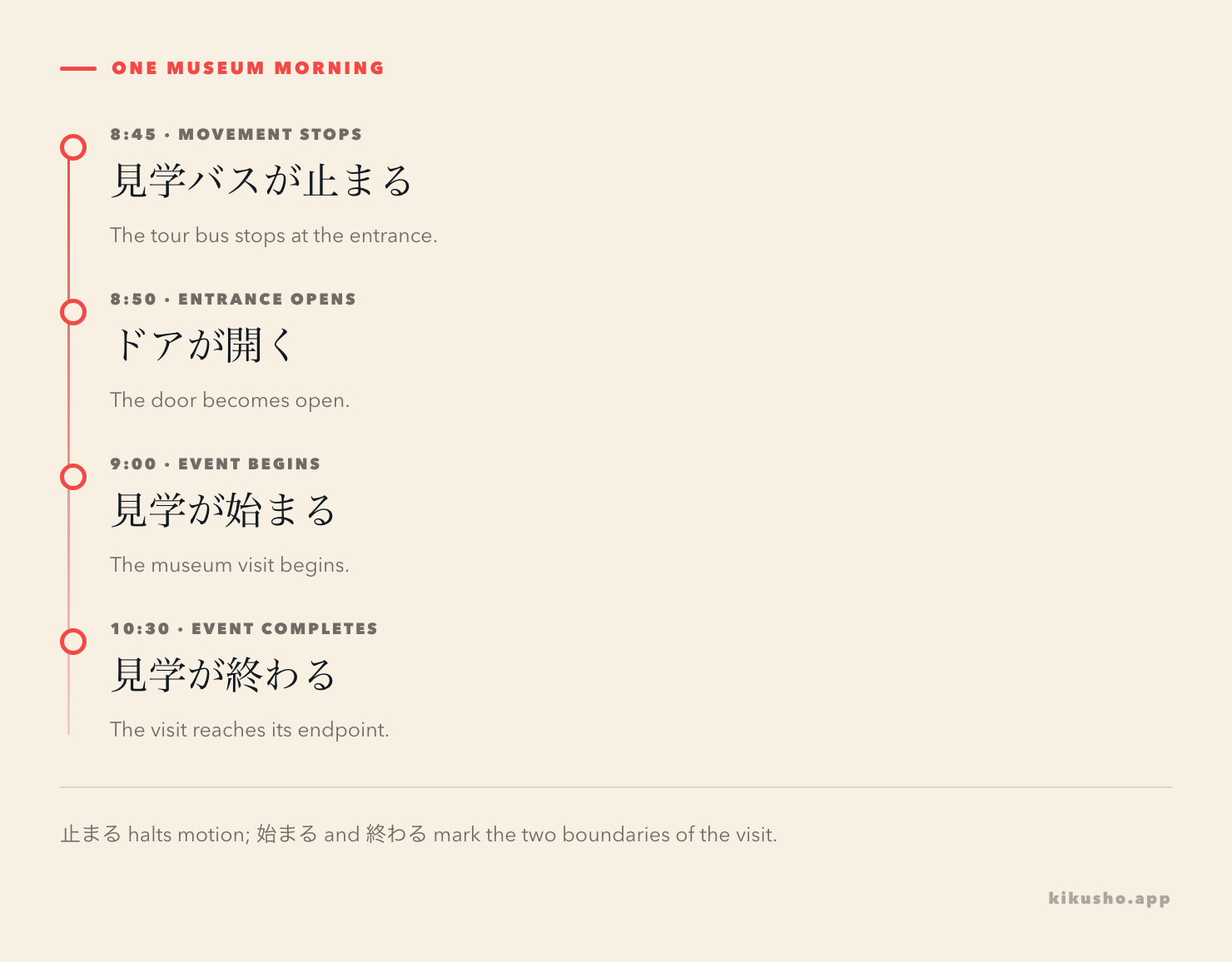
九時前に見学バスが入口で止まります。八時五十分に入口のドアが開き、係の人が窓を開けます。九時に博物館の見学が始まります。十時半に見学が終わると、バスは次の場所へ行きます。
くじまえに けんがくバスが いりぐちで とまります。はちじ ごじゅっぷんに いりぐちの ドアが あき、かかりの ひとが まどを あけます。くじに はくぶつかんの けんがくが はじまります。じゅうじはんに けんがくが おわると、バスは つぎの ばしょへ いきます。
The tour bus stops at the entrance before nine. At 8:50 the entrance door opens, and a staff member opens a window. The museum visit begins at nine. When the visit ends at 10:30, the bus goes to the next place.
When you save these words in Kikusho, keep the noun and particle: ドアが開く, 窓を開ける, バスが止まる and 見学が始まる. The complete frame turns four similar English verbs into four visible Japanese decisions.
Why Kikusho teaches these four at N5
Kikusho's September 2026 reference inventory places the exact 開く(あく), 開ける(あける), 止まる(とまる) and 始まる(はじまる) records at N5. Its two baseline files share Waller/Tanos lineage. A separate study index corroborates 開ける, 止まる and 始まる at N5.
That index files a headword-only 開く result under N4 but gives the reading ひらく, so it does not contradict the exact N5 entry 開く(あく) taught here. This is a spelling collision between two readings, not reliable evidence that the same lexical item moved levels. The JLPT organisers do not publish a fixed vocabulary syllabus, so Kikusho records the disagreement and teaches the verified reading and frame directly.
Practice: follow the museum schedule before opening the key
1 · Door sound. The museum door opens. Which kana belongs to 開く in ドアが開く?
A. あく
B. あける
C. ひらく
D. しまる
2 · Stop sound. The bus comes to a halt. Which kana belongs to 止まる in バスが止まる?
A. やまる
B. とめる
C. とまる
D. しまる
The schedule now moves from recognizing sound to choosing the correct written verb.
3 · Opening-action spelling. Which word is あける, “to open something”?
A. 空く
B. 開ける
C. 開く
D. 明る
4 · Beginning-event spelling. Which word is はじまる, “for an event to begin”?
A. 初める
B. 始める
C. 初まる
D. 始まる
5 · Door event. No actor is named; the entrance door becomes open at 8:50. Complete ドアが_.
A. 開きます
B. 開けます
C. 止まります
D. 始まります
6 · Staff action. A staff member acts on the window. Complete 係の人が窓を_.
A. 開きます
B. 止まります
C. 開けます
D. 始まります
7 · Vehicle change. The tour bus comes to a halt at the entrance. Complete バスが入口で_.
A. 始まります
B. 止まります
C. 開けます
D. 終えます
8 · Event boundary. The museum visit begins at nine. Complete 九時に見学が_.
A. 開けます
B. 止めます
C. 終えます
D. 始まります
The final two items ask what the complete clause claims, rather than testing one form in isolation.
9 · Paraphrase the actor. What does 係の人がドアを開けました say?
A. The door opened, with no actor presented.
B. The staff member stopped at the door.
C. The staff member opened the door.
D. The visit began at the door.
10 · Complete timeline. Which line distinguishes a vehicle stopping from an event reaching its endpoint?
A. バスが止まり、見学が終わります。
B. バスが終わり、見学が止まります。
C. バスを止まり、見学を終わります。
D. バスが開けて、見学が始めます。
The answer panel below follows the same sequence as the morning: opening state, human action, stopped movement, begun event and completed visit.
Answers and explanations
Check the noun's particle first; it usually reveals whether the sentence reports an event or an action.
- A. ドアが開く is read ドアがあく. The reading ひらく belongs to other frames such as 本を開く.
- C. 止まる is read とまる and reports that the vehicle itself stops.
- B. 開ける is the transitive verb used when someone opens a door, window or container.
- D. 始まる uses 始 and the intransitive ending まる for an event beginning.
- A. ドアが開きます reports the door's change from closed to open.
- C. 窓を開けます marks the window as the object of the staff member's action.
- B. バスが止まります reports that the bus comes to a halt.
- D. 見学が始まります places the visit at its beginning boundary.
- C. 係の人が is the actor, ドアを is the object, and 開けました is the completed opening action.
- A. 止まる fits the vehicle's halted movement; 終わる fits the visit reaching its endpoint.
Common questions
What is the difference between 開く and 開ける?
開く, read あく here, says that a door, window or shop becomes open and normally takes が. 開ける says that someone opens it and marks the opened thing with を.
When is 開く read あく and when is it read ひらく?
Use あく when something becomes open, as in ドアが開く. The reading ひらく appears when opening something that spreads out, such as 本を開く, or holding an event, as in 会議を開く. Learn each reading with its frame.
What is the difference between 止まる and 止める?
止まる reports that a bus, clock or flow stops and uses the stopped thing as its subject. 止める reports that someone stops something and marks it as an object with を.
What is the difference between 始まる and 始める?
始まる says an event begins, as in 授業が始まる. 始める says someone starts the event or activity, as in 先生が授業を始める.