On this page
A day of speaking Japanese asks the same small courtesies of you before it asks anything hard. You greet someone (挨拶), you thank them (お礼), you say sorry for being late (謝る), you wave off an offer rather than impose (遠慮), and along the way you are treated kindly (親切) or served carefully (丁寧), or you excuse a small rudeness of your own (失礼). Seven N4 words, and between them they cover the conduct an ordinary day runs on.
What binds them is register, not meaning. These are the plain, everyday versions: 謝る, not the formal 詫びる; お礼, not the 御礼状 of a business letter. They are the base layer that keigo is later stacked on top of, which is why they reach you early and stay useful for years. Learn them as seven things you do to people, in the order a day hands them to you, and the grammar of politeness has somewhere to attach.
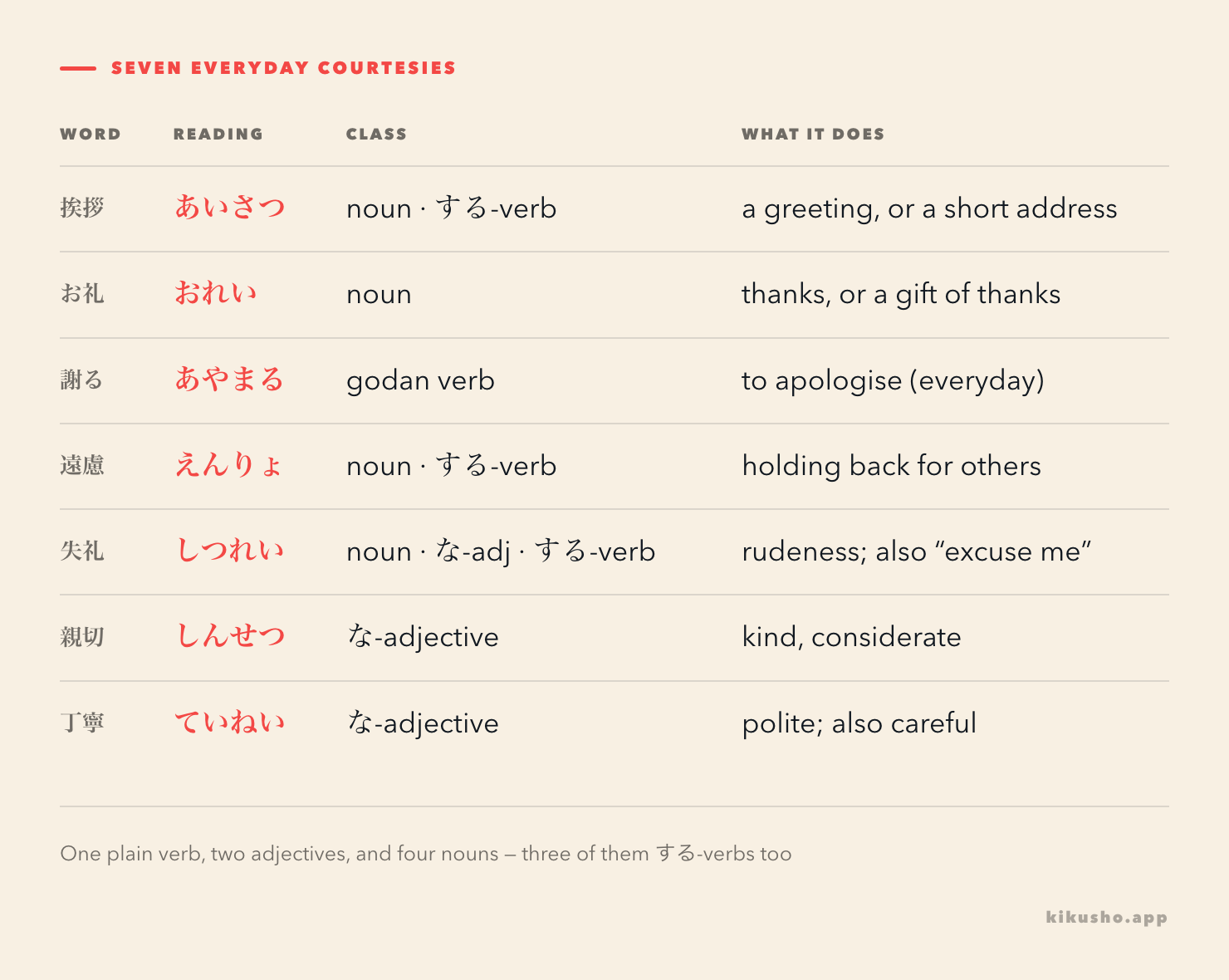
The seven, and what class each one is
Six of the seven are nouns or な-adjectives; only 謝る is a plain verb. Three of them — 挨拶, 遠慮 and 失礼 — also work as する-verbs, so the same word names both the thing and the doing of it. Keep the class in view, because it decides the particle and the ending you reach for.
| Word | Reading | Class | What it does |
|---|---|---|---|
| 挨拶 | あいさつ | noun, する-verb | a greeting, or a short formal address |
| お礼 | おれい | noun | thanks, or a gift given in thanks |
| 謝る | あやまる | godan verb | to apologise (the everyday word) |
| 遠慮 | えんりょ | noun, する-verb | holding back out of consideration |
| 失礼 | しつれい | noun, な-adj, する-verb | rudeness; also "excuse me" |
| 親切 | しんせつ | な-adjective | kind, considerate |
| 丁寧 | ていねい | な-adjective | polite; also careful |
One word sits on a border. Most lists place 挨拶 at N4, but at least one files it a level higher at N3. Treat that as a note about where an exam might test it, not a reason to leave it for later: it is among the first words a learner ever uses, whatever the label.
挨拶 and お礼: the words you use first
挨拶 is the greeting itself, and it is wider than おはよう. It names the whole class of set phrases you trade on meeting and parting, and it stretches to a short formal address: the 挨拶 at a wedding is a speech, not a wave. You do it with する or を: 朝の挨拶をする, きちんと挨拶する. A first day at a Japanese company usually includes 挨拶回り, going desk to desk to introduce yourself.
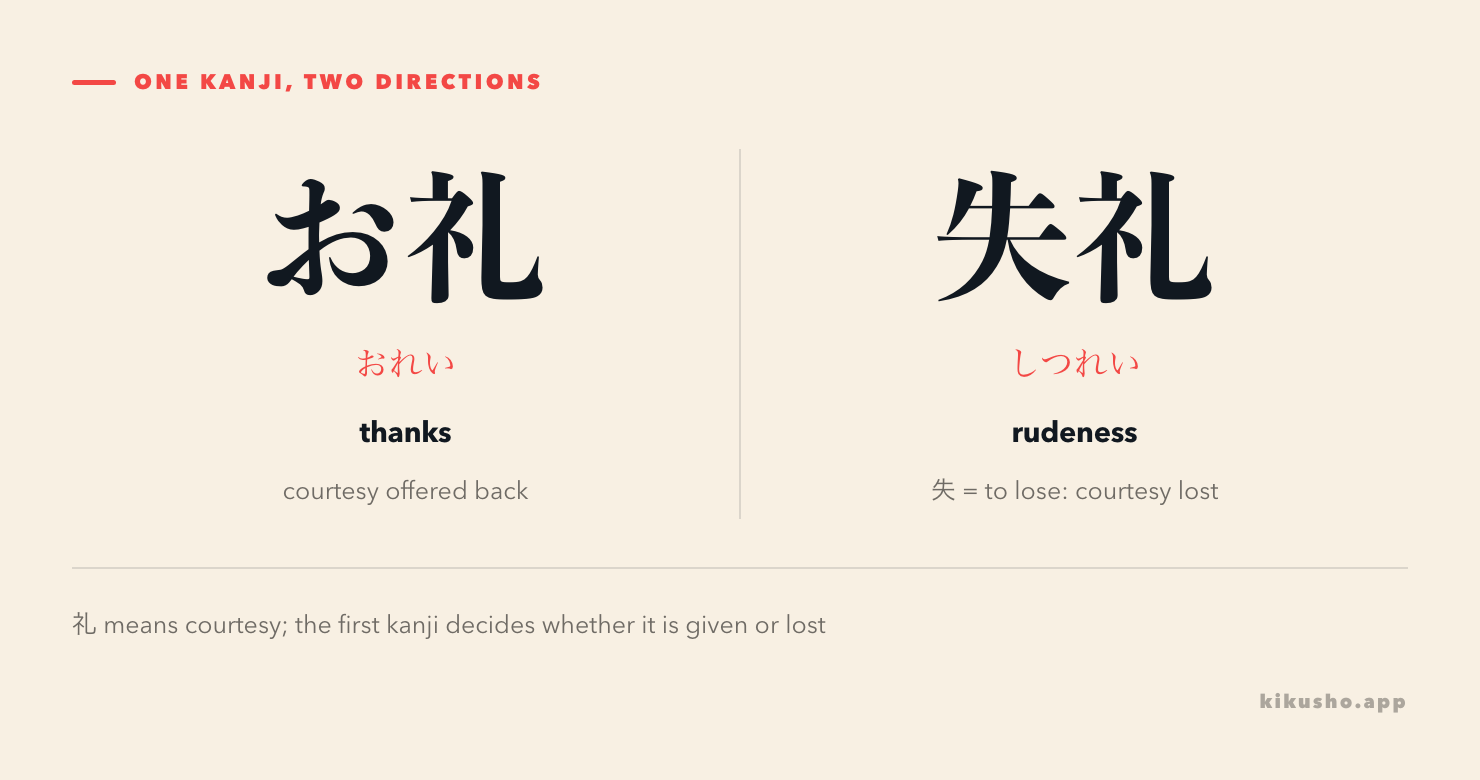
お礼 is thanks made concrete. お礼を言う is to say thank you; お礼をする can mean to repay a kindness with something; and お礼 on its own is often the gift or token itself, as in お世話になったお礼. The お is all but welded on here, part of the word rather than a detachable politeness. The kanji 礼 means courtesy, and it returns in a moment wearing the opposite sign.
謝る and 失礼: saying sorry, and naming rudeness
謝る is the ordinary apology. It is the word for a normal, spoken sorry: for running late, for a slip at work, for knocking someone's umbrella on a crowded platform. It is a godan verb (謝ります, 謝って, 謝った), and the person you apologise to takes に: 友達に謝る, お客さんに謝る. What you apologise for takes を: 遅刻を謝る, 失礼を謝る. There is a more formal, more written word for the same act, 詫びる, with the noun お詫び; that pair belongs to the N2 courtesy vocabulary and can wait.
失礼 is 礼 with its sign flipped. 失 is to lose, so 失礼 is courtesy lost: rudeness. As a な-adjective it labels the offence: 失礼な質問, 失礼な人. As a する-verb it turns into a set phrase you will say many times a day. 失礼します is what you offer entering a room, leaving before others, or ending a call; 失礼しました apologises for a small lapse; 失礼ですが softens a question before you ask it. Said lightly it is nearer to "excuse me" than to a real apology, which is what keeps it clear of 謝る.
遠慮: the restraint English needs a sentence for
遠慮 is the word that feels most foreign, because it names a move English handles with a whole clause. At its core it is holding back out of consideration for others: not taking the last piece, not pressing your opinion, declining a kindness so as not to impose. 遠慮する is to do exactly that, and it doubles as a soft way to decline. お茶のおかわりは遠慮した turns down a refill without a flat "no".
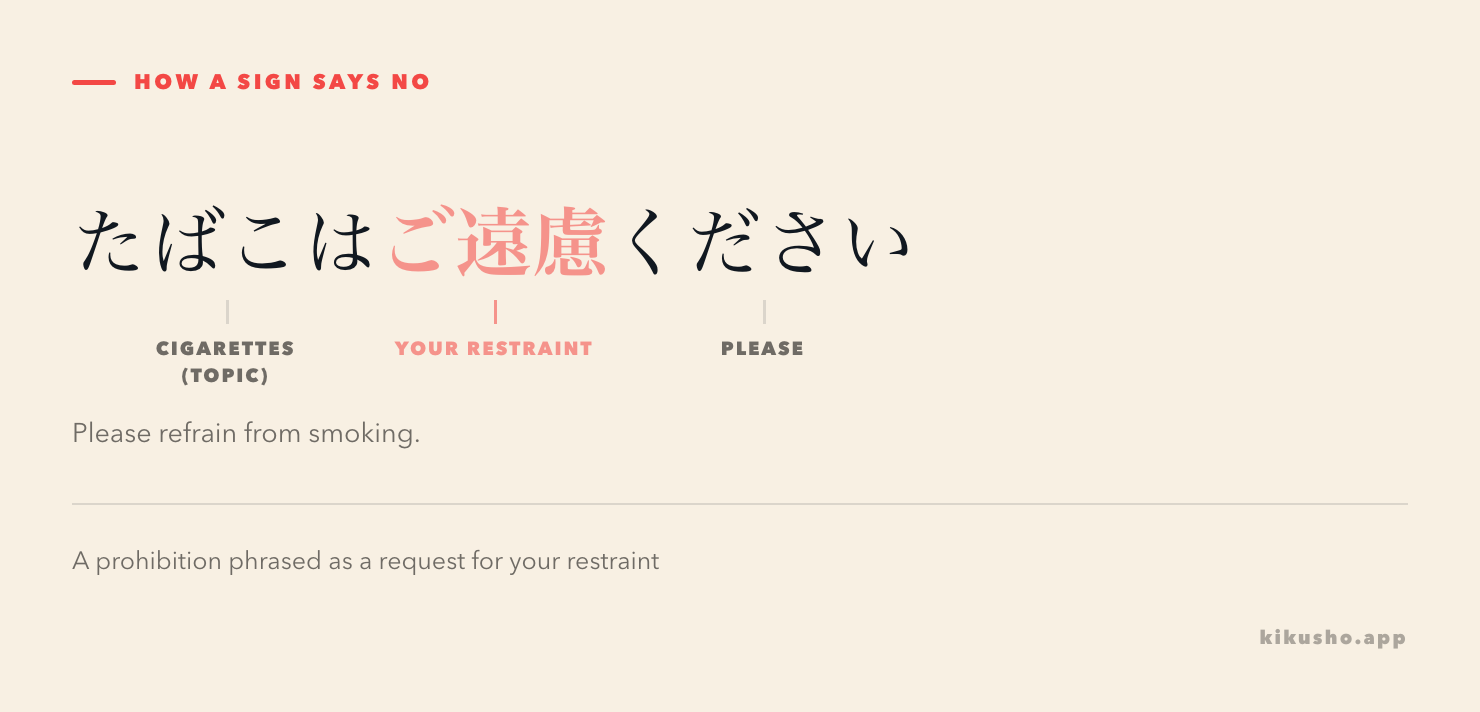
Two set forms carry most of its weight, and they point opposite ways. 遠慮なく tells someone not to hold back: 遠慮なくお使いください, please use it freely. ご遠慮ください asks them to hold back, and it is how signs and announcements say "don't" without saying it. Reading the one and producing the other is the real N4 skill here.
親切 and 丁寧: kind, and careful
The last two describe how a person treats you or does a job, and both are な-adjectives. 親切 is kindness aimed at a person: 親切な店員, a kind shop assistant. You are kind to someone with に: 彼はいつも私に親切にしてくれる. When a stranger helps you unasked, ご親切に is the set thanks for it.
丁寧 is the one to watch, because it holds two senses English keeps apart. The first is polite: 丁寧な言葉遣い is courteous speech, and 丁寧語 is the です/ます register itself. The second is careful and thorough: 丁寧に書く is to write neatly, with attention, and 丁寧な仕事 is a painstaking job. What joins them is due care, whether the thing being done is speech or work. Which sense applies is nearly always settled by what 丁寧 describes: someone's manner, or an action and its result. This is where politeness stops being single words and becomes the grammar of keigo, which 丁寧語 names.
Where the pattern bends
The set has a shape, and the useful part is where it breaks.
- 失礼 is the negative one, and the busiest. It is the only word here that names a fault rather than a courtesy, and the only one that is a noun, a な-adjective and a set-phrase verb at once. You will say 失礼します more often than any of the other six.
- 謝る is the only plain verb. The rest are nouns or な-adjectives; 謝る conjugates like any godan verb, and it is the one whose formal twin, 詫びる, waits a level ahead.
- 丁寧 is the only one doing two jobs. Every other word points one way. 丁寧 covers both courtesy and care, so a reader who learns only "polite" will misread 丁寧に確認する, which is checking something carefully, not politely.
Which ones you will meet this week
None of these waits for a lesson. 挨拶 and 失礼します reach you on the first morning; お礼 and 親切 the first time someone helps you; 遠慮 the first time you have to turn something down without giving offence; 謝る the first time you are late. They come attached to a situation, one at a time, which is the opposite of how a column of words hands them over.
That spread is the argument for keeping each word at the moment it turns up, instead of pre-loading all seven from a column. The moment a doorway stops you with ご遠慮ください, or a clerk's 丁寧な対応 makes you want the word for it, is when the word is worth keeping. Kikusho is built to make that keeping cost nothing: aim the phone at the sign, drop in the line you read, or speak the phrase you heard, and it drafts a card for you to check and save, with the reading, the meaning and a note on register already on it. The schedule under the reviews is FSRS and runs with no signal, which suits a courtesy you met once at a counter and will next need a month from now.
What these seven buy you is not a mark on a test. It is the first time you decline an offer with 遠慮 rather than a stiff "no", and the person across from you eases, because the courtesy landed the way you meant it.
Practice: readings, meaning and register
Try the whole set before you open the answers.
1 · Read the restraint word. Give the reading of the bold word: 店内では、たばこはご遠慮ください。
- ① えんりょ
- ② おんりょ
- ③ えんろ
- ④ とおりょ
2 · The courtesy adjective. What is the bold word's reading? 先生はいつも丁寧に教えてくれる。
- ① ていねい
- ② ちょうねい
- ③ ていれい
- ④ ていね
3 · Describe the helper. Choose the word that fits: 重い荷物を持ってくれるなんて、( )な人ですね。
- ① 親切
- ② 失礼
- ③ 丁寧
- ④ お礼
4 · The late arrival. Choose the word that fits: 待ち合わせに遅れたので、友達に( )。
- ① 謝った
- ② 遠慮した
- ③ 挨拶した
- ④ お礼を言った
5 · A softer no. Which phrase is closest in meaning to the bold word? お茶のおかわりは遠慮した。
- ① 断った
- ② 感謝した
- ③ 謝った
- ④ 挨拶した
6 · Using 丁寧. In which sentence is 丁寧 used naturally?
- ① 彼は字を丁寧に書く。
- ② 私は友達を丁寧する。
- ③ 今日は丁寧な天気ですね。
- ④ 電車が丁寧に遅れた。
Answers and explanations
①, えんりょ. The reading of 遠慮 is えんりょ. ② おんりょ borrows the wrong on-reading for 遠; ③ えんろ drops the medial vowel; ④ とおりょ takes the kun-reading とお of 遠 (as in 遠い), which the compound does not use.
①, ていねい. 丁寧 is read ていねい. ② ちょうねい reaches for チョウ, a reading of 丁 heard in 丁目 but not here; ③ ていれい and ④ ていね are near-misses with the wrong second syllable or a missing one.
①, 親切. Someone carrying your heavy bag is being kind, so 親切な人 fits. ③ 丁寧 (polite, careful) does not describe an act of help; ② 失礼 is the opposite; ④ お礼 is a noun for thanks and cannot follow な to describe a person.
①, 謝った. You were late, so you apologise to your friend: 友達に謝った, with に marking the person. ② 遠慮した (held back) and ③ 挨拶した (greeted) miss the situation, and ④ お礼を言った (thanked) is the wrong response to being late.
①, 断った. Here 遠慮した means you politely declined the refill, so 断った (refused, declined) is closest. ② 感謝した (thanked), ③ 謝った (apologised) and ④ 挨拶した (greeted) each name a different act.
①, 彼は字を丁寧に書く。 丁寧に書く, to write carefully, uses the adverb form correctly. ② treats 丁寧 as a する-verb taking a person, which it is not; ③ 丁寧な天気 (careful weather) and ④ 丁寧に遅れた (carefully late) attach the word to things it cannot describe.
Once these seven feel automatic, the next step is not more courtesy words but the grammar that carries them: how the same politeness lives in verb endings and requests. Japanese keigo basics picks up exactly there, and 〜てください for polite requests is the pattern behind ご遠慮ください and お使いください.
Common questions
Is 謝る the same as 詫びる?
Both mean to apologise. 謝る (あやまる) is the everyday, spoken sorry you use for being late or making a mistake. 詫びる (わびる) is more formal and more written, and its noun お詫び appears in official apologies. At N4, 謝る is the word you need; 詫びる comes a level later.
What does ご遠慮ください mean on a sign?
It is a polite way to say "please don't". 遠慮 is holding back out of consideration for others, so たばこはご遠慮ください literally asks for your restraint regarding cigarettes, which is how Japanese signs say "please refrain from smoking" without a blunt prohibition.
Does 丁寧 mean polite or careful?
Both. 丁寧な言葉遣い is polite, courteous speech, and 丁寧語 is the です/ます register itself; 丁寧に書く is to write neatly and with care. The shared idea is doing something with due attention. What 丁寧 describes — manner or an action — tells you which sense is meant.
Is 失礼 rude or polite?
The word names rudeness: 失礼な質問 is a rude question. But as a set phrase it is courteous: 失礼します is the "excuse me" you say entering or leaving a room, and 失礼しました apologises for a small lapse. The same word plays both roles.