On this page
でしょう (deshō) and だろう (darō) can make the same inference; the first is polite and the second is plain. Either form can also turn an assumption toward a listener for confirmation, so purpose and register decide more than the English word “probably.”
Both forms are commonly taught as N5 grammar by JLPT Sensei for でしょう and JLPT Sensei for だろう. Bunpro also lists でしょう and だろう at N5. These levels are teaching estimates because the JLPT does not publish an exhaustive grammar syllabus.
Ask what the sentence is doing, then choose its register
Use one decision test in two parts:
- Are you offering your own tentative conclusion, or do you expect the listener to confirm an assumption?
- Are you addressing that listener politely or in plain speech?
The first answer chooses the conversational job. The second answer normally chooses between でしょう and だろう.
| Purpose | Polite | Plain | Typical English cue |
|---|---|---|---|
| Tentative inference | でしょう | だろう | probably; I expect |
| Expected confirmation | でしょう? | だろう? | right?; isn't it? |
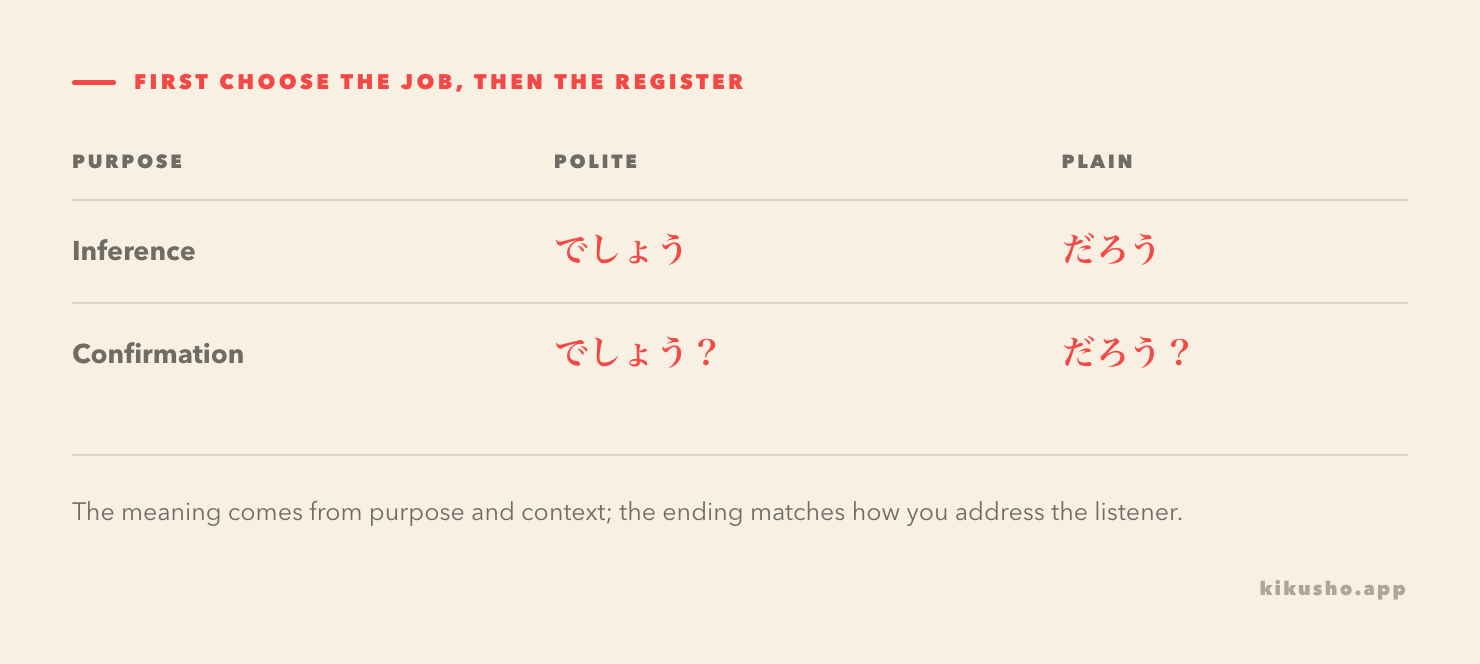
This table does not rank the forms by certainty. Switching from だろう to でしょう usually changes how you address the listener, not how many percent certain you are. Evidence, context, adverbs and delivery still shape the strength of the conclusion.
An inference offers the speaker's tentative conclusion
Suppose you checked the forecast but cannot know tomorrow's weather with certainty:
明日は雨が降るでしょう。
あしたはあめがふるでしょう。
It will probably rain tomorrow.
The speaker presents rain as an expected result. In an ordinary polite explanation, でしょう fits. The corresponding plain prediction is:
明日は雨が降るだろう。
あしたはあめがふるだろう。
It will probably rain tomorrow.
The forecast has not changed. The second sentence uses plain style. It may fit an internal monologue, plain writing or speech where that register is appropriate. Said directly to someone, it can sound more assertive than a learner expects.
The same distinction works with a reason already in view:
日曜日だから、銀行は休みだろう。
にちようびだから、ぎんこうはやすみだろう。
Since it is Sunday, the bank is probably closed.
The reason supports the inference; it does not make the conclusion certain. For a separate comparison between an open possibility and an expectation, see かもしれない and でしょう.
Confirmation turns an assumption toward the listener
Now imagine that two coworkers received the same schedule. One checks the remembered time:
明日の会議は九時からでしょう?
あしたのかいぎはくじからでしょう?
Tomorrow's meeting starts at nine, right?
This is not a forecast about an unknown event. The speaker already expects “yes” and asks the other person to confirm that shared assumption. NIHONGO NET's でしょう lesson highlights this agreement-seeking use.
Rising intonation often helps signal confirmation in speech, while a falling or neutral ending often presents an inference. Intonation is a clue, not a complete rule. The schedule, shared knowledge and expected answer are what make the example a confirmation request.
Plain だろう can perform the same job:
この道で合っているだろう?
このみちであっているだろう?
This is the right road, isn't it?
Directed at another person, this may feel insistent or rough depending on the relationship and delivery. だろう is not restricted to men, but sentence-final plain forms often carry social coloring that a dictionary gloss omits. In a polite conversation, でしょう is the safer N5 choice.
Both endings follow a plain predicate
The material before でしょう or だろう stays in a plain form. Do not switch the verb itself to ます just because でしょう is polite.
| Predicate type | Polite ending | Plain ending | Meaning |
|---|---|---|---|
| Verb: 行く | 行くでしょう | 行くだろう | will probably go |
| Verb, past: 帰った | 帰ったでしょう | 帰っただろう | probably went home |
| Verb, negative: 来ない | 来ないでしょう | 来ないだろう | probably will not come |
| い-adjective: 高い | 高いでしょう | 高いだろう | is probably expensive |
| な-adjective: 静か | 静かでしょう | 静かだろう | is probably quiet |
| Noun: 学生 | 学生でしょう | 学生だろう | is probably a student |
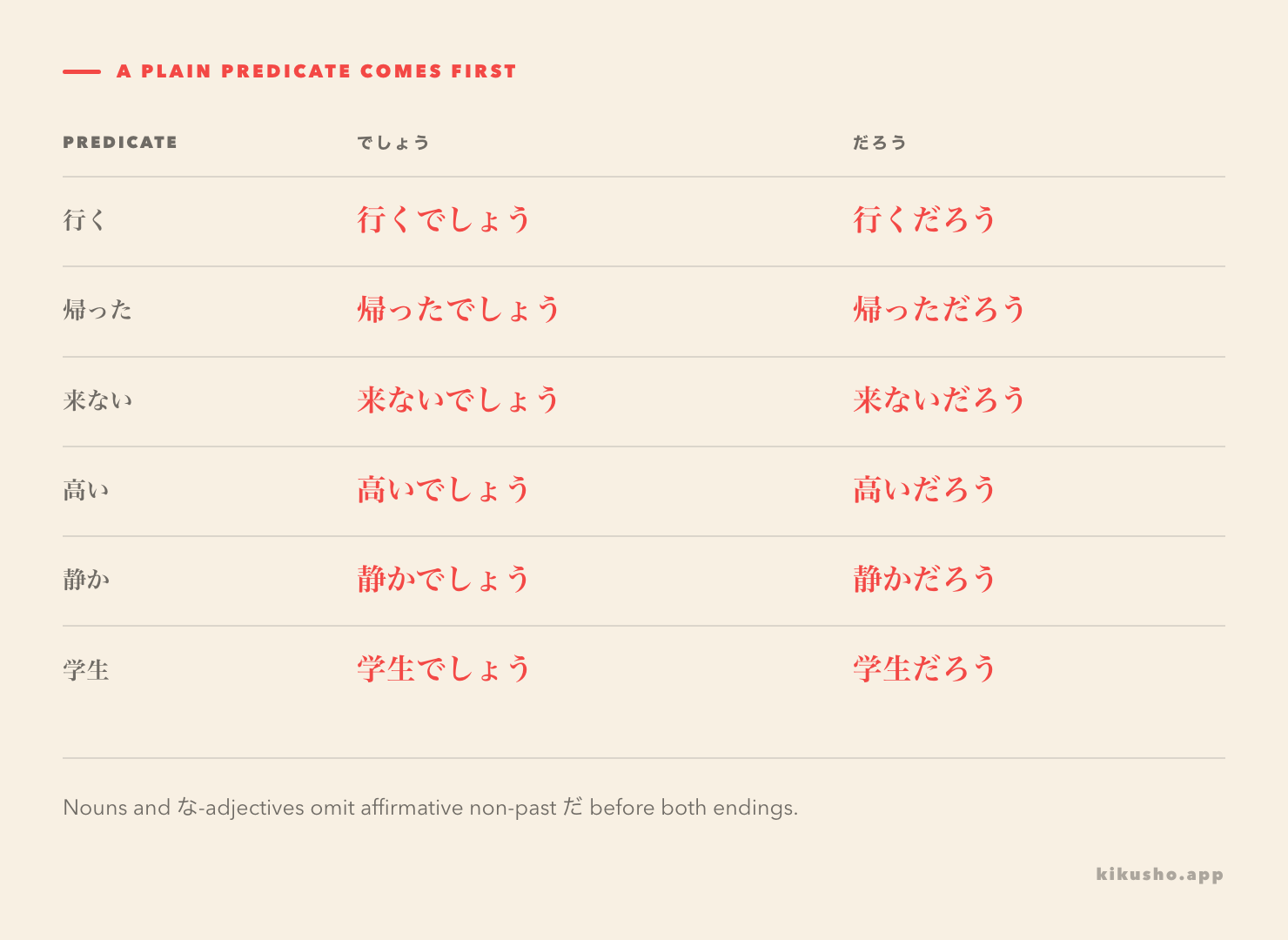
Nouns and な-adjectives lose affirmative non-past だ before both endings: 学生でしょう, not 学生だでしょう; 静かだろう, not 静かだだろう. This resembles other constructions that attach to a plain predicate, but the exact noun and な-adjective rule still needs attention.
Past and negative information remains in the predicate:
- 休みだったでしょう — it was probably a day off / it was probably closed
- 高くなかっただろう — it probably was not expensive
- 行かないでしょう — probably will not go
For the beginner pattern, use 先生は来るでしょう, not 先生は来ますでしょう. Politeness appears at the sentence ending. The underlying distinction between noun, な-adjective, い-adjective and verb predicates is developed in the です and だ lesson.
でしょう is polite, but it does not automatically sound gentle
Polite morphology describes the relationship to the listener. It does not guarantee that a claim feels soft. A firm prediction in でしょう can sound like an announcement or an expert assessment:
午後は風が強くなるでしょう。
ごごはかぜがつよくなるでしょう。
The wind will probably become stronger in the afternoon.
That tone fits a forecast. In casual conversation, a speaker may instead frame a personal judgment with と思います, “I think,” depending on the situation. The point is not to replace every でしょう. It is to hear the stance carried by the whole sentence.
Plain だろう deserves the same care. It is natural in suitable plain contexts and appears widely in writing, thought and dialogue. Treating it as “the male version” hides those uses; treating it as a direct substitute for polite でしょう can make a learner sound unexpectedly forceful.
The conversational contraction でしょ is common. It keeps the same broad jobs while sounding more casual than full でしょう. Learn it for recognition, but keep full でしょう as the clear polite model in this lesson.
Nearby patterns change the question
With a question word, どこだろう can mean “I wonder where,” and 何でしょう can politely ask what something is. Those patterns involve an unknown slot rather than a listener simply confirming an assumption.
Likewise, でしょうか can present a polite question or softened uncertainty. Compare:
- 明日は休みでしょう? — Tomorrow is a day off, right? The speaker expects confirmation.
- 明日は休みでしょうか。 — I wonder whether tomorrow is a day off. The answer is treated as less assumed.
Context and delivery can still vary, but the final か changes the interaction enough to learn as a neighboring pattern. This page keeps its practice on the assigned N5 pair: inference and expected confirmation with でしょう and だろう.
Practice
Complete every question before moving to the shared answer section.
Question 1
You looked at the forecast and are speaking politely. Choose the ending that presents snow as your tentative inference.
天気予報を見ました。明日は雪が降る( )。
A. でしょう
B. だろう
C. ですでしょう
D. ますでしょう
Question 2
Choose the plain counterpart of この店は高いでしょう without changing its basic inference.
A. この店は高いですだろう。
B. この店は高いだろう。
C. この店は高いだでしょう。
D. この店は高くだろう。
Question 3
Choose the standard polite attachment for a prediction about a quiet library.
A. この図書館は静かだでしょう。
B. この図書館は静かなでしょう。
C. この図書館は静かでしょう。
D. この図書館は静かですでしょう。
Question 4
Read the exchange. Both speakers received the same calendar.
A: 明日は休み( )?
B: はい、休みです。
Choose the polite ending that checks A's expected answer.
A. でしょう
B. だろう
C. でした
D. ではありません
Question 5
Put all four pieces in order to make a plain inference meaning “That train probably won't come anymore.” Start with その電車は.
その電車は / もう / 来ない / だろう
Question 6
A staff member is giving a polite prediction to a customer. Select the form that keeps the verb plain before the ending.
午後は店が( )。
The shop will probably become busy in the afternoon.
A. 混みますだろう
B. 混むでしょう
C. 混むだでしょう
D. 混みでしょう
Question 7
Correct the attachment error while keeping the sentence polite and predictive.
先生はあとで来ますでしょう。
Write the complete corrected Japanese sentence.
Answers and explanations
Answer 1
A: でしょう. The complete sentence is 明日は雪が降るでしょう, read あしたはゆきがふるでしょう. 降る stays plain, and でしょう makes the address polite. B preserves the prediction but changes to plain register. C and D stack a polite form before でしょう.
Answer 2
B: この店は高いだろう。 Read このみせはたかいだろう. An い-adjective already has its plain non-past shape, so だろう follows 高い directly. The other choices add です or だ, or change 高い to an adverbial form without a following verb.
Answer 3
C: この図書館は静かでしょう。 Read このとしょかんはしずかでしょう. 静か is a な-adjective stem here. Omit affirmative non-past だ and な before でしょう. Adding です also duplicates politeness.
Answer 4
A: でしょう. 明日は休みでしょう? asks the listener to confirm an assumption from the shared calendar. B can perform confirmation in plain speech, but it does not match the requested polite address. C states the past, and D makes a negative statement.
Answer 5
その電車はもう来ないだろう。 Read そのでんしゃはもうこないだろう. The order is その電車は / もう / 来ない / だろう. 来ない contains the predicted non-arrival; だろう marks the conclusion as a plain inference.
Answer 6
B: 混むでしょう. The complete sentence is 午後は店が混むでしょう, read ごごはみせがこむでしょう. The verb remains in its plain dictionary form before polite でしょう. A mixes ます with だろう, while C inserts an extra だ and D uses the verb stem without ます.
Answer 7
先生はあとで来るでしょう。 Read せんせいはあとでくるでしょう. Replace polite 来ます with plain 来る before でしょう. The final ending already supplies polite style while presenting the teacher's arrival as a prediction.
Save the assumption with the sentence
A flashcard containing only でしょう = probably loses the moment when the same form asks “right?” Keep the line before it or the reply after it: a forecast supports inference, while a shared schedule and a confirming answer reveal expected agreement.
When you capture an example in Kikusho, keep that context in the editable sentence and check the generated explanation before saving. A short note such as “shared calendar; asks for confirmation” preserves the decision that a translation alone cannot show. On review, identify the conversational job first and choose polite or plain register second.
Common questions
What is the difference between でしょう and だろう?
They can express the same tentative inference or request for agreement. でしょう addresses the listener politely; だろう belongs to plain speech and can sound blunt or assertive when directed at someone. The main difference is register, rather than a fixed difference in certainty.
Does でしょう mean probably or right?
It can do either job. In a statement such as 明日は雨でしょう, it offers an inference: it will probably rain tomorrow. Directed toward a listener with confirming context and often rising intonation, でしょう? asks for expected agreement: right?
What form comes before でしょう and だろう?
Use a plain predicate: 行くでしょう, 高いだろう, 静かでしょう and 学生だろう. Omit affirmative non-past だ after nouns and な-adjectives, but retain past and negative forms such as 休みだったでしょう and 行かないだろう.
Is だろう only used by men?
No. It is a plain form, not a male-only form. Sentence-final だろう can sound forceful or stereotypically masculine in some conversations, so learners should judge the relationship and tone rather than treating gender as a grammar rule.