On this page
でも at the start of a sentence means “but” or “however.” Noun + をください asks the listener to give or provide that thing. They often meet in the same beginner dialogue, but they do different jobs: one changes the direction of the conversation, while the other makes a request.
Two lookalikes make the boundary useful. Noun + でも can offer one example among other possibilities, and verb て-form + ください asks someone to perform an action. Position tells you which construction you are reading.
The position test decides among four patterns
Start with the words immediately before and after the form. Do not translate でも or ください in isolation.
| Pattern | Job | Example | Meaning |
|---|---|---|---|
| Sentence 1. でも、 Sentence 2. | introduce a contrast | 安いです。でも、遠いです。 | It is cheap. But it is far away. |
| Noun をください | request a thing | 水をください。 | Water, please. |
| Noun でも + predicate | present an example or loose suggestion | コーヒーでも飲みませんか。 | Shall we have coffee or something? |
| Verb て-form ください | request an action | 水を飲んでください。 | Please drink some water. |
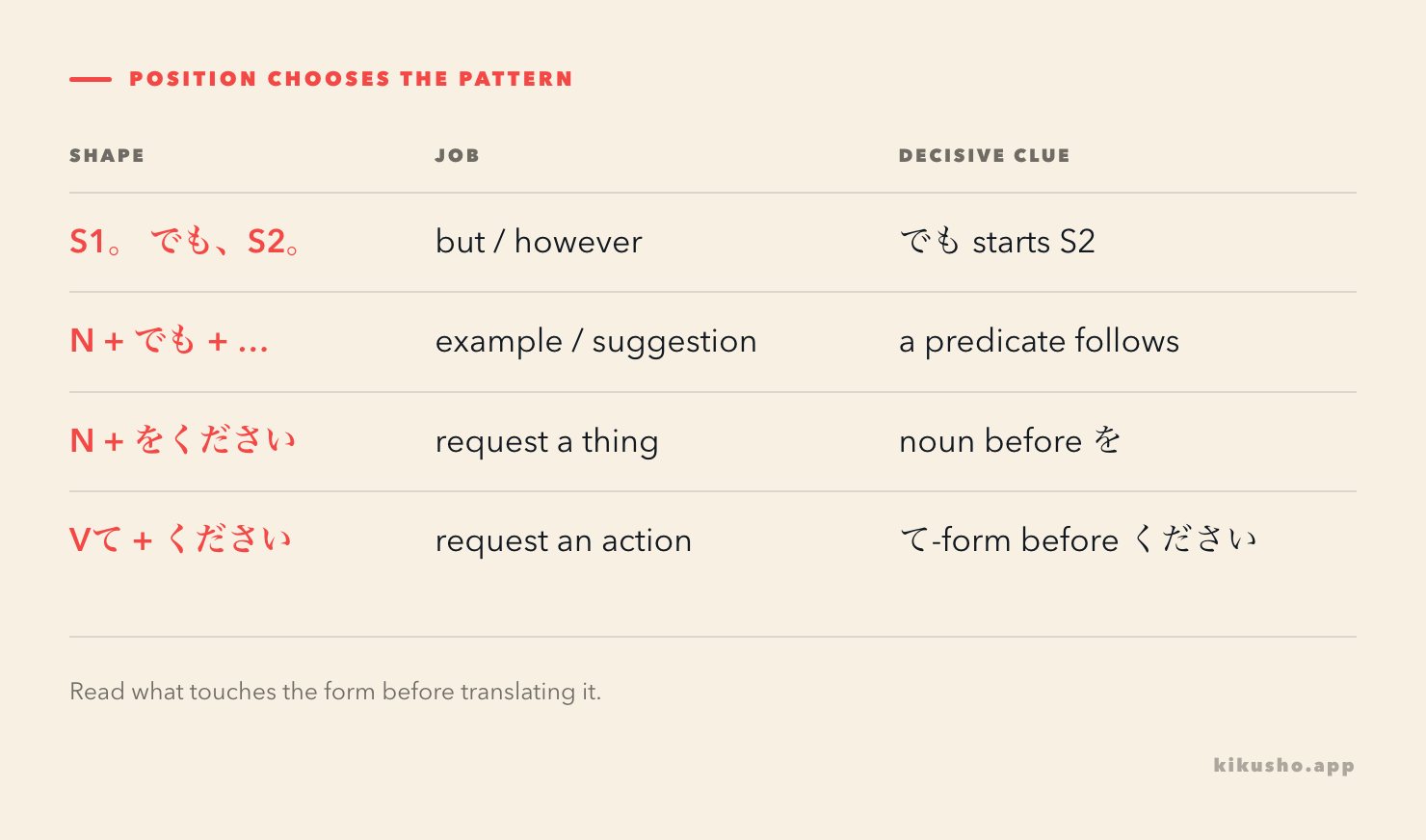
The two curriculum items on this page are the first and second rows: sentence-opening でも, and Noun + をください. JLPT Sensei places both at N5. Marugoto's A1 grammar materials, produced by the Japan Foundation, independently teach both patterns at introductory level.
The apparent disagreement in the source inventory is a surface match. Bunpro's N4 page teaches the third row, noun + でも for an example or suggestion. It is not assigning a different level to the sentence-opening conjunction. The official JLPT FAQ also makes the larger limit clear: the current exam has no published exhaustive grammar list, so these labels are study placements.
でも starts a new sentence and reverses an expectation
Sentence-opening でも points back to a complete statement, then adds something that pulls against it.
この店は安いです。でも、駅から遠いです。
この みせは やすいです。でも、えきから とおいです。
This shop is cheap. But it is far from the station.
The first fact creates a favourable picture. The second adds a drawback. The contrast can also run from a difficulty to a favourable result:
日本語は難しいです。でも、おもしろいです。
にほんごは むずかしいです。でも、おもしろいです。
Japanese is difficult. But it is interesting.
The punctuation reveals the attachment: でも begins the second sentence. JLPT Sensei's N5 entry describes it as a conjunction between contrasting ideas, and Japanese Introductory 1 likewise treats it as a sentence connector rather than a particle attached to a noun.
English “but” can join two clauses inside one sentence. At this stage, keep Japanese でも in the clear beginner frame S1。でも、S2. Do not place it directly after an adjective or verb as if it were an English conjunction:
× この店は安いでも、遠いです。
○ この店は安いです。でも、遠いです。
The contrast is about expectation, not simply one positive word followed by one negative word. 今日は日曜日です。でも、仕事があります means “Today is Sunday. But I have work.” Neither sentence contains grammatical negation; the surprise comes from the usual expectation that Sunday is free.
Noun + をください requests the thing before を
When you have chosen an item, place it before をください:
すみません、このパンをください。
Excuse me, this bread, please.
水をください。
みずを ください。
Water, please.
The noun is the thing requested. In a shop, これをください usually means “I'll take this one,” rather than a dramatic command to hand something over. The service setting makes the practical meaning clear. Tokyo University of Foreign Studies gives the structure Nをください, notes its use for orders and purchases, and distinguishes the softer question Nをくださいませんか for a personal request.
You can include a quantity:
コーヒーを二つください。
コーヒーを ふたつ ください。
Two coffees, please.
In ordinary shop and restaurant speech, を is often omitted: コーヒー二つください and このパンください are common. Both TUFS and Tofugu's request guide record that omission. Keep the full Noun + をください pattern while learning how the sentence is built; recognise the shorter version when listening.
This construction requests an available thing. 水がほしいです states “I want water,” while 水をください addresses someone who can provide it. In a café, shop, or reception desk, that direct request is expected. A large personal favour requires more attention to the relationship and burden than an ordinary order does.
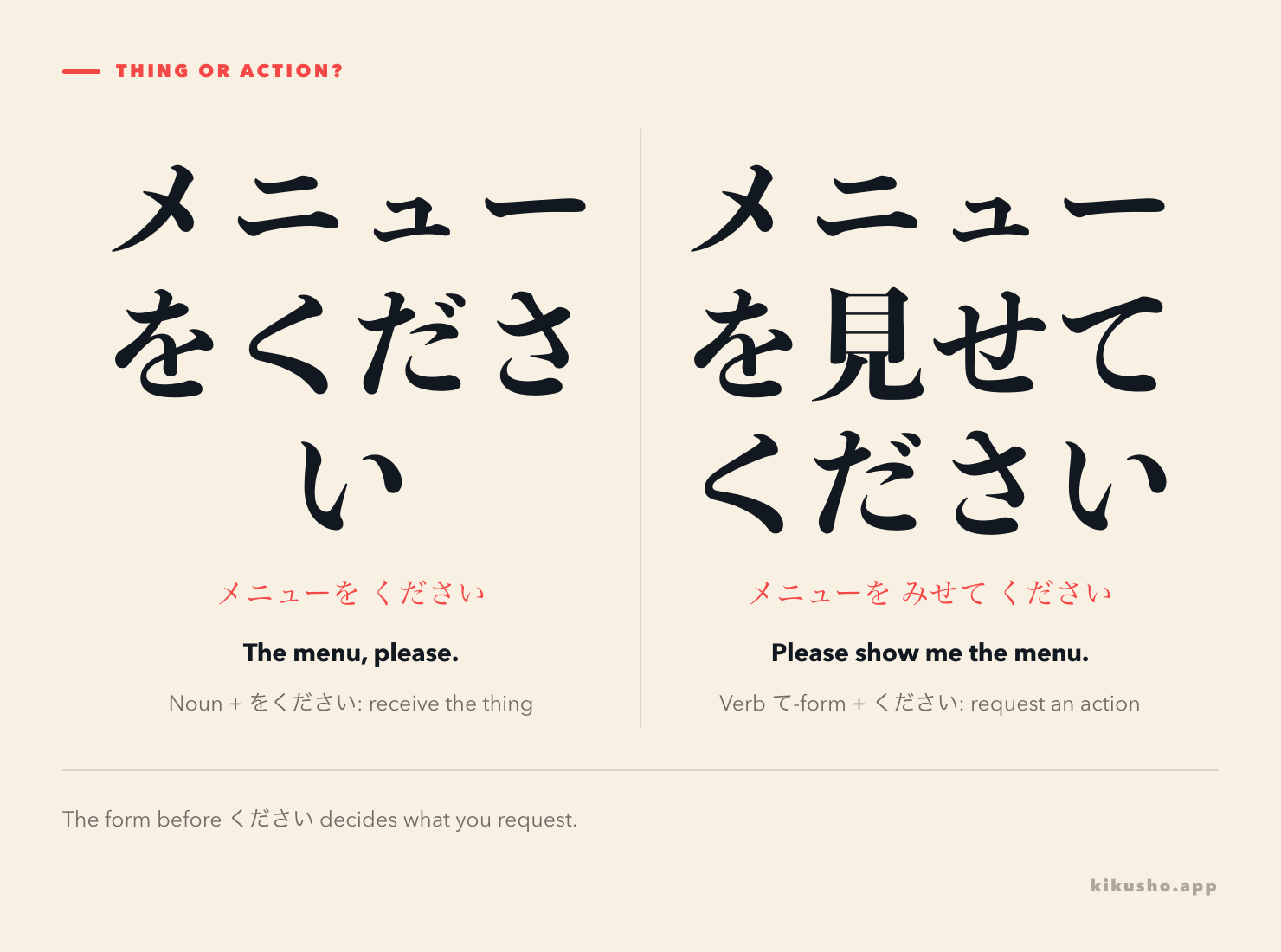
The noun pattern and the verb pattern request different results
The form before ください decides whether you want an object or an action.
| You want | Pattern | Example |
|---|---|---|
| a thing | Noun + をください | メニューをください。 |
| an action | Verb て-form + ください | メニューを見せてください。 |
In メニューをください, the menu itself stands before をください. In メニューを見せてください, メニューを is the object of 見せる, “to show,” and 見せてください asks the listener to perform that action. The same distinction appears in 水をください (“Water, please”) and 水を飲んでください (“Please drink some water”). The direction has changed: the speaker receives water in the first sentence; the listener drinks it in the second.
The ~てください lesson covers verb formation, directness and register in full. Here, you only need the attachment test: a noun comes before をください, while an action verb changes to its て-form before ください.
Noun + でも leaves the offer open
Now compare the sentence connector with でも attached to a noun:
コーヒーでも飲みませんか。
コーヒーでも のみませんか。
Shall we have coffee or something?
Coffee is an example, not a fixed order. Tea or another drink could still answer the suggestion. Bunpro calls this use 例示(れいじ), presenting an example. でも follows コーヒー, and the predicate 飲みませんか still comes later in the same sentence.
That differs from both target patterns:
- 紅茶は飲みます。でも、コーヒーは飲みません。 “I drink tea. But I do not drink coffee.” Here でも opens a contrasting sentence.
- コーヒーでも飲みませんか。 “Would you like coffee or something?” Here でも follows the example noun.
- コーヒーをください。 “Coffee, please.” Here the customer has selected coffee.
Do not treat コーヒーでも as a literal two-item choice. It keeps the category loose. If you want to name two alternatives, use コーヒーかお茶: “coffee or tea.”
You may also meet 学校でも勉強します, where で marks the place of study and も adds that place: “I study at school too.” The lesson on も, と and や explains that attachment. The sounds match, but the surrounding sentence assigns a different structure.
One café exchange contains all three decisions
Read the whole exchange before translating each でも:
店員:コーヒーでもどうですか。
てんいん:コーヒーでも どうですか。
Staff: How about coffee or something?客:コーヒーは好きです。でも、今日はアイスティーをください。
きゃく:コーヒーは すきです。でも、きょうは アイスティーを ください。
Customer: I like coffee. But today, iced tea, please.
The staff member's コーヒーでも offers coffee as one possibility. The customer's sentence-opening でも contrasts a general preference with today's choice. アイスティーをください then requests the selected item.
This is a useful kind of phrase to keep intact in Kikusho. A card containing the two-sentence reply preserves the full stop before でも and the noun before をください. Those small neighbours are what let you recover the function when the same sounds return in another conversation.
Practice: choose by position and purpose
Complete all seven questions before checking the answer block.
Question 1: grammar choice
Complete the contrast: このかばんは安いです。__、重いです。
“This bag is cheap. But it is heavy.”
A. をください
B. でも
C. と
D. も
Question 2: grammar choice
At a restaurant, you want a glass of water. Which sentence requests the item?
A. 水をください。
B. 水でも。
C. 水を飲んでください。
D. 水が好きです。
Question 3: grammar choice
You already handed your friend a menu and want them to look at it. Which sentence requests that action?
A. メニューをください。
B. メニューを見ました。
C. メニューを見てください。
D. メニューでもください。
Question 4: sentence composition
Arrange every chunk once to say “This bread, please.”
ください / このパン / を
Question 5: sentence composition
Join these two complete ideas with sentence-opening でも: “Japanese is difficult. But it is interesting.”
日本語は難しいです / おもしろいです
Question 6: text grammar
Choose both forms that complete the café reply.
店員:何にしますか。
客:コーヒーは好きです。__、今日はアイスティー__ください。
A. でも / を
B. コーヒーでも / を
C. でも / で
D. をください / を
Question 7: meaning from structure
What does コーヒーでも飲みませんか leave open?
A. Only coffee can be chosen.
B. Coffee is one suggested example; another drink remains possible.
C. The speaker has ordered coffee.
D. The speaker does not drink coffee.
Answers and explanations
Answer 1
B. でも. It starts a new sentence and introduces the unexpected drawback 重いです, “it is heavy.” をください requests a noun, と cannot fill this sentence-opening contrast slot, and も would need an element to attach to.
Answer 2
A. 水をください. The requested thing 水 stands before をください. C asks the listener to drink water, which reverses who receives it. D states a preference. B is incomplete here: 水でも can introduce water as an example only when an appropriate predicate or offer follows.
Answer 3
C. メニューを見てください. 見る → 見て names the listener's requested action. A asks to receive a menu, and B reports past viewing. D wrongly combines the example particle でも with ください and does not express the intended action.
Answer 4
このパンをください. The noun phrase このパン names the chosen item, を marks it as what is requested, and ください completes the request. In a shop you may hear このパンください, but the question asks for every supplied chunk.
Answer 5
日本語は難しいです。でも、おもしろいです。 Both sides are complete sentences. The second fact pulls against the expectation created by “Japanese is difficult.” Do not write 難しいでも; sentence-opening でも follows the full stop.
Answer 6
A. でも / を. The complete reply is コーヒーは好きです。でも、今日はアイスティーをください, “I like coffee. But today, iced tea, please.” B repeats コーヒー where only the connector belongs. C replaces the object marker with で, and D puts a request form in the connector slot.
Answer 7
B. コーヒーでも presents coffee as an example inside a suggestion. The listener may accept coffee or move to another suitable drink. A makes the offer too narrow, C confuses a suggestion with コーヒーをください, and D would require a negative predicate such as コーヒーを飲みません.
Common questions
What does でも mean at the start of a sentence?
Sentence-opening でも means but or however. It introduces a fact that contrasts with the previous sentence: この店は安いです。でも、遠いです means “This shop is cheap. But it is far away.”
How do you ask for an item with ください?
Put the item before をください: 水をください means “Water, please,” and これをください means “This one, please.” In shops and restaurants, speakers often omit を, but noun + をください is the complete beginner pattern.
What is the difference between Nをください and Vてください?
Noun + をください requests a thing, while verb て-form + ください requests an action. メニューをください asks for a menu; メニューを見せてください asks the listener to show you the menu.
Why does another source place でも at N4?
It may be describing a different construction with the same spelling. Sentence-opening でも meaning “but” is commonly taught at beginner level. Noun + でも can present one possible example, as in コーヒーでも飲みませんか, “Shall we have coffee or something?” Bunpro labels that use N4.