On this page
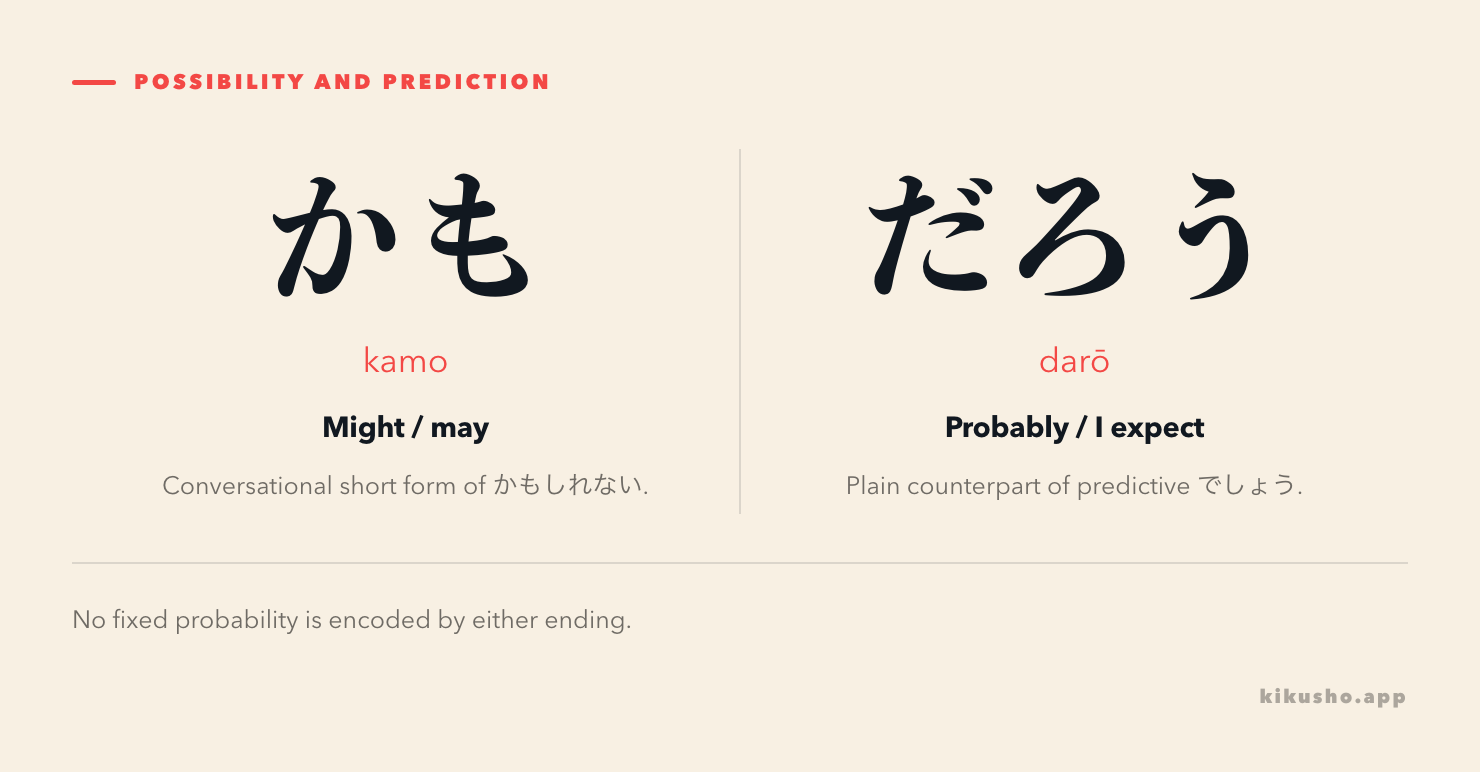
かもしれない (kamoshirenai) leaves something open as a possibility; でしょう (deshō) can present your tentative prediction or invite the listener to confirm it. Choosing between them requires the situation, not a percentage chart.
This N4 grammar comparison teaches かもしれない, its polite form かもしれません, and casual かも. It uses the earlier でしょう / だろう distinction to compare predictions, with confirmation as an essential boundary. Bunpro's かもしれない lesson and JLPT Sensei's lesson both place the possibility construction at N4; Bunpro places basic でしょう at N5. These are teaching estimates, rather than an official exhaustive exam syllabus.
Ask whether you are leaving an option open or offering a prediction
Imagine that the museum's hours have changed. You have not checked them. Saying 休みかもしれません, “It might be closed,” keeps closure among the possibilities.
Now imagine a scheduled announcement about tomorrow's conditions. The speaker offers an estimate of what will happen. A prediction with でしょう fits that stance: “It will probably…” The speaker still lacks certainty.
Before choosing an ending, ask what your sentence is doing:
| Your purpose | Useful ending | What the listener receives |
|---|---|---|
| Leave an uncertain possibility open | かもしれない / かもしれません | “It might be the case.” |
| Present a tentative expectation | だろう / でしょう | “I expect that it probably is.” |
| Invite confirmation of an assumption | でしょう? | “That's the case, right?” |
The first two purposes overlap. A reason for suspecting something does not force you to use でしょう. You can notice a clue and still choose to leave your conclusion tentative. Likewise, a forecast is a prediction, not proof of tomorrow's conditions.
Attach かもしれない to the plain predicate
Politeness belongs in かもしれません, rather than in the word immediately before it. The standard pattern is 閉まるかもしれません, not 閉まりますかもしれません. Read 閉まる as しまる, “to close.”
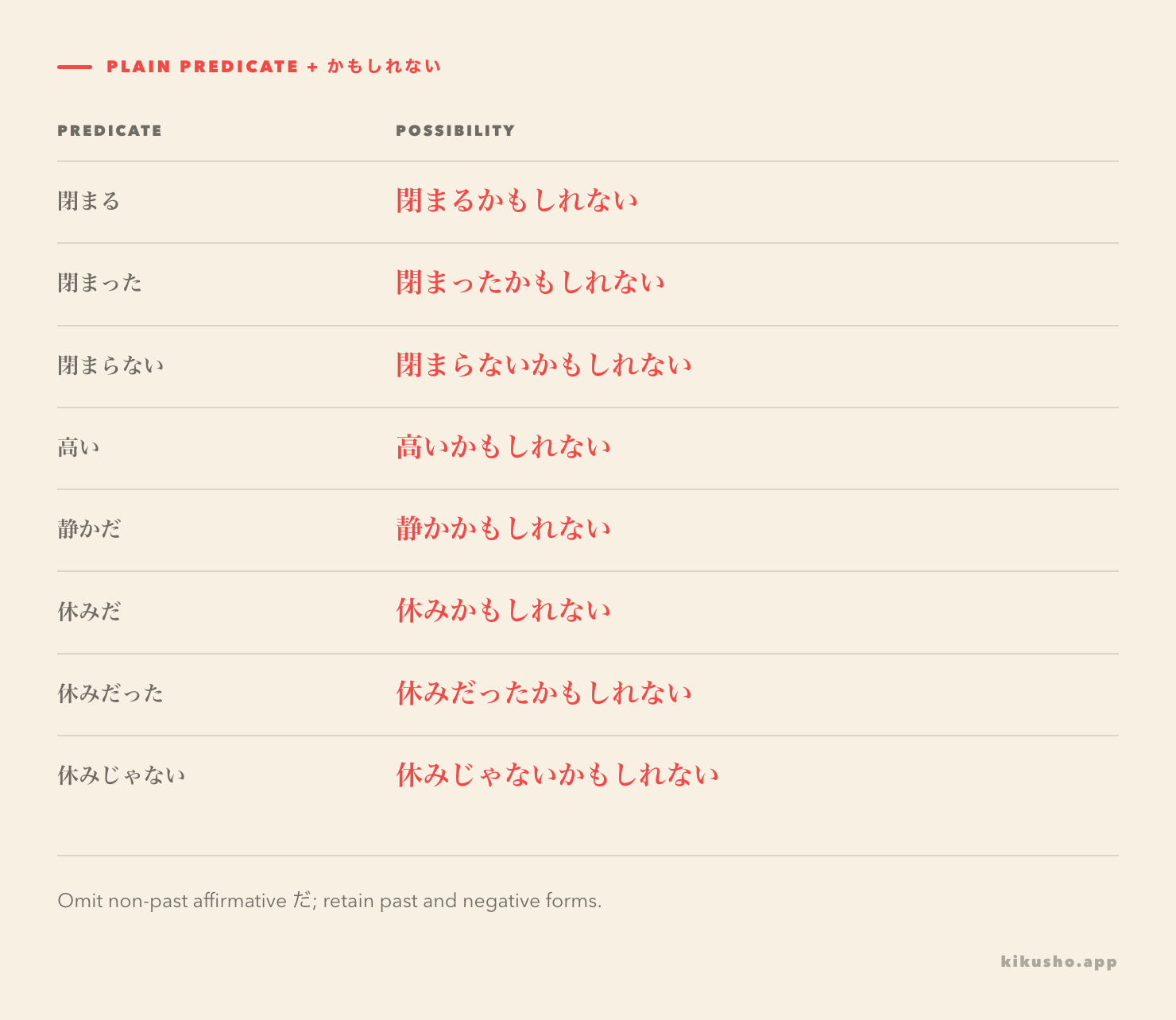
Tofugu's formation guide distinguishes the attachment by word class: nouns and な-adjectives lose affirmative non-past だ, while verbs and い-adjectives retain their plain endings. Past and negative predicates remain available.
| Predicate being considered | With かもしれない | Reading and meaning |
|---|---|---|
| 閉まる, closes / will close | 閉まるかもしれない | しまるかもしれない, might close |
| 閉まった, closed | 閉まったかもしれない | しまったかもしれない, might have closed |
| 閉まらない, does not / will not close | 閉まらないかもしれない | しまらないかもしれない, might not close |
| 高い, expensive | 高いかもしれない | たかいかもしれない, might be expensive |
| 静かだ, quiet | 静かかもしれない | しずかかもしれない, might be quiet |
| 休みだ, a day off / closed | 休みかもしれない | やすみかもしれない, might be a day off / closed |
| 休みだった, was a day off / closed | 休みだったかもしれない | やすみだったかもしれない, might have been a day off / closed |
| 休みじゃない, is not a day off / closed | 休みじゃないかもしれない | やすみじゃないかもしれない, might not be a day off / closed |
The noun's translation follows the situation. 休み can describe your day off; about a shop or museum, it can describe closure. Saving “holiday” as its only English gloss can hide that difference.
Do not interpret the final ない of かもしれない as “the event does not happen.” 来るかもしれない means “might come.” To consider non-arrival, change 来る to 来ない: 来ないかもしれない, “might not come.” For a polite warning to someone waiting, use 来ないかもしれません. Read these as くる and こない.
If those changes are still difficult, revisit plain and polite negatives. The uncertainty construction preserves the event you put before it.
A possibility can concern the past or your own plans
You cannot find the receipt. You remember tidying your bag yesterday, but you are not certain what you threw away:
レシートを捨てたかもしれない。
レシートをすてたかもしれない。
I might have thrown away the receipt.
The guess is being made now about an earlier event. 捨てた supplies that earlier time. You do not need to move the uncertainty ending into the past just because the receipt disappeared yesterday.
The same pattern can describe an undecided personal plan:
来週、京都に行くかもしれません。
らいしゅう、きょうとにいくかもしれません。
I might go to Kyoto next week.
This leaves the trip unsettled. It does not promise attendance. JLPT Sensei and Bunpro both illustrate this possibility use with future actions.
With friends, the shortened かも carries that tentative stance: 来週、京都に行くかも. For the polite model practised here, keep かもしれません. Tofugu also describes softening your own assessment with this construction. An opinion framed as a possibility can sound less committal, even when the speaker already has an impression.
Predictive でしょう presents an estimate, with a register of its own
For a hypothetical weather bulletin:
午後は風が強くなるでしょう。
ごごはかぜがつよくなるでしょう。
The wind will probably become stronger in the afternoon.
Here the announcer is making a prediction. 強くなる means “become stronger”; it remains plain before でしょう. Bunpro's でしょう lesson treats the ending as polite and contrasts its tentative expectation with かもしれない.
The attachment has familiar shapes: 高いでしょう, 静かでしょう, 休みでしょう. There is no extra affirmative だ before でしょう. For an earlier event, 休みだったでしょう keeps だった. To predict a negative outcome, 閉まらないでしょう means “It probably won't close.” Tofugu's だろう guide explains plain, negative and past predicates with the corresponding plain ending.
Do not make でしょう your automatic replacement for every polite “probably.” In a prediction, it can sound like an announcement or an authoritative assessment. Mayumi Ito's lesson for Mango Languages discusses this register and the conversational alternative と思います. The published thinking-verbs lesson explains how 思う frames a judgment.
だろう is the plain counterpart for the comparison; it can sound assertive in conversation. Changing it to でしょう changes the address to your listener, while the precise stance still comes from the sentence and situation. This page does not teach every use of either ending.
Both endings can fit, but they offer different commitments
Suppose a colleague asks whether tomorrow's meeting room will be quiet. You have not been there at that hour:
明日は静かかもしれません。
あしたはしずかかもしれません。
It might be quiet tomorrow.
That offers an option. Now suppose you are offering a tentative assessment based on the expected attendance:
明日は静かでしょう。
あしたはしずかでしょう。
It will probably be quiet tomorrow.
Both sentences are well formed. The change is what the speaker presents, rather than a measurement of the room. Confidence can be affected by the context, adverbs and purpose. For the vocabulary that shapes estimates, continue with たぶん, おそらく and きっと.
でしょう can turn an assumption toward the listener
You and a colleague both received the timetable. You check your remembered starting time:
会議は十時からでしょう?
かいぎはじゅうじからでしょう?
The meeting starts at ten, right?
The colleague can confirm it. A rising ending helps invite that response. This is different from predicting an unknown start time. 会議は十時からかもしれません would say the meeting might start at ten, leaving it uncertain rather than inviting the same confirmation. Tofugu's でしょう explanation describes this agreement use; Mango Languages independently distinguishes it from prediction.
In casual dialogue, でしょ is a common shortened form. Listen to the speaker's expectation as well as the upward movement: asking someone to agree can sound insistent. A polite-looking ending alone does not settle whether the remark feels considerate.
Practice
Use the specified meaning or conversational purpose to choose. Attempt the complete set before scrolling to the explanations.
Question 1
Select the standard polite sentence meaning “The shop might be closed today.”
A. 今日は店が休みだかもしれません。
B. 今日は店が休みですかもしれません。
C. 今日は店が休みかもしれません。
D. 今日は店が休みなかもしれません。
Question 2
Select the standard sentence meaning “Sato might not come.”
A. 佐藤さんは来るかもしれない。
B. 佐藤さんは来ないかもしれない。
C. 佐藤さんは来ませんかもしれない。
D. 佐藤さんは来ないでしょう。
Question 3
Put all four pieces in order to mean “I might have thrown away the ticket.” Start with 切符を.
切符を / ない / 捨てた / かもしれ
Question 4
Put all four pieces in order as a tentative prediction: “The wind will probably become stronger in the afternoon.” Start with 午後は風が.
強く / でしょう / 午後は風が / なる
Question 5
Read this message from someone who is still unsure about travelling:
まだ予定は決まっていません。来週、京都に行く( )。決まったら、連絡します。
予定(よてい)means plans; 決まる(きまる)means to be decided; 連絡する(れんらくする)means to contact someone. Select the ending that keeps the trip a possibility and makes this sentence polite.
A. かもしれません
B. かもしれない
C. ますかもしれません
D. ことにしました
Question 6
Read the exchange. A is checking a remembered time with someone who has the same timetable; A is not presenting the time as merely one possibility.
A: 会議は十時から( )?
B: はい、十時からです。
Select the ending that invites confirmation of A's assumption.
A. かもしれません
B. だかもしれません
C. でしょう
D. ではありません
Keep your choices together before moving on; the reasoning below includes the differences in meaning.
Answers and explanations
Answer 1
C: 今日は店が休みかもしれません。 The reading is きょうはみせがやすみかもしれません. 休み is a noun here, so the possibility ending follows it directly. A keeps an unwanted affirmative だ, B inserts です, and D inserts な where this construction does not use it.
Answer 2
B: 佐藤さんは来ないかもしれない。 Read さとうさんはこないかもしれない. 来ない supplies the possibility of not coming. A leaves arrival possible instead. C attaches to polite 来ません. D is grammatical, but presents non-arrival as a prediction: “Sato probably won't come.” That differs from the requested possibility.
Answer 3
切符を捨てたかもしれない。 Read きっぷをすてたかもしれない. The order is 切符を / 捨てた / かもしれ / ない. The past 捨てた describes the ticket's possible disposal; かもしれない marks your present uncertainty about it. 捨てない would consider not throwing it away and would lose the requested past event.
Answer 4
午後は風が強くなるでしょう。 Read ごごはかぜがつよくなるでしょう. The order is 午後は風が / 強く / なる / でしょう. 強い becomes 強く before なる; predictive でしょう follows the completed plain predicate.
Answer 5
A: かもしれません. The complete sentence is 来週、京都に行くかもしれません, read らいしゅう、きょうとにいくかもしれません. The undecided plans and promised later update support a possibility. B has the same possibility meaning but misses the requested polite address. C would produce 行くますかもしれません, which is not the standard attachment. D presents a decision to go, conflicting with the message's unsettled plans.
Answer 6
C: でしょう. 会議は十時からでしょう? checks the assumed starting time, and B confirms it. A instead presents an uncertain possibility. B adds a misplaced だ. D produces a negative assertion, “It doesn't start at ten,” rather than the specified confirmation request.
Keep the assumption beside the words
A note that saves only でしょう → “probably” cannot recover why your colleague expected an answer. Keep the surrounding turn: who knew the time, who was checking, and what followed. For かもしれません, keep what was still unsettled.
When pasting a short message into Kikusho, check the drafted card's explanation and editable example against that situation before saving it. A review cue such as “undecided trip, update later” preserves something that a translation of 行く alone cannot: whether the speaker has committed to going.
Common questions
What is the difference between かもしれない and でしょう?
かもしれない presents something as a possibility: it might be true. In a prediction, でしょう presents the speaker's tentative expectation: it will probably be true. Neither ending supplies a fixed probability. でしょう can also invite confirmation or agreement from the listener.
Can I put だ before かもしれない or でしょう?
Omit affirmative non-past だ after a noun or な-adjective: 休みかもしれない and 静かでしょう. Past だった remains: 休みだったかもしれない. Negative forms also remain, as in 休みじゃないかもしれない.
How do I politely say might not come in Japanese?
来ないかもしれません means might not come. Use the plain negative 来ない before the polite ending かもしれません. The ない inside かもしれない alone does not negate the event: 来るかもしれない means might come.
Is でしょう always a polite way of saying probably?
No. It can seek agreement, often with rising intonation, rather than predict an unknown event. A prediction ending in でしょう can also sound like a formal announcement. Politeness, confidence and conversational purpose need separate attention.