On this page
With nouns and な-adjectives, です is polite and だ is plain: 学生です/学生だ and 静かです/静かだ. The match stops there. 高いです is correct but 高いだ is not, and a verb such as 行く becomes 行きます, not 行くです, when you make it polite.
That small mismatch is the useful answer. です and だ overlap in one part of Japanese grammar, but they do not behave as two interchangeable translations of English is.
The rule fits in one table
Start with the kind of word that ends the predicate. Then choose plain or polite style.
| Predicate ending | Plain style | Polite style | Form to reject |
|---|---|---|---|
| noun | 学生だ | 学生です | — |
| な-adjective | 静かだ | 静かです | × 静かなです |
| い-adjective | 高い | 高いです | × 高いだ |
| verb | 行く | 行きます | × 行くです |
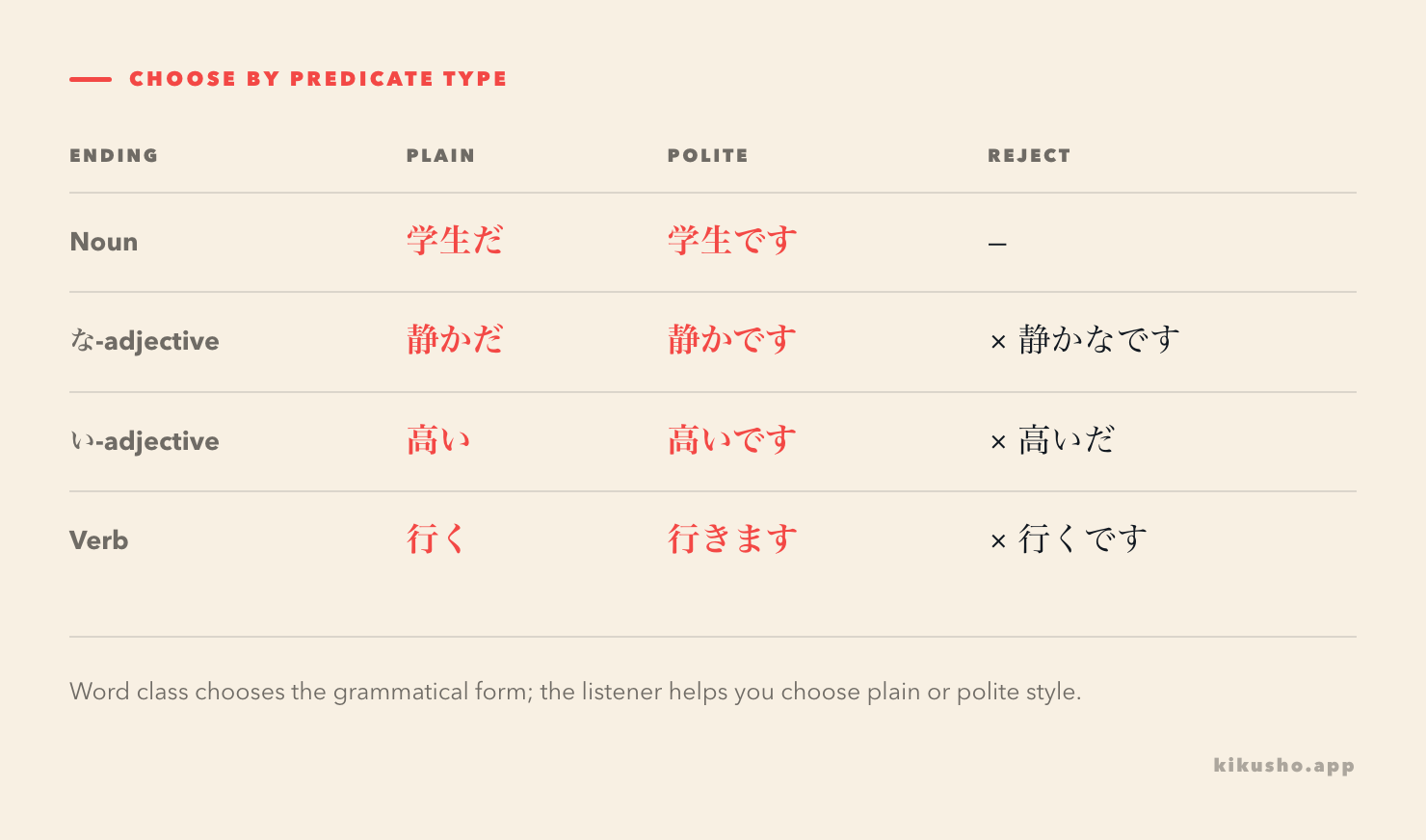
The first two rows contain the true だ/です pair. In the third row, the い-adjective is already a complete predicate, so plain style needs nothing after it. In the fourth, the verb has its own polite ending, ます.
This is the N5 foundation commonly listed as だ/です. JLPT Sensei presents the pair as an N5 grammar point, while Bunpro treats だ and です separately. The JLPT itself does not publish an exhaustive grammar list, so “N5” here describes the reference placement, not an official promise about a fixed syllabus.
Ask what ends the predicate, then who is listening
Two questions settle the choice.
- What kind of word completes the statement? A noun, な-adjective, い-adjective or verb determines which endings are grammatical.
- What relationship are you speaking in? A stranger, customer, teacher or new acquaintance normally calls for polite です/ます style. Close friends and family often use plain style.
Do the grammar question first. Social distance cannot make 高いだ grammatical. Once you know which forms the predicate allows, the listener helps you choose among them.
This is also why translating first can mislead you. 学生です may be “I am a student,” and 部屋は静かです may be “the room is quiet,” but Japanese does not insert a separate equivalent of am or is in every kind of sentence. The predicate type carries more information than the English translation shows.
だ belongs after nouns and な-adjectives in plain style
After a noun, だ closes a plain affirmative statement:
- 私は学生だ。(I am a student.)
- 明日は休みだ。(Tomorrow is a day off.)
- これは本だ。(This is a book.)
The same pattern follows a な-adjective used as the predicate:
- この部屋は静かだ。(This room is quiet.)
- 田中さんは元気だ。(Tanaka is well.)
- この町は便利だ。(This town is convenient.)
The な of a な-adjective appears before a noun: 静かな部屋, “a quiet room.” It does not remain before だ or です at the end of the sentence. That gives 静かだ and 静かです, never 静かなだ or 静かなです.
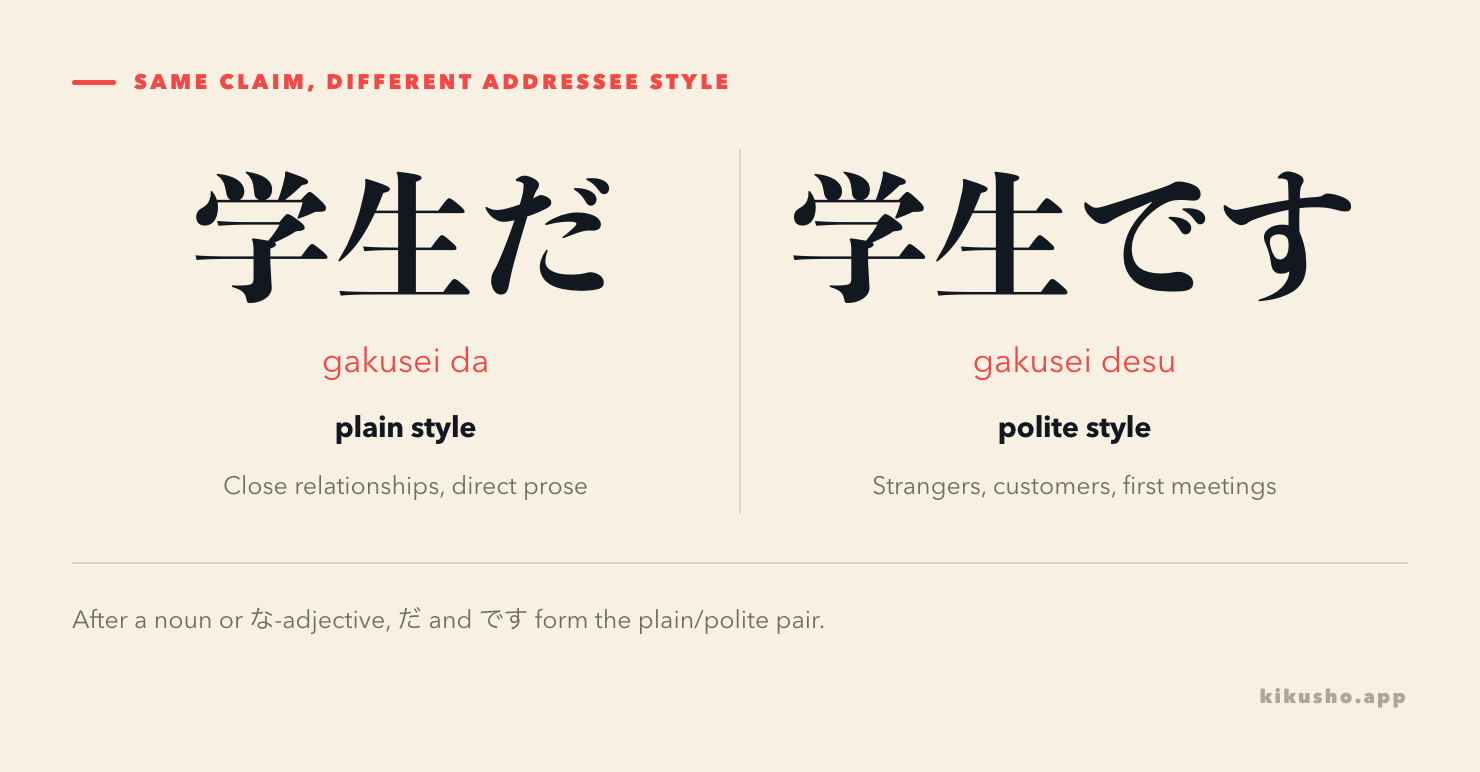
Plain style is not a synonym for rude speech. It is normal with people who share a close relationship and in many forms of direct prose. But sentence-final だ can sound firm or explicit. Casual conversation also allows a noun or な-adjective stem to stand without it in places such as 学生? or 元気?. Treat that as a conversational option, not as proof that だ is forbidden.
です makes noun and な-adjective statements polite
For those same predicates, replace だ with です when the interaction calls for polite style:
| Plain | Polite | Meaning |
|---|---|---|
| 学生だ | 学生です | is a student |
| 休みだ | 休みです | is a day off |
| 静かだ | 静かです | is quiet |
| 元気だ | 元気です | is well |
The proposition stays the same. 私は学生だ and 私は学生です both identify the speaker as a student; the second sentence addresses the listener politely. Tofugu's guide to だ places it after nouns and な-adjective stems, and its guide to です shows the polite pattern.
For a first meeting, a shop interaction or a conversation with someone you do not know well, です is the useful default. As a relationship becomes closer, speakers may move into plain style. That shift is social rather than factual: the larger Japanese politeness system calls です/ます 丁寧語, politeness aimed at the addressee.
い-adjectives reveal why the pair is not symmetrical
An い-adjective can finish a plain sentence by itself:
- この本は面白い。(This book is interesting.)
- 今日は暑い。(It is hot today.)
- このかばんは高い。(This bag is expensive.)
To speak politely, add です: 面白いです, 暑いです, 高いです. Do not replace it with だ. The forms 面白いだ, 暑いだ and 高いだ are ungrammatical in the standard pattern.
The difference becomes even clearer in the past. The adjective itself changes: 高い → 高かった → 高かったです. Nouns and な-adjectives instead put the past marking on the copular ending: 学生だ → 学生だった and 学生です → 学生でした. Iori Hamada's open Japanese course lays out the same split for past adjectives and nouns.
So in 高いです, です does not supply a missing is. 高い already predicates “is expensive.” Here です marks the sentence as polite.
Verbs use ます for the ordinary polite pattern
A verb also completes a plain sentence without だ:
- 明日行く。(I will go tomorrow.)
- 毎日勉強する。(I study every day.)
- すしを食べる。(I eat sushi.)
The ordinary N5 polite forms are 行きます, 勉強します and 食べます. The lesson on verb groups and the ます-form shows how to build them. Do not attach です directly and produce 行くです or 食べるです as your default polite sentence.
That gives one dependable division of labour:
- noun or な-adjective: choose だ/です
- い-adjective: choose plain adjective/adjective + です
- verb: choose dictionary form/ます-form
Once the word class is visible, the apparent だ-versus-です puzzle becomes a four-row pattern instead of a translation problem.
The register can change while the claim stays put
Imagine two introductions. With a new client you say 私はアンナです. Later, a close friend asks who the new student is and you answer アンナだ. Both sentences identify Anna. Their difference lies in how the speaker positions the listener.
That does not make です a decorative extra everywhere. With noun and な-adjective predicates it is the polite form that closes the affirmative sentence. With い-adjectives, the adjective already does the grammatical work of predication and tense, while です supplies polite style. One spelling performs related jobs in different structures.
The practical consequence is better than a definition: save the ending with the whole sentence. A card containing only “です = is” hides the word class and the social setting that decide whether the form belongs there. In Kikusho, keep a line such as この店は静かです with its source situation, then compare it with a plain line such as この部屋は静かだ. The contrast gives recall something precise to retrieve.
Practice without looking at the solutions
Question 1: choose the ending. You are speaking politely to a client. Complete 田中さんは先生___。
- ア. だ
- イ. です
- ウ. ます
- エ. な
Question 2: choose the ending. Make この本は面白い___。 polite.
- ア. です
- イ. だ
- ウ. ます
- エ. な
Question 3: correct the sentence. A learner writes 今日は暑いだ。 Give one plain correction and one polite correction.
Question 4: build a plain sentence. Arrange these parts to say “This room is quiet” to a close friend: だ / この部屋は / 静か.
Question 5: choose for the relationship. Complete the two replies with だ or です.
店員:学生ですか。
あなた:はい、学生___。
友達:明日は休み?
あなた:うん、休み___。
Question 6: choose the polite verb ending. Complete 明日、東京へ行き___。
- ア. だ
- イ. です
- ウ. ます
- エ. な
Answers and explanations
Answer 1. イ. です. 先生 is a noun predicate, and the client-facing context calls for polite style. だ would make the sentence plain; ます attaches to a verb stem, and な does not close this predicate.
Answer 2. ア. です. 面白い is an い-adjective and can take です for polite speech. 面白いだ is not the plain counterpart; plain style is simply 面白い.
Answer 3. Plain: 今日は暑い。 Polite: 今日は暑いです。 暑い already finishes the plain predicate. Add です only for the polite version; do not add だ.
Answer 4. この部屋は静かだ。 静か is a な-adjective stem. Before a noun it takes な, as in 静かな部屋, but at the end of this plain affirmative sentence it takes だ.
Answer 5. はい、学生です。 and うん、休みだ。 The first reply keeps polite style with the shop clerk. The second uses plain style with a friend. 休みです would also be grammatical, but it would not match the requested close-friend register; casual speech may also omit だ and say うん、休み.
Answer 6. ウ. ます, producing 明日、東京へ行きます。 行く is a verb, so its ordinary polite counterpart uses the ます-form. 行くです is not the standard N5 conversion.
The next time a sentence needs an ending, identify the final predicate before deciding how polite to sound. If it is a noun or な-adjective, だ/です is a real pair. If it is an い-adjective or verb, the plain half of the pattern lives in the word itself.
Common questions
What is the difference between です and だ?
With a noun or な-adjective predicate, です gives the sentence polite style and だ gives it plain style: 学生です versus 学生だ, and 静かです versus 静かだ. The pairing does not extend to every predicate. An い-adjective takes です for polite speech but never だ, while a verb normally takes ます for polite speech.
Can です follow an い-adjective?
Yes. 高いです and おいしいです are standard polite sentences. The adjective already supplies the predicate and its tense; です adds polite style. The plain counterparts are 高い and おいしい, not 高いだ or おいしいだ.
Is だ rude or masculine?
だ belongs to plain style, so it can sound too direct with a stranger or customer, but it is not inherently rude or restricted to men. Speakers of any gender use plain forms in suitable relationships and kinds of writing. Sentence-final だ can also sound more explicit than simply ending on a noun or な-adjective stem in casual conversation.
Can I put です after a verb?
Not as the ordinary N5 polite counterpart of a verb. Use the ます-form: 行く becomes 行きます and 食べる becomes 食べます. Forms such as 行くです are outside the standard beginner pattern taught here.