On this page
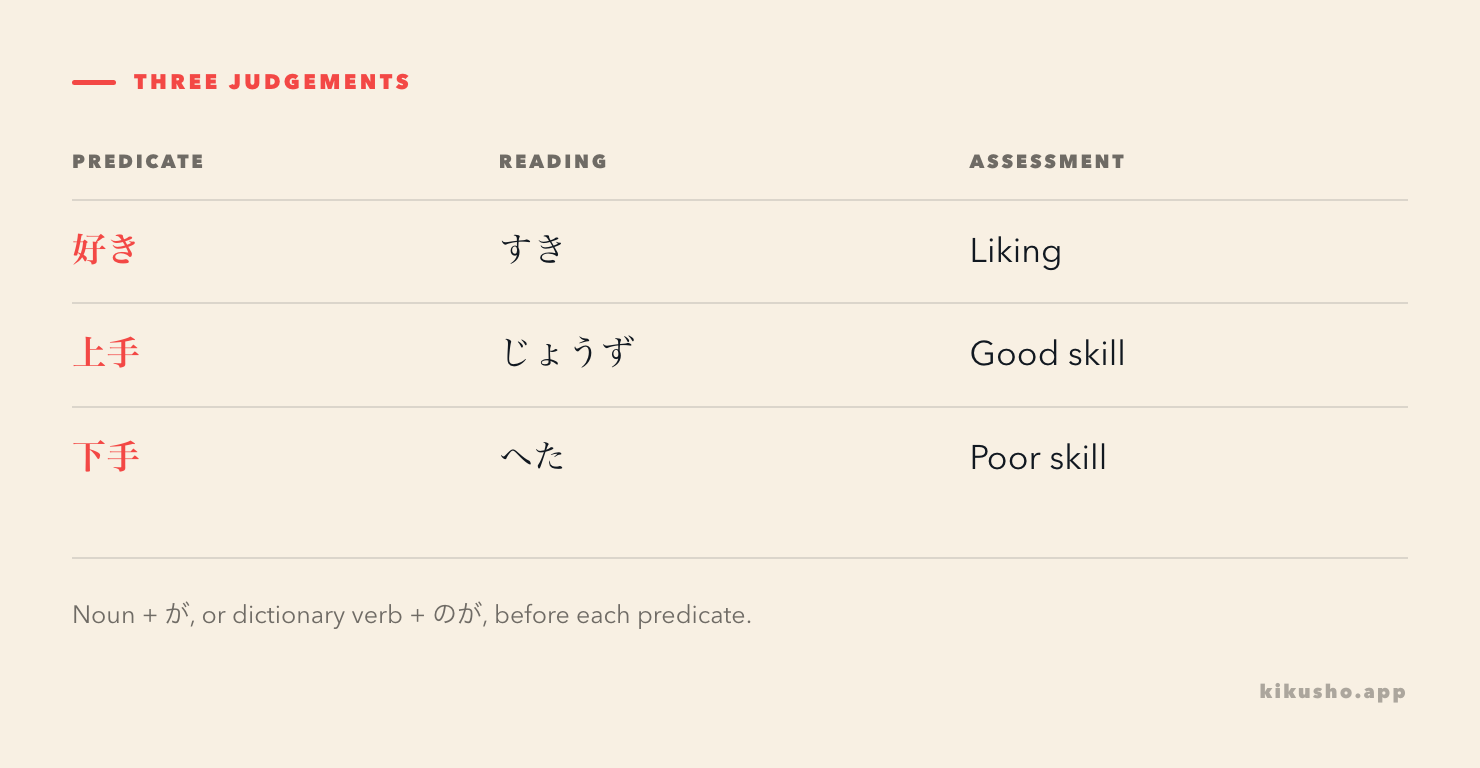
Noun + が好きです expresses liking, while noun + が上手です evaluates skill. With an action, put の after a dictionary-form verb: 歩くのが好きです means “I like walking”; 泳ぐのが上手です means “someone is good at swimming.”
The third member of this set is 下手(へた), poor at something. All three use the same activity frame, so you can change the judgement without rebuilding the action.
These three descriptions share a frame, but assess different things
A person introduced with は supplies the topic. が marks the thing or activity being described by 好き, 上手 or 下手. These predicates behave as な-adjectives rather than as English action verbs such as “like.” The adjective construction matters even when its most natural English translation contains a verb. Bunpro's 好き explanation identifies the adjectival pattern and its nominalizer.
私は写真が好きです。
わたしは しゃしんが すきです。
I like photographs.
山田さんは料理が上手です。
やまださんは りょうりが じょうずです。
Yamada is good at cooking.
Do not decide the particle by the English translation. In this basic preference pattern, 写真を好きです is an incorrect replacement for 写真が好きです. For the broader topic distinction, see は and が.
If the person is already clear, you need not repeat that person's name or 私は in every reply. A short 写真が好きです can answer a question about your interests. The context, rather than the adjective alone, tells the listener whose preference it is.
The set contains liking, good performance and poor performance
| Predicate | Reading | What it tells you | Noun frame | Activity frame |
|---|---|---|---|---|
| 好き | すき / suki | The person likes it | 写真が好きです | 写真を撮るのが好きです |
| 上手 | じょうず / jōzu | The person does it skilfully | 料理が上手です | 料理を作るのが上手です |
| 下手 | へた / heta | The person does it poorly | 歌が下手です | 歌うのが下手です |
Here 撮る(とる) means take a photograph, 作る(つくる) means make, and 歌う(うたう) means sing. The table's last column specifies the action, rather than leaving the reader to infer it from a noun.
For example, 写真が好きです can describe someone who enjoys looking at photographs. 写真を撮るのが好きです explicitly says that the person enjoys taking them. Neither sentence establishes that the photographs they take are good.
Likewise, 料理を作るのが上手です says that someone cooks well. It does not state that they enjoy cooking. 歌うのが下手です reports poor singing skill; it does not say that the person dislikes singing.
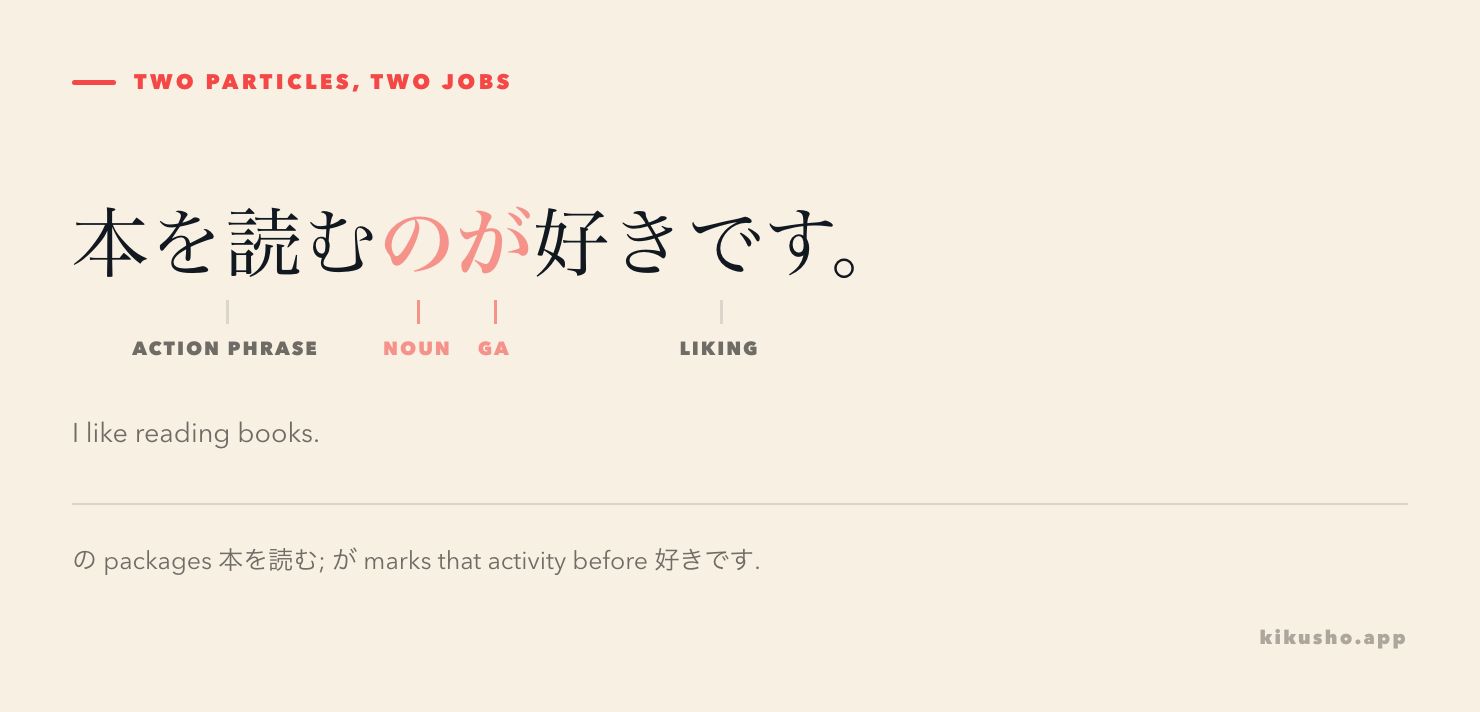
の packages the action, and が connects it to the assessment
Use dictionary form + の + が + predicate. The verb before の retains its dictionary form in the polite pattern too. Politeness appears at the end with です. This conversion from a verb phrase to a noun-like activity is called nominalization. The independently authored にほんご部 lesson on のが demonstrates that frame with 好き, 上手 and 下手.
| Action | Activity | Completed description |
|---|---|---|
| 歩く(あるく), walk | 歩くの | 歩くのが好きです。, likes walking |
| 泳ぐ(およぐ), swim | 泳ぐの | 泳ぐのが上手です。, swims well |
| 歌う(うたう), sing | 歌うの | 歌うのが下手です。, sings poorly |
歩きますのが好きです does not fit the construction taught here: replace 歩きます with 歩く. 歩くが好きです omits the part that makes the action available as an activity.
The package can contain more than the verb. In 本を読むのが好きです, 本を読む is the action phrase “read books.” Keep its object marker を. The following の packages that whole phrase, and が marks the resulting activity.
兄は魚を焼くのが上手です。
あには さかなを やくのが じょうずです。
My older brother is good at grilling fish.
Here 魚を焼く identifies what the brother does well. Changing 魚を to 魚が would alter that inner clause; it is not a repair required by 上手. The を lesson explains its object role separately.
The ending changes the judgement; the activity keeps its basic form
For a polite negative or past assessment, change the predicate ending. The table shows 好き, but 上手 and 下手 accept the same endings. Japan Society's Lesson 14 illustrates the polite noun frames and their affirmative, negative and past forms.
| Assessment | Polite ending | Example meaning |
|---|---|---|
| Present liking | 好きです | likes it |
| Present negative | 好きではありません | does not like it |
| Past liking | 好きでした | liked it |
| Past negative | 好きではありませんでした | did not like it |
子どものころ、走るのが好きでした。
こどもの ころ、はしるのが すきでした。
When I was a child, I liked running.
走る(はしる) stays in dictionary form because it names the activity. 好きでした locates the liking in the past. Bunpro explicitly notes this tense placement for 上手 and 下手 too. A past-tense verb inside other nominalized clauses can have its own purpose; this is the basic frame for a general activity assessment.
For a question, add か after です: 歩くのが好きですか。 asks whether someone likes walking. The answer can be はい、好きです。 when the activity is already understood.
Skill judgements need more care than statements of preference
These are ordinary expressions, but 上手 can sound self-congratulatory when you apply it to your own skill. Bunpro flags that pragmatic risk; it is not a rule making every first-person 上手 sentence ungrammatical. When introducing a hobby, a straightforward preference such as 歌うのが好きです states your interest without assessing your performance.
Also distinguish 上手ではありません, “not good at it,” from an inability claim. A person may swim poorly and still swim. This lesson assesses enjoyment and performance; it does not teach the separate potential-verb system.
下手 gives a negative skill judgement. Treat a statement about somebody else's performance accordingly; adding polite です changes the sentence register, not the content of that judgement. Nor is 下手 a substitute for 好きではありません: poor performance and lack of interest describe different facts.
Bunpro groups these three nominalized constructions at N5; JLPT Sensei's 好き lesson also gives that level to verb + のが好き. The exam does not issue a complete grammar syllabus; these publisher labels therefore remain estimates of when to learn the construction. You need dictionary forms, basic adjective endings and the distinction between a topic and the activity being assessed.
こと can also nominalize an action; do not infer that every ことが好き sentence is wrong. The exercises below specifically practise の. Choosing between nominalizers across all contexts needs a separate treatment.
The useful examples come from hobbies you can name
A photography conversation gives you both 写真 and 写真を撮る. A meal gives you the difference between liking a dish and preparing it well. These contexts help you retrieve the whole activity rather than attaching が to whichever noun appears first.
If you save a sentence in Kikusho through text capture, inspect the editable card before keeping it. For a phrase about taking photographs, retain 写真を撮る in the example; a card reduced to 写真 and “photo” would lose the action being enjoyed. Its audio can support later review of the phrase without turning the card into an assessment of your own skill.
For another use of an action phrase, the published に行く lesson shows a different attachment: 撮りに行く uses a verb stem for purpose. Do not borrow that stem for 撮るのが好き.
Practice
Attempt Questions 1–6 before continuing to the shared answer section. The tasks use the の pattern taught above; no answer requires a judgement about こと.
Question 1
Choose the particle for a neutral statement of liking:
私は写真__好きです。
A. を B. に C. が D. で
Question 2
Which completion gives “Mori is good at grilling fish” in the taught activity frame?
森さんは魚を焼く__上手です。
A. をが B. のが C. ので D. がを
Question 3
Arrange these chunks to complete “I like walking.” Use every chunk once.
私は____。
好きです / の / 歩く / が
Question 4
Arrange these chunks after the topic to give “My older brother is bad at singing.”
兄は____。
が / 下手です / の / 歌う
Question 5
Read both statements. Choose what the speaker explicitly says about swimming.
私は泳ぐのが好きです。でも、上手ではありません。
A. I dislike swimming.
B. I cannot swim at all.
C. I swim well and dislike it.
D. I enjoy swimming, but I am not good at it.
Question 6
Complete the paragraph. The second sentence must mean “When I was a child, I was bad at running.”
今は走るのが好きです。子どものころ、__。
A. 走るのが下手でした
B. 走るのが下手です
C. 走りますのが下手でした
D. 走るのが好きでした
Keep your chosen letters and assembled sentences beside you for comparison.
Answers and explanations
Answer 1
The choice is C, が. Since 写真 names the thing liked, 私は写真が好きです。 uses the noun preference frame. を would be an English-style object substitution. に and で do not supply the required relation to 好き in this sentence.
Answer 2
B. のが. The result is 森さんは魚を焼くのが上手です。 The inner を belongs to 焼く; の packages 魚を焼く, and が marks the activity being evaluated. A and D misorder incompatible particle sequences. C gives ので, a different construction, and fails to connect the activity to 上手 here.
Answer 3
私は歩くのが好きです。 Order: 歩く / の / が / 好きです. Put the nominalizer after the dictionary verb and before が. Moving の after the adjective would no longer build the activity 歩くの.
Answer 4
兄は歌うのが下手です。 Order: 歌う / の / が / 下手です. 下手, read へた, supplies the poor-skill assessment. The verb's dictionary form is 歌う, not the polite 歌います, even though the completed sentence ends politely.
Answer 5
D. 好きです supplies enjoyment; 上手ではありません denies good performance. Nothing explicitly denies all swimming ability. A contradicts the preference, and C asserts the opposite of both clauses. The contrast is possible because liking and skill are separate assessments.
Answer 6
A. 走るのが下手でした. The supplied meaning requires both poor skill and a past ending. B gives a present assessment. C puts a polite verb before の instead of the dictionary form. D has a usable activity frame but says “liked running,” which does not match the requested fact. The complete paragraph contrasts current liking with past poor performance without claiming how skilled the speaker is now.
Common questions
How do I say I like doing something in Japanese?
Use a dictionary-form verb followed by のが好きです: 歩くのが好きです means I like walking. A noun can go directly before が, as in 散歩が好きです, I like walks.
Does が上手 mean the same thing as が好き?
No. 上手, read じょうず, evaluates skill; 好き, read すき, expresses liking. Someone can enjoy an activity while doing it poorly, or perform it well without enjoying it.
Why can a sentence with のが好き still contain を?
In 本を読むのが好きです, を marks the books being read inside 本を読む. の packages that action as an activity, and が connects the whole activity to 好きです. The two particles have different jobs.
Is ことが好き always wrong?
No. こと can also nominalize a verb phrase. This lesson practises the のが好き construction; it does not establish a universal prohibition on ことが好き.