On this page
コーヒーを飲みます means “I drink coffee”: を comes after コーヒー and identifies it as the thing drunk. Use that same noun phrase + を + verb pattern for a direct object, then learn to recognize spoken forms such as コーヒー飲む?, where the object remains but the particle is unspoken.
The full form shows you the grammar. The shorter form asks you to recover it from the words and the situation. Learning を requires both skills.
Put を after the object, not after every noun
In a basic sentence, を follows the noun or noun phrase that the verb takes as its object. The verb stays at the end:
| Object phrase | Verb and reading | Complete pattern | Meaning |
|---|---|---|---|
| お茶(おちゃ) | 飲む(のむ) | お茶を飲む | drink tea |
| 雑誌(ざっし) | 読む(よむ) | 雑誌を読む | read a magazine |
| 写真(しゃしん) | 撮る(とる) | 写真を撮る | take a photo |
| 電車(でんしゃ) | 待つ(まつ) | 電車を待つ | wait for the train |
Iori Hamada's introductory Japanese course gives the noun-or-noun-phrase attachment and the pronunciation o. The character is still written を. Typing wo produces that character; typing o normally produces お. Do not turn お茶を飲む into お茶お飲む because the two kana sound alike.
This lesson teaches the direct-object use of を, listed at N5 by JLPT Sensei and Bunpro. Those are study-list placements. The JLPT organizers do not publish an exhaustive grammar syllabus.
The particle marks the whole noun phrase
The object can be longer than one word. In この雑誌を読みます, “I read this magazine,” を comes after この雑誌. In 母のかばんを持ちます, “I carry my mother's bag,” it comes after the whole phrase 母のかばん(ははのかばん).
Keep the describing material with its noun:
- 雑誌を: a magazine as the object
- この雑誌を: this magazine as the object
- 母の雑誌を: my mother's magazine as the object
The phrase grows, but the particle keeps the same job. You do not need an extra を after この or 母. の joins the possessor to the noun inside the phrase; を marks the completed phrase's role in the sentence.
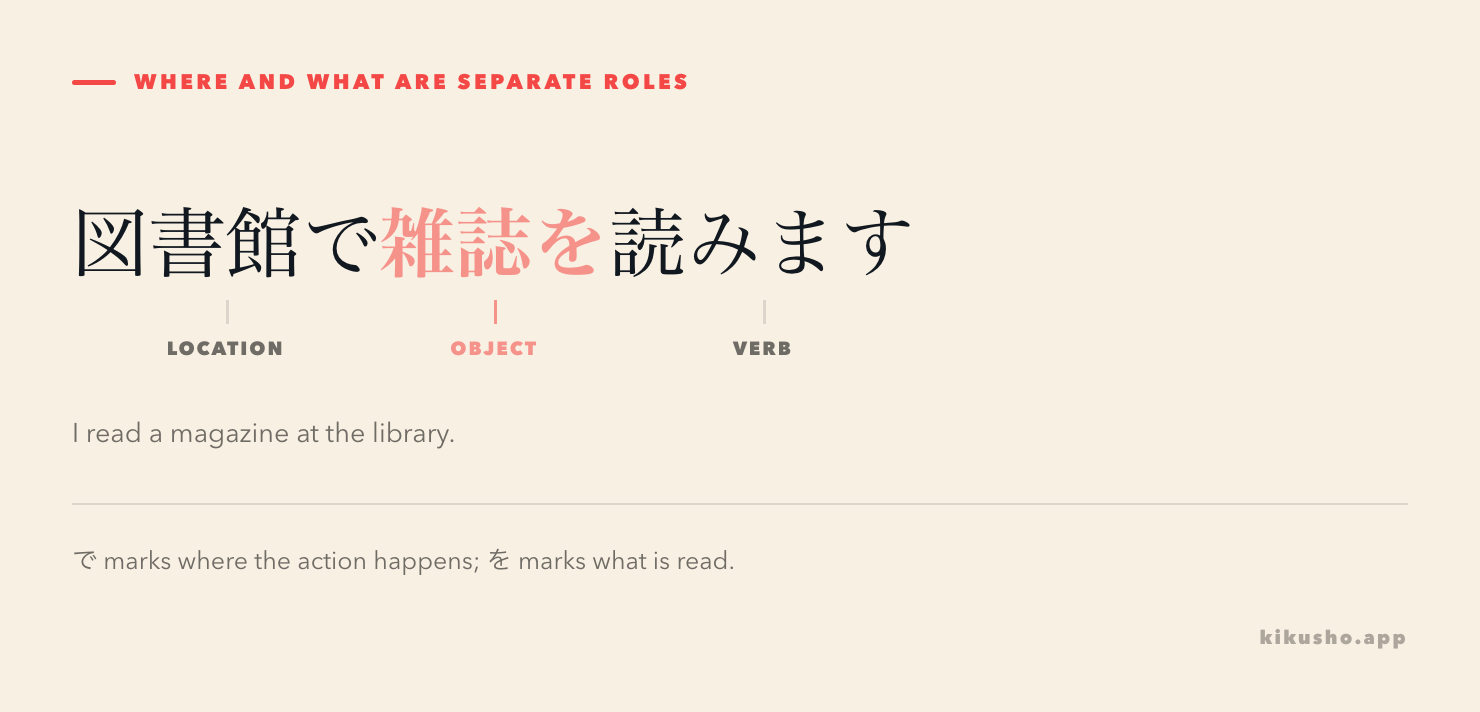
In 図書館で雑誌を読みます, “I read a magazine at the library,” two noun phrases take different particles. 図書館で(としょかんで) names where the reading happens. 雑誌を names what you read. The location does not become an object simply because it stands near the verb.
An object need not be physically changed
“The thing acted on” is a useful first explanation, but do not make it a physical test. A magazine does not have to change when you read it, and a train does not change because you wait for it. Japanese still uses 雑誌を読む and 電車を待つ.
English can also disguise the pattern. We say “wait for a train” and “listen to music,” while Japanese uses 電車を待つ and 音楽を聞く(おんがくをきく). An English preposition does not choose the Japanese particle.
Learn the Japanese phrase with the verb. The N5 everyday verb lesson gives more object-and-verb combinations. A bare translation such as “wait” cannot tell you whether the noun beside it needs を, に or another particle.
Questions, negatives and polite endings keep the object pattern
Changing the verb does not remove the object's role:
| Sentence | Meaning |
|---|---|
| お茶を飲みます。 | I drink tea. |
| お茶を飲みますか。 | Do you drink tea? / Will you have tea? |
| お茶を飲みません。 | I do not drink tea. / I will not have tea. |
| 昨日、お茶を飲みました。 | I drank tea yesterday. |
The verb carries politeness, negation and tense. お茶を remains the object phrase in every row. The ます-form lesson explains how those polite forms are built.
When the unknown part is the object, use 何を(なにを): 何を読みますか, “What will you read?” The answer fills that slot: 雑誌を読みます, “I will read a magazine.” Do not choose が just because 何 is a question word. Its grammatical role decides the particle; here it is the object of 読む.
Spoken を can disappear while the noun stays
With a friend, コーヒー飲む? is an ordinary short question: “Will you have coffee?” The object コーヒー is still there. What you do not hear is を.
The Tokyo University of Foreign Studies language module explains that spoken Japanese can show noun roles through context and position without an overt object particle. It also cautions against treating conversation as written grammar with random pieces deleted: different styles have their own patterns.
For a learner, a useful comparison is コーヒーを飲む? → コーヒー飲む?. It reveals the unspoken role without claiming that every spoken sentence was produced by mechanically deleting a particle. Short, familiar exchanges make that role easy to recognize. A long sentence introducing several new people and things asks more of the listener, so keeping particles is a good way to make your meaning clear.
Omission does not automatically mean a plain verb ending. In a shop or restaurant you may hear 水、ください(みず、ください), “Water, please.” The TUFS request lesson explicitly permits N、ください in ordering contexts. The polite request remains, even though を is unspoken. 水をください is the clear full pattern to learn first.
A missing particle, object and verb are three different cases
Compare these replies around one book:
| Spoken line | What is still said | What context supplies |
|---|---|---|
| この本、読んだ? | the object and verb | the object's を role |
| うん、読んだ。 | the verb | この本を, from the question |
| 何を? | the question object and を | the already mentioned verb |
読んだ(よんだ) is the plain past form of 読む. The first line asks “Did you read this book?” The second says “Yes, I read it.” If someone has just said that they read something, 何を? can ask “What?” while leaving the understood 読んだ unspoken.
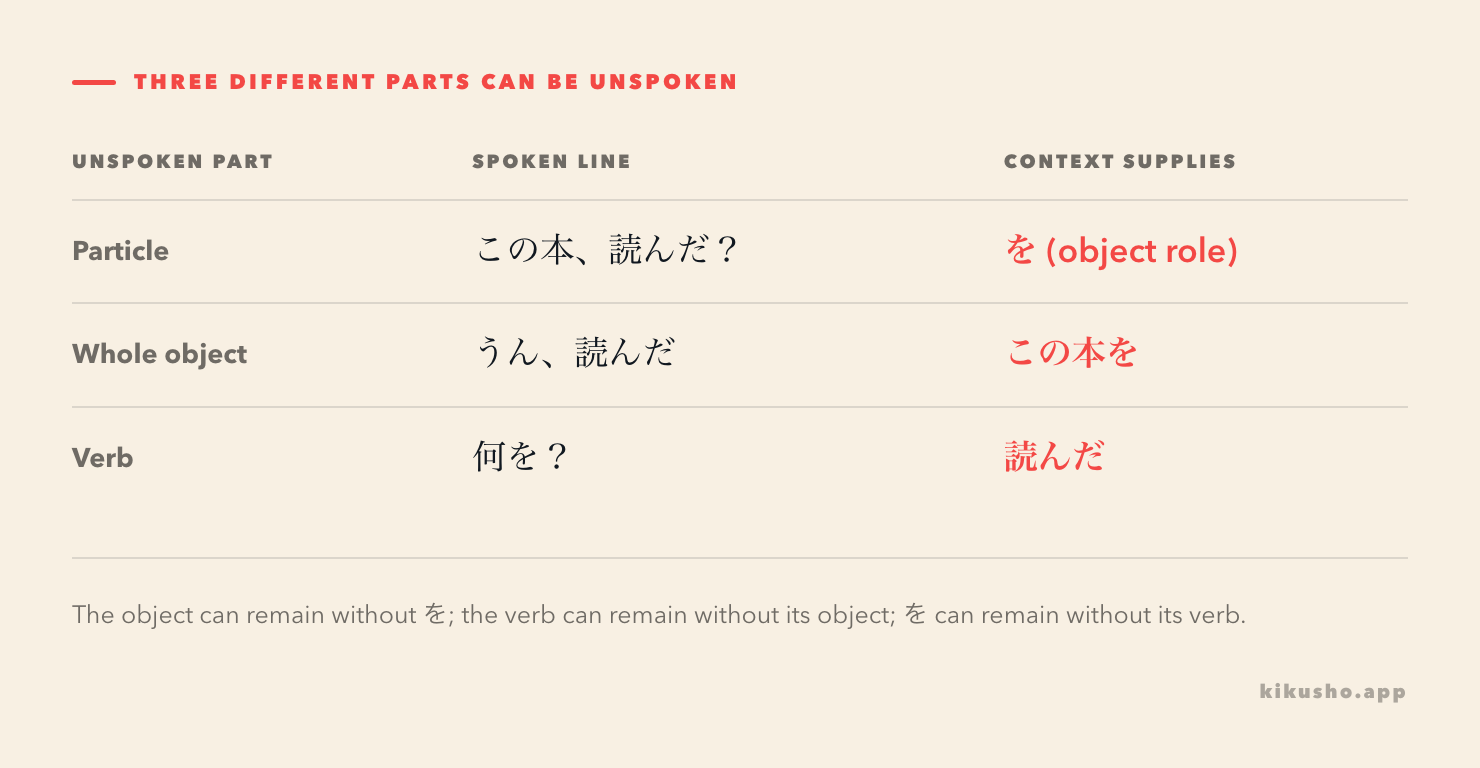
These cases explain two opposite surprises. A transitive verb can appear without any visible を phrase because its object is understood. And a line can end in を because its verb is understood. Tofugu's を reference describes that sentence-final use explicitly.
If you capture うん、読んだ on a card by itself, the object has vanished from the evidence. In Kikusho, paste the preceding question with the reply and check the generated example before saving it. Keeping the two lines preserves what “it” referred to; an isolated verb cannot do that.
Some predicates and motion phrases need a different reading
The direct-object rule has boundaries. 好き(すき) is a な-adjective, so the beginner pattern is コーヒーが好きです, “I like coffee,” rather than コーヒーを好きです. これは本です, “This is a book,” identifies something; it does not give 本 an object role. The lesson on です and だ separates those noun predicates from verbs.
Nor does every visible を prove that the verb is transitive. 公園を歩く(こうえんをあるく) means to walk through or along the park, and 家を出る(いえをでる) means to leave the house. Here を marks a path or a place left. Those motion uses are distinct from the direct object in 雑誌を読む; the everyday verb lesson explores the path pattern, and the verb-family lesson compares leaving with putting something out.
Keep を in standard beginner exercises and formal writing. Recognize its absence when a real spoken exchange licenses it. That gives you a reliable full form to produce and a way to understand a shorter form when it arrives.
Practice the roles and the short forms
Question 1: choose the particle. Complete the standard sentence ここで写真___撮ります: “I take a photo here.”
- ア. が
- イ. を
- ウ. に
- エ. で
Question 2: choose the two particles. Complete 図書館___雑誌___読みます: “I read a magazine at the library.”
- ア. を / で
- イ. に / が
- ウ. で / を
- エ. が / に
Question 3: compose a sentence. Arrange を / 読みます / この雑誌 into one standard sentence meaning “I read this magazine.”
Question 4: correct the spelling. A learner writes お茶お飲みます. Correct the sentence and explain which kana changes.
Question 5: read the exchange. A friend asks この本、読んだ? You reply うん、読んだ. For the book, what is unspoken in the question, and what is unspoken in the reply? Give a fuller version of each line.
Question 6: identify the limit. In 公園を歩きます, does 公園 name a direct object or a route? Then choose the standard sentence that means “I like coffee.”
- ア. コーヒーを好きです。
- イ. コーヒーが好きです。
- ウ. コーヒーで好きです。
- エ. コーヒーに好きです。
Answers and explanations
Answer 1. イ. を, giving ここで写真を撮ります. 写真 is what you take; ここで already identifies where the action happens. The other particles do not mark this direct object in the standard sentence.
Answer 2. ウ. で / を. 図書館で marks the reading's location, while 雑誌を marks its object. Reversing them would give the library an object role and the magazine a location role.
Answer 3. この雑誌を読みます。 The noun phrase この雑誌 stays together, followed by its particle を and then the verb 読みます.
Answer 4. お茶を飲みます。 Change the second お, the one after 茶, to を. The first お belongs to お茶 and stays. The object particle has the pronunciation o but the spelling を.
Answer 5. In この本、読んだ?, the noun phrase この本 remains and を is unspoken. A fuller line is この本を読んだ? In うん、読んだ, the whole object phrase この本を is understood: うん、この本を読んだ. Both original lines also leave the people understood, but the question asks specifically about the book.
Answer 6. 公園 names the route or area traversed, not a direct object receiving the reading-or-drinking kind of action. The correct preference sentence is イ. コーヒーが好きです. 好き takes が in this beginner pattern; a noun's particle depends on the predicate and the role, not just on whether English calls it an object.
Common questions
When do I use the Japanese particle を?
Put を directly after the noun or noun phrase that is the direct object of a verb: コーヒーを飲みます means I drink coffee, and 写真を撮ります means I take a photo. It can also mark a route or a place left with certain motion verbs, so not every を marks a direct object.
Is を pronounced o or wo?
In the standard pronunciation taught to beginners, を sounds like お, o. The spelling wo distinguishes the written character in romanization and keyboard input. Write the particle as を, even when its pronunciation is o.
Can I leave out を when speaking Japanese?
Yes, in a suitable spoken context where the noun's role is clear. A friend may say コーヒー飲む? rather than コーヒーを飲む?. Short shop orders such as 水、ください can also omit it while keeping a polite request. Keep を in your standard practice sentences and formal writing; omission is context-sensitive, not a rule to apply to every particle.
Does a missing を mean the object is missing?
No. In コーヒー飲む?, the object コーヒー is still spoken and only を is unspoken. In a reply such as うん、飲む, the whole object phrase can be understood from the preceding question. These are different kinds of shortening.