On this page
本を借りに行きます(ほんを かりに いきます) means “I will go to borrow a book”: put the verb's ます-stem before に行く to name the purpose of going. The destination can be stated separately, so 図書館へ本を借りに行きます tells you both where you are going and what you intend to do there.
に行く joins a journey to its intended action
In this N5 grammar pattern, the first verb supplies the purpose and 行く supplies the movement. 借りる(かりる), “borrow,” becomes 借りに行く, “go to borrow.” The ordinary polite version ends in 行きます; the purpose still uses the same stem.
The St. Olaf Japanese course explains this relationship between a destination, an action phrase and movement. It is not a special borrowing phrase: the same arrangement works when you go to read, run, eat or meet someone.
This page teaches that one purpose-of-movement construction. It does not teach every use of に, every way to express “in order to,” or the separate ていく pattern. You need the verb-group and ます-form lesson first if finding the stem is still uncertain.
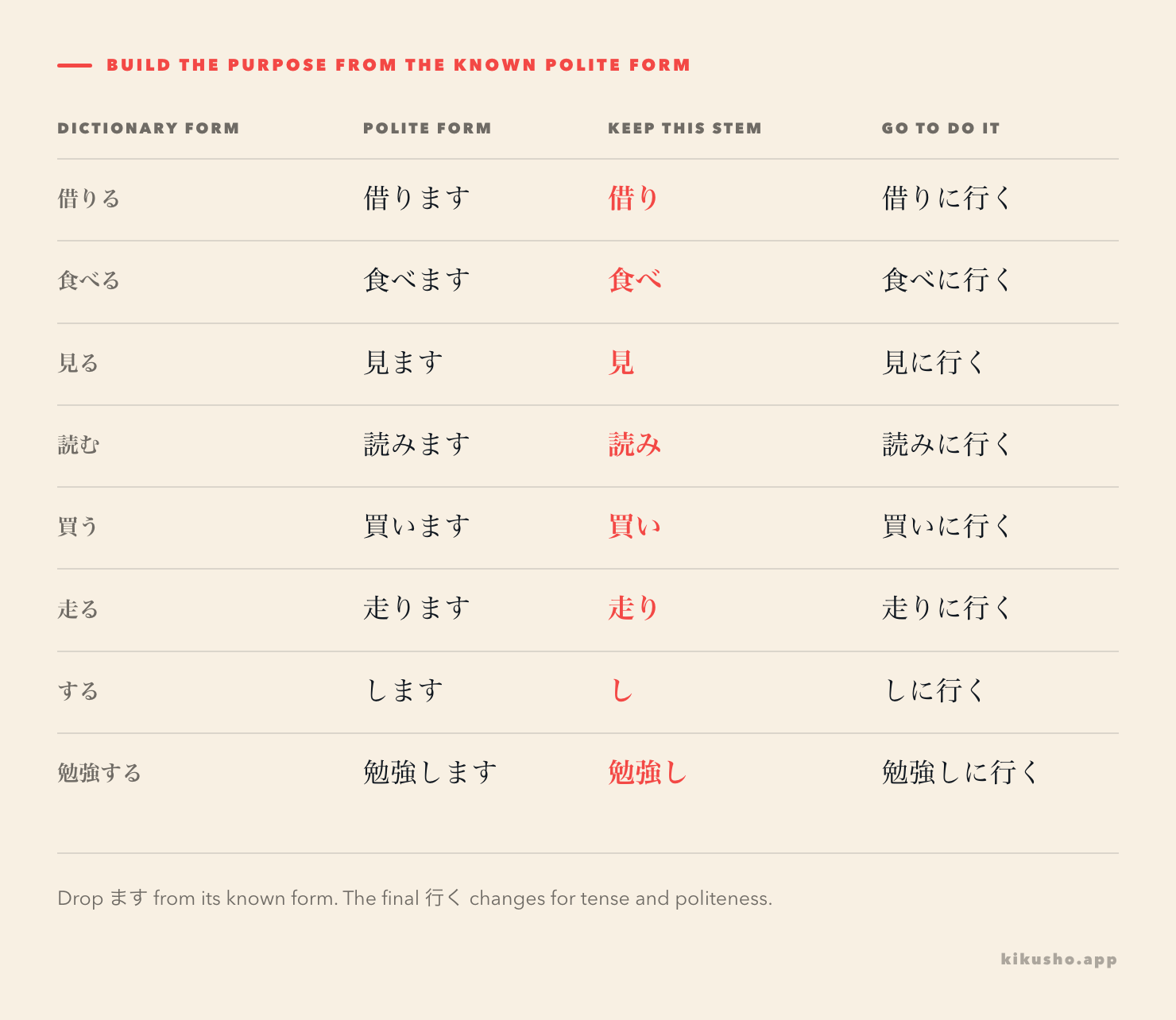
Remove ます from the known polite form
Start with 借ります(かります). Remove ます and keep 借り. Then attach に and the movement verb: 借りに行きます. “ます-stem” here is the classroom name for that pre-ます form; it does not mean the entire polite verb.
| Dictionary form | Known polite form | Stem to keep | Purpose with 行く |
|---|---|---|---|
| 借りる・かりる | 借ります | 借り・かり | 借りに行く: go to borrow |
| 食べる・たべる | 食べます | 食べ・たべ | 食べに行く: go to eat |
| 見る・みる | 見ます | 見・み | 見に行く: go to see/watch |
| 読む・よむ | 読みます | 読み・よみ | 読みに行く: go to read |
| 買う・かう | 買います | 買い・かい | 買いに行く: go to buy |
| 走る・はしる | 走ります | 走り・はしり | 走りに行く: go for a run |
| する | します | し | しに行く: go to do |
| 勉強する・べんきょうする | 勉強します | 勉強し | 勉強しに行く: go to study |
Ichidan verbs lose their final る
Borrowing, eating and seeing use 借り, 食べ and 見. These are ichidan verbs, often called る-verbs. The pattern gives 映画を見に行く(えいがを みに いく), “go to see a film.” Neither 見るに行く nor 見ますに行く uses the required stem.
Godan verbs need their い-row form
読む → 読み, 買う → 買い and 走る → 走り use the stem already present before ます. Removing the dictionary ending without replacing it will not produce those forms. In particular, 走る ends in る but belongs to the godan group: use 走り, not 走.
する gives し, including in compounds
勉強する becomes 勉強しに行く, because 勉強します has 勉強し before ます. The し does not acquire a new meaning here; it is the stem of する.
土曜日は、図書館へ日本語を勉強しに行きます。
どようびは、としょかんへ にほんごを べんきょうしに いきます。
On Saturday, I will go to the library to study Japanese.
日本語を belongs with 勉強する. You do not need to discard the action's object when putting that action inside a purpose phrase.
A place, an object and a purpose keep separate particles
駅の店へパンを買いに行きます。
えきの みせへ パンを かいに いきます。
I will go to the shop at the station to buy bread.
| Fragment | Job in the sentence |
|---|---|
| 駅の店へ | Destination: the shop at the station |
| パンを | Object of buying: bread |
| 買いに | Purpose: to buy |
| 行きます | Movement: will go |
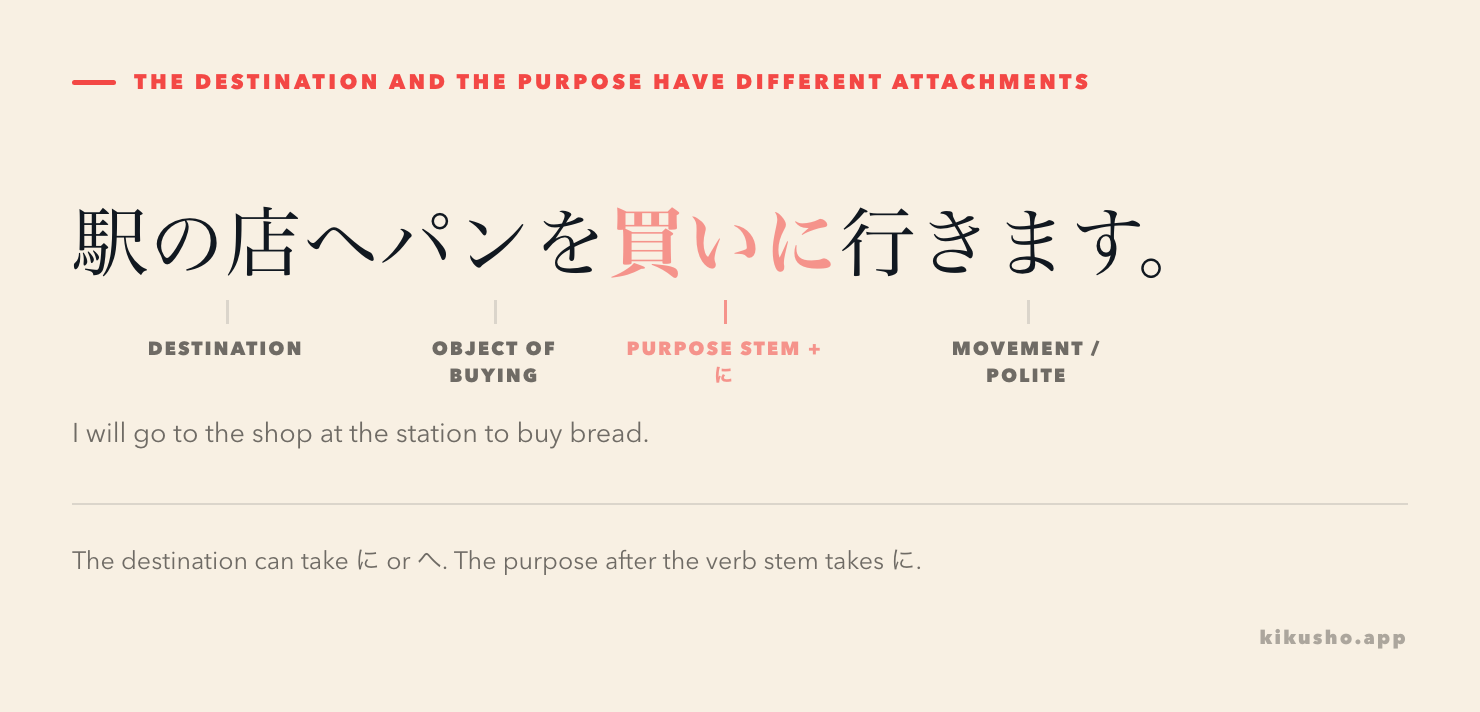
The destination can also take に: 駅の店にパンを買いに行きます has two occurrences of に with different attachments. One follows a place; the other follows the action stem. Repeating the particle does not make the sentence wrong.
へ is available for the destination, not as a replacement for the purpose に in this construction. 買いへ行きます is not the ordinary form for “go to buy.” If the place-particle choice needs its own explanation, the N5 place-particle comparison distinguishes a destination from an activity site.
Compare 図書館で本を読みます, “I read a book at the library,” with 図書館へ本を読みに行きます, “I go to the library to read a book.” The first locates the reading; the second names the library as the destination of going. They can describe parts of the same day, but their main verbs do different work.
Tense and politeness belong to the movement verb
The purpose stem does not become past just because the journey did. Keep 買い and change the final verb.
| Final expression | Meaning |
|---|---|
| パンを買いに行く | go / will go to buy bread, plain |
| パンを買いに行きます | go / will go to buy bread, polite |
| パンを買いに行った | went to buy bread, plain |
| パンを買いに行きました | went to buy bread, polite |
| パンを買いに行きません | do not / will not go to buy bread, polite |
買ったに行きました is not a past version of the construction. It puts a conjugated past verb where the purpose stem is required. 買いに行きません instead negates going for that purpose. It does not establish that bread will never be bought by another route.
You can make an invitation with 映画を見に行きませんか, “Would you like to go and see a film?” The purpose remains 見に; the invitation is carried by the final question. The invitation lesson treats the choice between inviting someone and proposing what to do together.
来る and 帰る can carry the same purpose
The Japan Foundation's Akiko grammar notes, lesson 7 teach purpose に with going, coming and returning. St. Olaf also lists those three movement verbs. They are variants of the movement frame, not three separate meanings of the purpose marker.
友達が私の家へゲームをしに来ました。
ともだちが わたしの いえへ ゲームを しに きました。
A friend came to my house to play a game.
来る(くる) presents coming toward the relevant viewpoint. Its polite form is 来ます(きます), and the past is 来ました(きました). Here し is the purpose stem; 来ました is the movement verb. Those two roles should not be confused because 来る is itself irregular.
昼ご飯を食べに家に帰ります。
ひるごはんを たべに いえに かえります。
I will return home to eat lunch.
In the ordinary reading, the traveller intends to do the purpose action. The lunch belongs to the person returning, and the game to the friend coming over. If another person is to perform an action, do not simply assign their purpose verb to the traveller and assume the relationship is expressed.
An activity noun can name the purpose, but any noun cannot
Some familiar activity nouns work directly: 買い物に行く(かいものに いく), “go shopping,” and 散歩に行く(さんぽに いく), “go for a walk.” The Japan Foundation and St. Olaf both describe noun purposes alongside verb-stem purposes.
This does not make パンに行く a way to say “go to buy bread.” パン names the thing, not the purchasing activity. Keep パンを買いに行く when that is your intended meaning. The N5 action-noun set covers the meanings of 買い物 and 散歩 separately.
A purpose does not guarantee its result
ケーキを買いに行きましたが、店は休みでした。
ケーキを かいに いきましたが、みせは やすみでした。
I went to buy a cake, but the shop was closed.
The journey took place and its purpose was buying a cake. The second clause prevents you from concluding that the purchase succeeded. This is why a translation such as “went and bought” can be too strong unless the surrounding passage establishes the result.
Do not replace the stem with a て-form to repair that supposed problem. 食べに行く names eating as the purpose of going; 食べて行く can mean eating before leaving. Bunpro's comparison on its に行く page distinguishes these. The wider uses of ていく require a separate lesson.
If you capture a spoken outing plan in Kikusho, retain the purpose verb as you heard it. A card for 買う alone will not make you retrieve 買いに. Check the generated example against the plan, then use its translation to recall the whole purpose phrase on a later review.
Reference notes and prerequisites
JLPT Sensei's に行く lesson and the inspected Bunpro page both label this construction N5. The consulted references agree on that study placement. These are estimates, not an exhaustive official grammar syllabus from the JLPT.
The required foundations are a known ます form, basic object を and destination に/へ. Noun purposes and the same purpose with 来る or 帰る are explained here as related variants. Other uses of に still need their own explanations.
Practice questions
Attempt all six items; solutions are grouped after them. These are original teaching questions.
Question 1
Complete the plan using the correct form of 見る.
明日、映画を__に行きます。
ア. 見る
イ. 見ます
ウ. 見
エ. 見て
Question 2
Arrange the pieces after 私は to make a sentence. Put the destination first, followed by the object, purpose and final movement verb.
買いに ・ 行きます ・ 店へ ・ パンを
Question 3
Read the short diary entry and select the statement supported by it.
昨日、駅の店へケーキを買いに行きました。でも、店は休みでした。
ア. ケーキを買いました。
イ. ケーキを買いに店へ行きました。
ウ. 家でケーキを作りました。
エ. 駅の店へ行きませんでした。
Question 4
Supply the purpose phrase in the report about a visit.
週末、弟は私の家へゲームを__来ました。
ア. するに
イ. しで
ウ. しますに
エ. しに
Question 5
Write one polite past sentence beginning with 昨日 to say you went to meet a friend. Include 友達に, the purpose formed from 会う, and 行きました.
Question 6
The speaker explains the order of tomorrow's actions:
本はまだ持っていません。まず図書館へ行きます。そこで本を借ります。
Which completion preserves that order?
明日は図書館へ本を__。
ア. 借りて行きます
イ. 借りに行きます
ウ. 借りるに行きます
エ. 借りたに行きます
Answers and explanations
Answer 1
ウ:見。 The relevant polite verb is 見ます, so its pre-ます form is 見. The completed plan means “Tomorrow, I will go to see a film.” ア retains the dictionary ending, イ retains ます and エ substitutes the て-form; none supplies the required purpose stem.
Answer 2
私は店へパンを買いに行きます。 In the order requested, 店へ names the destination, パンを is the object of 買う, 買いに states the purpose, and 行きます finishes the sentence. Japanese allows other arrangements of some preceding phrases; the requested order is a composition constraint, not a claim that all alternatives are ungrammatical.
Answer 3
イ. The writer went to the shop intending to buy cake. ア incorrectly asserts a successful purchase, while the closed shop blocks that inference. ウ invents cake-making at home, and エ denies the journey that the diary reports. The past form 行きました confirms going, not a completed buying event.
Answer 4
エ:しに。 ゲームをする has します as its polite form, giving the stem し. The final 来ました supplies polite past movement. ア and ウ leave the wrong verb endings before に; イ replaces the purpose marker with で. The completed sentence says the younger brother came to the speaker's house to play a game.
Answer 5
昨日、友達に会いに行きました。 Read it as きのう、ともだちに あいに いきました. 会う becomes 会います, so keep 会い before the purpose に. The first に belongs to 友達に, the person being met; the second marks the purpose after 会い. Changing the whole phrase to 会ったに would misplace the past marking.
Answer 6
イ:借りに行きます。 Going to the library comes before the intended borrowing there. ア instead presents borrowing before the movement, which does not preserve the stated sequence. ウ uses dictionary 借りる where 借り is needed; エ wrongly marks the purpose verb as past. The complete line records tomorrow's plan, not a claim that the book has already been obtained.
Common questions
How do I form a verb before に行く?
Use the form immediately before ます: 読みます gives 読み, so 読みに行く means go to read. 食べます gives 食べ, and します gives し. Do not attach purpose に directly to the dictionary form or the full ます form.
Can I use へ instead of に for the purpose?
A destination can take に or へ, as in 店に買いに行く or 店へ買いに行く. The purpose marker after the verb stem stays に. 買いへ行く does not follow this ordinary purpose construction.
Does 買いに行きました mean the purchase succeeded?
It says someone went for the purpose of buying. It does not by itself guarantee a completed purchase. A later sentence can report that the shop was closed or that the desired item was unavailable.