On this page
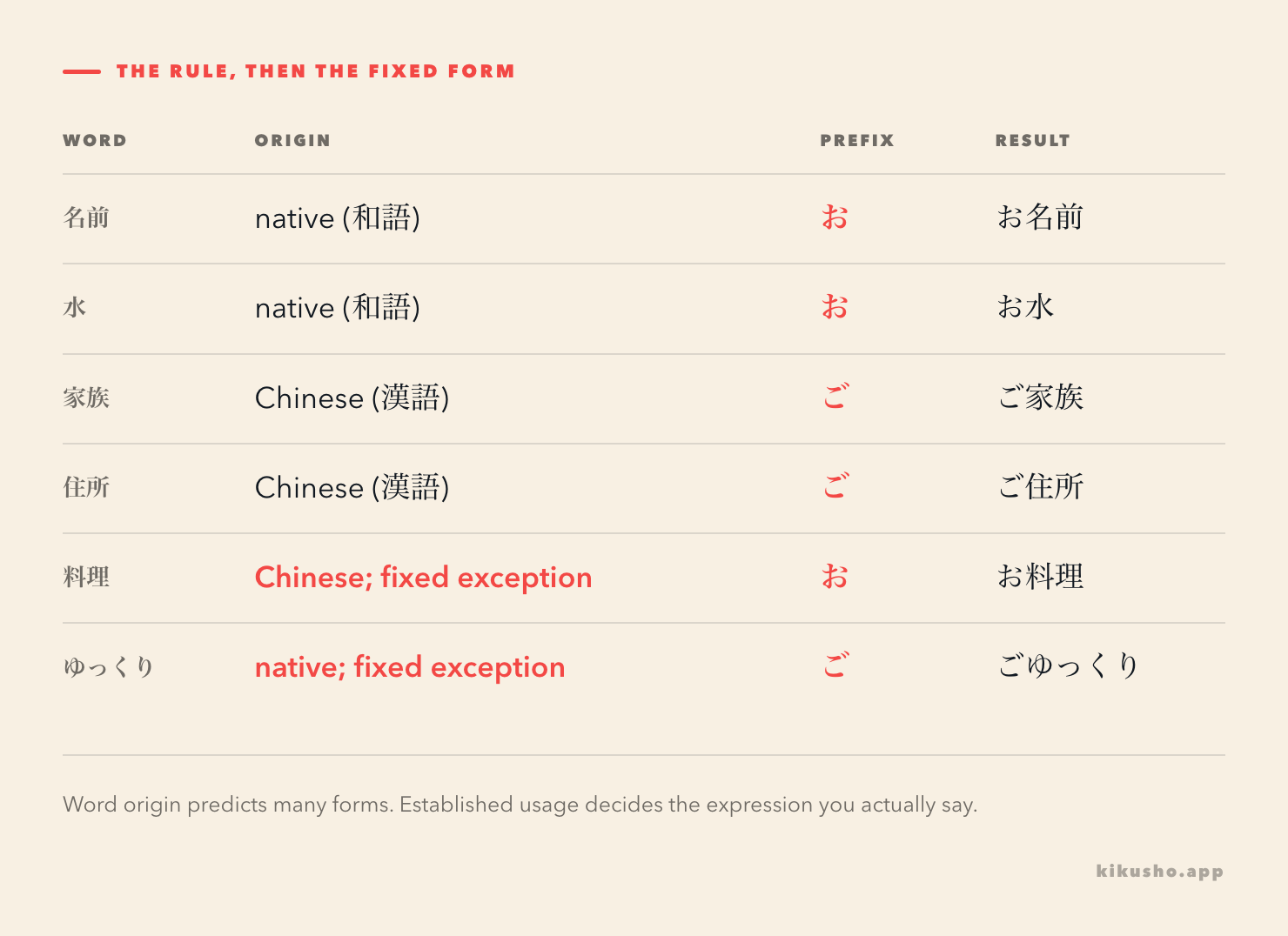
お and ご are two common readings of the prefix 御. Start with one reliable rule: native Japanese words usually take お, while Chinese-origin words usually take ご. That gives you お名前, お水, ご家族 and ご住所. Then learn the whole prefixed word, because established forms such as お茶, お料理 and ごゆっくり do not follow the simple prediction.
The prefix can respect another person, present your own action humbly when it is directed toward that person, or make an everyday word sound refined. It is useful, but it is not a decoration you can attach to every noun.
The starting rule: お with native words, ご with Chinese-origin words
Japanese vocabulary has several historical layers. Two matter here:
- 和語 (wago), native Japanese words, usually take お: お名前 (name), お水 (water), お手紙 (letter), お忙しい (busy).
- 漢語 (kango), Chinese-origin words, usually take ご: ご家族 (family), ご住所 (address), ご注文 (order), ご立派 (splendid).
The kanji count is only a clue. Many kango are two-kanji compounds, but counting characters does not produce the rule. 電話 is a two-kanji kango and the established form is お電話, not the predicted ご電話. Learn the origin rule as a strong first guess, then trust the form Japanese speakers actually use.
Both prefixes are usually written in hiragana. In formal writing, either can appear as 御, so 御住所 is read ごじゅうしょ while 御名前 is read おなまえ. Reading one kanji in more than one way is normal Japanese; the broader pattern is explained in why one kanji has several readings.
One sentence can use both prefixes
A restaurant question makes the rule visible twice:
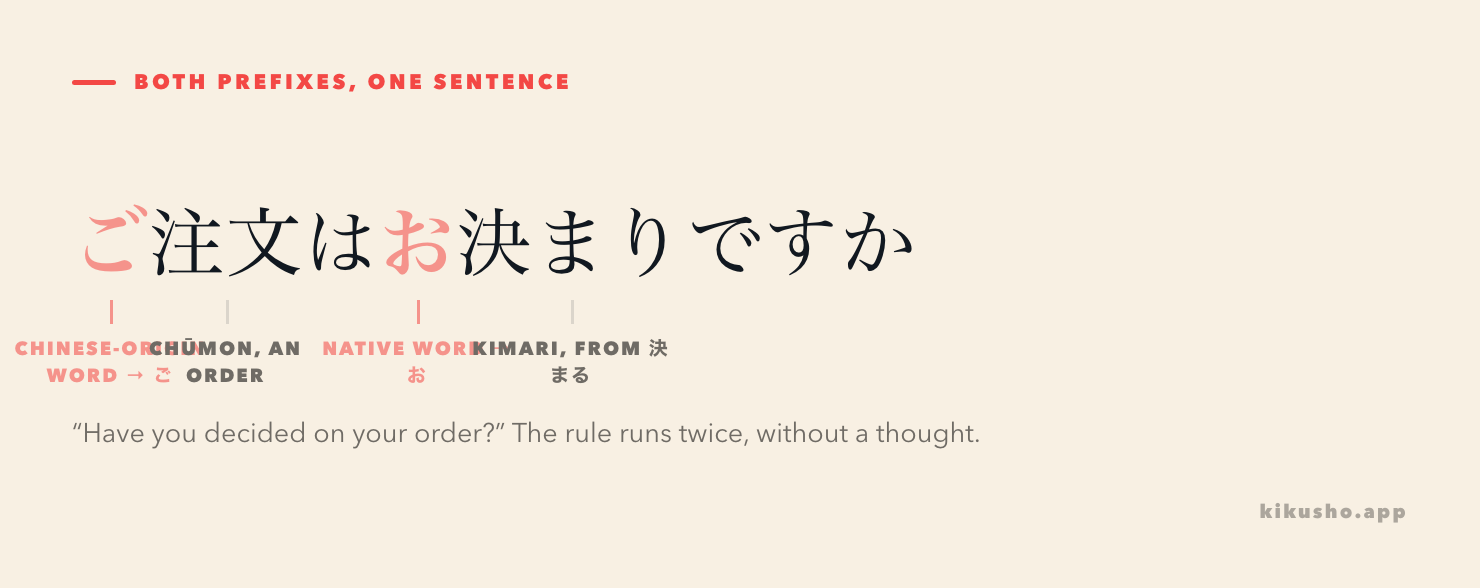
ご注文はお決まりですか。
Go-chūmon wa o-kimari desu ka.
Have you decided on your order?
注文 is a Chinese-origin compound, so it takes ご. 決まり comes from the native verb 決まる, so it takes お.
The translation does not need to contain “honourable.” The prefix changes the social presentation of the Japanese expression. Natural English usually expresses the same care through the whole sentence.
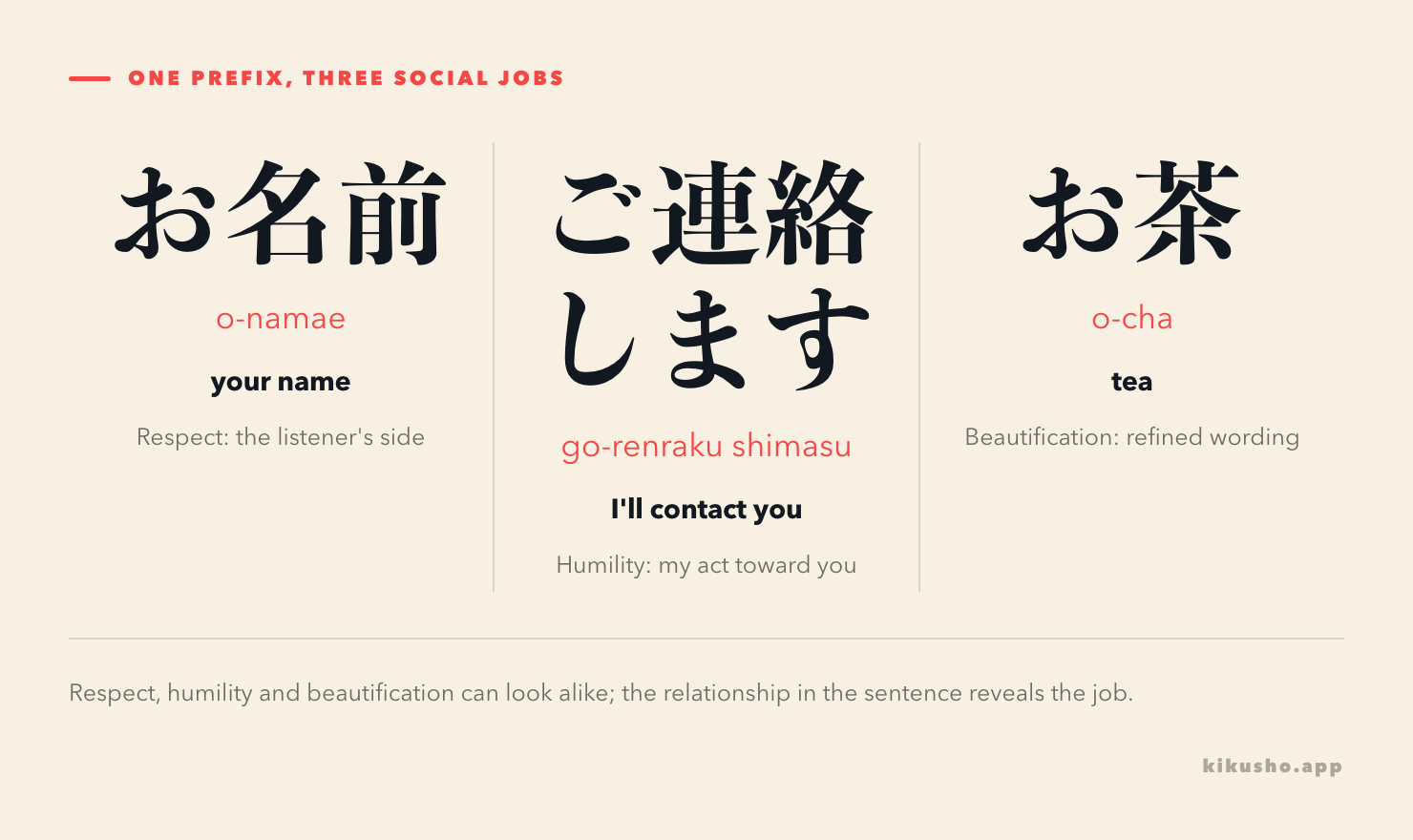
The same prefix can do three jobs
Knowing the job explains why the prefix may appear on another person's thing, your own action, or a thing that belongs to nobody.
1. Respect another person's side
お名前は何ですか。
O-namae wa nan desu ka.
What is your name?
ご家族は日本にいますか。
Go-kazoku wa Nihon ni imasu ka.
Is your family in Japan?
The name and family belong to the person being treated respectfully. This is why a self-introduction uses 私の名前は…, not 私のお名前は…. Likewise, when speaking to an outsider about your own family, 家族 is the normal beginner choice rather than ご家族.
2. Present your action humbly toward someone
明日、ご連絡します。
Ashita, go-renraku shimasu.
I will contact you tomorrow.
The contact is your action, but it is directed toward the other person. ご does not honor you; the whole expression presents your action with deference toward its recipient. This is the beginning of the more advanced お/ご~する humble pattern, so an N5 learner only needs to recognize common expressions such as ご連絡します.
3. Beautify an everyday word
お茶を飲みます。
O-cha o nomimasu.
I drink tea.
No owner is being honored. お茶 presents the thing in a familiar, refined way. The Agency for Cultural Affairs calls this 美化語 (bikago, beautifying language) and gives お酒 and お料理 as standard examples.
Beautification creates exceptions, not a second automatic rule
The origin rule still matters, but fixed usage has the last word. Common Chinese-origin words that take お include:
| Established form | Meaning | Why it matters |
|---|---|---|
| お茶(おちゃ) | tea | Chinese-origin 茶 with established お |
| お料理(おりょうり) | cooking; cuisine | common beautifying form |
| お電話(おでんわ) | telephone; phone call | established polite form |
| お元気(おげんき) | well; healthy | respectful fixed expression |
| お化粧(おけしょう) | makeup | common beautifying form |
Beautification does not always mean お. The official guidance also gives ご祝儀(ごしゅうぎ, congratulatory gift)as a beautifying form with ご. Tofugu notes exceptions in the other direction too, including the native expression ごゆっくり (“take your time”). These are reasons to learn useful words whole, not reasons to abandon the main rule.
Some prefixes have become part of the everyday word. ご飯(ごはん, cooked rice; meal)and おにぎり are not best understood as freely decorated versions that a beginner can strip down. Store the form you actually meet.
Do not manufacture polite words
Most katakana loanwords take neither prefix. パソコン, スマートフォン and インターネット normally remain bare. A few established service or household expressions, such as おトイレ, are exceptions. Their existence does not license forms such as おパソコン.
Titles such as 社長 and 先生 also do not normally become お社長 or ご先生. The title already carries a social role and uses its own patterns. Adding a prefix mechanically can sound childish, playful or simply wrong.
The safest beginner process is:
- Use お for a known native word and ご for a known Chinese-origin word.
- Check whether the prefixed expression is established.
- Ask what the prefix is doing: respect, humility or beautification.
- Do not add it merely because the sentence ends in です or ます.
Polite endings and honorific vocabulary are separate choices. The overview of Japanese politeness shows how they fit together without requiring you to produce advanced keigo yet.
A small contrast that prevents a large mistake
Compare the following pair:
お名前は何ですか。
What is your name?
私の名前はアナです。
My name is Ana.
The first expression raises the listener's side. The second simply identifies the speaker. The prefix disappears because honoring your own name would point the respect in the wrong direction.
This does not mean “never use a prefix with anything connected to yourself.” Beautifying words such as お茶 do not depend on ownership, and humble expressions such as ご連絡します describe your act toward someone else. Check the function, not just the owner.
Kikusho can help you keep these expressions as complete phrases. Photograph a menu or paste a sentence, select ご注文 or お手洗い, and save the reading, meaning and register note on one card. That preserves the prefix with the word instead of turning every encounter into a new guess. Kikusho supports study and review; these pages do not claim to reproduce an official exhaustive JLPT syllabus.
Practice: choose the established expression
Complete all seven questions before opening the answer section. Use the origin rule first, then check the social direction and any fixed exception.
Question 1
You politely ask another person for their name. Which is natural?
A. 名前は何ですか。
B. お名前は何ですか。
C. ご名前は何ですか。
Question 2
Choose the usual prefix for 住所(じゅうしょ, address).
A. お住所
B. ご住所
C. 住所ご
Question 3
Complete a neutral self-introduction: 私の__はミナです。
A. お名前
B. ご名前
C. 名前
Question 4
Put these chunks in a natural order to ask whether someone's family is well:
ですか / お元気 / ご家族は
Question 5
In ご注文はお決まりですか, why do the two prefixes differ?
A. ご is formal and お is casual.
B. 注文 is Chinese-origin, while 決まり comes from a native verb.
C. ご marks a question and お marks an answer.
Question 6
You mention an ordinary laptop with no playful effect. Which noun phrase is natural?
A. パソコン
B. おパソコン
C. ごパソコン
Question 7
Which statement is accurate?
A. Every Chinese-origin word must take ご without exception.
B. Beautifying language always takes お.
C. Word origin is a useful starting rule, but established usage includes exceptions.
Answers and explanations
Answer 1
B. お名前は何ですか。 名前 is a native Japanese word, and the prefix respectfully presents the listener's name. ご名前 is not the established form. The bare form can be grammatical, but B is the requested polite expression.
Answer 2
B. ご住所. 住所 is a Chinese-origin compound and conventionally takes ご. A prefix goes before the word, so C also has the wrong position.
Answer 3
C. 名前. In a basic self-introduction, do not honor your own name: 私の名前はミナです. The mistake is social direction, not merely the choice between お and ご.
Answer 4
ご家族はお元気ですか。
Go-kazoku wa o-genki desu ka.
Is your family well?
ご家族 is the established respectful form for the other person's family. お元気 is a fixed respectful expression and one of the kango words that takes お.
Answer 5
B. 注文 is kango and takes ご. 決まり is derived from the native verb 決まる and takes お. Both belong to the same polite question; the difference does not mark casual versus formal speech.
Answer 6
A. パソコン. Most katakana loanwords remain bare. A few expressions such as おトイレ are fixed exceptions, but that pattern cannot be extended freely to other loanwords.
Answer 7
C. The wago お / kango ご split predicts many forms, but usage controls exceptions such as お料理, お元気 and ごゆっくり. Beautification often appears with お, yet official guidance also records ご祝儀, so B is too absolute.
Common questions
What is the basic difference between お and ご?
Both are forms of the prefix 御. As a starting rule, native Japanese words usually take お, while Chinese-origin words usually take ご. Established exceptions mean that the complete prefixed word still has to be learned.
Why do お茶 and お料理 take お?
茶 and 料理 are Chinese-origin words, but お茶 and お料理 are established forms. Both are often beautifying language, which presents the thing in a refined way. Beautification creates exceptions, but it does not make every Chinese-origin word take お.
Can I add お or ご to any noun to sound polite?
No. Many combinations are fixed by usage. Most katakana loanwords remain bare, titles such as 社長 do not normally take the prefix, and an invented form such as おパソコン sounds wrong or playful.
Should I use お or ご for my own things?
Do not honor yourself with forms such as 私のお名前. Say 私の名前. A prefix can still appear in beautified fixed words such as お茶 or in a humble act directed toward someone else, as in ご連絡します.