On this page
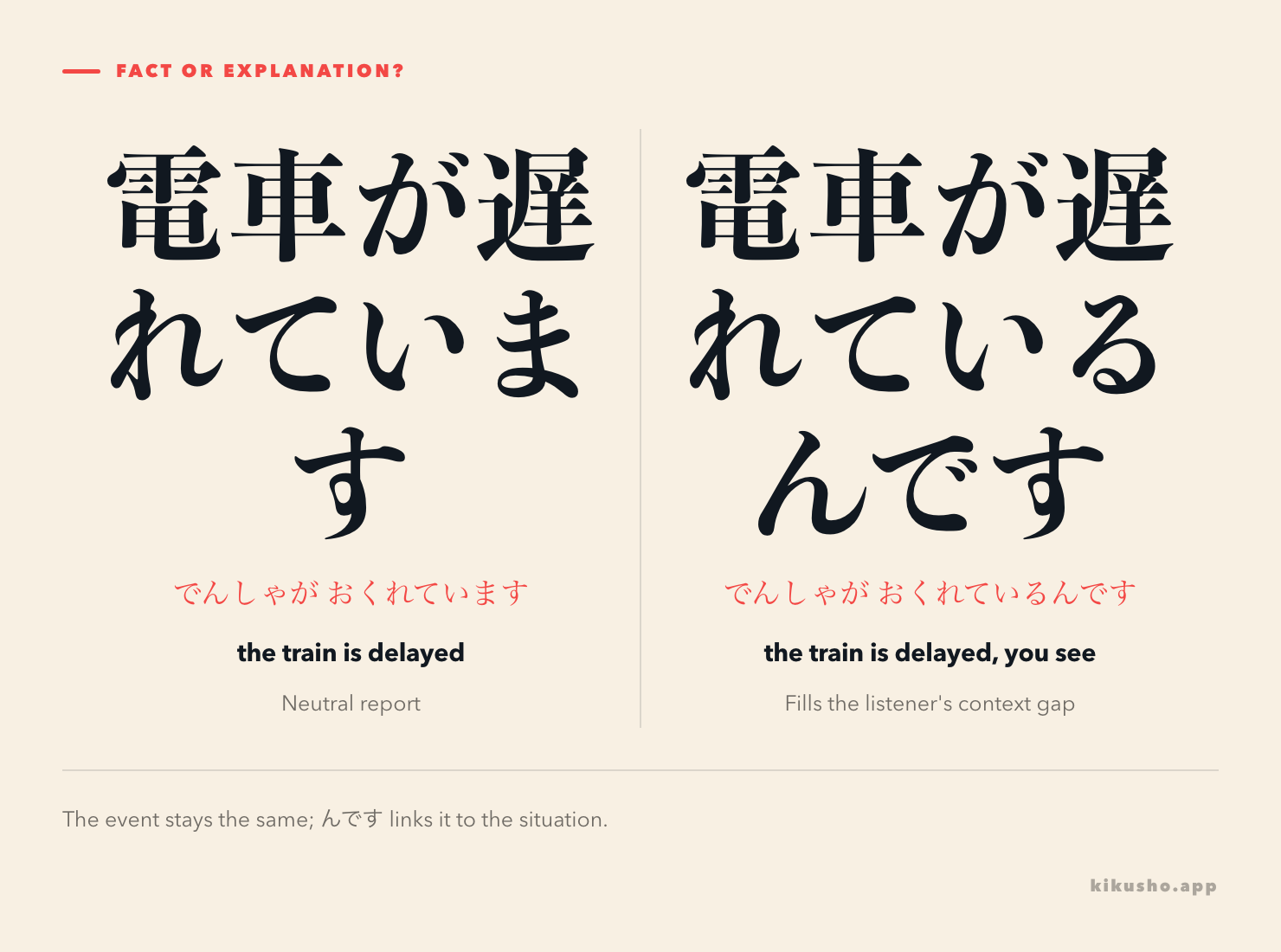
Use んです or のです when a statement explains the situation or fills in context the listener is missing. 電車が遅れているんです still says “The train is delayed,” but it presents that fact as relevant background, perhaps explaining why the speaker will be late.
んです is the normal polite conversational form. のです has the same core function with a more written or formal feel; casual speech commonly uses んだ.
A fact becomes an explanation when the situation calls for one
Compare a timetable report with a reply to someone waiting for you:
電車が遅れています。
でんしゃが おくれています。
The train is delayed.
電車が遅れているんです。
でんしゃが おくれているんです。
The train is delayed, you see. / It's that the train is delayed.
Both sentences contain the same event. The second connects it to a question already present in the conversation: Why are you late? Why have you not arrived? What is causing the problem?
English does not have one ending that matches this job. Depending on the scene, a translation may add the thing is, you see or it's because. Often natural English adds nothing and lets the dialogue carry the explanatory connection.
Tofugu's independently written explanatory-form guide describes the shared function as filling a gap in understanding. This is more precise than memorizing “んです means because.” Because normally links a cause to a result; んです can also clarify an identity, correct a misunderstanding, introduce relevant background or seek an explanation.
Attach the plain form, not the polite form
Verbs and い-adjectives attach directly in their plain forms. The final です makes the whole explanatory expression polite.
| Predicate type | Plain content | Polite explanation |
|---|---|---|
| verb, non-past | 行く | 行くんです |
| verb, past | 行った | 行ったんです |
| verb, negative | 行かない | 行かないんです |
| い-adjective | 忙しい | 忙しいんです |
| い-adjective, past | 忙しかった | 忙しかったんです |
今日は早く帰るんです。
きょうは はやく かえるんです。
I'm going home early today, you see.
昨日は忙しかったんです。
きのうは いそがしかったんです。
The thing is, I was busy yesterday.
Do not put a completed polite predicate inside the frame. × 帰りますんです and × 忙しいですんです each try to mark politeness twice. Keep 帰る or 忙しい plain inside, then let the final です address the listener politely.
The Japan Foundation's Marugoto grammar note gives a full table of plain non-past, past, affirmative and negative forms before んです. The rule is about attachment; the surrounding conversation decides what the explanation is doing.
Nouns and な-adjectives insert な in the present affirmative
For a present affirmative noun or な-adjective, add な before んです or のです.
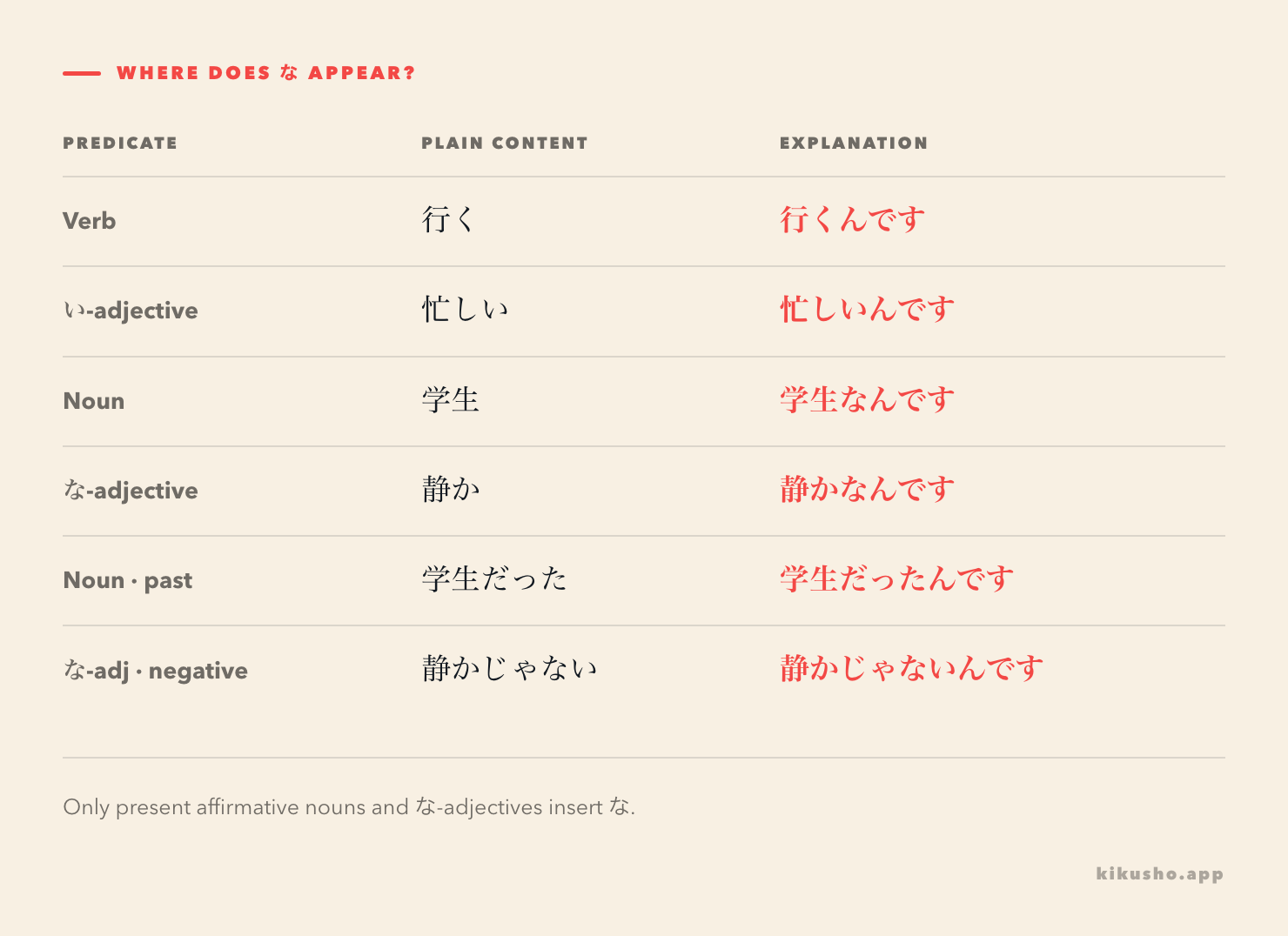
| Predicate type | Correct form | Not this |
|---|---|---|
| verb | 行くんです | × 行くなんです |
| い-adjective | 忙しいんです | × 忙しいなんです |
| noun | 学生なんです | × 学生んです |
| な-adjective | 静かなんです | × 静かんです |
あの人は新しい先生なんです。
あの ひとは あたらしい せんせいなんです。
That person is the new teacher, you see.
この部屋は夜、とても静かなんです。
この へやは よる、とても しずかなんです。
This room is very quiet at night, actually.
The extra な belongs only to the present affirmative shape. Past and negative forms already contain the plain copular material they need:
| Time or polarity | Noun example | な-adjective example |
|---|---|---|
| present affirmative | 学生なんです | 静かなんです |
| past affirmative | 学生だったんです | 静かだったんです |
| present negative | 学生じゃないんです | 静かじゃないんです |
| past negative | 学生じゃなかったんです | 静かじゃなかったんです |
Do not add な after だった or じゃない. × 学生だったなんです duplicates the connection. Tofugu and Marugoto both record the special な insertion and the ordinary past or negative attachments.
Questions seek the missing explanation
A question with んですか signals that the speaker sees or assumes a situation and wants the listener to supply its background.
腕のけが、どうしたんですか。
うでの けが、どうしたんですか。
What happened to your arm?
自転車で転んだんです。
じてんしゃで ころんだんです。
I fell off my bicycle.
The injury is visible, so the first speaker asks for the event behind it. The reply uses the same explanatory frame to fill that gap.
The Japan Foundation's Irodori grammar notes use this exact kind of exchange. They also distinguish どうしたんですか, prompted by an unusual visible situation, from a doctor's opening どうしましたか, where asking the patient what is wrong is already expected. The distinction is pragmatic rather than a claim that one question is always correct.
In casual conversation, の? often seeks the same explanation:
どうして帰るの?
どうして かえるの?
Why are you going home?
明日、試験があるんだ。
あした、しけんが あるんだ。
I have an exam tomorrow.
Tone and relationship matter. Asking どうして行かないんですか can sound concerned, curious or challenging because it asks the listener to account for a choice. The grammar does not make the question rude by itself, but it does ask for more than a bare yes-or-no fact.
んです and のです share a function but differ in register
The ん in んです is a spoken contraction of explanatory の. The ending after it selects politeness and style.
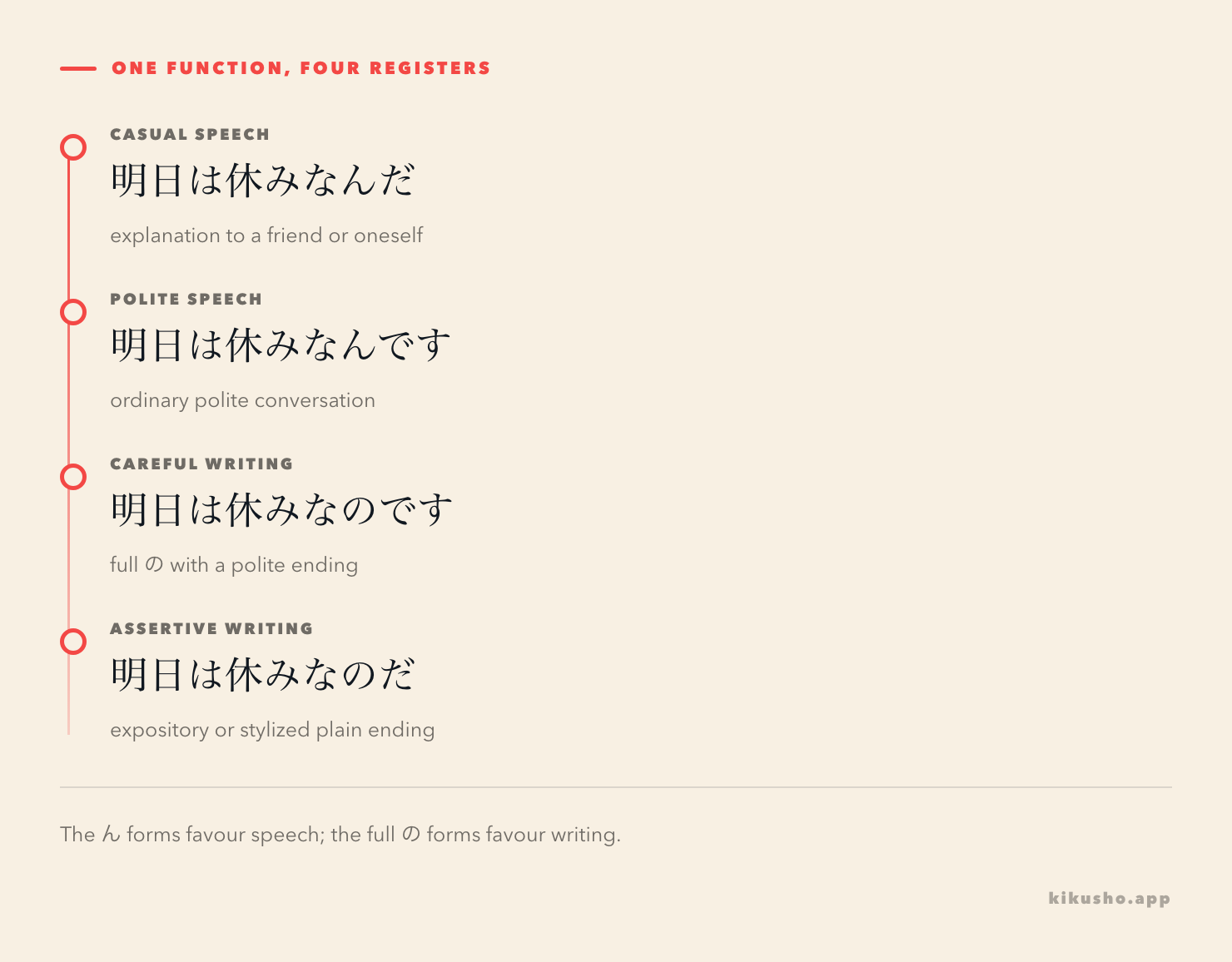
| Form | Common setting | Example |
|---|---|---|
| んだ | casual speech, self-directed realization | 明日は休みなんだ |
| んです | polite conversation | 明日は休みなんです |
| のです | careful or formal writing; deliberately formal speech | 明日は休みなのです |
| のだ | assertive explanatory writing or stylized speech | 明日は休みなのだ |
んです is polite because it ends in です, yet it remains conversational. のです keeps the full の and can sound stiff in everyday talk. のだ often belongs to explanatory prose, narration or a deliberately forceful character voice.
JLPT Sensei's んです entry places んです and んだ at N5 and identifies explanation, reasoning and emphasis. Its separate のです entry treats のです and のだ as the full-form family. Tofugu further separates colloquial ん forms from the more written or formal の forms.
Explanation is not the same as a ので reason clause
The shapes look similar, but their grammar is different:
雨が降っているんです。
あめが ふっているんです。
The thing is, it is raining.
雨が降っているので、出かけません。
あめが ふっているので、でかけません。
Because it is raining, I will not go out.
The first turn ends with explanatory んです. The second uses ので to connect a stated reason to the result 出かけません. The から and ので comparison teaches that reason connector. Do not turn every んです into a literal because-clause when no result follows.
Similarly, んですけど often presents background before a question or request: 聞きたいことがあるんですけど、今いいですか, “There is something I'd like to ask; is now a good time?” The けど and けれど lesson handles that conversational bridge. Here, んです supplies relevant context and けど leaves room for what comes next.
Both assigned forms are listed at N5 in JLPT Sensei's curriculum, and the retained Tanos N5 inventory also contains んです. The official JLPT FAQ explains that the test does not publish an exhaustive grammar list, so these placements guide study rather than guarantee a particular item on an exam.
When you save a line such as 今日は行けないんです in Kikusho, keep the situation beside it: a schedule conflict, illness or transport problem. The ending marks the sentence as explanatory, but the missing circumstance supplies what it explains. A full editable example makes that relationship available during review.
Practice: find the information gap
Work through the seven prompts before opening the answer section. For each one, inspect the inner plain form, any required な and the conversational clue that calls for an explanation.
Question 1
Choose the polite explanation “I'm going home early today.”
- な: 今日は早く帰りますんです。
- に: 今日は早く帰るんです。
- ぬ: 今日は早く帰るなんです。
- ね: 今日は早く帰りんです。
Question 2
Complete the present affirmative noun sentence “The thing is, I'm a student.”
私は学生__。
- な: んです
- に: なんです
- ぬ: だんです
- ね: にんです
Question 3
Which sentence correctly explains that the room was quiet?
- な: 部屋は静かだったんです。
- に: 部屋は静かだったなんです。
- ぬ: 部屋は静かでしたんです。
- ね: 部屋は静かくんです。
Question 4
Arrange every chunk once to ask politely “What happened?” while seeking an explanation.
んですか / どうした
Question 5
Choose the reply that naturally explains why the speaker cannot eat lunch with a friend.
A:一緒に昼ご飯を食べませんか。
B:すみません、今日は授業が__。
- な: あるんです
- に: ありますんです
- ぬ: あるなんです
- ね: あるのでです
Question 6
Which form best fits ordinary polite conversation rather than deliberately formal written exposition?
実は、明日試験が__。
- な: あるんです
- に: あるのだ
- ぬ: ありますのだ
- ね: あるだ
Question 7
Explain the difference between these two sentences in the situation where a colleague asks why you cannot leave yet.
仕事が残っています。
仕事が残っているんです。
Answers and explanations
Answer 1
に: 今日は早く帰るんです. The inner verb stays in plain form 帰る, and the final です makes the explanatory turn polite. 帰りますんです puts a polite form inside the frame; the other choices invent attachments.
Answer 2
に: なんです. A present affirmative noun inserts な: 学生 + な + んです. Bare 学生んです omits that connection, while 学生だんです keeps だ where な is required.
Answer 3
な: 部屋は静かだったんです. Past だった already supplies the plain copular form before んです, so no extra な appears. 静かでした is polite inside the frame, and 静かく wrongly treats 静か as an い-adjective.
Answer 4
どうしたんですか is the complete question. Plain past どうした comes before んですか. The question seeks the event or situation that explains what the speaker has noticed.
Answer 5
な: あるんです. The invitation creates the missing question “Why not?” 今日は授業があるんです supplies the relevant background. ありますんです puts polite ます inside the frame, and あるのでです does not correctly build either んです or a ので reason clause.
Answer 6
な: あるんです. It is the ordinary polite conversational form. あるのだ is explanatory but belongs more readily to assertive writing or stylized speech. The other two options do not form the construction correctly.
Answer 7
仕事が残っています neutrally reports that work remains. 仕事が残っているんです offers the same fact as the explanation for not leaving yet. The event does not change; the second sentence explicitly connects it to the colleague's information gap.
Common questions
What do んです and のです mean?
They present a statement as an explanation or as context relevant to the situation. English may use “the thing is,” “it's because,” or no extra words at all. The form does not always introduce a literal cause; context decides the most natural translation.
What is the difference between んです and のです?
They share the same core explanatory function. んです is the usual polite conversational form. のです keeps the full の and is more common in careful or formal writing; in ordinary conversation it can sound stiff. Casual speech commonly uses んだ, while written explanatory prose can use のだ.
Why do nouns and な-adjectives use なんです?
In the present affirmative, nouns and な-adjectives insert な before the explanatory の or ん: 学生なんです and 静かなんです. Verbs and い-adjectives attach directly in plain form: 行くんです and 忙しいんです. Past and negative noun or な-adjective forms already carry だった or じゃない, as in 学生だったんです.
What is the difference between どうしましたか and どうしたんですか?
Both can ask what happened. どうしたんですか asks for an explanation prompted by an observed situation, such as seeing an injured arm. どうしましたか is a more neutral inquiry and fits settings where asking is expected, such as a doctor beginning a consultation.