On this page
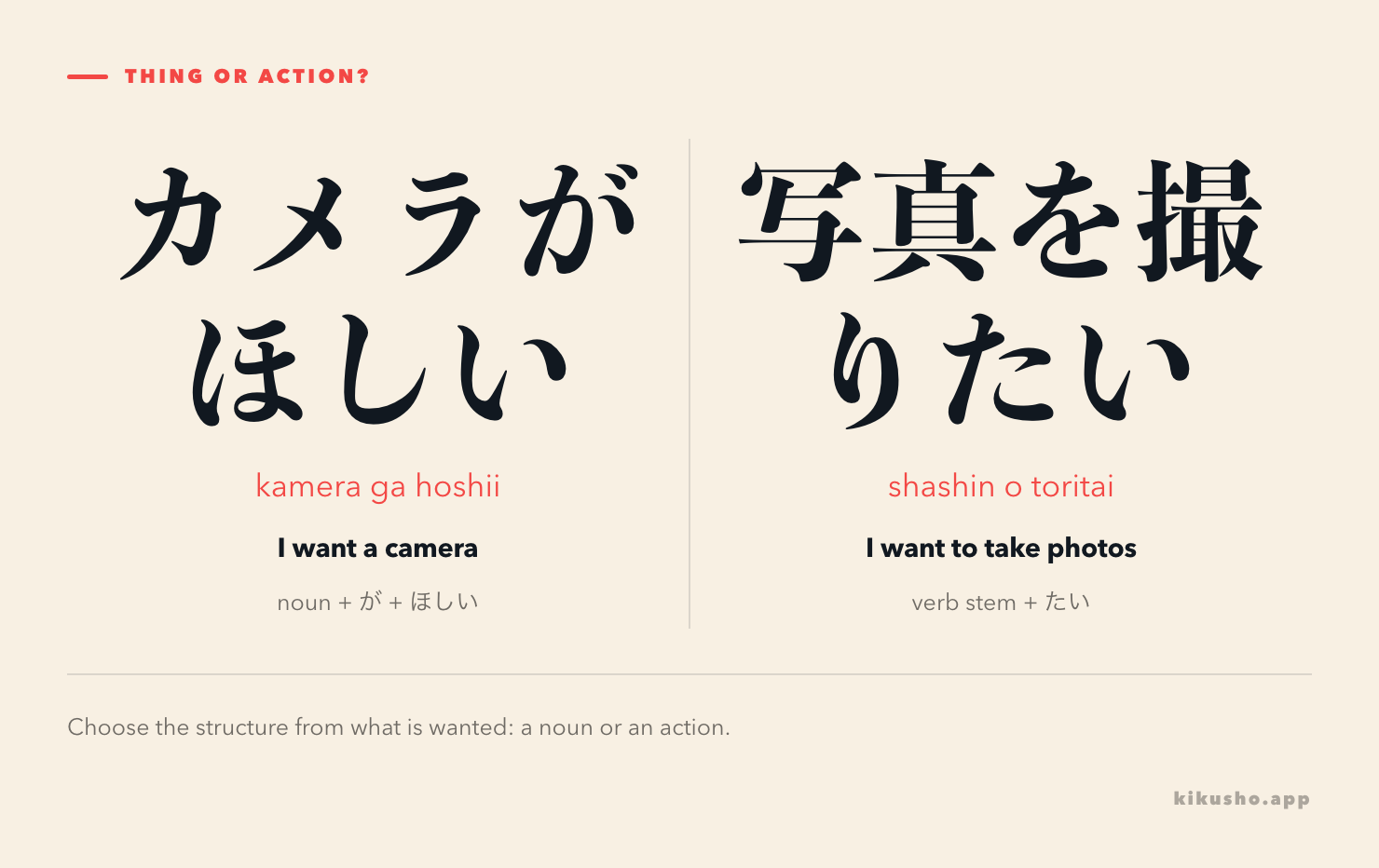
新しいカメラがほしいです means “I want a new camera,” while 写真を撮りたいです means “I want to take photographs.” Use noun + がほしい for a wanted thing and a verb's ます-stem + たい for an action you want to do.
The English verb want hides this split. Japanese makes you decide whether the missing part is a noun or an action before you build the sentence. That decision also explains why が appears with ほしい and why 飲みたい cannot follow a noun directly.
Put the thing before がほしい
The basic pattern is compact:
Noun + が + ほしいです
In 水がほしいです(みずがほしいです), water is the thing desired. 時間がほしいです(じかんがほしいです) asks for “time” as a noun even though time is not a physical object. The pattern covers things, people in a desired relationship, time, help expressed as a noun and other noun phrases.
| Wanted noun | Sentence | Meaning |
|---|---|---|
| 水(みず), water | 水がほしいです。 | I want water. |
| 新しい辞書(あたらしいじしょ), a new dictionary | 新しい辞書がほしいです。 | I want a new dictionary. |
| 休み(やすみ), a break/day off | 休みがほしいです。 | I want a break. |
| 日本人の友達(にほんじんのともだち), a Japanese friend | 日本人の友達がほしいです。 | I want a Japanese friend. |
The Japan Foundation's teaching material identifies the noun before が as the target of the speaker's desire. It also treats ほしい as an い-adjective. That is why the core pattern uses が, not を: 新しい辞書をほしいです is not the standard beginner construction.
This が is easier to remember if you connect it with other predicates learned early. 日本語が好きです and 時間があります also place が before a non-verb predicate or an existence verb. The 好き and 上手 lesson gives that wider pattern.
Put the action before たい
If you want to do something, begin with a verb. Remove ます from its polite form and attach たい:
| Dictionary form | Polite form | Desired action |
|---|---|---|
| 飲む(のむ), drink | 飲みます | 飲みたい, want to drink |
| 買う(かう), buy | 買います | 買いたい, want to buy |
| 食べる(たべる), eat | 食べます | 食べたい, want to eat |
| する, do | します | したい, want to do |
| 来る(くる), come | 来ます(きます) | 来たい(きたい), want to come |
So the idea “I want water” can point to two different sentence plans:
- 水がほしいです: water itself is wanted.
- 水を飲みたいです: drinking water is the desired action.
In the second sentence, 水 remains the object of 飲む and takes を. The desired ending attaches to 飲み, not to 水: 水が飲むたいです mixes the two structures and does not work.
The complete ~たい lesson owns the stem rules, the を/が choice available with some simple transitive たい predicates, and the limits on whose wish is being stated. Here, the useful first decision is smaller: identify a noun for がほしい or an action for ~たい.
Change ほしい like an い-adjective
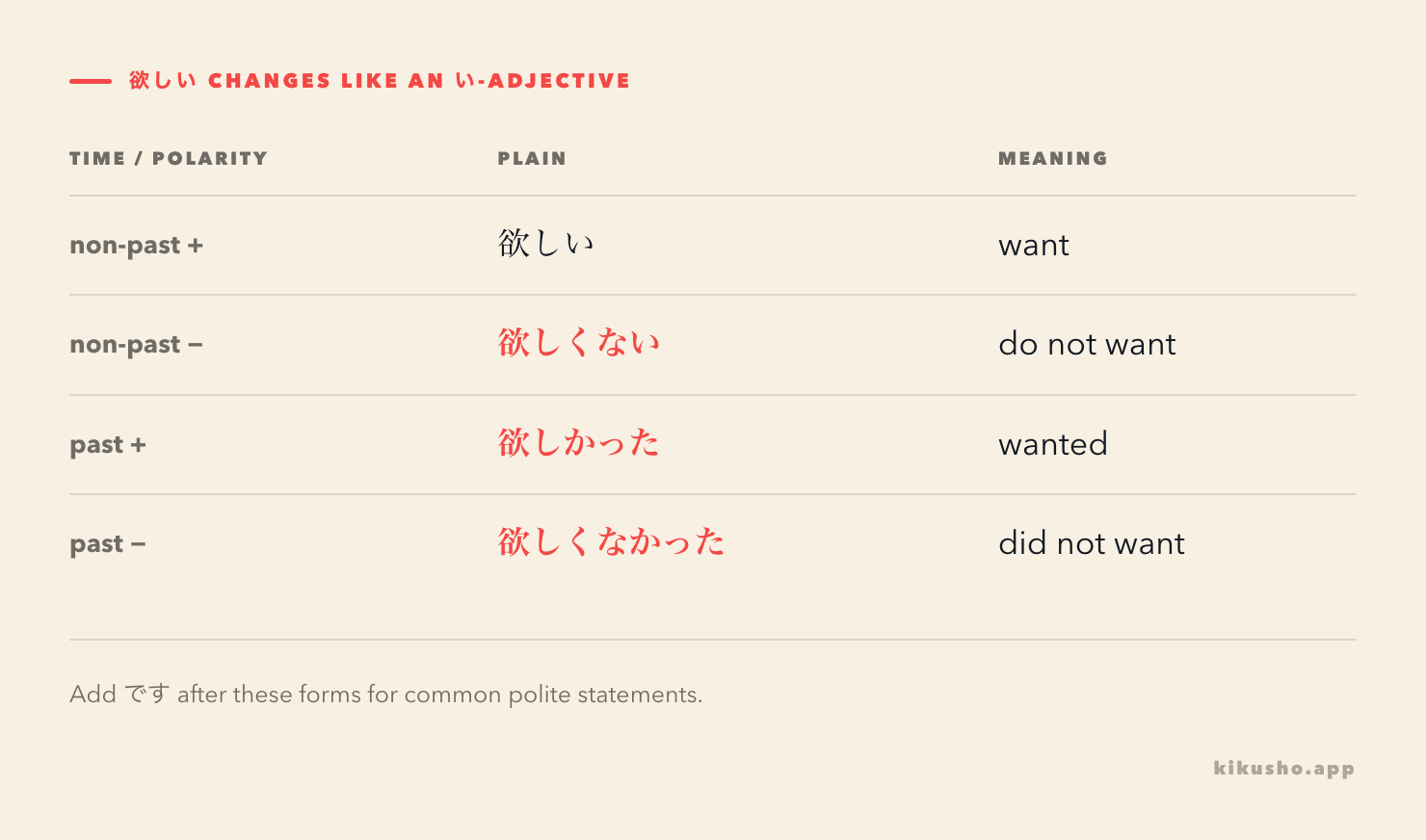
欲しい ends in い and changes like other い-adjectives. Do not put the negative or past only on です.
| Time and polarity | Plain | Common polite statement |
|---|---|---|
| want | 欲しい(ほしい) | 欲しいです |
| do not want | 欲しくない(ほしくない) | 欲しくないです |
| wanted | 欲しかった(ほしかった) | 欲しかったです |
| did not want | 欲しくなかった(ほしくなかった) | 欲しくなかったです |
子どもの時、犬が欲しかったです(こどものとき、いぬがほしかったです) means “When I was a child, I wanted a dog.” It says nothing about whether the speaker got one. A wish and its result are separate facts.
今は車が欲しくないです(いまはくるまがほしくないです) means “I don't want a car now.” Here 車 is contrasted with possible alternatives or with another time, so は replaces the basic が. That does not make が optional in every exercise. Learn Nがほしい as the neutral pattern, then recognise は when the context makes the desired noun a topic or contrast.
Kanjipedia records 欲しい(ほしい) for wanting something as one's own. Both the kanji spelling 欲しい and the kana spelling ほしい appear in teaching material. The grammatical behaviour is the same.
A direct statement normally gives the speaker's wish
もっと時間がほしいです normally presents the speaker's own desire: “I want more time.” In conversation, 私は can disappear because the perspective is understood.
A question can ask a familiar listener:
誕生日に何がほしいですか。
たんじょうびに なにが ほしいですか。
What do you want for your birthday?
The Japan Foundation material explicitly gives 何がほしいですか and どれがほしいですか for asking a listener. It also warns teachers that a direct desire question can be impolite toward a superior. The grammar is correct; the relationship determines whether the question is suitable.
For another person's private wish, quote the information instead of presenting it as direct access to their mind:
兄は「新しい自転車がほしい」と言っています。
あには「あたらしいじてんしゃがほしい」といっています。
My older brother says, “I want a new bicycle.”
The Japan Foundation's Akiko and Friends grammar notes teach the same reporting solution for both ほしい and Vたい. Japanese also has ほしがる for an observed desire, but that is a later construction; it is not a substitute to force into this N5 pattern.
ほしい does not automatically make a request
水がほしいです reports a need or desire. 水をください asks someone to give you water. In a café both may lead to water, but the sentences do different grammatical jobs. The でも and をください lesson explains direct requests for available items.
The softer 水がほしいんですが…… can present a need to someone expected to supply an ordinary available item. The unfinished ending leaves room for the listener to respond. It is contextual, not a magic polite replacement for every request or a way to demand a large favour.
Do not confuse noun + がほしい with Vてほしい, either. 水がほしい means that water is wanted. 手伝ってほしい(てつだってほしい) means “I want you/someone to help.” The latter asks for another person's action and is outside this article's assigned construction.
If these patterns blur together, save a whole contrast in Kikusho: 新しいカメラがほしい。写真を撮りたい。 Keeping both sentences on one editable card makes the noun/action choice visible during review, while saved audio remains available offline.
Practice
Answer all seven questions before opening the solutions. The answer block stays below the complete set so later headings do not reveal the next result.
Question 1. Choose the ordinary polite sentence meaning “I want a new bag.”
- ア. 新しいかばんをほしいです。
- イ. 新しいかばんがほしいです。
- ウ. 新しいかばんが買いたいです。
- エ. 新しいかばんをたいです。
Question 2. Complete the two sentences with ほしい or a correct たい form.
- 冷たい水が__です。 (I want cold water.)
- 冷たい水を飲み__です。 (I want to drink cold water.)
Question 3. Change 休みが欲しいです into a common polite sentence meaning “I did not want a break.”
Question 4. Your friend asks 誕生日に何がほしいですか. Answer in Japanese: “I want a Japanese dictionary.” 辞書 is read じしょ.
Question 5. Choose the sentence that means “I want to buy a bicycle,” rather than “I want a bicycle.”
- ア. 自転車がほしいです。
- イ. 自転車を買いたいです。
- ウ. 自転車をほしいです。
- エ. 自転車が買います。
Question 6. Complete the diary passage with the best option. The writer wanted a dog as a child but does not want one now.
子どもの時、犬が__。でも、今は犬が欲しくないです。
- ア. 欲しいです
- イ. 欲しかったです
- ウ. 欲しくなかったです
- エ. 飼いたいです
Question 7. Rewrite the direct claim 兄は新しい自転車がほしいです so that it clearly reports what the brother says. Use 「…」と言っています.
Answers and explanations
Answer 1. イ. 新しいかばんがほしいです. The desired thing is the noun 新しいかばん, so it takes が before ほしい. ア incorrectly uses を in the basic noun pattern. ウ combines a noun marked by が with 買いたい and does not mean the requested sentence. エ attaches たい to a noun.
Answer 2. 冷たい水がほしいです and 冷たい水を飲みたいです. The first wants a noun, 水. The second wants to perform 飲む, so 飲みたい follows the verb's ます-stem; 水 is the object of that action.
Answer 3. 休みが欲しくなかったです. Change the final い of 欲しい to くなかった, then keep です. 欲しいでした would put the past in the wrong place, and 欲しくないです is non-past.
Answer 4. 日本語の辞書がほしいです(にほんごのじしょがほしいです). The noun phrase 日本語の辞書 is the desired thing and takes が. 日本語辞書がほしいです can also occur as a compact compound, but the の phrase is the expected beginner answer.
Answer 5. イ. 自転車を買いたいです. 買いたい expresses the desired action “want to buy,” and 自転車 is what will be bought. ア is grammatical but means “I want a bicycle.” ウ uses the wrong particle for noun + ほしい, while エ states neither a wish nor a complete standard sentence.
Answer 6. イ. 欲しかったです. 子どもの時 sets the wish in the past, and the first sentence is positive. ア leaves it non-past, ウ says the writer did not want a dog, and エ changes the meaning to wanting to keep or own a pet without supplying the past form.
Answer 7. 兄は「新しい自転車がほしい」と言っています(あには「あたらしいじてんしゃがほしい」といっています). The quoted ほしい keeps the brother's own perspective, and 言っています identifies his words as the source. The exercise does not claim that he received a bicycle.
Why this lesson is placed at N5
JLPT Sensei labels noun + がほしい N5, and the Japan Foundation material connects it with the former beginner-level syllabus. Bunpro and the Tanos list place a matching surface form at N4, so the recorded level evidence disagrees. The construction is taught here as foundational N5 grammar while that boundary remains explicit.
No current official JLPT document publishes an exhaustive grammar list; the official FAQ explains that vocabulary, kanji and grammar item lists are no longer issued. Codex, an AI agent, compared every Japanese form and each exercise answer here with the cited references; a human Japanese-language reviewer has not signed off on the lesson.
Common questions
What is the difference between ほしい and たい?
Use noun + がほしい for a thing you want, such as カメラがほしい. Use a verb's ます-stem + たい for an action you want to do, such as 写真を撮りたい.
Which particle comes before ほしい?
In the basic pattern, the desired noun takes が: 水がほしいです. を does not replace が in this noun pattern. は can appear when that noun is the topic or is being contrasted, as in 水はほしくないです.
How do you make ほしい negative or past?
欲しい is an い-adjective. Use 欲しくない for do not want, 欲しかった for wanted, and 欲しくなかった for did not want. Add です for common polite statements.
Can I use ほしい for another person's wishes?
A direct statement with ほしい normally presents the speaker's own wish. You can ask a listener what they want or quote another person's words, as in 兄は時間がほしいと言っています.