On this page
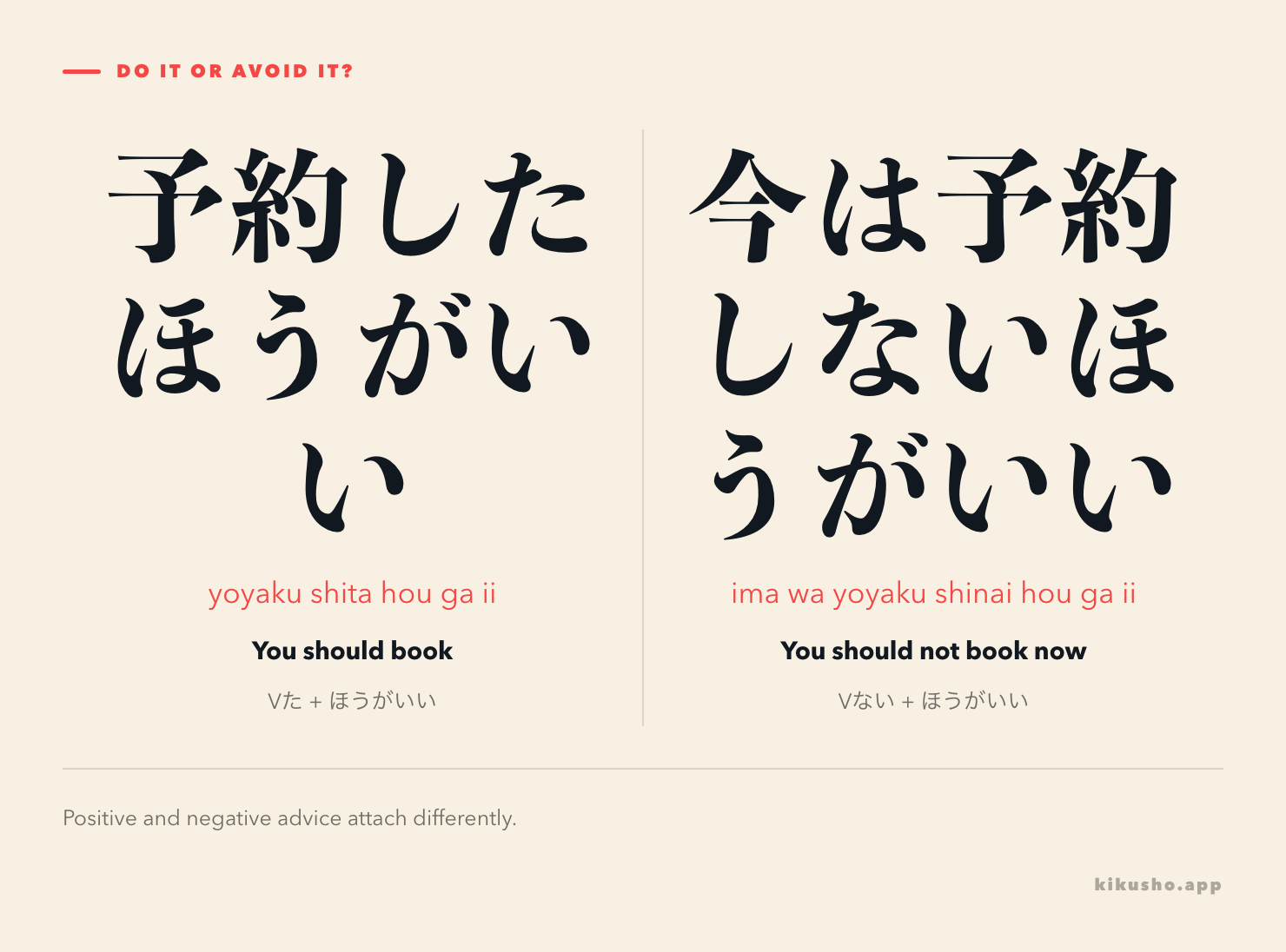
早く予約したほうがいいです means “You should book early,” while 日曜日は行かないほうがいいです means “You should not go on Sunday.” For positive advice, put ほうがいい after a verb's た-form; for negative advice, put it after the ない-form.
The shape is asymmetric on purpose: Vた + ほうがいい recommends doing an action, and Vない + ほうがいい recommends avoiding it. The た in positive advice does not mean that the advised action already happened.
Positive advice takes the た-form
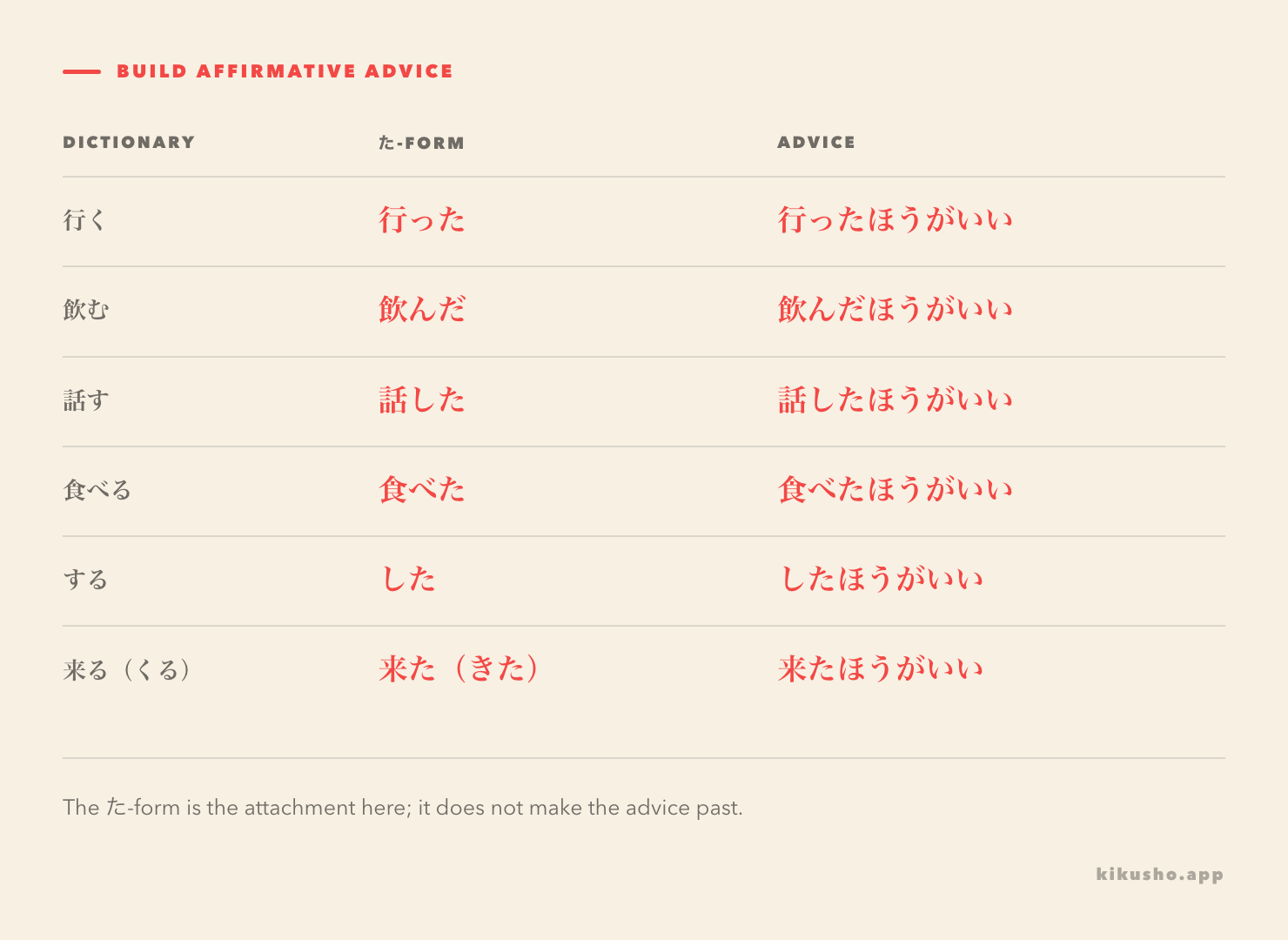
Build the affirmative pattern with the same た-form used for plain past, then add ほうがいいです:
Vた + ほうがいいです
| Dictionary form | た-form | Advice |
|---|---|---|
| 行く(いく), go | 行った | 行ったほうがいいです |
| 飲む(のむ), drink | 飲んだ | 飲んだほうがいいです |
| 話す(はなす), speak | 話した | 話したほうがいいです |
| 食べる(たべる), eat | 食べた | 食べたほうがいいです |
| する, do | した | したほうがいいです |
| 来る(くる), come | 来た(きた) | 来たほうがいいです |
The Japan Foundation's grammar explanation identifies Vたほうがいい as advice to perform the action. If the た-form itself is not secure, the plain-past lesson supplies the sound changes behind 行った, 飲んだ and 話した.
明日は早く来たほうがいいです(あしたははやくきたほうがいいです) advises someone to come early tomorrow. 明日 fixes the action in the future, which proves that 来た is serving the advice construction rather than reporting a completed visit.
Negative advice keeps the ない-form
For advice against an action, attach the same ending to the negative plain form:
Vない + ほうがいいです
ここでは写真を撮らないほうがいいです(ここではしゃしんをとらないほうがいいです) means “You should not take photographs here.” 今は買わないほうがいいです(いまはかわないほうがいいです) recommends waiting rather than buying now.
| Dictionary form | ない-form | Negative advice |
|---|---|---|
| 行く | 行かない | 行かないほうがいいです |
| 飲む | 飲まない | 飲まないほうがいいです |
| 話す | 話さない | 話さないほうがいいです |
| 食べる | 食べない | 食べないほうがいいです |
| する | しない | しないほうがいいです |
| 来る | 来ない(こない) | 来ないほうがいいです |
Do not make “should not” with Vなかったほうがいいです. The Japan Foundation explicitly excludes that form from this advice use. 行かなかったほうがいい does not serve as the ordinary counterpart of 行ったほうがいい. The intended N5 pair is 行ったほうがいい / 行かないほうがいい.
The N5 negative-form lesson shows why the godan vowels change in 行かない, 飲まない and 話さない, and why 来ない is read こない.
The た-form here does not locate the action in the past
In an independent sentence, 予約した can mean “booked.” Inside 予約したほうがいい, however, that complete form sits before ほう, “side” or “alternative.” The whole expression presents doing the action as the better course.
That construction explains why translating one word at a time fails. The advice is not “the booked side was good.” It is a present judgment about which course to take. A time word can make the future orientation explicit:
来週のホテルは、今日予約したほうがいいです。
らいしゅうのホテルは、きょうよやくしたほうがいいです。
You should book next week's hotel today.
This is also why the dictionary-form sentence needs care. 予約するほうがいい can compare alternatives or state a general preference for booking, while 予約したほうがいい is the established direct-advice pattern. If an N5 exercise asks what someone should do in a particular situation, choose the た-form for affirmative advice.
The article on より, のほうが and いちばん teaches ほう inside ordinary comparisons. There, 電車のほうが速い says the train alternative is faster. Advice grows from the same “better side” idea, but its verb attachment is a separate construction.
Polite grammar can still carry firm advice
行ったほうがいいです is polite in its ending. It can still sound like a strong recommendation, especially when the listener did not ask. The Japan Foundation's Irodori grammar collection describes Vた/ないほうがいい as somewhat stronger than Vるといい and notes the implication that ignoring the advice may cause trouble.
That force suits a concrete reason:
この道は暗いですから、一人で歩かないほうがいいですよ。
このみちはくらいですから、ひとりであるかないほうがいいですよ。
This road is dark, so you should not walk alone.
The reason makes the recommendation accountable. よ presents it as useful information for the listener; と思います makes the statement explicitly the speaker's judgment:
- 駅で聞いたほうがいいですよ。 You should ask at the station.
- 駅で聞いたほうがいいと思います。 I think it would be better to ask at the station.
The Foundation teaching material lists both よ and と思います as common ways to soften the delivery. They do not erase the content of the advice. Relationship, urgency and whether the listener invited an opinion still matter.
Tokyo University of Foreign Studies places the form in a full advice dialogue: illness and fever lead to the recommendation to go to a hospital, followed by advice not to overexert oneself. The context gives each recommendation a reason rather than presenting ほうがいい as a free-standing command.
Advice is different from duty and prohibition
English often translates ~たほうがいい as “should,” but it does not create a rule. Compare these three sentences:
| Sentence | What it does |
|---|---|
| 早く帰ったほうがいいです。 | recommends going home early |
| 早く帰らなければなりません。 | says one must go home early |
| ここに入ってはいけません。 | prohibits entering here |
Advice identifies the better course. Obligation says the action is required, while ~てはいけない says an action is not allowed. The permission and prohibition lesson covers that last boundary.
A direct recommendation can also differ from a request. 先生に聞いたほうがいいです advises the listener to ask the teacher. 先生に聞いてください asks the listener to do it. The first evaluates an option; the second addresses the action itself.
When a line of advice matters to you, save the reason with it in Kikusho. A card containing 雨が強くなるそうですから、早く帰ったほうがいいです preserves why the speaker chose a firmer recommendation. You can edit the drafted meaning and register note before saving, then review the complete sentence and its audio offline.
Ask whether an action is the better course
Turn the pattern into a question when you want advice:
Vた + ほうがいいですか
先に電話したほうがいいですか(さきにでんわしたほうがいいですか) asks “Should I call first?” The negative version asks whether avoiding an action is better: 今日は運転しないほうがいいですか, “Would it be better not to drive today?”
The answer does not have to repeat the form. はい、そうしたほうがいいですよ endorses the proposed course. いいえ、電話しなくても大丈夫です says that not calling is okay. A question seeks a judgment; it does not force the adviser to agree with its premise.
Practice
Complete all seven tasks before reading the solutions. Every answer and explanation appears together after the final question.
Question 1. Choose the ordinary polite advice meaning “You should leave early.”
- ア. 早く帰るほうがいいです。
- イ. 早く帰ったほうがいいです。
- ウ. 早く帰らないほうがいいです。
- エ. 早く帰ってほうがいいです。
Question 2. Write positive advice with 薬を飲む(くすりをのむ), “take medicine.” Use the polite ending です.
Question 3. Write negative advice meaning “You should not use this computer.” Begin with このパソコンは and use 使う(つかう).
Question 4. Tomorrow's train is crowded. Complete the advice with the correct form of 行く(いく), “go”: 座りたいなら、早く駅に__ほうがいいですよ。
- ア. 行く
- イ. 行った
- ウ. 行かない
- エ. 行って
Question 5. Choose the sentence that asks “Should I make a reservation?”
- ア. 予約したほうがいいですか。
- イ. 予約しないほうがいいです。
- ウ. 予約しましたか。
- エ. 予約してはいけませんか。
Question 6. Read the exchange and select the best reply. The speaker has an exam tomorrow and says they plan to stay awake all night.
A: 明日は試験ですが、今夜は寝ません。
B: それは大変ですよ。少しでも__。
- ア. 寝たほうがいいですよ
- イ. 寝ないほうがいいですよ
- ウ. 寝ました
- エ. 寝てはいけません
Question 7. Explain why 来週、東京に行ったほうがいいです can advise someone to go next week even though 行った is a た-form. Does the sentence say the trip already happened?
Answers and explanations
Answer 1. イ. 早く帰ったほうがいいです. Affirmative advice uses the た-form 帰った. ア uses the dictionary form and is not the standard answer for direct situational advice. ウ recommends not leaving early, and エ puts the て-form before ほうがいい.
Answer 2. 薬を飲んだほうがいいです. 飲む is a godan verb whose た-form is 飲んだ. 飲んでほうがいい confuses the て-form with the required た-form, while 飲まないほうがいい would reverse the recommendation.
Answer 3. このパソコンは使わないほうがいいです. Negative advice keeps the ない-form 使わない. 使わなかったほうがいいです is not the ordinary N5 form for “should not use.”
Answer 4. イ. 行った. The desired result is advice to go to the station early, so affirmative た-form advice is 早く駅に行ったほうがいいですよ. ウ would advise against going; ア and エ use the wrong attachment for this exercise.
Answer 5. ア. 予約したほうがいいですか. The question asks whether making a reservation is the better course. イ is a statement advising against it, ウ merely asks whether a reservation was made, and エ asks about prohibition rather than seeking ordinary advice.
Answer 6. ア. 寝たほうがいいですよ. The exam supplies a reason to recommend at least some sleep. イ and エ advise the opposite. ウ reports a completed action and does not answer the announced plan.
Answer 7. The た-form is the required attachment inside the affirmative advice construction; it does not independently set past time there. 来週 places the proposed trip in the future, so the sentence recommends going next week and does not say that the trip already happened.
Why this lesson is placed at N5
JLPT Sensei's ほうがいい entry and the Tanos comparison list both place the basic form at N5. The assigned inventory row has no level disagreement. The た-form and ない-form are prerequisites, while dictionary-form comparison, hindsight with ほうがよかった, lighter Vるといい and other advice patterns remain separate scopes.
The JLPT does not issue an exhaustive current grammar list, as its official FAQ explains. Codex, an AI agent, checked the Japanese forms, readings, translations and original exercises here against the cited teaching references; no human language review is claimed.
Common questions
How do you use ほうがいい to give advice?
Use a verb's た-form + ほうがいい for advice to do something: 早く寝たほうがいい. Use the ない-form + ほうがいい for advice not to do it: 遅く寝ないほうがいい.
Why does positive advice use the past form before ほうがいい?
The た-form is the fixed attachment used by this advice pattern; it does not put the recommended action in the past. 明日行ったほうがいい can advise someone to go tomorrow.
Is ~たほうがいい polite or strong?
Adding です makes the sentence polite to the listener, but the advice can still be firm. よ or と思います can make the delivery less abrupt, and context decides whether giving the advice is welcome.
Can I ask for advice with ~たほうがいいですか?
Yes. Use Vたほうがいいですか to ask whether doing something is the better course, and Vないほうがいいですか to ask whether avoiding it is better.