On this page
起きる, 待つ, 働く, 食べる, 寝る: an N5 learner meets all five doing nothing more than living through one ordinary day in Japanese. Every N5 verb list already has them, sorted by かな order with a bare gloss beside each one. None of them tells you which object or particle actually shows up next to the verb in a real sentence, and that is the half of a verb worth learning.
These nineteen verbs are the shape of one day, not the alphabet
A verb list sorted あ、い、う、え、お puts 遊ぶ next to 歩く because both start with あ, not because you would ever use them near each other. That ordering is a filing system for a dictionary, and every large N5 verb list on the web still uses it: a hundred-plus entries, kanji, reading, gloss, next row.
This set skips the filing system. These nineteen verbs are the ones an ordinary day calls for, in roughly the order the day calls for them: get up, get to work, do the work, eat, and stop. Reading them in that order does something a-i-u-e-o order cannot: it hands you the object or the scene each verb expects before you have to guess.
The set itself
| Kanji | Reading | Meaning | Typical use |
|---|---|---|---|
| 起きる | おきる | to get up | 七時に起きる: get up at seven |
| 歩く | あるく | to walk | 道を歩く: walk along the road |
| 走る | はしる | to run | 駅まで走る: run to the station |
| 待つ | まつ | to wait | 電車を待つ: wait for the train |
| 働く | はたらく | to work | 会社で働く: work at the company |
| 書く | かく | to write | 日記を書く: write a diary entry |
| 使う | つかう | to use | 辞書を使う: use a dictionary |
| 作る | つくる | to make | 晩ご飯を作る: make dinner |
| 持つ | もつ | to hold, carry | かばんを持つ: carry a bag |
| 売る | うる | to sell | 花を売る: sell flowers |
| 買う | かう | to buy | パンを買う: buy bread |
| 読む | よむ | to read | 新聞を読む: read the newspaper |
| 話す | はなす | to speak | 日本語を話す: speak Japanese |
| 見る | みる | to see, watch | テレビを見る: watch TV |
| 食べる | たべる | to eat | ご飯を食べる: eat a meal |
| 飲む | のむ | to drink | 水を飲む: drink water |
| 遊ぶ | あそぶ | to play, hang out | 友達と遊ぶ: hang out with a friend |
| 休む | やすむ | to rest, take a day off | 会社を休む: take a day off work |
| 寝る | ねる | to sleep, go to bed | 十時に寝る: go to bed at ten |
Two of these are worth separating before they blur together. 待つ and 持つ share their right-hand half, 寺, and their readings differ by one mora, まつ against もつ, which is exactly why a tired eye reads one for the other.
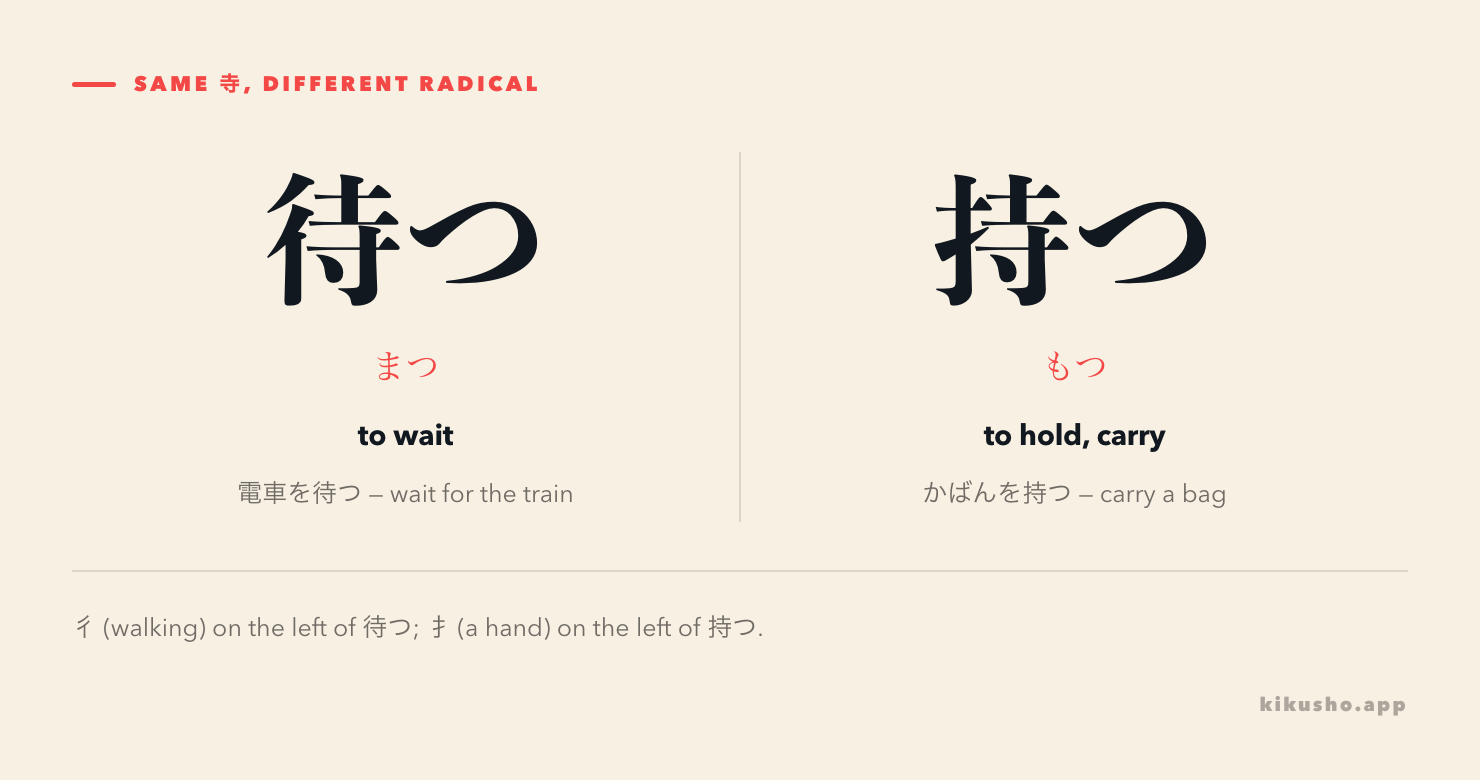
The left-hand radical is the tell every time: 彳 (a person's steps) on 待つ, 扌 (a hand) on 持つ. Waiting is not holding, and the two kanji were never meant to look this close; they just both build on 寺.
Most of these already come with an object attached
Look back at the "typical use" column and a pattern shows up before you go looking for it: twelve of these nineteen verbs pair with を and a noun that receives the action. 本を読む, the book gets read. パンを買う, the bread gets bought. 電車を待つ, the train gets waited for. That を is not decoration; it names the thing the verb is done to, and a card that keeps 待つ without 電車を is keeping half a verb.
This is also where a bare gloss actively misleads you. "待つ: to wait" tells you nothing about what follows it in an actual sentence, and a learner who has only ever seen the gloss will just as easily reach for に or で when they need を. Learning word groups by their conjugation pattern tells you how a verb changes shape; learning it with its object tells you how to use the shape once you have it, which is the half most lists skip.
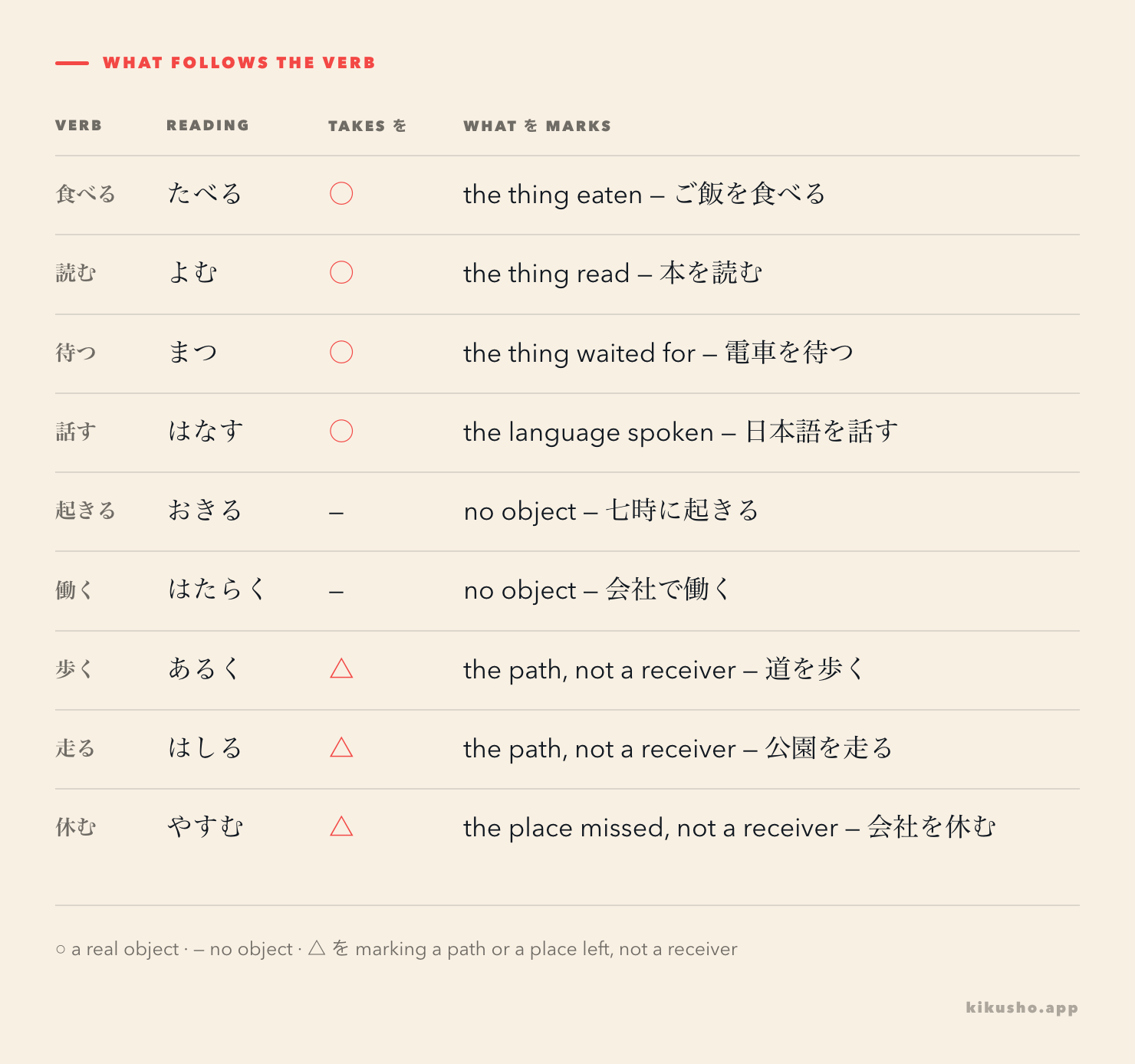
歩く, 走る and 休む keep を without giving it a receiver
Three verbs in this set look like the transitive twelve above and are not. 歩く and 走る are intransitive: nothing gets walked or run the way bread gets bought. But both still take を when a path follows them, 道を歩く, 公園を走る, because を can also mark the ground a movement crosses rather than the thing a movement produces. Grammar references call this a path use of を, distinct from its object use, and it shows up on any verb of motion that covers distance: 歩く, 走る, and also 渡る (to cross) and 通る (to pass through), neither of which is in this set.
休む plays the same trick from the other direction. 会社を休む does not mean the company gets rested; it means you are absent from it, and を here marks the place you are leaving out of, the same job it does in 家を出る, to leave the house. Neither 歩く's path nor 休む's departure gives the verb an object in the sense 買う or 読む has one. The を survives; the receiver does not.
Skip that distinction and the mistake is audible: 会社で休む sounds like resting inside the building, on a chair somewhere, when what you meant was staying home. で marks where an action happens; を here marks what you are missing out on. One kana, opposite meaning.
Which of these you will meet depends on which side of the counter you are on
Some of these nineteen verbs are things you do; others are things you mostly read about someone else doing, at least at the start. 待つ, 見る, 話す, 食べる and 買う come up in your own sentences within the first week, because they describe what you personally do all day. 売る, on the other hand, mostly arrives from the other side of a transaction, a sign or a clerk's sentence, until you are the one running the shop.
That split matters for where you will meet each word. 書く and 読む show up on forms and signs before they show up in speech. 走る and 遊ぶ depend entirely on whether your day has room for either. 働く and 休む are the two you will hear about far more than you will use about yourself, in the exact sentence someone gives for being late or absent.
Noticing which bucket a verb falls into is more useful than memorising all nineteen at once. When one of them arrives in a sentence that is actually about your day, not a workbook's, that is the moment worth capturing: the exact object it came with, in Kikusho, from a photo of the sign or the line someone just said, rather than the bare dictionary form you would otherwise have to reconstruct the object for from memory.
Four questions the set earns you
Question 1. Choose the correct reading for the underlined verb: 「毎朝、六時に_起きます_。」
a) おきます b) いきます c) おこります d) ねます
Answer 1: おきます. (b) いきます is 行きます, "to go", one kana off and a completely different verb. (c) おこります is 起こります, "to occur", the same 起 kanji in a different verb. (d) ねます is 寝ます, the opposite end of the day from getting up.
Question 2. Which kanji correctly writes まちます in this sentence? 「駅で、でんしゃを_まちます_。」
a) 待ちます b) 持ちます c) 立ちます d) 行きます
Answer 2: 待ちます. (b) 持ちます is もちます, "to carry", the visually confusable twin from earlier in this article, but it does not read まちます. (c) 立ちます, たちます, "to stand", fits the station scene but not the given reading. (d) 行きます is いきます, an unrelated verb.
Question 3. Which verb best completes this sentence? 「疲れたので、今日は早く___。」(Since I'm tired, today I'll ___ early.)
a) 寝ます b) 起きます c) 休みます d) 遊びます
Answer 3: 寝ます, "go to bed". (b) is the opposite action. (c) 休みます means to rest or take time off, not specifically to lie down and sleep, so it does not fit "early" the way going to bed does. (d) is unrelated to tiredness.
Question 4. Which sentence means almost the same as 「田中さんは病気で、会社を休みました」?
a) 田中さんは病気で、会社に行きませんでした。 b) 田中さんは病気で、会社で働きました。 c) 田中さんは病気で、会社を作りました。 d) 田中さんは病気で、会社で休みました。
Answer 4: (a), "Tanaka was sick and did not go to work" restates the same fact without 休む. (b) contradicts it: working, not resting. (c) swaps in an unrelated verb, 作る. (d) swaps を for で, which changes 休む from "absent from the company" to "resting inside the company", a different scene from the original sentence.
Learn these nineteen with the object each one already carries, and the next new verb you meet will come with a gap-shaped question attached: not just what it means, but what it happens to.
Common questions
Why isn't 行く (to go) or 来る (to come) on this list?
They belong to a different set in the curriculum's rotation, not to this one. 来る is one of only two irregular verbs in the language, alongside する, which is reason enough to give it a comparison of its own rather than folding it into a list of regular verbs.
待つ and 持つ look almost identical. Are they related?
No. They share only their right-hand half, 寺, and the reading is one mora apart, which is exactly why the eye skips past the real difference. 待つ's radical is 彳, a person walking; 持つ's is 扌, a hand. Waiting has nothing to do with holding; the kanji just happen to rhyme.
Do I have to learn these nineteen verbs in this order?
No. The order here follows a day, not a dependency: none of these verbs requires having learned another one first. The sequence is a memory hook, so a hard one borrows footing from the ones around it, not a syllabus.