On this page
Japanese dates from the 1st to the 10th are read as established whole words, from 一日(ついたち) and 二日(ふつか) to 十日(とおか). Most later dates use the number plus にち, but 十四日(じゅうよっか), 二十日(はつか) and 二十四日(にじゅうよっか) still break that pattern. Written 一日 is いちにち when it means one day of time.
Why these dates belong together
This N5 vocabulary set belongs on a calendar, where the reading is tied to a date rather than to the sound of each kanji. The first ten dates keep older Japanese words; the first is a complete exception. The Japanese education ministry's calendar chart lists the special dates through the 24th, and MLC Japanese Language School's N5 table gives a full month. These are time nouns: many can also measure a number of days. Context tells you whether 二日(ふつか) is the second of a month or two days.
The set itself
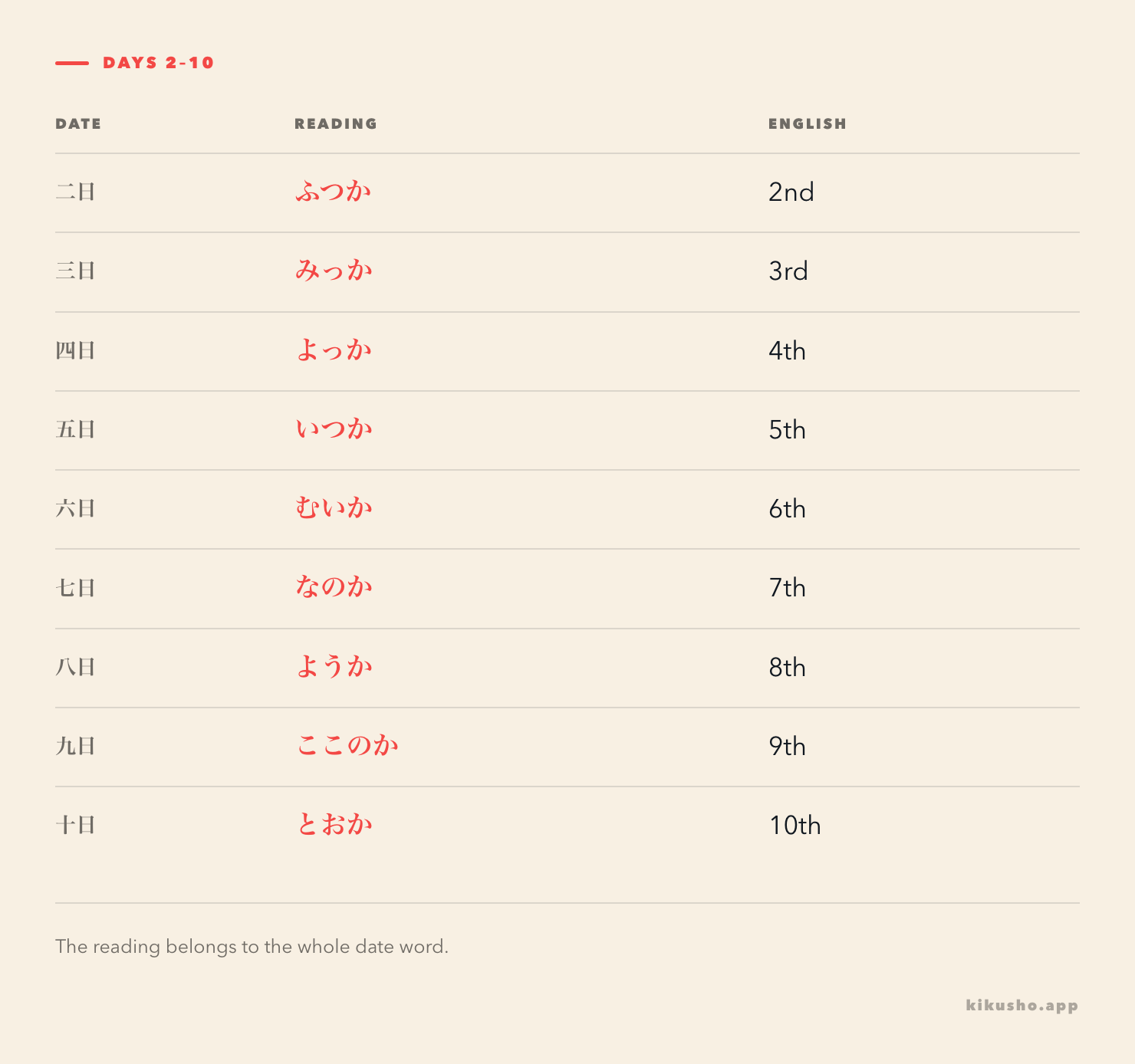
Each row below gives an assigned spelling and reading, its date sense, and a phrase you can use. 一日 appears twice because its two spoken words have different senses.
| Word | Reading | Sense | Usual phrase |
|---|---|---|---|
| 一日 | ついたち | calendar 1st | 四月一日(しがつついたち): April 1st |
| 一日 | いちにち | one day of time | 一日休みます(いちにちやすみます): rest for a day |
| 二日 | ふつか | 2nd; two days | 二日に会います(ふつかにあいます): meet on the 2nd |
| 三日 | みっか | 3rd; three days | 三日から(みっかから): from the 3rd |
| 四日 | よっか | 4th; four days | 四日に行きます(よっかにいきます): go on the 4th |
| 五日 | いつか | 5th; five days | 五日に会います(いつかにあいます): meet on the 5th |
| 六日 | むいか | 6th; six days | 六日に帰ります(むいかにかえります): return on the 6th |
| 七日 | なのか | 7th; seven days | 七日から(なのかから): from the 7th |
| 八日 | ようか | 8th; eight days | 八日に行きます(ようかにいきます): go on the 8th |
| 九日 | ここのか | 9th; nine days | 九日に会います(ここのかにあいます): meet on the 9th |
| 十日 | とおか | 10th; ten days | 十日まで(とおかまで): until the 10th |
| 二十日 | はつか | 20th; twenty days | 二十日に帰ります(はつかにかえります): return on the 20th |
The readings agree across the ministry chart, MLC's teaching table and Tae Kim's independently written date guide. The duration senses are explained in Tofugu's original counter guide. The phrases use the ordinary date particle に or the boundaries から and まで; the N5 time-word lesson explains why calendar dates behave differently from 明日.
The same sound can do two jobs. 二日に会います usually schedules a meeting on the 2nd when the month is understood. 二日休みます measures a two-day break. Add a month to the first if the date might otherwise be unclear: 五月二日に会います specifies May 2nd. Add an interval word to the second if you need to stress the length: 二日間休みます says two days of rest. The extra 間(かん) belongs to the duration, not to a calendar date. Tofugu's counter examples contrast dates and counted days with this same set of readings.
The pattern that runs through the later dates
| Date | Reading | Construction |
|---|---|---|
| 十一日 | じゅういちにち | 11 + にち |
| 十二日 | じゅうににち | 12 + にち |
| 十三日 | じゅうさんにち | 13 + にち |
| 十五日 | じゅうごにち | 15 + にち |
| 二十一日 | にじゅういちにち | 21 + にち |
| 三十日 | さんじゅうにち | 30 + にち |
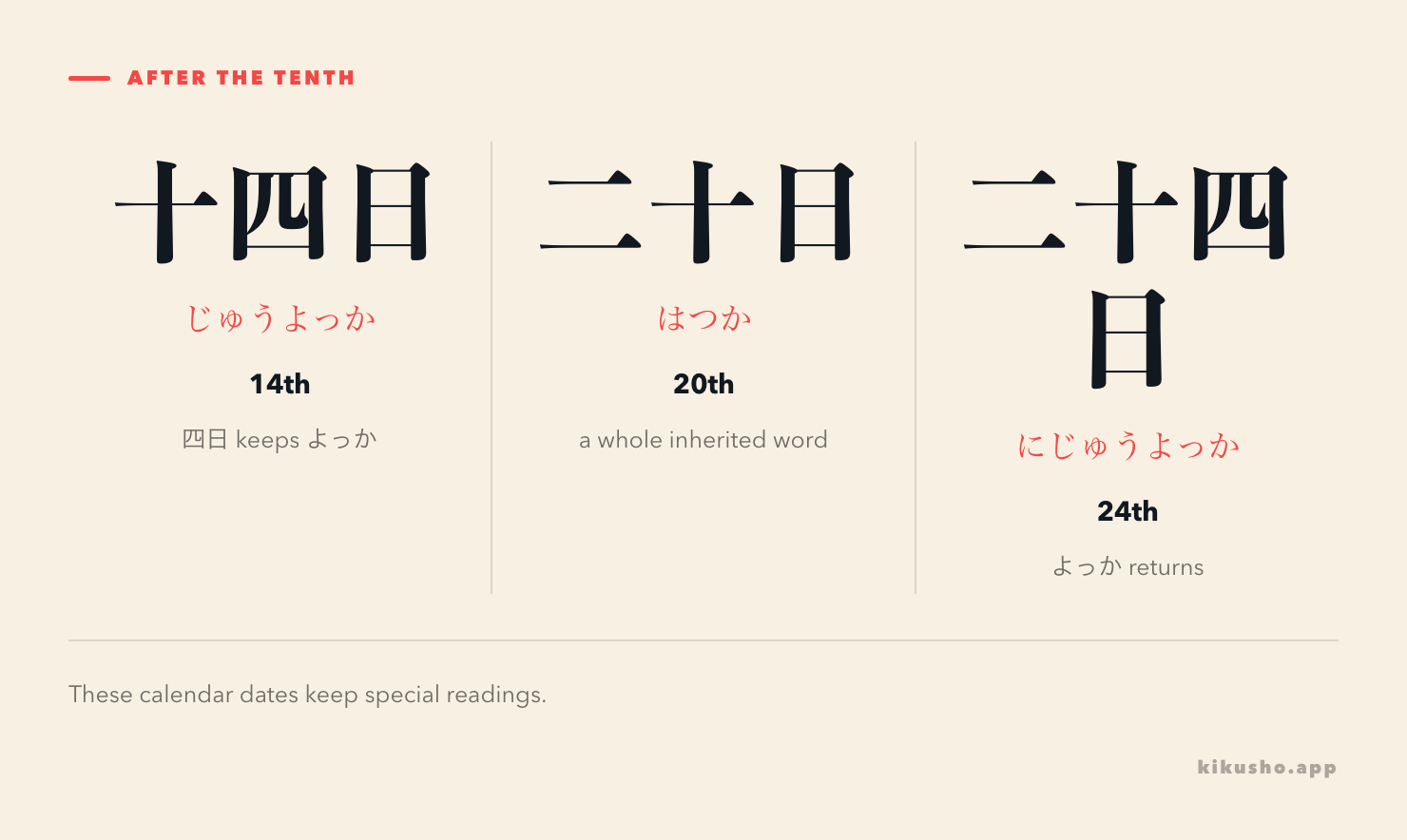
Keep the exceptions beside that pattern: 十四日(じゅうよっか) and 二十四日(にじゅうよっか) reuse よっか, while 二十日(はつか) is a whole inherited word. These calendar readings are confirmed by the education ministry's chart and Tae Kim's date list. Tofugu notes that some duration contexts allow other readings for 十四日 or 二十日; the familiar calendar readings here are the first choice for dates.
You do not need to memorize 31 separate date words. Learn the first ten, then use 十一日, 十二日 and 十三日 to hear the number-plus-にち rhythm. When you reach 十四日, stop and retrieve よっか. Resume the pattern at 十五日. The same check occurs in the twenties: 二十一日 and 二十二日 follow the number pattern, but 二十四日 returns to よっか. 二十日 is the one date in that stretch you have to retrieve as はつか before continuing. This gives you a small list of exceptions and a productive rule for the rest.
The two readings that break the set
The same written 一日 is ついたち for the first of the month and いちにち for one day as an interval. Compare 四月一日に行きます (I will go on April 1st) with 一日休みます (I will rest for one day). A month names the first reading; a duration phrase selects the second. Japanese textbook publisher Mitsumura Tosho and Tofugu independently explain this split.
Try the same written characters in two fuller phrases. 五月一日 has a month name before 一日, so the speaker means May 1st and reads ごがつついたち. あと一日 means one more day and is read あといちにち. The characters alone are not the test; the phrase is. Some dictionaries record historical or formal readings, but they are unnecessary for a typical N5 calendar.
Which dates you will meet this month
Read the first ten aloud as a sequence, then pick the 14th, 20th and 24th on a real calendar. Attach a month to each, such as 六月二十日(ろくがつはつか). On a ticket or a notice, keep the month and surrounding line when saving a date in Kikusho; those clues show that 一日 is a calendar point rather than a day of time. You can check the card's reading before saving it and review the phrase later. The N5 number lesson supplies the numbers for regular dates.
When you ask for a date, 何日(なんにち) means “what day of the month?” In 何日に行きますか, the answer can be 三日に行きます or 十一日に行きます; one answer uses a special reading, the other the number pattern. A printed calendar lets you check both while saying a natural short exchange. The weekday is a separate word: 五月三日 gives a date, while 月曜日 names Monday. A month, a date and a weekday can appear together on a notice, but they are different things to read. Tae Kim's date guide lists 何日 and the weekday forms separately.
Check yourself
Question 1: kanji reading. How do you read 五月九日 as a calendar date?
- A. ごがつきゅうにち
- B. ごがつここのか
- C. ごがつようか
- D. ごがつここのにち
Question 2: orthography. Which written date is read はつか?
- A. 二日
- B. 十日
- C. 二十日
- D. 二十四日
Question 3: date or interval. A notice says 六月一日に会います. Is 一日 here ついたち (June 1st) or いちにち (one day)? Give the reading and reason.
Question 4: date pattern. Write the reading of 七月十四日, then of 七月十五日 to show where the regular pattern resumes.
Question 5: text grammar. Complete the invitation with the ordinary calendar-date reading and the date particle: 八月二十四日(____)__会います。 Write both blanks.
Answers and explanations
Answer 1. B, ごがつここのか. 九日 is ここのか, not regular きゅうにち. ようか belongs to 八日; ここのにち mixes a special word with the regular suffix.
Answer 2. C, 二十日. 二日 is ふつか, 十日 is とおか, and 二十四日 is にじゅうよっか. The twentieth keeps はつか even though it is past the first ten dates.
Answer 3. ついたち, because 六月 sets a calendar month and the phrase gives a day in it. 一日 as a length of one day is ordinarily いちにち in another context.
Answer 4. しちがつじゅうよっか for July 14th and しちがつじゅうごにち for July 15th. The 14th retains よっか; the 15th uses number plus にち. 七月 is しちがつ in both.
Answer 5. にじゅうよっか and に: 八月二十四日(にじゅうよっか)に会います。 二十四日 keeps the special よっか ending, and に marks when the meeting happens.
On a real notice, ask two things in order: does 一日 name a calendar point or an interval, and is the numbered date one of the marked exceptions? The rest can be read with the ordinary number pattern.
Common questions
How do you read the first of a month in Japanese?
一日 is ついたち for the calendar first; it is いちにち for one day as a length of time. The surrounding month or duration phrase decides.
Are all dates after the tenth number plus にち?
No. 十四日 is じゅうよっか, 二十日 is はつか, and 二十四日 is にじゅうよっか. Most other later dates use number plus にち.
Can 二日 mean two days as well as the second?
Yes. It is ふつか in both uses. A month name points to a date; a phrase measuring time points to a two-day interval.