On this page
父(ちち) and お父さん(おとうさん) both name a father, but the setting chooses the form. Tell an outsider about your own father with 父; ask about their father with お父さん. Address your own father at home and お父さん is natural again. The fourteen N5 words in this set work as relationship words, not interchangeable English synonyms.
Why these family words belong together
The Japan Foundation's teaching chart divides own-family and other-family terms and notes that お〜さん forms also occur inside one's own family. Japan Society's original lesson independently makes the same three-way distinction with workplace and home examples. These are N5 vocabulary estimates from named lists; the JLPT does not publish an exhaustive official word syllabus.
The set itself
| Relationship | Your family, to an outsider | Another person's family / address at home |
|---|---|---|
| Father | 父(ちち) | お父さん(おとうさん) |
| Mother | 母(はは) | お母さん(おかあさん) |
| Older brother | 兄(あに) | お兄さん(おにいさん) |
| Older sister | 姉(あね) | お姉さん(おねえさん) |
| Younger brother | 弟(おとうと) | 弟さん(おとうとさん) for another's; a name at home |
| Younger sister | 妹(いもうと) | 妹さん(いもうとさん) for another's; a name at home |
| Grandfather | 祖父(そふ) | おじいさん(おじいさん) |
| Grandmother | 祖母(そぼ) | おばあさん(おばあさん) |
| Family | 家族(かぞく) | ご家族(ごかぞく) |
| Parents | 両親(りょうしん) | ご両親(ごりょうしん) |
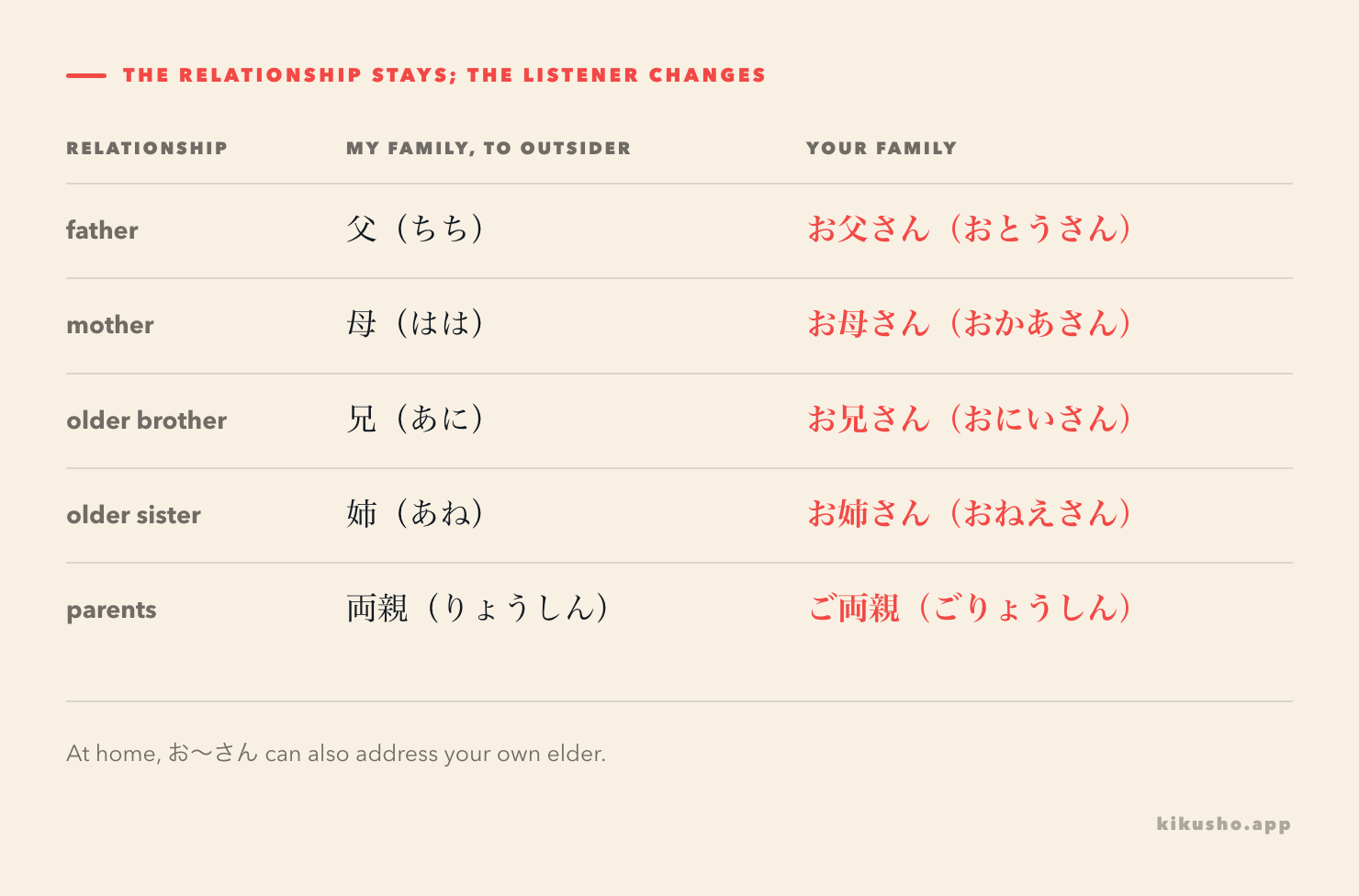
The fourteen assigned headwords here are 父, 母, 兄, 姉, 弟, 妹, お父さん, お母さん, お兄さん, お姉さん, おじいさん, おばあさん, 家族 and 両親. The extra other-side forms and 祖父・祖母 complete the comparison; they are not counted among the assigned items. Tae Kim's original chart confirms the pairs and readings.
Each assigned word below is a noun. Its phrase shows the relationship in use:
| Headword / reading | Sense taught | Phrase |
|---|---|---|
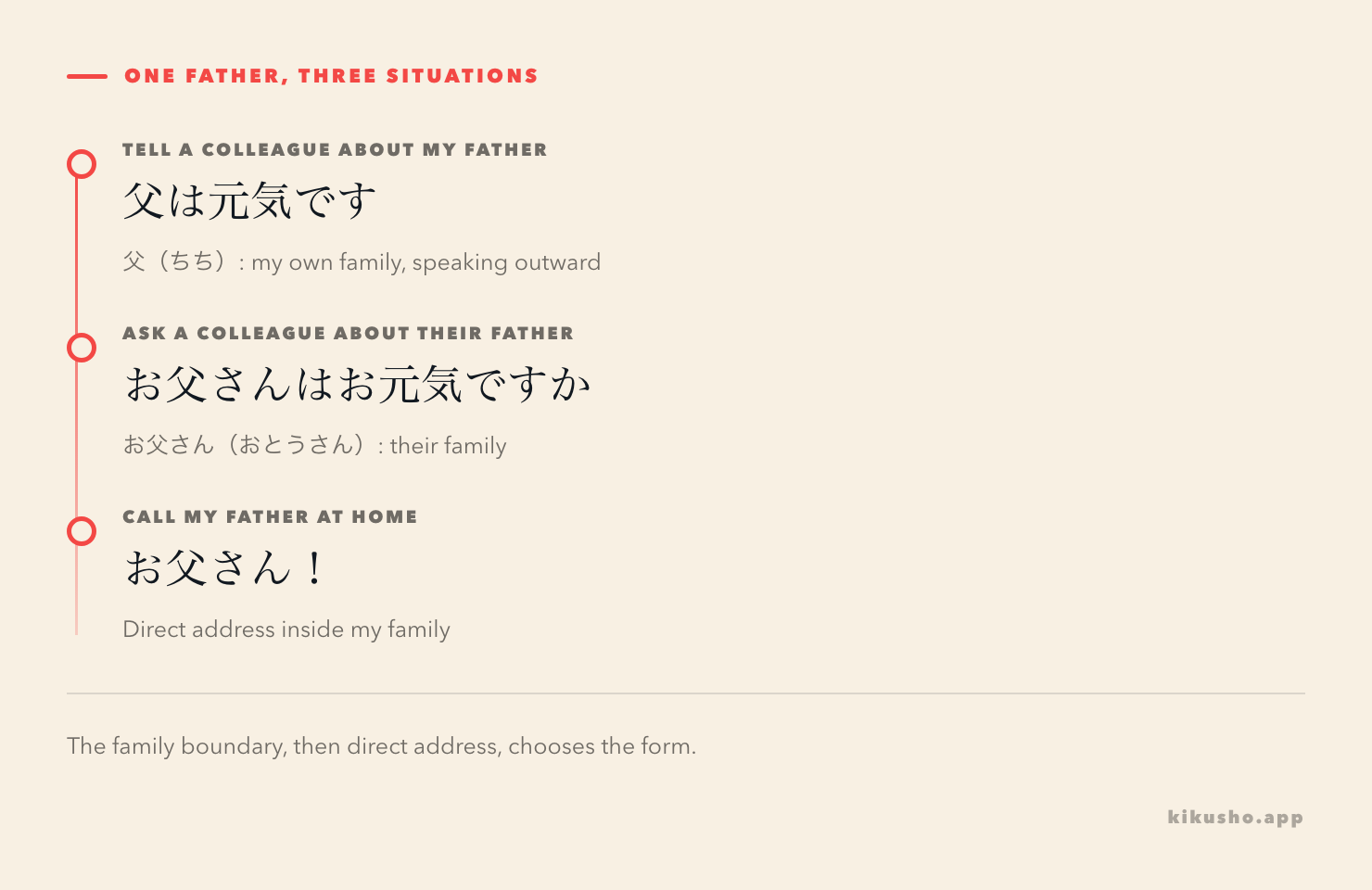
| 父(ちち) | my father, to an outsider | 父は元気です: my father is well |
| お父さん(おとうさん) | your father; Dad at home | お父さんはお元気ですか: is your father well? |
| 母(はは) | my mother, to an outsider | 母も元気です: my mother is well too |
| お母さん(おかあさん) | your mother; Mom at home | お母さんはお元気ですか: is your mother well? |
| 兄(あに) | my older brother | 兄は福岡にいます: my older brother is in Fukuoka |
| お兄さん(おにいさん) | your older brother; home address | お兄さんはお元気ですか: is your older brother well? |
| 姉(あね) | my older sister | 姉は京都にいます: my older sister is in Kyoto |
| お姉さん(おねえさん) | your older sister; home address | お姉さんはお元気ですか: is your older sister well? |
| 弟(おとうと) | younger brother, especially my own | 弟は学生です: my younger brother is a student |
| 妹(いもうと) | younger sister, especially my own | 妹は学生です: my younger sister is a student |
| おじいさん(おじいさん) | your grandfather; Granddad at home | おじいさんはお元気ですか: is your grandfather well? |
| おばあさん(おばあさん) | your grandmother; Grandma at home | おばあさんはお元気ですか: is your grandmother well? |
| 家族(かぞく) | family | 家族は元気です: my family is well |
| 両親(りょうしん) | both parents, especially my own | 両親は元気です: my parents are well |
Learn 父/お父さん and 母/お母さん as whole words with their readings. Adding お to 父 mechanically does not produce お父さん. The same change of reading occurs with the older siblings.
The pattern follows the group boundary
You can answer 父は元気です about your father and ask お父さんはお元気ですか about a colleague's father. For the group, 両親は元気です describes your parents while ご両親はお元気ですか asks about theirs. Japan Society's question and answer checks that switch. The family pair is an early, concrete version of the group boundary in Japanese politeness.
Direct address and younger siblings break a simple two-column rule
At home, お母さん! is natural even though she is your mother. The Japan Foundation teaching note explicitly includes お父さん・お母さん・お兄さん・お姉さん・おじいさん・おばあさん inside a family. Todaimae's independently authored family lesson confirms direct address and says a younger sibling is commonly called by name.
弟さん and 妹さん are possible for another person's younger sibling; the assigned N5 headwords here are the plain 弟 and 妹. おじいさん and おばあさん can also refer to an older man or woman outside kinship. The relationship in the question fixes the family sense.
Which forms you will meet in a first conversation
An introduction may start with 家族 and 両親, then describe your own 父・母・兄・姉・弟・妹. When someone asks about your relatives, listen for お〜さん and ご両親. Save a phrase with its speaker and listener: a card containing only お母さん cannot tell you which mother is meant. Kikusho lets you capture a phrase, check its reading and edit its card before review. The N5 question-word lesson supplies question forms to pair with these nouns.
Check yourself
Question 1: context. You tell a new colleague “My father is well.” Choose the noun for __は元気です.
- A. 父
- B. お父さん
- C. 母
- D. 両親
Question 2: reading. Write the hiragana reading of 姉 when referring to your own older sister.
Question 3: another family. You ask a classmate “Are your parents well?” Choose the noun for __はお元気ですか.
- A. 両親
- B. ご両親
- C. 家族
- D. 父
Question 4: direct address. You call to your own mother at home. Write the word you can call out.
Question 5: younger sibling. To tell an outsider “My younger brother is a student,” choose the assigned N5 noun for __は学生です.
- A. お兄さん
- B. 兄
- C. 弟
- D. お父さん
Question 6: grandparent. A classmate speaks about their grandmother. Which assigned word names her, and what is its reading?
Answers and explanations
Answer 1. A, 父: 父は元気です. The speaker is talking to an outsider about their own father. お父さん usually points to the listener's father here.
Answer 2. あね. 姉(あね) is the own-family outsider form. お姉さん(おねえさん) refers to another person's older sister or addresses one's older sister at home.
Answer 3. B, ご両親: ご両親はお元気ですか asks about the classmate's parents. 両親 is the plain own-family word.
Answer 4. お母さん! Home address is an exception to the simple own/other table. Use 母 when describing her to an outsider.
Answer 5. C, 弟: 弟は学生です. 兄 and お兄さん name an older brother; お父さん names a father.
Answer 6. おばあさん(おばあさん). The question sets the family sense. 祖母(そぼ) is the plain word for your own grandmother when speaking to an outsider; it completes the table but is not one of the fourteen assigned items.
When a family word seems to have two answers, identify whose relative is in the sentence and who hears it. That context is part of the vocabulary.
Common questions
Why do 父 and お父さん both mean father?
父(ちち) is the standard word for your own father when speaking to an outsider. お父さん(おとうさん) refers to someone else's father or addresses your own father at home.
Can I call my own mother お母さん?
Yes, when speaking to her or within the family. To describe her to an outsider, 母(はは) is the standard form.
What about someone else's younger brother or sister?
弟さん(おとうとさん) and 妹さん(いもうとさん) can refer respectfully to another person's younger siblings. At home, younger siblings are usually called by name.