On this page
Add か after a polite statement to ask a yes-or-no question: 駅に行きますか asks “Are you going to the station?” To ask for a kind, a reason or a method, put どんな, どうして or どうやって in the question; AかBか sets out alternatives. The short reply should supply the missing information, not simply repeat every word of the question.
Five N5 patterns ask for five kinds of information
| Pattern | Where it goes | What the listener supplies | Short model exchange |
|---|---|---|---|
| Sentence + か | After the polite predicate, such as です or ます | Yes or no | 行きますか。→ はい、行きます。 |
| どんな + noun | Immediately before the noun | A kind or quality | どんな本ですか。→ 旅行の本です。 |
| どうして + question | Before the action or at the start | A reason or explanation | どうして歩きますか。→ 近いからです。 |
| どうやって + action | Before the action or at the start | A method or means | どうやって行きますか。→ バスで行きます。 |
| AかBか | After each alternative in a choice phrase | Which option applies | 行くか行かないか、決めましたか。→ まだ決めていません。 |
These are constructions, not an exhaustive list of Japanese question words. 誰, どこ, 何 and いつ are also beginner words, but this lesson focuses on its five assigned N5 patterns. JLPT Sensei and Bunpro both place sentence-final か at N5. The JLPT does not publish an exhaustive official grammar list, so N5 is a teaching placement rather than a promise about a particular exam question.
Before making these questions, be comfortable with です and the polite ます forms in the N5 verb-groups guide. Keep the predicate near the end; you do not have to move the unknown part to the front as English often does.
Sentence-final か changes the request, not the word order
Compare the statement and the question:
明日、駅に行きます。
あした、えきに いきます。
I will go to the station tomorrow.
明日、駅に行きますか。
あした、えきに いきますか。
Will you go to the station tomorrow?
The verb and the destination stay where they were; か follows 行きます. In polite conversation, はい、行きます (“Yes, I will”) and いいえ、行きません (“No, I will not”) echo the relevant verb. After これは本ですか, an answer can instead echo the noun predicate: はい、本です. A bare はい or いいえ can work when the situation is clear, but echoing the predicate makes a first exchange easier to follow.
Friends may drop sentence-final か and ask 明日、行く? with intonation. That is a casual question, not a polite 行きますか with its marker accidentally removed. Bunpro's question-particle entry distinguishes sentence-final questions from other uses of か.
どんな must lead a noun, and its answer names a kind
どんな本が好きですか。
どんな ほんが すきですか。
What kind of books do you like?旅行の本が好きです。
りょこうの ほんが すきです。
I like travel books.
The question seeks a type of 本, not a yes or no about whether you like books. どんな directly precedes that noun. The answer replaces the unknown kind with 旅行の. You can similarly ask どんな映画 or どんな人. JLPT Sensei's どんな entry and Tofugu's question-determiner explanation independently confirm the before-noun pattern. Bunpro lists the standalone word at N5, while it teaches the broader そんな/こんな/あんな/どんな family as an N4 grammar group. That grouping is a later comparison, not a reason to postpone this question.
どうして usually asks why; どうやって asks how to do it
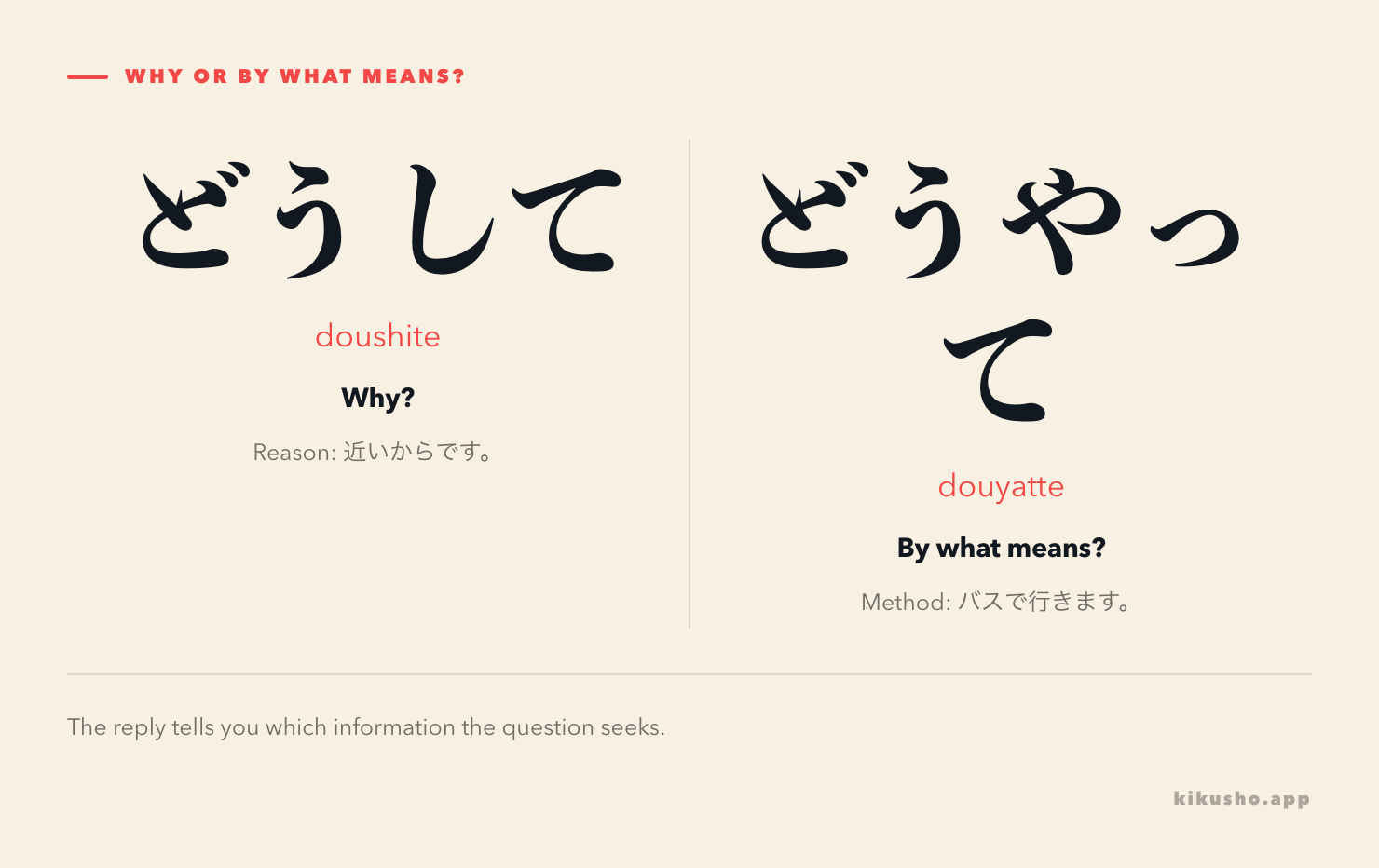
Put the two exchanges beside each other. The first answer explains a reason; the second supplies a means:
どうして歩いて行きますか。
どうして あるいて いきますか。
Why are you going on foot?近いからです。
ちかいからです。
Because it is close.
どうやって駅に行きますか。
どうやって えきに いきますか。
How will you get to the station?バスで行きます。
バスで いきます。
I will go by bus.
から marks the explanation in the first reply; バスで gives the means in the second. どうやって can ask how to make, send or reach something, not only how to travel. JLPT Sensei's どうやって lesson and an independent introductory Japanese textbook describe it as a method question.
Do not turn the contrast into an absolute ban on another sense. JLPT Sensei's どうして lesson includes “how” or process examples; Bunpro foregrounds “why.” For a beginner who explicitly wants a method, どうやって makes that request clearer. In the mini-dialogues above, the answers settle what was asked.
AかBか puts か between alternatives
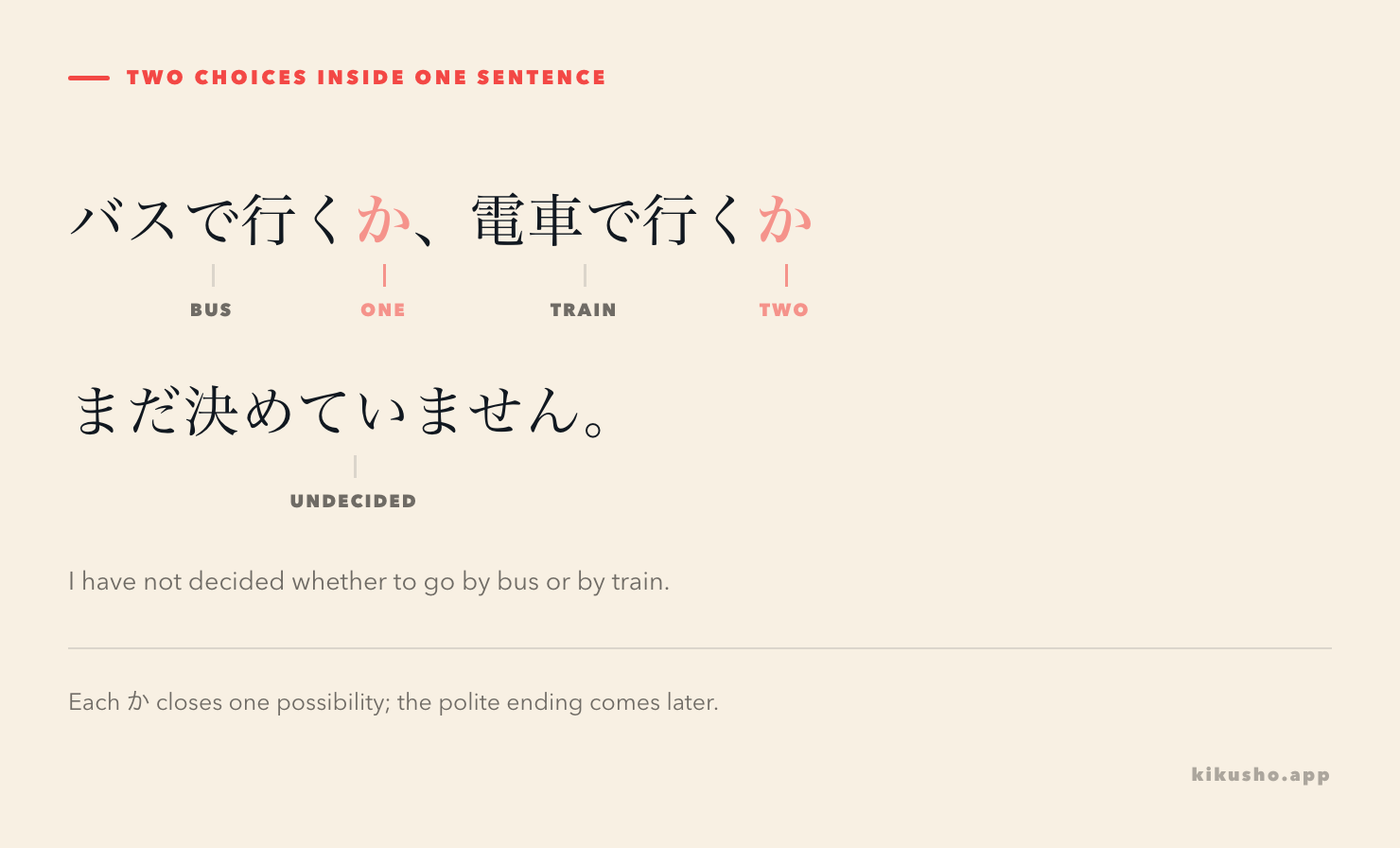
The same written particle can mark a question at the end or divide possible answers inside a sentence. Listen for its position:
明日、駅に行きますか。
あした、えきに いきますか。
Are you going to the station tomorrow?
バスで行くか、電車で行くか、まだ決めていません。
バスで いくか、でんしゃで いくか、まだ きめていません。
I have not decided whether to go by bus or by train.
The first か comes after a polite predicate and asks for yes or no. In the second sentence, each か closes one possible action. 行く is the plain dictionary form inside the alternatives; 決めていません is the polite sentence ending. JLPT Sensei's か〜か lesson and Bunpro's choice entry independently show alternatives with verbs and nouns.
For a simple noun choice, Japanese may say お茶かコーヒー with only the first か. The full お茶かコーヒーか is possible when both options are presented as an unresolved choice. Keep the two-か form when practising the complete AかBか pattern; notice the shorter form when reading.
Practise the five patterns before looking below
Question 1 (grammar choice). Complete 明日、駅に行きます__。 to ask “Will you go to the station tomorrow?” A. か B. が C. を D. で
Question 2 (sentence composition). Write a polite Japanese question meaning “What kind of books do you like?” using どんな and 本が好きです. Keep どんな next to the noun.
Question 3 (grammar in context). Match the replies to the questions: どうして歩いて行きますか。 / どうやって駅に行きますか。 Replies: 近いからです。 / バスで行きます。 Which reply belongs to each question?
Question 4 (grammar choice). Fill both blanks: バスで行く__、電車で行く__、まだ決めていません。 A. か/か B. と/と C. を/を D. です/です
Question 5 (sentence composition). Give a short negative answer to 明日、駅に行きますか。 that echoes the verb rather than using いいえ alone.
Finish all five before comparing your choices and sentences with the explanations.
Answers and explanations
Answer 1. A, か. It follows polite 行きます and marks the whole sentence as a question. が, を and で have other jobs and cannot simply finish this question.
Answer 2. どんな本が好きですか。 どんな modifies 本 directly; か follows the polite predicate. 本がどんな好きですか separates どんな from its noun and is not the intended pattern.
Answer 3. どうして → 近いからです; どうやって → バスで行きます. 近いからです supplies a reason for walking; バスで行きます supplies a means of reaching the station. The answer content, rather than an English one-word gloss, resolves the intended question.
Answer 4. A, か/か. Each particle closes an alternative action in 行くか、行くか. と would not form this two-choice clause with these verbs; を marks an object, and です is not inserted after each plain verb here.
Answer 5. いいえ、行きません。 The negative of 行きます gives the requested no answer while keeping the action clear. いいえ、行きます contradicts its own opening; いいえ、行きませんか would ask another question.
Save the answer shape with the question
When a real conversation gives you どうやって駅に行きますか and バスで行きます, keep both lines: the reply teaches what kind of information the question requested. Kikusho can turn text, speech or a photo into an editable card, so you can check the wording before saving it and review it offline. If the answer is a noun phrase, how の joins nouns helps you read replies such as 旅行の本.
Common questions
Is か required at the end of every Japanese question?
No. It is standard after polite です and ます here. Friends also ask questions with a rising tone and no final か; do not carry a stiff ですか ending into every casual exchange.
Does どうして always ask for a reason?
It most often asks why in the exchanges here, but dictionaries and teaching guides also allow how or process readings in context. Use どうやって when you specifically need the method or means.
Must both alternatives have か?
No. AかBか makes both choice boundaries visible, especially for clauses. In a simple noun choice, the final か may be omitted.