On this page
These sixteen N5 Japanese い-adjectives make eight useful opposite pairs: 新しい/古い for new and old, 大きい/小さい for size, and six more. A pair works when the same noun and the same sense stay in view. 高い(たかい) opposes 低い(ひくい) for height, but an expensive price opposes 安い(やすい), "inexpensive," rather than 低い.
Eight pairs give the sixteen words a job
An adjective does not describe a bare scale floating in the air. A building can be new or old, high or low, and big or small; each pair asks a different question of that one building. A line can be long yet thin. Remember the noun as well as the two ends of the scale, and the pairs become useful descriptions rather than sixteen English labels.
Every assigned word below is an い-adjective. The readings and the short phrases identify the sense taught here. The Japan Foundation's Starter word list checks 新しい, 古い, 大きい, 小さい, 高い and 低い in descriptions of a town; its adjective explanation checks how an い-adjective stands before a noun or ends a sentence with です. The remaining words are checked below against the NINJAL dictionary and a separately authored Tokyo language-school list. These level lists are estimates, not an official exhaustive JLPT vocabulary list.
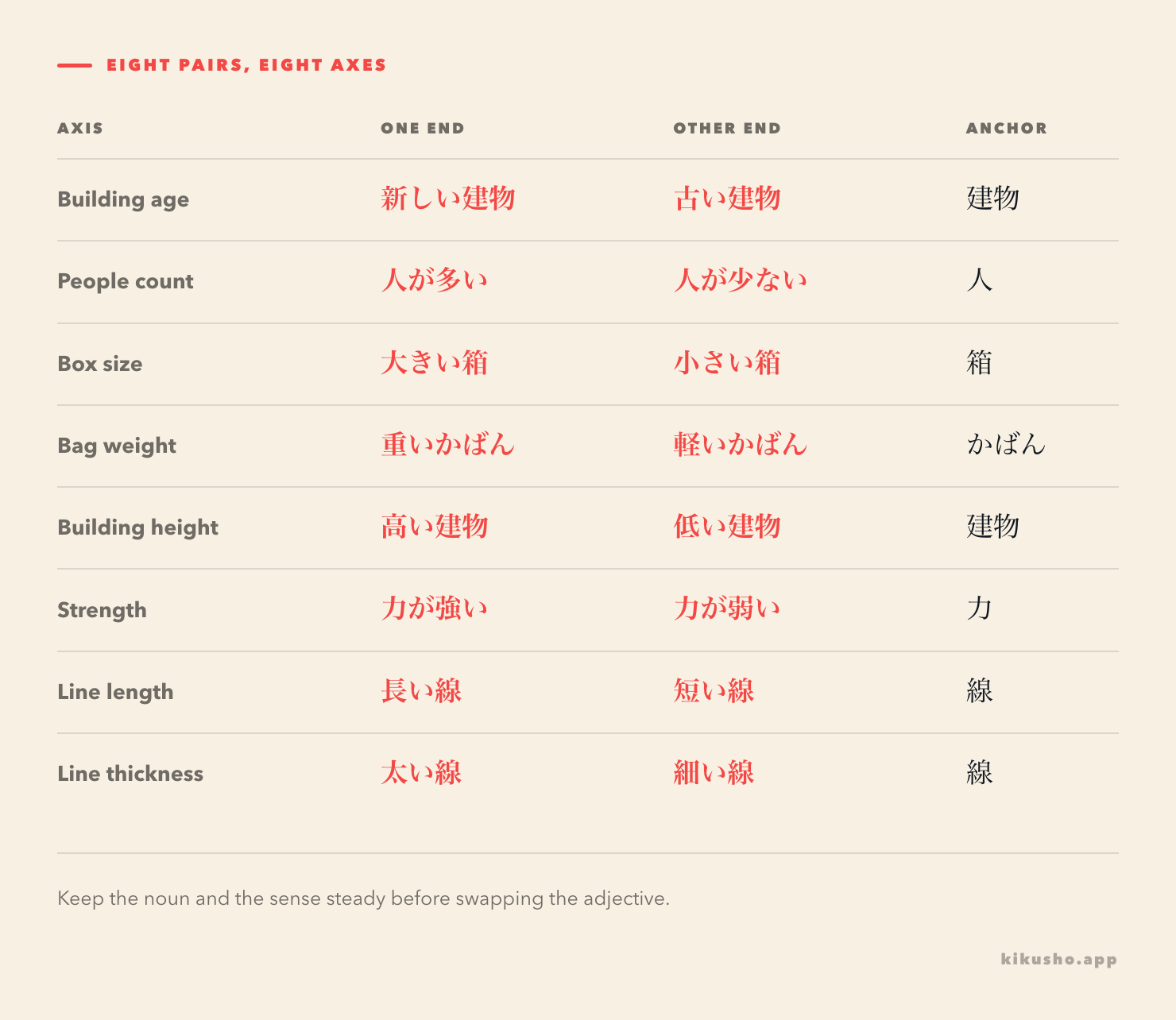
The eight pairs, with readings and one noun each
| What changes | One end: reading and sense | Other end: reading and sense | Keep the noun in the phrase |
|---|---|---|---|
| Age of a building | 新しい(あたらしい), new | 古い(ふるい), old | 新しい建物 / 古い建物 |
| Number of people | 多い(おおい), many | 少ない(すくない), few | 人が多い / 人が少ない |
| Overall size of a box | 大きい(おおきい), big | 小さい(ちいさい), small | 大きい箱 / 小さい箱 |
| Weight of a bag | 重い(おもい), heavy | 軽い(かるい), light | 重いかばん / 軽いかばん |
| Height of a building | 高い(たかい), high or tall | 低い(ひくい), low | 高い建物 / 低い建物 |
| Strength | 強い(つよい), strong | 弱い(よわい), weak | 力が強い / 力が弱い |
| Length of a line | 長い(ながい), long | 短い(みじかい), short | 長い線 / 短い線 |
| Thickness of a line | 太い(ふとい), thick | 細い(ほそい), thin or slender | 太い線 / 細い線 |
The NINJAL entries for 軽い, 弱い, 長い and 太い give the weight, strength, length and thickness senses and name their partners. 多い gives 少ない as its quantity counterpart. The school list independently checks the common い-adjective class, readings and N5 placement of the majority of this set; the curriculum inventory carries the exact sixteen-word scope.
Hold the noun still, then switch one description
長い線 is a long line and 短い線 is a short one. 太い線 and 細い線 describe the very same line's thickness. The second pair cannot answer a question about length. That is the useful pattern across the set: a contrast has a noun and an axis. The NINJAL 長い entry distinguishes length from height and names 短い as its opposite; its 太い entry gives a line and a rope as thickness examples and names 細い. 太い is not a general substitute for 大きい; one measures thickness, the other overall size.
The pairs also travel into short sentences. このかばんは重いです means "This bag is heavy"; このかばんは軽いです changes only the weight. この建物は高いです can describe height when you are looking up at it. The adjective keeps its final い before です; it does not need the な used by a な-adjective. If you want the object first in your memory, use 重いかばん, 高い建物 or 細い線, with the noun beside the word.
Three places where a memorised opposite misleads you
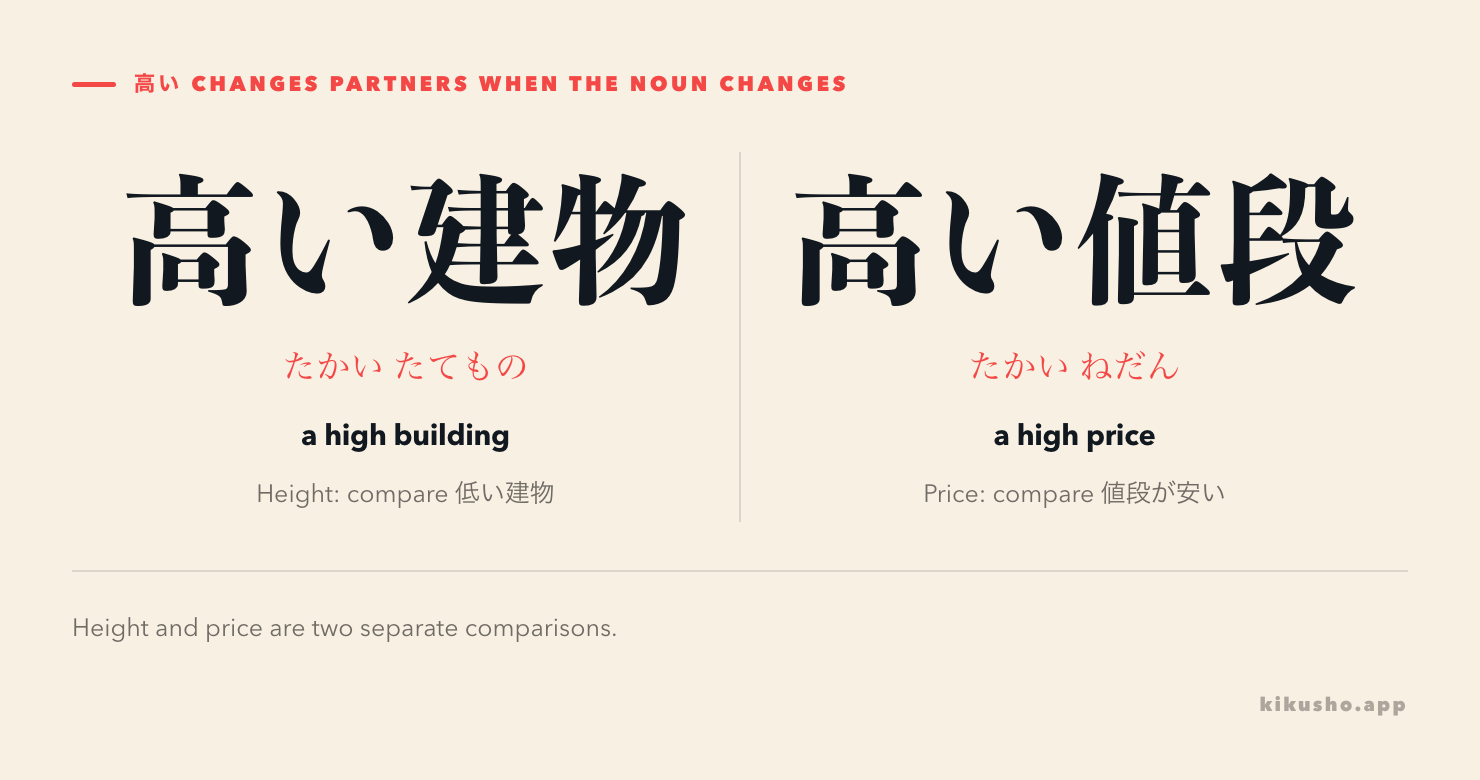
First, 高い can measure height or price. 高い建物/低い建物 contrasts buildings by height. 値段が高い/値段が安い contrasts prices: the counterpart is 安い, not 低い. 安い is shown only to settle this meaning; it is outside the sixteen assigned words. The Japan Foundation word list places 高い/低い with town descriptions, while the NINJAL 安い entry identifies high price as its opposite. You cannot choose an antonym from the spelling 高い alone.
Second, 古い describes an old building, bag or idea, but 古い友人 is a long-time friend, not a friend who is elderly. Its opposite 新しい works for a new building; it does not solve the friend's age. The NINJAL 古い entry gives both 古い家 and 古い友人 and separates their senses. Keep the old/new pair on buildings in this lesson; read a person's age from the surrounding context rather than from 古い alone.
Third, quantity usually arrives as 人が多い or 人が少ない, "there are many/few people." 多い人 does not simply mean "many people"; placing 多い before 人 would try to describe a person, not the number of people present. NINJAL's 多い entry gives predicative quantity sentences and shows that an attributive use needs a fuller construction, such as 事故の多い交差点, a junction with many accidents. The separately authored Sakura lesson likewise uses 人が多い. For a first N5 quantity sentence, the noun with が is the reliable form.
The first pairs you will meet on a walk or at a shop
新しい/古い, 大きい/小さい and 高い/低い are useful when you describe buildings or boxes you can see. 多い/少ない describes people at a station, while 重い/軽い matters when you pick up a bag. 長い/短い can describe a road or waiting time; 太い/細い a line on a sign or map. The earlier transport-words lesson teaches 道(みち), "road," and learning words in sentences explains why the noun beside a word deserves space on its card.
If someone says 高いですね in a shop, the thing that is high may be a price. If they say it looking at a building, it may be height. Kikusho can draft a card from the heard phrase, a photo or text; check the sense and keep 値段 or 建物 in the example before saving it. The reviewed card then remains available for offline practice. One adjective with two nouns is more informative than a card that says only "high."
Check yourself
Question 1. An announcer says 「人が多いです」 at a station. How do you read the adjective 多い? a) おおい b) おおきい c) おもい d) すくない.
Question 2. Which kanji writes ふとい, "thick," in 「__線」? Choose one: a) 細い b) 太い c) 高い d) 古い.
Question 3. A building is only one storey high. Which phrase describes its height? Choose one: a) 低い建物 b) 安い建物 c) 少ない建物 d) 軽い建物.
Question 4. A price tag is far above your budget. Which sentence describes the price? Choose one: a) 値段が高いです b) 値段が低いです c) 値段が太いです d) 値段が長いです.
Question 5. A station has many people. Which natural N5 sentence states that quantity? Choose one: a) 人が多いです b) 多い人です c) 人が太いです d) 人が弱いです.
Question 6. Which sentence restates 「これは太い線です」, "This is a thick line"? Choose one: a) この線は太いです b) この線は細いです c) この線は長いです d) この線は短いです.
Question 7. In 古い友人, what is old? Choose one: a) the friendship b) the friend's age c) the friend's height d) the friend's bag.
Answers and explanations
Answer 1. a) おおい. おおきい reads 大きい, big; おもい reads 重い, heavy; すくない reads 少ない, few. The first two look close in kana but measure different things.
Answer 2. b) 太い. 細い is thin, 高い is high, and 古い is old. The line's width decides between 太い and 細い; its length would call for 長い or 短い.
Answer 3. a) 低い建物. 低い measures low height and pairs with 高い on that axis. 安い concerns price; 少ない quantity; 軽い weight. None describes a building's height here.
Answer 4. a) 値段が高いです. With 値段, 高い means expensive. 低い is the low counterpart for height or level, not the normal word for an inexpensive price; 太い and 長い measure thickness and length.
Answer 5. a) 人が多いです. 人が names what is numerous. 多い人 does not count people, while the other choices describe thickness or weakness rather than the number present.
Answer 6. a) この線は太いです. It keeps the same line and thickness. 細い reverses the thickness; 長い and 短い switch to length, so they cannot restate the first sentence.
Answer 7. a) the friendship. 古い友人 means a friend known for a long time. It does not say the friend is elderly, tall or carrying an old bag.
Common questions
Are all sixteen words in this N5 set い-adjectives?
Yes. Each ends in い in its dictionary form and can stand before a noun, as in 新しい建物. This lesson's sixteen-word scope does not include な-adjectives such as 静か.
Is 低い the opposite of 高い when a price is expensive?
No. 高い and 低い oppose each other for height or level. For price, 高い means expensive and 安い means inexpensive. 安い is a contextual comparison here, not one of this lesson's sixteen assigned words.
Can 大きい and 小さい stand before a noun as 大きな and 小さな?
Yes. 大きい/大きな and 小さい/小さな can each modify a noun. They are still い-adjectives; the extra attributive forms do not make them ordinary な-adjectives.