On this page
For basic place uses, に (ni) marks where a person or thing is, or the goal of movement; で (de) marks where an activity or event takes place. へ, pronounced え (e), marks direction and can replace destination に with ordinary verbs for going, coming and returning.
That gives you three roles to distinguish, rather than three English words to memorise. “At the library” can describe somebody's presence or somebody's reading. Japanese marks those relationships differently, even though the building is unchanged.
The test: presence, activity, or movement toward a place?
Before choosing a particle, finish the thought in your head:
| What you are saying | Basic place marker | Example |
|---|---|---|
| Somebody or something is there | に | 図書館に友達がいます。 |
| An activity happens there | で | 図書館で本を読みます。 |
| Somebody goes, comes or returns there | に or へ | 図書館に/へ行きます。 |
Read 図書館 as としょかん, “library”; 友達 as ともだち, “friend”; and 本 as ほん, “book.” The three examples mean “A friend is at the library,” “I read books at the library,” and “I go to the library.”
This table is a starting point for the basic constructions below. An event's venue needs a further check, even when the verb is ある.
に locates a person or thing and marks a destination
With the independent existence verbs いる and ある, place + に identifies where a person or thing is:
図書館に友達がいます。
としょかんにともだちがいます。
A friend is at the library.
本は図書館にあります。
ほんはとしょかんにあります。
The books are at the library.
The first introduces a friend with が; the second locates books already under discussion with は. Neither choice changes the location marker に. The ある and いる lesson explains which referents use each verb and how their negative and past forms work.
Movement gives に another place role:
明日、図書館に行きます。
あした、としょかんにいきます。
Tomorrow I will go to the library.
行きます(いきます) is “go,” and 明日(あした) means “tomorrow.” This time 図書館に is the intended destination, rather than a statement that the speaker is already inside it. The same marker works with 来ます(きます), “come,” and 帰ります(かえります), “return.”
The TUFS case-particle explanation separates movement goals from places of existence. Both belong here; “に means a motionless location” would fail as soon as you say where you are going.
で marks the place of an activity
Use place + で when you describe what happens there:
図書館で本を読みます。
としょかんでほんをよみます。
I read books at the library.
読みます(よみます) means “read.” 図書館で locates the reading; 本を marks what you read. The place is not a direct object, so do not exchange those markers just because both nouns appear before the verb. The を lesson develops that other noun role.
Compare 公園に犬がいます (こうえんにいぬがいます, “There is a dog in the park”) with 公園でパンを食べます (こうえんでぱんをたべます, “I eat bread in the park”). 公園(こうえん) remains the same place. Presence selects に; the eating activity selects で. The sentence about eating may leave the eater understood, but that does not turn the park into the eater.
You do not need the further claim that a library is necessary for reading. Reading could happen elsewhere. で identifies the setting of the action being described, as in Tae Kim's contextual-particle explanation.
For verbs whose meanings need closer attention, such as residing and working, continue with why 住む takes に when 働く takes で. That lesson covers its workplace and sleeping contrasts; this page keeps the basic three-particle place frames together.
へ points in the direction of movement
Put へ after the place you are heading to:
明日、図書館へ行きます。
あした、としょかんへいきます。
Tomorrow I will go to the library.
Read 図書館へ as toshokan e. The written kana is へ, but its particle reading is え. Inside a word such as 部屋(へや), “room,” it keeps the ordinary he reading. Do not pronounce the place phrase toshokan he.
へ can also accompany coming and returning: 図書館へ来ます, “come to the library,” and 家へ帰ります(いえへかえります), “return home.” Direction here concerns movement toward a place, not the place where a person is currently present.
Therefore 図書館へ友達がいます does not express the ordinary “A friend is at the library.” The existence frame needs 図書館に. Sharing a destination use does not make the two particles substitutes in every construction containing a place.
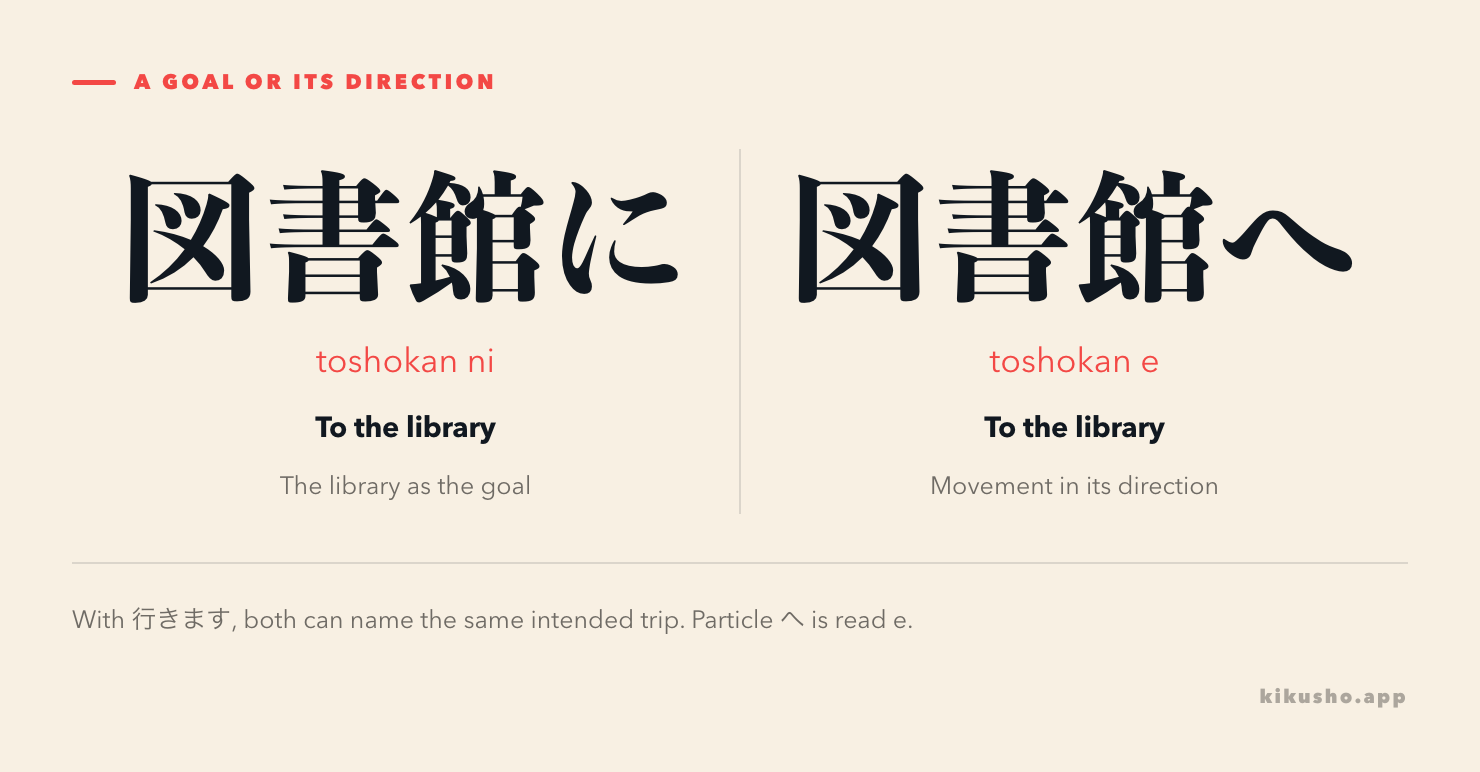
The overlap: に and へ can describe the same trip
| Sentence | Shared meaning | What the place phrase presents |
|---|---|---|
| 図書館に行きます。 | I will go to the library. | The library as the goal. |
| 図書館へ行きます。 | I will go to the library. | Movement in the library's direction. |
JLPT Sensei's directional lesson accepts both markers with the same going verb. Bunpro's へ guide also distinguishes direction from a focus on the destination, while recognising ordinary “go to” usage.
Avoid turning that tendency into a rule that に means you definitely arrived and へ means you did not. These examples announce a plan; they do not report its outcome. In many everyday exchanges, both identify the same intended trip. English “toward” can help explain the directional nuance, but it is not a compulsory translation of every へ.
The overlap belongs to the movement construction. It does not license へ for the reading site in 図書館で本を読みます, or for the friend's location in 図書館に友達がいます.
An event uses で even when the verb is ある
The noun matters as well as the verb:
ホテルに友達がいます。
ほてるにともだちがいます。
A friend is at the hotel.
ホテルで会議があります。
ほてるでかいぎがあります。
There is a meeting at the hotel.
会議(かいぎ) means “meeting.” The friend is a person whose presence you locate with に. The meeting is an event taking place at a venue, so its location takes で, although あります remains the verb.
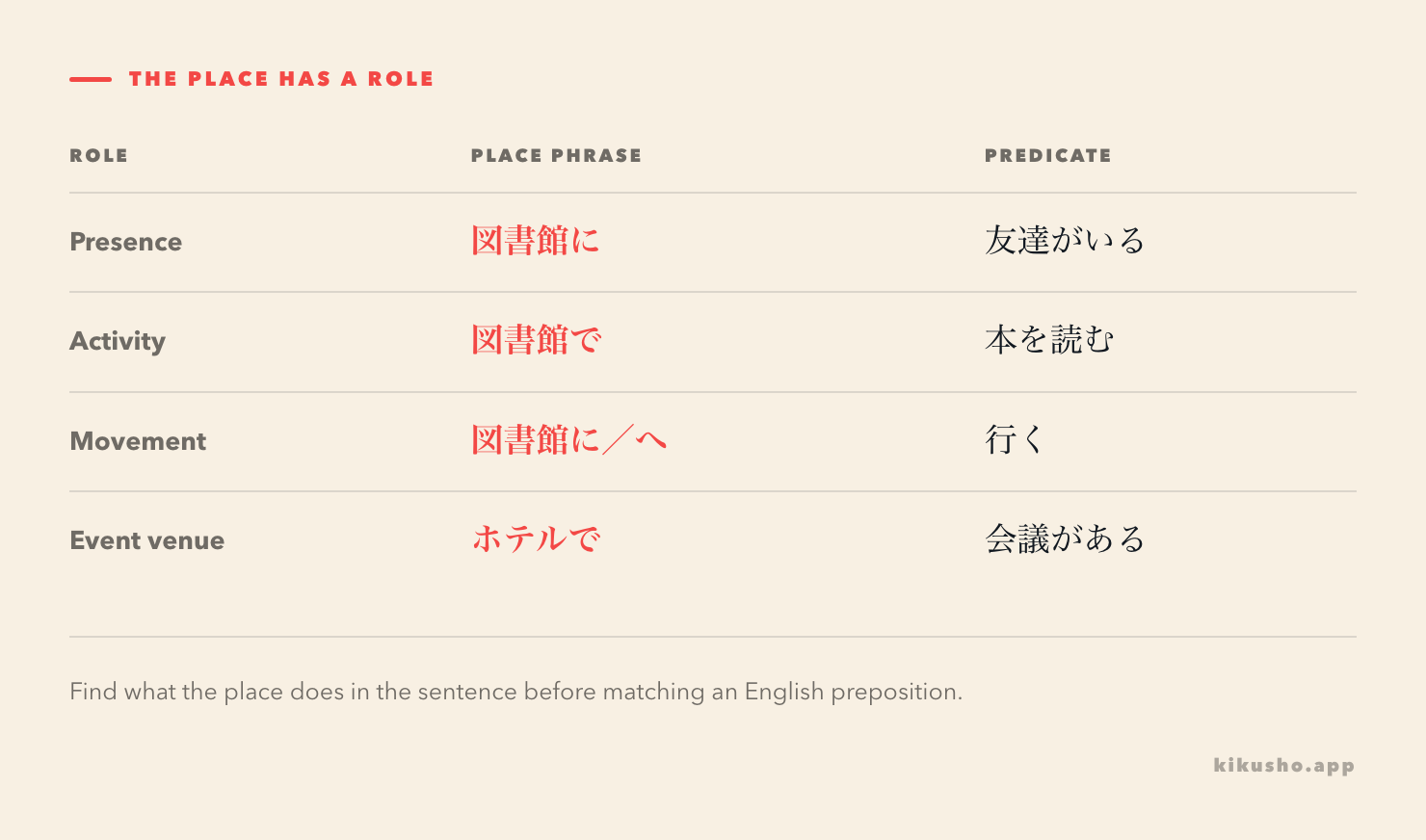
| Role | Place phrase | Predicate |
|---|---|---|
| Physical presence | 図書館に | 友達がいる, a friend is there |
| Reading activity | 図書館で | 本を読む, read books |
| Movement | 図書館に/へ | 行く, go |
| Event venue | ホテルで | 会議がある, a meeting takes place |
TUFS explicitly shows event-location で alongside existence-location に. That is why a shortcut based only on the final verb ある misses part of the distinction. The earlier existence-verb lesson explains this event sense too; use the grid here to compare it with the other place roles.
Keep the other noun roles separate
A sentence can combine time and place phrases. 三時に図書館へ行きます (さんじにとしょかんへいきます, “I will go to the library at three o'clock”) marks a time with 三時に and a destination/direction with 図書館へ. 三時に図書館に行きます is also grammatical: repeating に does not make both nouns places. For time choices, see which time words take に.
Likewise, バスで図書館に行きます (ばすでとしょかんにいきます, “I will go to the library by bus”) uses で for travel means, not an activity site. The transport-word lesson separates vehicle, destination and boarding location. This page teaches basic place uses; means, time, recipients and other constructions are separate scopes.
The particles themselves are usable in plain and polite sentences: 図書館へ行く is plain, 図書館へ行きます is polite. へ is standard Japanese, not an incorrect or exclusively formal version of に. Bunpro and JLPT Sensei classify these basic particles as N5 grammar. That is a study placement; the JLPT FAQ explains why exhaustive grammar specifications are no longer published.
If you record a short spoken plan in Kikusho, check the editable card against the original clause. 図書館にいる tells you where someone is; 図書館へ行く tells you where someone is going. A card that keeps only “library” cannot test that difference. Retain the place phrase with its verb, then practise recalling the clause from a presence, reading or travel situation.
Seven exercises with the solutions below
The JLPT test-item table includes grammar selection, sentence composition and text grammar at N5. The following prompts are original practice for this lesson, with no claim that seven answers measure readiness for the whole exam.
Question 1. Locate a dog in the park: 公園(_____)犬がいます。 Choose the basic presence marker. Read 犬 as いぬ.
A. へ B. に C. で D. を
Question 2. Identify the park as the setting for eating: 公園(_____)パンを食べます。 “I eat bread in the park.”
A. に B. へ C. が D. で
Question 3. In 図書館(_____)行きます, which statement correctly describes the choices for an ordinary trip to the library?
A. Only に can mark the destination.
B. Only で can mark the destination.
C. Both に and へ work; their emphasis differs.
D. に, で and へ are freely interchangeable here.
Question 4. Build “Tomorrow I will go to the park” from these four pieces: 行きます / へ / 明日 / 公園. Begin with 明日 and use each piece once.
Question 5. Read the two linked statements and supply the location marker for the second:
朝は図書館にいます。図書館(_____)本を読みます。
朝(あさ) means “morning.” The speaker is at the library in the morning and reads books there.
A. を B. に C. で D. へ
Question 6. ホテルに友達がいます locates a friend at the hotel. Complete ホテル(_____)会議があります to announce a meeting taking place there.
A. で B. に C. へ D. を
Question 7. For 三時に図書館へ行きます, choose the correct explanation of the two place/time phrases and the pronunciation of へ.
A. 三時に marks a destination; 図書館へ marks presence.
B. 三時に marks time; 図書館へ marks the destination and is read toshokan he.
C. 三時に marks time; 図書館へ marks direction/destination and is read toshokan e.
D. 三時に marks an activity site; へ is pronounced ni.
Write the relevant noun role alongside each choice so you can check more than a letter.
Answers and explanations
Answer 1. B — に. 公園に犬がいます locates the dog with independent いる. で would locate an activity or event, へ would mark direction, and を would not mark this place of presence. The sentence says where the dog is, not what it is doing.
Answer 2. D — で. 公園でパンを食べます locates the eating activity. The bread already takes を as what is eaten. に and へ do not mark the site of eating in this basic construction; が would mark another noun role instead of the required setting.
Answer 3. C — に and へ both work. 図書館に行きます presents the library as a goal; 図書館へ行きます presents the movement in its direction. Either can mean “I will go to the library.” で is not the destination marker here. A rejects a valid へ sentence, and D wrongly treats activity-location で as the same choice.
Answer 4. 明日、公園へ行きます。 The sequence is 明日 → 公園 → へ → 行きます. Read it あした、こうえんへいきます. The supplied marker follows the park, giving the movement phrase 公園へ. No extra に is required, and the question fixes 明日 as the first piece.
Answer 5. C — で. The complete text is 朝は図書館にいます。図書館で本を読みます。 The first sentence locates the speaker; the second locates the reading activity. Keeping the same building does not require keeping に. へ would mark movement toward it, and を would not supply the reading site's marker.
Answer 6. A — で. ホテルで会議があります describes an event held at a venue. に locates the friend in the preceding sentence, but the meeting calls for event-location で. へ and を do not mark the meeting venue in the requested frame. The verb あります alone is not enough to decide.
Answer 7. C. 三時に marks the time, three o'clock; 図書館へ identifies the movement's direction/destination. Particle へ is read え, so the phrase is toshokan e. B assigns the correct roles but the wrong particle reading. A and D misidentify what the three-o'clock phrase is doing.
Ask a partner where they are now, what they do there, and where they will go next. Give the place in each answer even if it repeats. Then replace only the destination marker with へ, leaving the verb unchanged, and say that last answer again.
Common questions
How do I choose ni, de or e for a place?
In basic place sentences, に locates a person or thing with いる/ある and marks a destination with movement verbs. で marks where an activity or event takes place. へ marks direction and overlaps に with 行く, 来る and 帰る. The same place can take different particles because its role in the sentence changes.
Are ni and e interchangeable?
With basic going, coming and returning, both can mark the place: 図書館に行きます and 図書館へ行きます can both mean I will go to the library. に presents the goal; へ presents the direction. That does not make へ a substitute for に in existence sentences such as 図書館に友達がいます.
Is the particle he pronounced he or e?
The directional particle is written へ but pronounced え, e. Read 図書館へ as toshokan e. The same kana has the normal he reading inside words such as 部屋, heya, meaning room. The special reading concerns its use as a particle.
Does aru always take ni for a place?
No. に locates a physical thing in 本が図書館にあります, meaning the books are at the library. When ある announces an event, its venue takes で: ホテルで会議があります means there is a meeting at the hotel. Check what the noun and predicate describe, rather than selecting the particle from ある alone.