On this page
と and たら both translate as "if" or "when," and the difference between them is not about time. It is about whether anyone gets to decide what happens next. と names a result that follows on its own, with no one choosing it; たら names what turns out to be true once something happens, and that includes a result somebody chose on purpose: a request, an invitation, a plan. と can never carry one.
That one asymmetry, more than any rule about habits or one-time events, is what decides which of the two a sentence needs.
と reports what nobody had to decide
春になると、桜が咲きます。 When spring comes, cherry blossoms bloom. Nobody arranges this. It happens every year, the same way, because that is what spring does. と is built for exactly that shape of sentence: condition on one side, an automatic, no-exceptions consequence on the other.
The same holds for a machine instead of a season: このボタンを押すと、ドアが開きます (press this button and the door opens). Nothing about the button decides to cooperate or not. The result is wired in.
と even reaches into the past, as long as the connection stays automatic. ボタンを押すと、すぐに店員が来た (I pushed the button, and the clerk came right away) reports one specific occasion, not a habit, but the clerk's arrival still reads as the button's direct, immediate effect rather than a coincidence. That is what keeps と in play here, and rules it out a few sentences down, where the connection is only ever a guess until it happens.
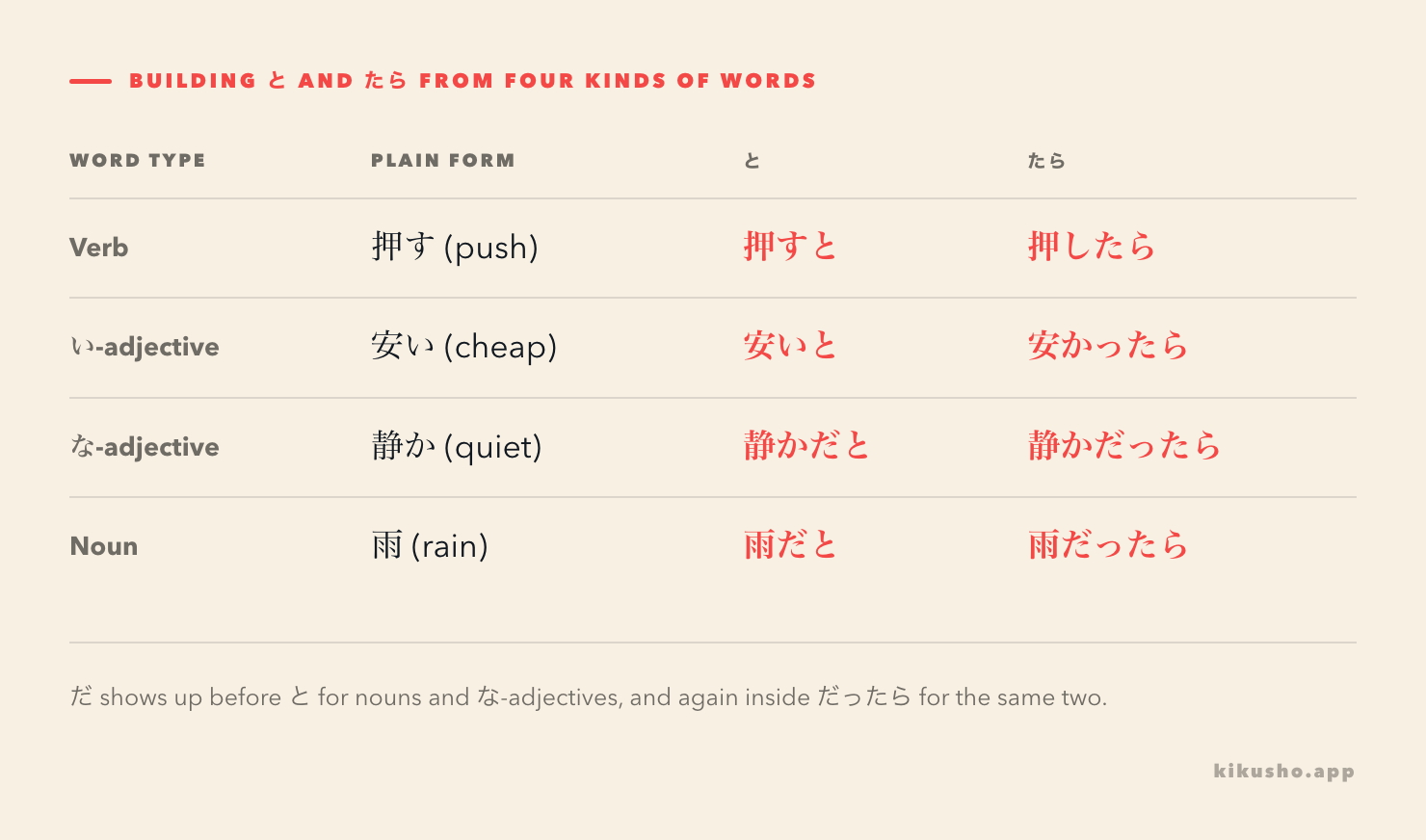
Both と examples above attach the same way: a verb's plain dictionary form, or an い-adjective's plain form, takes と directly. A な-adjective or a noun needs だ first: 静かだと (if it's quiet), 雨だと (if it's rain).
The test is what comes after the comma
Before choosing a particle, read the second half of the sentence first. Does it contain a request, an invitation, an order, or the speaker announcing a plan? If it does, と is already disqualified, whatever the first half looks like.
家に着いたら、電話してください。 Once you get home, please call me. でんわしてください is a request, someone deciding to ask something of someone else, and と has no way to carry that. Try to force it, 家に着くと、電話してください, and the sentence does not describe a slightly wrong nuance. It fails outright: the piece that needs to attach has nothing to attach to.
This is the fastest check there is, faster than judging whether an event is one-time or repeated: look past the comma before you look before it.
たら belongs to the one time it happened, and to whatever you decide next
たら does not carry と's promise that the result was inevitable, which is exactly why it can carry so much more.
It carries the plain hypothetical: お金があったら、旅行します (if I had money, I would travel). Nothing here is automatic; having money does not make travel happen by itself, someone still has to choose to go.
It carries the request from the previous section, and any command, suggestion or plan built the same way: 家に着いたら、電話してください, 晴れたら、公園へ行きましょう (if it's sunny, let's go to the park).
And it carries the one use と cannot touch at any distance: a past discovery, where the second half was true before you knew it and finding out is the whole point of the sentence. 家に帰ったら、誰もいなかった. I got home, and nobody was there. と would claim that an empty house follows from arriving home as a matter of course. It does not; it was simply what you found.
Formation runs through the plain past. A verb takes its た-form and adds ら: 押す becomes 押した, then 押したら. An い-adjective drops the い and adds かったら: 安い becomes 安かったら. A な-adjective or noun takes だったら: 静かだったら, 雨だったら.
The same morning can be a rule or a single occasion
Nothing stops both particles from attaching to the same verb. What changes is which claim the sentence is making.
朝起きるとコーヒーを飲みます (once I'm up in the morning, I drink coffee) is a fact about your mornings in general. Every one of them goes this way, or enough of them that saying so is fair.
今朝起きたらもう10時でした (this morning, I woke up and it was already 10) is a fact about exactly one morning, and an unwelcome one. と would turn this into a claim that waking up makes it 10 o'clock, which is nonsense; たら just reports what the speaker found.
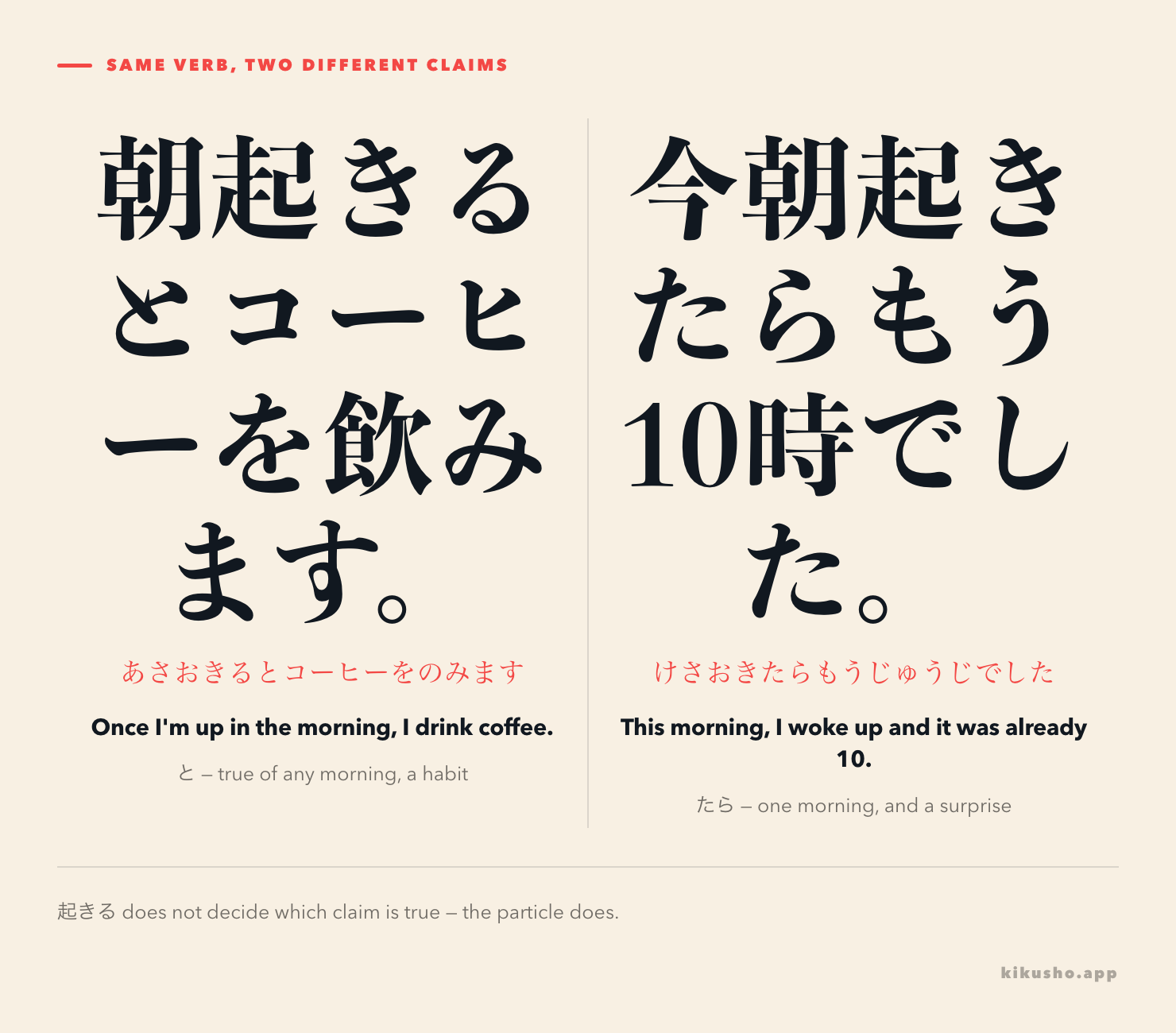
Notice that the fact deciding between them was never in the trigger clause: 朝起きると and 今朝起きたら look almost identical up to the particle. The evidence lives in what comes after, 飲みます stated as routine, でした reporting a fact already settled. A card that keeps only the half-sentence around と or たら has thrown away the exact clause that made the choice necessary. Kikusho keeps the whole sentence on every card by default, trigger and claim together, so the reason a particular と or たら was there is still legible the next time you review it, instead of a bare particle you have to reconstruct a rule for.
Swap them and the sentence changes what it claims, not just its grammar
The clearest mistake is the one that breaks outright: と followed by an invitation or a request, like 晴れると、公園へ行きましょう. A native ear catches this instantly, because ましょう has nowhere to land.
The quieter mistake is the one that stays grammatical and just says something else. 春になると花見に行きます, said about this coming spring, reads as a claim that you go flower-viewing every spring: a fact about your habits, not an announcement of a plan. Say what you meant, this particular spring, and it needs たら: 春になったら花見に行きます. The grammar will not stop you from making the first mistake; only knowing which claim you are making will.
Put the test to three sentences
Question 1. Complete the sentence with the right form: 「宝くじが___、会社を辞めるつもりです。」(If I win the lottery, I'm planning to quit my job.)
a) 当たると b) 当たったら c) 当たるたら d) 当たっると
Answer 1: 当たったら. つもりです states the speaker's own plan, which と can never introduce, ruling out (a) before the conjugation is even checked. たら is built from the plain past, 当たった, plus ら, not by gluing たら onto the dictionary form (c) or inserting an extra る (d), neither of which is a real conjugation.
Question 2. Put these into a natural sentence meaning "when winter comes, it snows": 雪が ・ 冬に ・ 降ります ・ なると
Answer 2: 冬になると、雪が降ります。 The condition comes first (冬になると), then the automatic result (雪が降ります): snow following winter is exactly the no-exceptions pattern と is built for, and it is also why たら would sound odd here, since nothing about this sentence is a one-time report.
Question 3. Complete the story with the right form of 開ける (to open): 「きのう、うちに帰りました。ドアを開ける前は静かでした。でも、ドアを___、部屋の電気がついていました。」(Yesterday I went home. Before I opened the door, it was quiet. But when I opened the door, the light in the room was on.)
a) 開けると b) 開けたら c) 開けてと d) 開けるたら
Answer 3: 開けたら. The light being on was not caused by opening the door: it was already on, and the speaker only found out at that moment. That is the discovery use たら covers and と cannot: と would claim the light turning on follows from opening a door as a matter of course, which nothing in the story supports. (c) and (d) are not conjugations that exist.
Once the deciding fact turns out to live after the particle and not in front of it, と and たら stop being a pair of translations for "if" and start being two different claims about who, or what, is responsible for the result: the same kind of split that separates ている from てある, and the same instinct that decides whether a sentence marks its subject with は or が. Japanese keeps drawing that line with grammar. English mostly leaves it to tone.
Common questions
Can と and たら both be correct in the same sentence?
Often, and they end up meaning different things. 朝起きるとコーヒーを飲みます (once I'm up, I drink coffee) reports a habit, true of any morning. 今朝起きたらもう10時でした (this morning, I woke up and it was already 10) reports one particular morning and what turned out to be true on it. Same verb, same trigger, different claim.
Why can't と be followed by please, let's, or I will?
Because と states that the result follows on its own, with nobody deciding it. A request, an invitation or a stated plan is the opposite of that: someone choosing what happens next, which grammars built on と have nowhere to put. たら carries no such claim, which is why 電話してください (please call) and 行きましょう (let's go) attach to it without trouble.
What about ば and なら, the other two conditionals?
They exist, and each does a job neither と nor たら does well: ば is closer to general advice and mutual conditions, なら reacts to something already said rather than to an event. Both come with their own restrictions worth learning on their own terms, not folded into this pair.
Does と ever describe something that only happened once?
Yes, when the result followed immediately and automatically: ボタンを押すと、すぐに 店員が来た (I pushed the button, and the clerk came right away) is a single past event, not a habit. What と cannot do is describe a one-time result that depended on the situation rather than following as a matter of course. That is たら's job, including the times the result was a surprise.