On this page
Stroke order matters when you write kanji by hand and when you look one up by its shape, and almost nowhere else. If you mostly read and type, and you keep your vocabulary by capturing and reviewing it, you can learn the handful of general rules loosely and skip drilling the exact sequence of every character.
That is the short answer, and it is worth being precise about, because "always learn stroke order from day one" is advice built for a classroom where the test is written by hand. Most people learning Japanese now meet kanji on a screen and produce them by tapping a reading. For them the question is not whether stroke order is real. It is. The question is which of its payoffs they will ever collect.
Stroke order is a set of rules for forming a character by hand
The order is not arbitrary and it is not folklore. Each character has a standard sequence, codified in dictionaries and taught in Japanese primary schools, and it exists to solve one problem: making a handwritten character legible and consistent when it is written quickly. Write the strokes in the canonical order and they land in proportion, the character balances, and the next person can read it. Write them in a random order and the same strokes crowd or splay, even when every line is technically present.
So the payoff of stroke order is physical. It lives in the hand and the pen. Everything that follows is a question of whether your week contains the situations where that physical payoff is collected.
For reading and typing, the order that built a character is invisible
Here is the part the classroom advice skips. When you read a character, you see the finished shape. The sequence that produced it left no trace on the page — a character written in the wrong order and one written correctly are, once the ink is dry, the same picture. Reading asks you to recognise that picture, and recognition has nothing to hold onto in the order.
Typing is the same story from the other end. You enter the reading, a list of candidates appears, and you choose the one you want. The device draws every stroke, in the correct order, whether or not you could have. Your job was to recognise the right character in the list — production, the thing stroke order governs, was handled for you.
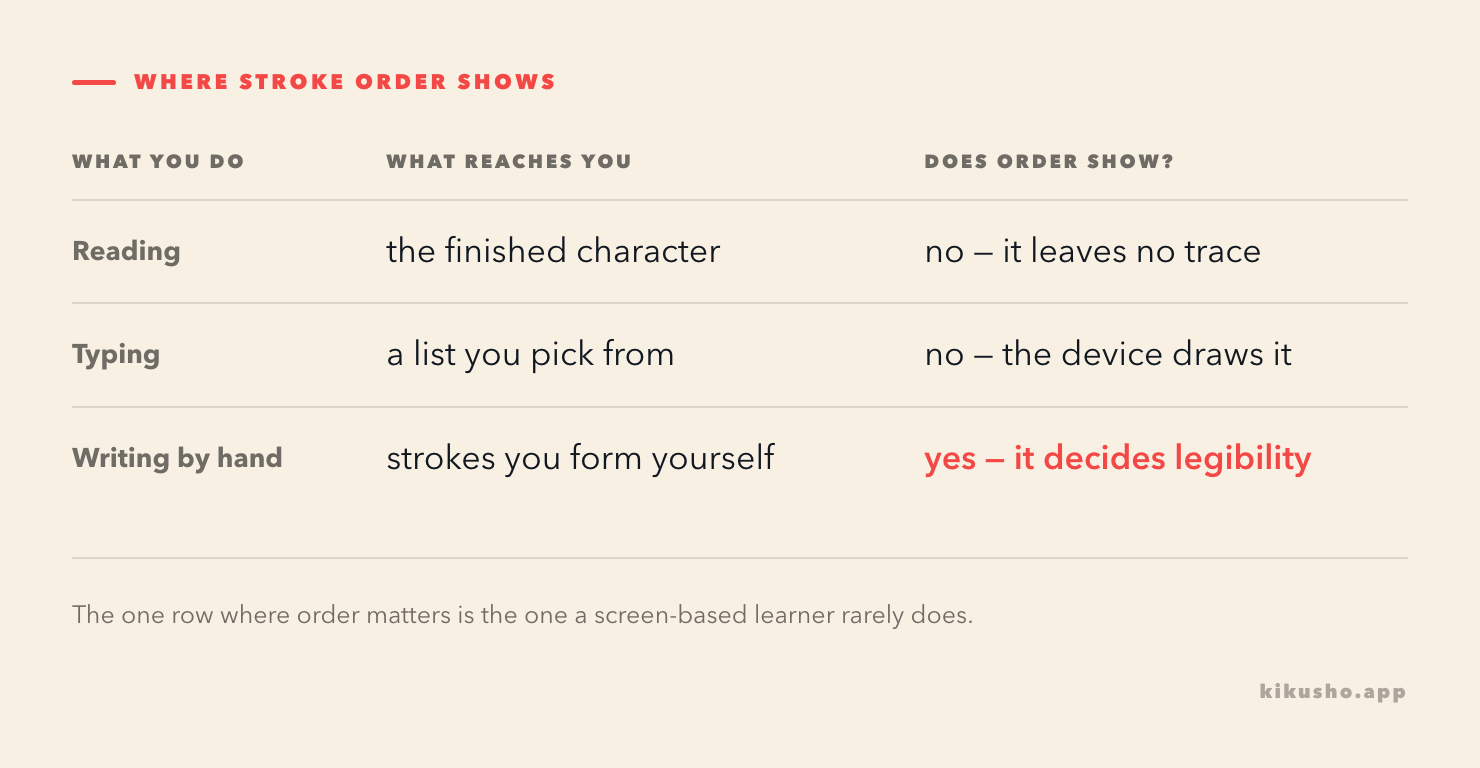
The two things you do most with kanji on a phone, reading and typing, never touch stroke order. That is not a loophole. It is the ordinary shape of a modern learner's day, and it is why the honest answer is conditional rather than a flat yes.
The real payoffs are three, and none of them is recognition
If you are going to spend time on stroke order, spend it knowing exactly what you are buying. There are three real returns, and they are all about output.
Legible handwriting. If you take notes in Japanese, fill in forms, or write anything by hand, order is what keeps a dense character balanced. A ten-stroke character like 書 holds together because its horizontals are stacked in a fixed order and spaced as you go; produced out of sequence, the same ten strokes fight for room.
Looking a character up by its shape. A paper dictionary is indexed by radical and stroke count, and handwriting input — the iOS handwriting keyboard, a draw-to-search box in a dictionary app — reads the order and direction of your strokes to guess what you drew. Approximately correct order is what makes those tools recognise you.
Reading other people's handwriting. Handwritten and cursive Japanese merges strokes and rounds corners, and the only way to reconstruct a fast-written character is to know the canonical path its strokes were meant to follow. This one arrives late, but it is real.
Notice what is not on the list: recognising printed characters, typing, and passing a multiple-choice exam. If none of the three payoffs is in your week, the case for drilling each character's sequence is thin.
Stroke order quietly teaches you to see the parts, not the strokes
There is a subtler benefit, and it is the one worth keeping even if you never pick up a pen. Writing a character in order walks you through its structure. You do not draw fourteen loose lines — you draw a radical, then a phonetic element, then the piece inside it, in that grouping, every time.
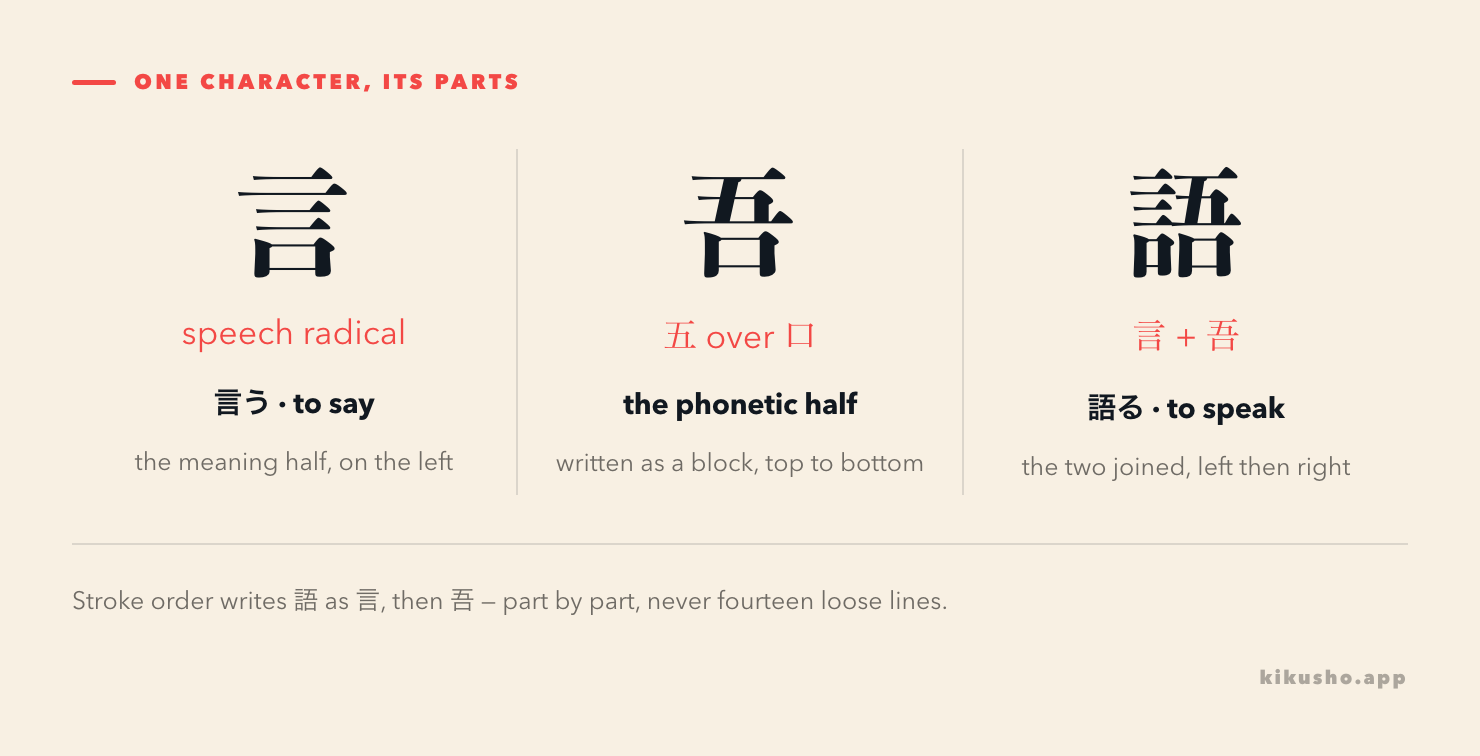
語 is not fourteen arbitrary strokes. It is 言, the speech radical, plus 吾, and 吾 is 五 sitting over 口. The stroke order rehearses that decomposition, and seeing characters as a few reusable parts rather than a tangle of lines is exactly what stops them blurring together. It is the same insight that lets you tell two look-alike kanji apart by the component that differs rather than by staring at the whole shape.
The catch is that stroke order is one route to that awareness, not the only one. You can learn the components directly — as radicals with meanings, as keywords — and get the same structural sight without drilling a single sequence. If component-awareness is what you are after, go at it directly; you do not need the choreography to arrive.
Learn the principles, not the choreography of every character
This is where the practical answer lives. A small set of rules governs almost every character, and once you know them your guess at a new character's order will be right often enough for handwriting input and for legible notes.
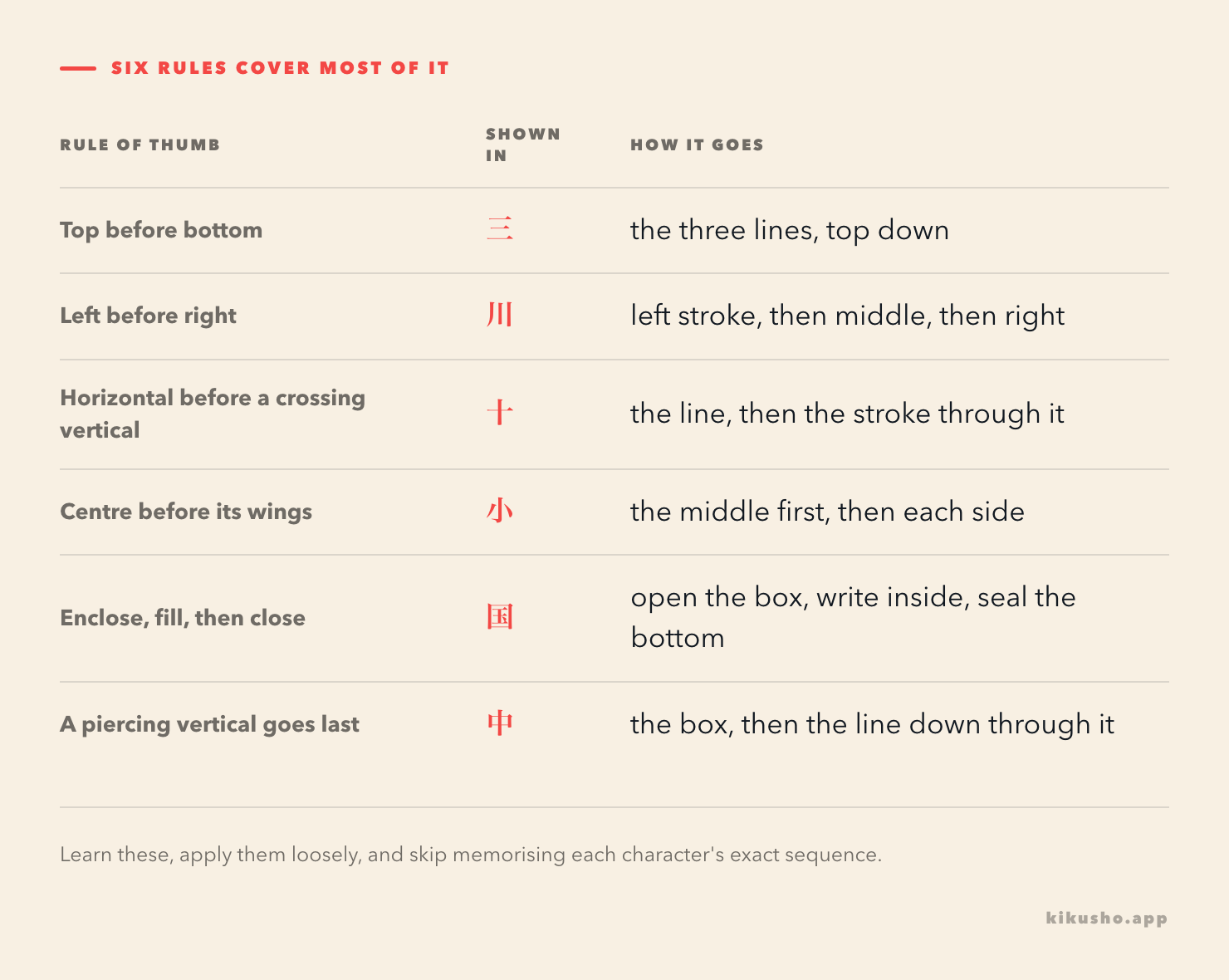
Learn those six and apply them loosely. What you do not need is to memorise the exact sequence of each of two thousand characters as a separate fact to be maintained — that is the drilling that eats hours and returns almost nothing if you never write by hand. The rules are cheap and general; the per-character sequences are expensive and, for a screen-based learner, mostly inert.
When it genuinely pays to drill: handwriting, exams, and paper lookup
The conditional answer cuts both ways. There are learners for whom exact stroke order is worth real practice, and it is worth naming them so you know which side you are on.
If you handwrite Japanese regularly — notes in class, letters, forms — drilling pays, because legibility is the whole point and it comes from order. If you are sitting the Kanji Kentei, the Japanese-native kanji exam, you will be writing characters by hand under time pressure and order is graded in effect through legibility. And if you rely on paper dictionaries or handwriting search, roughly correct order is what makes lookup work.
If you capture and review, aim for recognition, not production
For most people learning Japanese today, the daily task is recognition: reading a sign, a message, a subtitle, and knowing the word. Production by hand barely enters it. That should decide where your effort goes.
Recognition is trained by meeting a word, keeping it, and being asked to recall it again later, on a schedule — the count of times you retrieve it, not the count of times you re-draw it, is what makes it stick. Handwriting a character fifty times feels like study, but most of what it trains is a motor skill you will rarely use, and the memory gain inside it was always the retrieval, not the pen.
This is the part Kikusho is built to make effortless. Point the camera at the line, say it, or paste it, and a card comes back with the word, its reading, the meaning, a register note and an example sentence, which you check before it is saved. From then on it comes back on an FSRS schedule that runs with no signal at all, training the recognition that reading and listening actually ask of you. Stroke order stays available for the day you decide to write by hand — but it stops being the toll you pay to keep the words you met.
Common questions
Do I need stroke order to pass the JLPT?
No. Every level of the JLPT is multiple choice — vocabulary, grammar, reading and listening — with nothing you write by hand, so stroke order never comes up. The exam that does require handwriting is the Kanji Kentei, a separate test aimed mainly at native speakers.
Does stroke order change how a kanji looks when I type it?
No. When you type, you enter the reading and choose the character from a list, and the device draws every stroke in the correct order regardless of what you know. Typing exercises your recognition of the character, never its production.
Does handwriting input on my phone need correct stroke order?
Roughly. Handwriting recognisers use the order and direction of your strokes as clues to guess what you drew, so approximately correct order helps them read it. A perfect sequence is not required, and the general rules are enough to get there.
Is it too late to learn stroke order if I skipped it?
No. The general rules are a short list you can pick up in an afternoon and apply to characters you already recognise. You are learning a handful of principles, not relearning two thousand characters one sequence at a time.