On this page
A little — but almost never for the reason you were told. What fixes a word in memory is the effort of dragging it back out of your head, and the pen only helps on the occasions when it forces you to do exactly that. Copy a word while you can see it and you gain almost nothing, whether the copy is made with a pen or a keyboard.
The belief that writing something down burns it in is strong, and it isn't baseless — it just credits the wrong part of the act. Handwriting bundles several things together: attention, slowness, and, sometimes, recall. Pull those apart and the memory turns out to live in the recall, which you can reach without a pen at all, and to be absent from the copying, which is most of what "writing a word out" usually means.
The studies people cite are about taking notes, not memorising words
The evidence usually waved at this question comes from a different experiment. Students taking lecture notes by hand understood the lecture better afterwards than students typing them — a real finding, and worth being precise about, because the reason is not the one people repeat.
The typists could go fast enough to catch the lecturer almost word for word. The writers couldn't keep up, so they had to compress each point to its gist as it went by, deciding on the fly what mattered. That compressing — the reformulating, the choosing — is what built the understanding. When both groups are asked to summarise rather than transcribe, the gap narrows sharply. It was never a fact about the hand. It was a fact about being forced to think while you wrote.
Copying a vocabulary word is the opposite exercise. There is nothing to reformulate: the word sits in front of you and the task is to reproduce it exactly. You are cast as the transcriber, not the summariser — the role that came second in the study people quote to defend handwriting.
A word sticks through retrieval, and copying skips it
What strengthens a memory is retrieval: being handed a partial cue and having to produce the rest from nothing. Recognising a word is cheap; reconstructing it is expensive, and the expense is the whole point. Seeing a word a second, fifth, tenth time does surprisingly little on its own — the count of times you retrieve it, not the count of times you re-see it, is what makes it stick.
Now put handwriting against that yardstick. There are two completely different acts hiding under the phrase "writing it down." One is copying a word you can see — pure re-exposure, the answer never leaving your sight. The other is writing a word from memory, with only its meaning in front of you — retrieval, the expensive kind. Same pen, same page, same hand; one builds the memory and the other doesn't. This is the same fault line that runs under why highlighting a word does almost nothing to teach it: the pleasant, effortless version of the act quietly removes the one moment that would have worked.
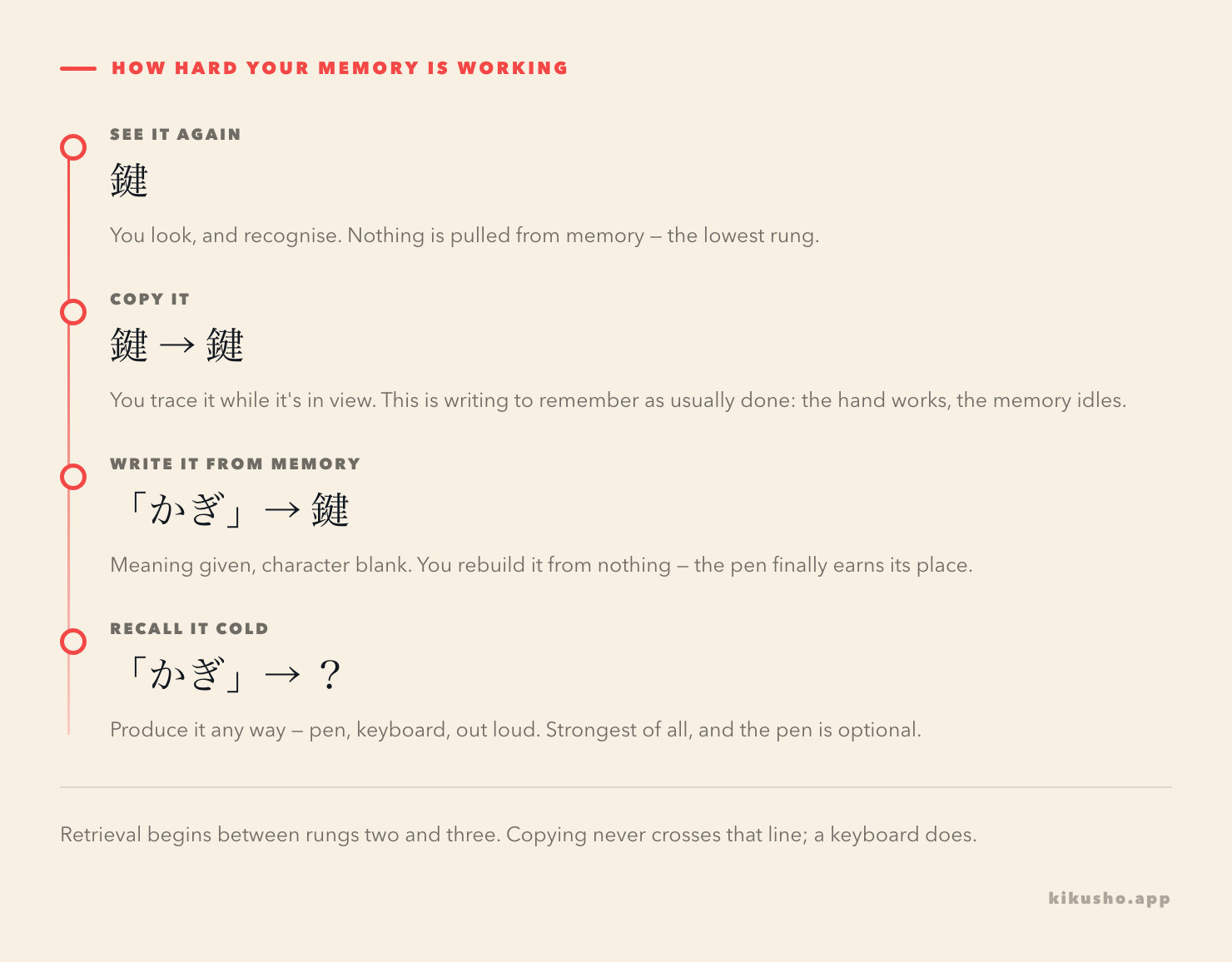
Look at where copying falls on that ladder. It is a rung above doing nothing, and several below the thing that actually teaches. The pen didn't move it up; only covering the answer does that.
Copying a kanji twenty times is close to the weakest thing you can do
The classic drill — write the character out twenty times down the margin — feels like the most diligent thing on the page, and it is close to the least useful. By the third repetition your hand is on autopilot and your attention has wandered to lunch. Nothing is being retrieved, because the answer you're reproducing has been sitting at the top of the column the entire time. You are not remembering the character twenty times. You are tracing it twenty times and remembering it zero.
Compare that to writing it once, from a blank space, with only the meaning as a prompt — then checking, then coming back to it tomorrow and trying again. One honest reproduction from memory, spaced out and repeated across days, does more than a full page done in one sitting. The full page is twenty reps of which none counts; the spaced single is a handful of reps of which every one is the kind that builds memory.
The first time you meet a shape, the pen genuinely earns its place
Here is the concession, and it is a real one. The first few times you meet a character you've never seen, writing it out does help — and this is where the brain-activation studies people cite actually apply. Forming an unfamiliar shape by hand forces you to notice its parts in a way that glancing at it never does. You cannot draw 鬱 without discovering, stroke by stroke, how much is packed into it; the pen marches your attention through every component instead of letting your eye slide over the whole blur.
But notice what that argument covers and what it doesn't. It is about learning to produce a new shape — encoding an unfamiliar form the first handful of times you face it. It is not a case for the twentieth repetition of a character you already recognise. Write a new character two or three times, slowly, to learn its geography. Then stop, because from that point on the useful work is recalling it, not re-drawing it.
Reading needs recognition; handwriting drills production
The deeper reason handwriting is oversold is that it trains the skill most learners need least. Recognising a character — seeing it and knowing the word — and producing it from nothing are two different memories, and reading leans almost entirely on the first.
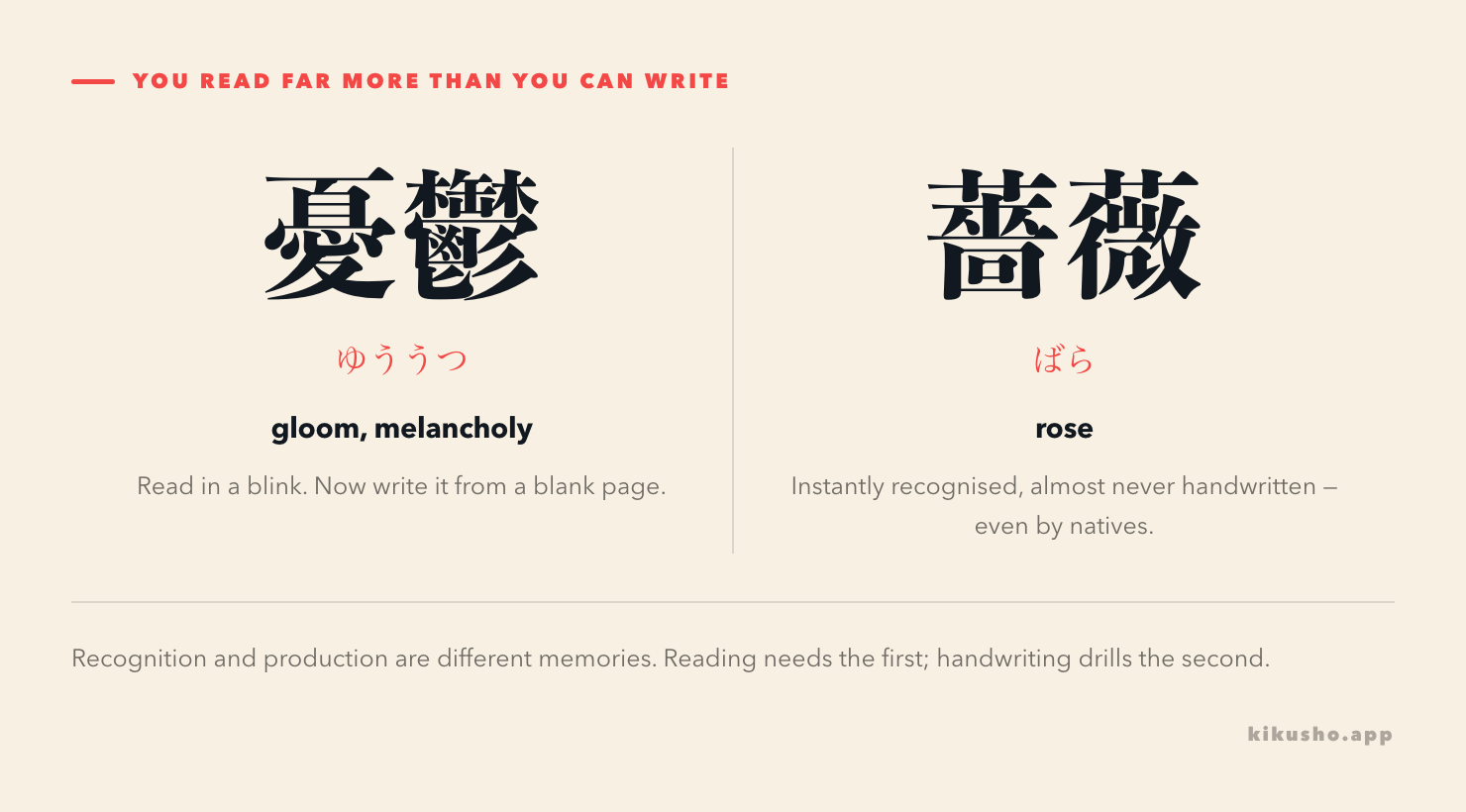
Any literate Japanese speaker reads 薔薇 and 憂鬱 without a flicker of hesitation, and a good number of them could not write either from a blank page. That gap is not a failing; it is the normal shape of a modern reader, whose eyes meet far more characters than their hand ever produces. If your week is reading signs, messages and subtitles, the memory you need is recognition, and handwriting spends its effort on production — the same reason stroke order matters for writing and lookup but not for reading or typing. Drilling the skill you rarely use is not diligence; it is aiming at the wrong target with great discipline.
Typing from memory does the same retrieval work as the pen
If retrieval is the engine, then anything that forces retrieval qualifies — and typing a word from memory absolutely does. When you type き and pick the right one from 木, 気, 来, 黄, you have just recalled which character the word wants; when you spell a word out and it comes back correct, you produced it from nothing. The motor path is different from the pen's, but the memory operation — meaning in, word out — is identical.
So "it only counts if you write it by hand" is not true. What genuinely doesn't count is tapping a suggestion you didn't have to recall, or copy-pasting a word into a note: those skip the retrieval exactly the way copying by hand does. The dividing line was never pen against keyboard. It is whether the word came from your memory or from the screen in front of you.
What to keep from writing by hand, and what to drop
None of this makes a pen useless. Keep the parts that force recall: writing a character from memory as a self-test, reproducing a new shape a few times to learn its parts, jotting a word you're trying to fix without peeking at the source. Drop the parts that don't: the margin full of copies, the second and third page of the same character, any writing done while the answer is visible. The test for a study action is a single question — did it make you produce the word from memory? If not, the tidiness of the page is the only thing you built.
This is also the quiet case for capturing and reviewing instead of copying. When you meet a word out in the day — a sign, a line of manga, something said to you — the work that keeps it isn't transcribing it into a notebook; it is meeting it again later, cold, and being made to recall it. Kikusho is built around that half: point the camera, say it, or paste it, and a card comes back with the word, its reading, the meaning and an example, which you check before it's saved. From then on it returns on an FSRS schedule and asks you to produce the word from its meaning, offline, which is the retrieval the pen was only ever a clumsy way of reaching. Write a new character out by hand the first time if it helps you see its shape — then let the recall, not the copying, be what makes it stay.
Common questions
Is handwriting a word a waste of time for learning vocabulary?
No, but its value is narrow. Handwriting helps when it forces you to retrieve — writing a word from memory with only its meaning in front of you — and when you are learning the shape of a character for the first few times. It does almost nothing when you copy a word you can already see, which is what most handwriting practice actually is.
Does typing a word help you remember it as well as writing it by hand?
Yes, when you type it from memory. Choosing the right character from an input list, or spelling a word out correctly, is retrieval — the same memory operation as writing it by hand, just with a different motor path. What doesn't help is tapping a suggestion you didn't have to recall, or copy-pasting, both of which skip the retrieval exactly the way copying by hand does.
Should I handwrite kanji over and over to learn them?
Not for reading. Recognising a character is trained by recalling it, not by re-drawing it, and copying one twenty times down a margin retrieves nothing after the first few strokes. Write a new character two or three times to learn its shape, then switch to recalling it from its meaning, spaced across days.