On this page
N4 feels harder than N5 because it stops testing what your words mean and starts testing what your sentence does to the people in it. N5 grammar builds statements: this is a pen, I went to Shibuya, the coffee is hot. N4 grammar builds the machinery around a statement — what happens if something else does, who performed an action for whom, whether the subject made the event happen or only let it. The vocabulary grows too, but that is not the part slowing you down.
So the jump is real, and it is not a matter of volume. Three of the things N4 introduces mark distinctions your first language never forced you to notice, and until you can see them, every sentence that uses one reads as slightly off for reasons you cannot name. Here is what changed, which pieces carry the most weight, and the order that costs you the least time.
What N4 adds that N5 didn't
At N5 you learn sentence shapes you can fill in like a form. X は Y です. A verb in ます form. Particles that say where, when and with whom. You can translate most of it into English almost word for word and be understood, because the grammar is doing the same job English grammar does.
N4 keeps all of that and layers operations on top of the verb. The families that appear are quick to list and slow to absorb:
- Conditionals. と, たら, ば and なら: four ways to say if or when.
- Transitivity pairs. Two related verbs, like 開く and 開ける, for one event.
- Giving and receiving. あげる, くれる and もらう, and the direction each one points.
- The potential form. 食べられる, 飲める: being able to do something.
- Passive and causative. される, させる, and the させられる that stacks them.
- The て-form's extensions. てある, ておく, てしまう, てみる, all built on one stem.
That last family is the hinge. The て-form is usually the final thing N5 teaches, and nearly everything in N4 attaches to it, which is why an N4 that arrives before the て-form is automatic feels like standing on a ladder whose bottom rung is loose.
The three distinctions English never taught you to notice
Most N4 grammar is new machinery for a job you already understand. The potential form is just can. The passive is close enough to the English passive to lean on. Three things are different in kind: they encode information English carries with word order, with tone, or with nothing at all, so there is no habit to transfer and you are learning the distinction itself rather than a new label for a familiar one. This is where "twice as hard" comes from.
Who a favour is for
English has gave and got, and it lets context sort out who came out ahead. Japanese decides that inside the verb. あげる sends the favour outward, くれる brings it toward you, and もらう turns the receiver into the subject.
- 友達が本をくれた (tomodachi ga hon o kureta): a friend gave me a book.
- 私が友達に本をあげた (watashi ga tomodachi ni hon o ageta): I gave a friend a book.
- 私が友達に本をもらった (watashi ga tomodachi ni hon o moratta): I got a book from a friend.
Say あげた when the book landed in your hands, and you have marked yourself as the giver, which is the mistake a native speaker catches at once. English never made you choose, so the choice feels like an extra step rather than the information it actually carries. The seat you speak from is the whole of what あげる, くれる and もらう encode.
One event, two verbs
A door opens. In English one verb, open, covers both the door opening and a person opening it, and the subject tells you which you meant. Japanese uses two different verbs, and picking the wrong one either invents someone who acted or erases someone who did.
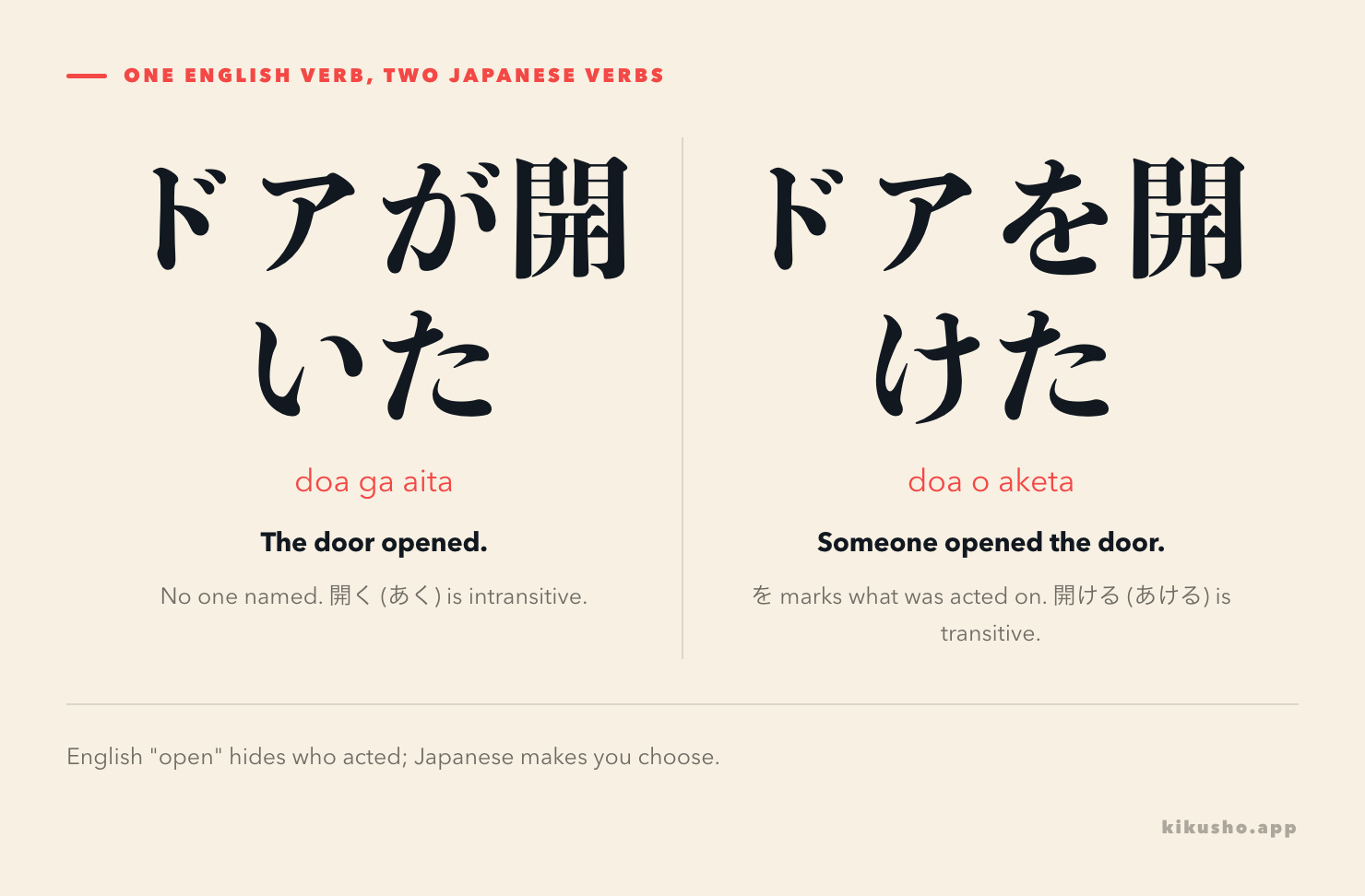
開く (あく) is intransitive: the door opened, and nobody is named. 開ける (あける) is transitive: someone opened it, and を marks the thing they acted on. Dozens of pairs work this way, and the endings only hint at which is which, so each pair is learned as vocabulary rather than derived from a rule.
One "if," four decisions
English gets by with if and when. Japanese forks the idea into four, and the fork is about what kind of condition you mean, not about style.
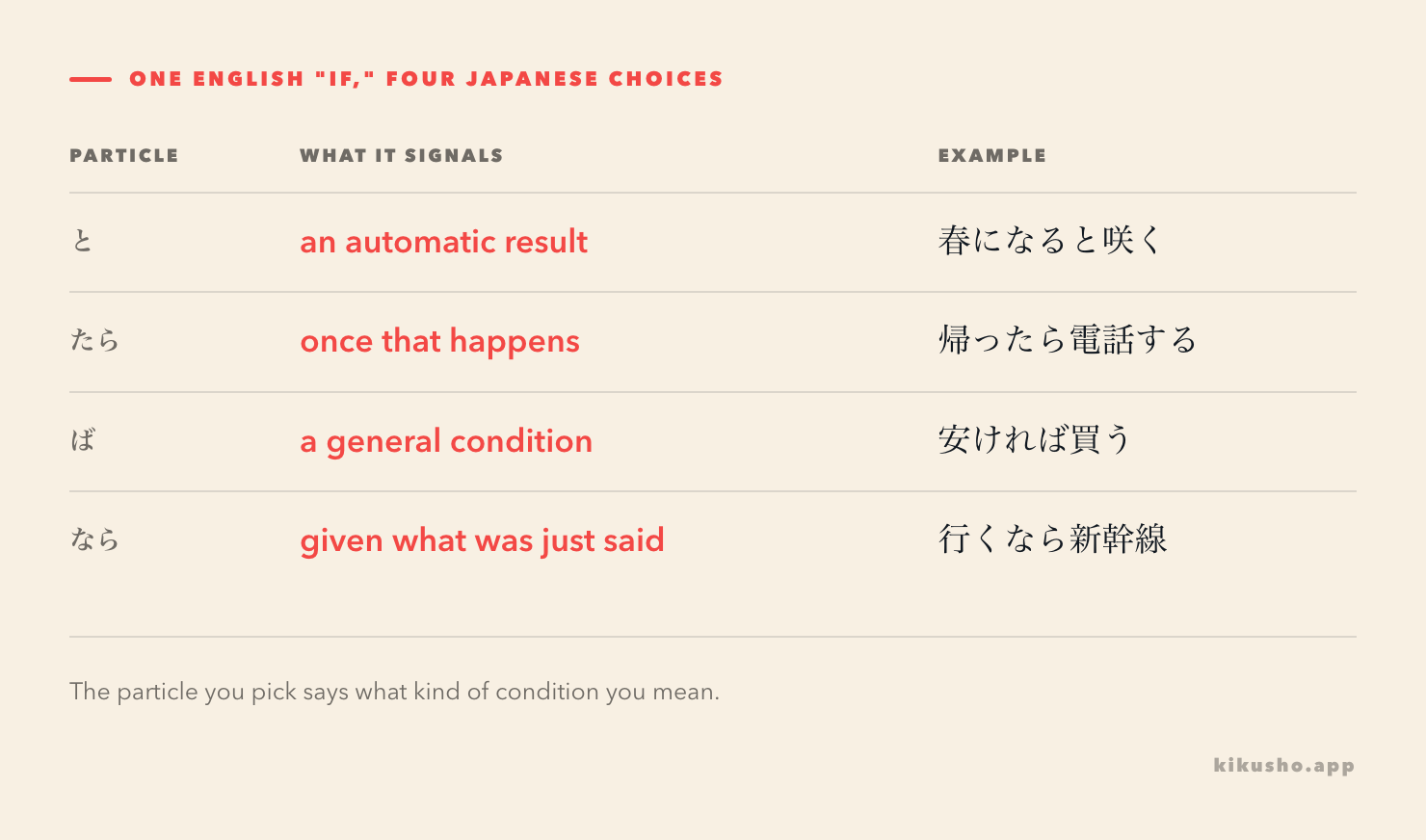
と is for an automatic result, the kind that always follows. たら is the everyday once that happens, good for a single occasion. ば states a general condition. なら responds to something just raised, closer to if that is the case. The differences are small on the page and loud in a sentence, which is why they get their own guides: と against たら, and ば against なら.
The thread through all three is the same. None of them is more grammar than N5 had. Each is a distinction English let you ignore, and N4 is the level where you stop being able to.
The vocabulary doubles, but that is not the wall
N4 does expect more words than N5. Commonly cited study lists put it at roughly double, with the same caveat as the grammar: the exam publishes no official word list, so the figure is an estimate. It sounds like the harder half of the jump and it is not, because vocabulary is additive. Each word is a discrete thing you meet, keep and review, and meeting a thousand of them is a matter of time rather than insight.
Grammar categories do not add that way. You cannot bank 開ける as one more item, because the day it clicks you have to re-see every sentence you thought you understood and check which verb it was really using. That is the work N4 asks for, and it is why the vocabulary is the part worth getting out of your own way.
This is where an app earns a narrow place. The N4 words you meet outside a textbook — a verb on a station sign, a phrase in a manga panel, something a colleague said — are exactly the additive load you can hand off. In Kikusho you photograph the sign or paste the line, glance at the card it drafts, and keep it, so the word enters a review schedule while your thinking goes to the grammar that needs it. It runs on iPhone, where the free tier allows five new captures each day and never limits how much of your saved deck you review.
What to learn first, and what can wait
The families do not sit at the same height, and taking them in the wrong order means relearning the lower ones later.
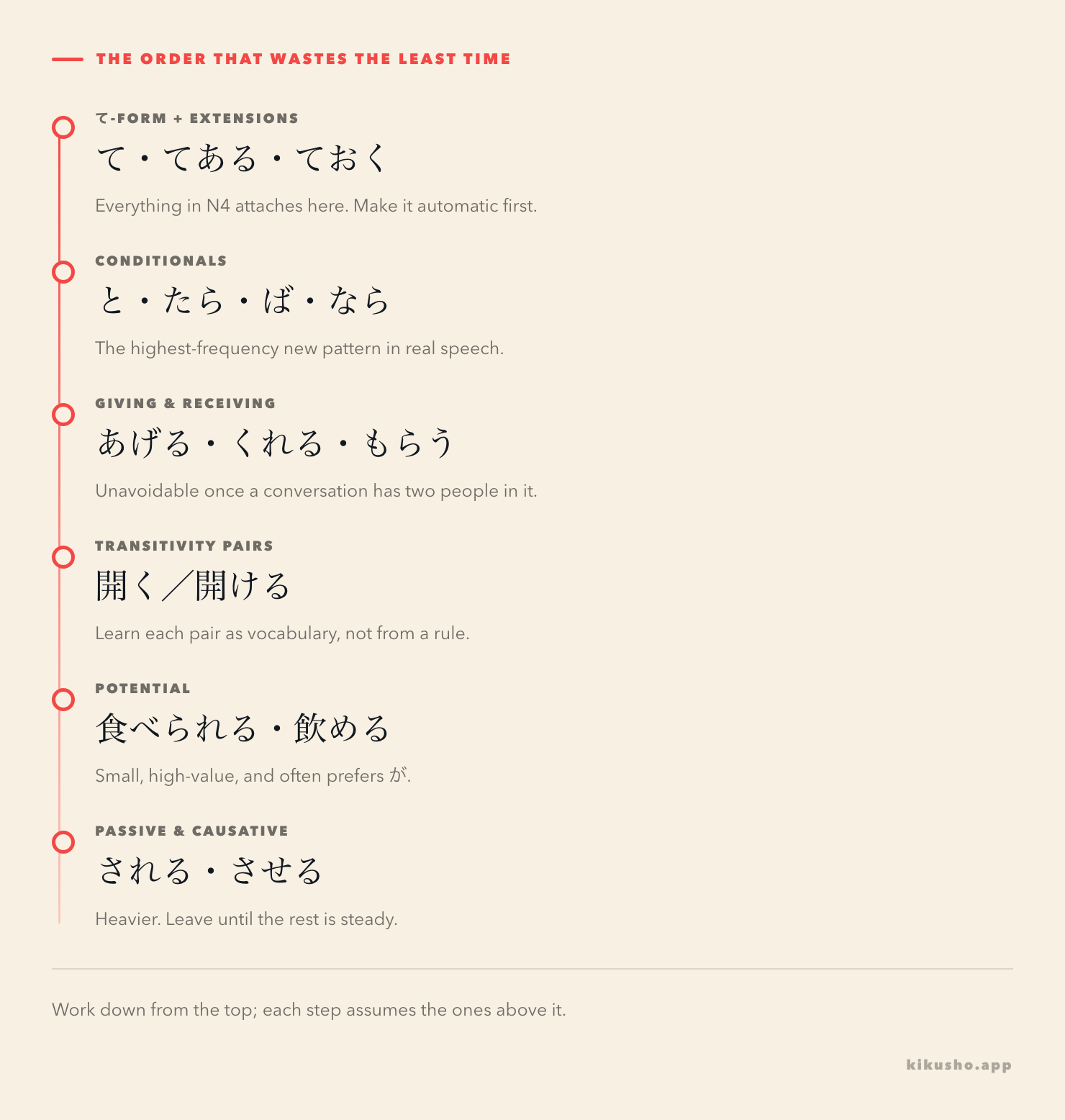
Make the て-form automatic before anything else, because てある, ておく, てしまう and the rest are dead weight while you are still assembling the stem. Then conditionals, which show up in every other sentence of real speech. Then giving and receiving, unavoidable the moment a conversation involves more than one person. Transitivity pairs come next and never quite stop, learned a pair at a time as you meet them. The potential form is small and high-value. Passive and causative are heavier, and the させられる that combines them can wait until the rest is steady. N4's service-speech keigo sits alongside all of this rather than at a single rung, and it rewards patience.
Where N4's reputation is wrong
N4 gets waved off as still-beginner, with the warning that the real cliff is N3. That has it backwards. The largest change in kind across the whole JLPT is the one from N5 to N4, because N4 is where the grammar stops resembling relabelled English and starts marking relationships in its own terms. N3 mostly adds volume and nuance on top of categories N4 already installed.
So if N4 feels twice as hard as N5, that is not slow progress. It is the one level where the kind of thinking changes, and it is a cost you pay once. After it, the idea that grammar points at people is a lens you own, and the levels above are refinements of that lens rather than new worlds to enter. The wall is real. It is also the last one of its kind.
Common questions
How long does it take to get from N5 to N4?
There is no honest fixed number. The limiting factor is not vocabulary but the new distinctions N4 introduces: conditionals, transitivity, and giving and receiving. Vocabulary you add steadily; the grammar takes as long as it takes to see those distinctions without translating first.
Should I finish all of N5 before starting N4?
Finish the て-form, which N5 usually teaches last, because almost every N4 pattern attaches to it. You do not need every N5 vocabulary word first: grammar is the prerequisite here, not word count.
Is N4 grammar or vocabulary harder?
Grammar. Vocabulary is additive: each word is a separate thing you keep and review. N4 grammar changes how you parse sentences you already thought you understood, which is slower and less predictable work.