
On this page
To make the Japanese verb て-form, first identify the verb group, then change its ending: 食べる → 食べて, 読む → 読んで, 書く → 書いて, and 話す → 話して. The form connects a verb to what follows, so the next piece supplies meanings such as sequence, request, progress, permission or trying something.
Start with the verb group
The て-form is one conjugation with several visible endings. Some verbs finish in て and others in で, but Japanese teaching materials call both of them て-forms. The split follows the verb group and, for う-verbs, the final kana of the dictionary form.
You need the group before you start. 食べる is a る-verb, so る drops. 帰る is an う-verb despite its similar spelling, so it follows the う-verb row and becomes 帰って. If that distinction is not settled yet, review how Japanese verb groups work before drilling this chart.
This lesson teaches the assigned foundational item Verb + て, inventory key g-14b41fc23d6a. Bunpro places it at N5, and the curriculum records no level disagreement. The JLPT does not publish an exhaustive grammar syllabus, so that label is a study placement. Genki Lesson 6 and the Japan Foundation's lesson on ~てください independently confirm the conjugation patterns taught below.
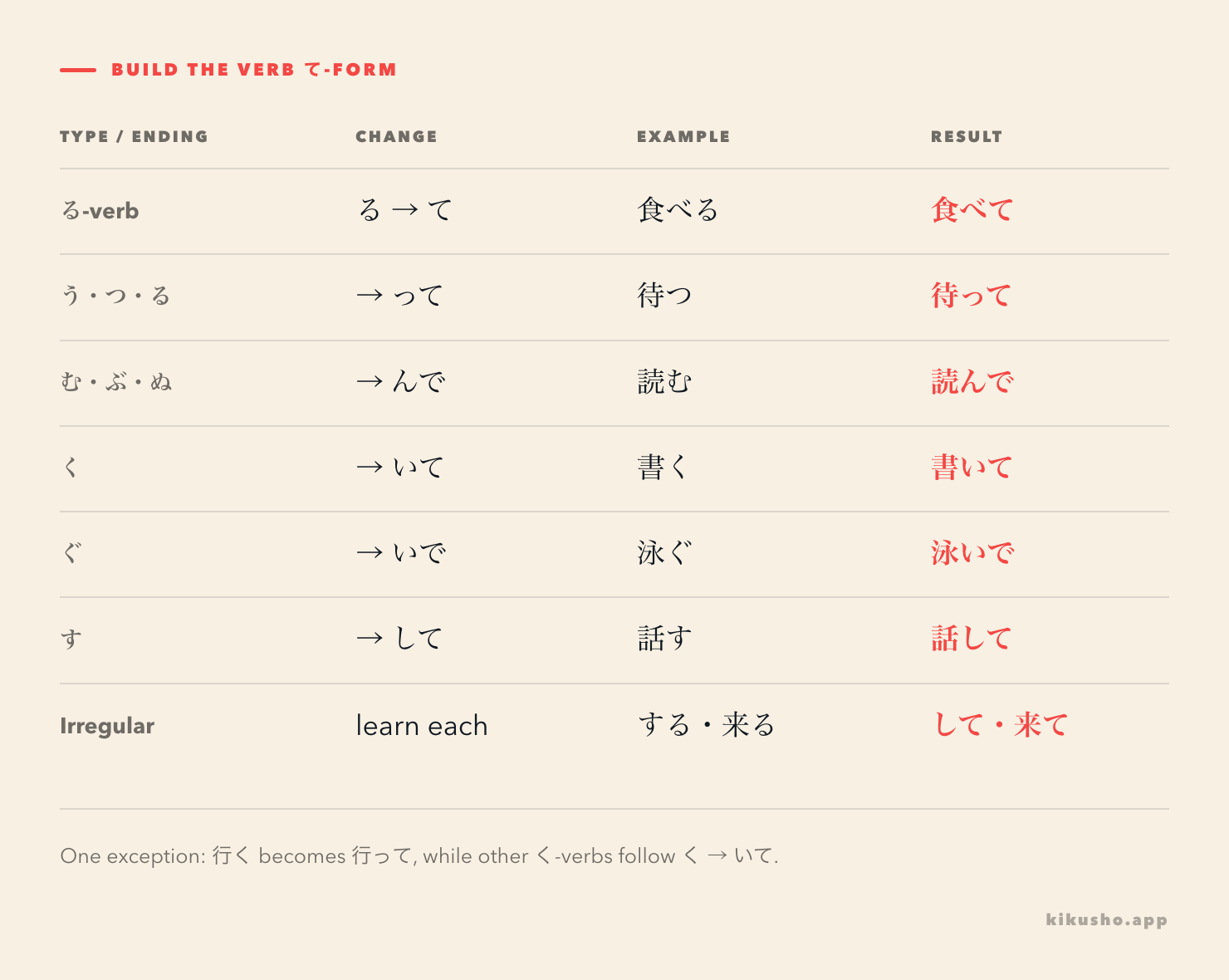
Build every affirmative verb て-form from this chart
| Verb type or ending | Change | Dictionary form | て-form |
|---|---|---|---|
| る-verb | る → て | 食べる(たべる) | 食べて(たべて) |
| う-verb: う・つ・る | → って | 会う・待つ・帰る | 会って・待って・帰って |
| う-verb: む・ぶ・ぬ | → んで | 読む・遊ぶ・死ぬ | 読んで・遊んで・死んで |
| う-verb: く | → いて | 書く(かく) | 書いて(かいて) |
| う-verb: ぐ | → いで | 泳ぐ(およぐ) | 泳いで(およいで) |
| う-verb: す | → して | 話す(はなす) | 話して(はなして) |
| Irregular | learn separately | する・来る(くる) | して・来て(きて) |
The Japan Foundation's formation table shows the same groups, including the voiced んで and いで endings. Genki also warns that a う-verb's ます-stem is not its て-form. 読む → 読みます does not license 読みにて or 読みて; return to the dictionary ending and make 読んで.
The two large groups are easier to remember as sound families. う・つ・る gather under って. The three nasal endings む・ぶ・ぬ gather under んで. The remaining pairs keep a trace of their original sound: く → いて, ぐ → いで, and す → して.
行く takes 行って, not 行いて
One everyday verb breaks the く row: 行く(いく) becomes 行って(いって). Do not extend that exception to other く-verbs.
| Dictionary form | Correct て-form | Incorrect guess |
|---|---|---|
| 行く(いく) | 行って(いって) | × 行いて |
| 書く(かく) | 書いて(かいて) | × 書って |
| 聞く(きく) | 聞いて(きいて) | × 聞って |
Both the Japan Foundation table and Genki mark 行く as the exception. Compound verbs ending in 行く retain it: 持って行く → 持って行って. The first て in that last form belongs to 持つ; the final 行って is the て-form of 行く.
The final verb supplies tense and politeness
The て-form does not say past, nonpast, polite or plain by itself. In a sequence, the final predicate controls the whole chain.
朝ごはんを食べて、学校へ行きます。
あさごはんを たべて、がっこうへ いきます。
I eat breakfast and then go to school.
朝ごはんを食べて、学校へ行きました。
あさごはんを たべて、がっこうへ いきました。
I ate breakfast and then went to school.
食べて stays unchanged. 行きます makes the first sentence polite nonpast; 行きました makes the second polite past. Genki explicitly describes this final-verb control when it teaches sequences of actions.
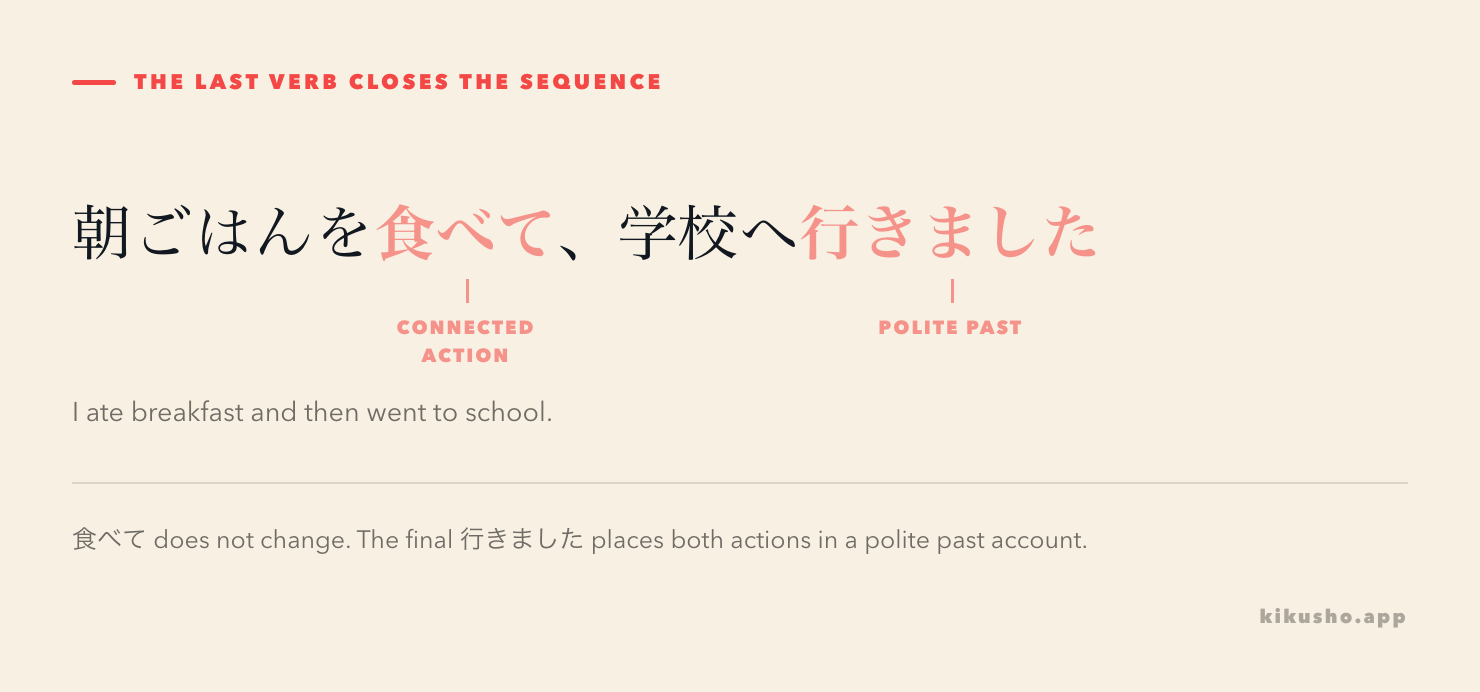
The same principle lets more than two actions form one sentence: 起きて、顔を洗って、朝ごはんを食べました means “I got up, washed my face and ate breakfast.” The last verb closes the sequence. Use the order that the events happened; the て-form does not reverse or randomize them.
What follows the form decides its job
The て-form is often called a connector because it creates a place for another verb or expression. The attachment, rather than て alone, supplies the more specific meaning.
| Pattern | What follows | Example | Job |
|---|---|---|---|
| Vて、V | another action | 読んで、寝ます | sequence |
| Vてください | ください | 読んでください | polite request |
| Vています | いる | 読んでいます | ongoing action here |
| Vてみる | みる | 読んでみる | try and see |
| Vておく | おく | 読んでおく | prepare by doing |
| Vてしまう | しまう | 読んでしまう | carry through to completion |
The ~てみる lesson follows a trial from 読む → 読んで → 読んでみる. The ~ておく lesson uses the same 読んで to mark preparation, while ~てしまう adds completion. The base does not change meaning on its own; the element after it changes the construction.
A bare て-form is limited by the situation
With a close friend or family member, a bare て-form can work as a request: ちょっと待って means “Wait a moment.” Adding ください gives the standard polite request ちょっと待ってください. The Japan Foundation's lesson presents exactly this register difference.
Do not treat bare 待って as a neutral complete sentence for every listener. It depends on tone and relationship, and can sound abrupt. It also does not mean that every て-form by itself is a command. In 本を読んで、寝ます, 読んで connects to the later action; nobody is being told to read.
This article stops at affirmative verb forms. Adjectives and nouns also have connecting forms, and negative verbs use ~ないで or ~なくて according to meaning. They are different attachment questions, so the positive verb table above should not be stretched to cover them.
Practice questions
Work through all six before checking the explanations.
Question 1: change a る-verb
What is the て-form of 見る(みる)?
- ア. 見って
- イ. 見んで
- ウ. 見て
- エ. 見いて
Question 2: keep the voiced ending
What is the て-form of 泳ぐ(およぐ)?
- ア. 泳いで
- イ. 泳いて
- ウ. 泳んで
- エ. 泳って
Question 3: remember the one く exception
Complete the request: 駅へ( )ください。 Use 行く.
- ア. 行いて
- イ. 行きて
- ウ. 行って
- エ. 行んで
Question 4: compose a sequence
Join 本を読みます and 寝ます to say “I read a book and then go to sleep.” Put the first verb in the て-form and keep the sentence polite.
Question 5: find where the tense lives
Read the sentence: 昨日は六時に起きて、朝ごはんを食べました。 Which part makes the sequence past and polite?
- ア. 昨日は
- イ. 六時に
- ウ. 起きて
- エ. 食べました
Question 6: build a polite request
Which sentence naturally asks someone to write their name here?
- ア. ここに名前を書いてください。
- イ. ここに名前を書きてください。
- ウ. ここに名前を書くください。
- エ. ここに名前を書んでください。
Answers and explanations
Answer 1
ウ, 見て. 見る is a る-verb, so remove る and add て. The other choices apply う-verb sound changes to the wrong group.
Answer 2
ア, 泳いで. A う-verb ending in ぐ changes to いで. 泳いて loses the voicing, while んで belongs to む・ぶ・ぬ and って belongs to う・つ・る.
Answer 3
ウ, 行って. 行く is the exception to the く → いて pattern. The full request is 駅へ行ってください, “Please go to the station.”
Answer 4
One answer is 本を読んで、寝ます。 読む ends in む, so it becomes 読んで. The final 寝ます keeps the full sequence polite and nonpast.
Answer 5
エ, 食べました. 起きて connects the first action but carries no tense or politeness itself. The final verb's ました places both actions in a polite past account; 昨日 confirms the time but does not conjugate the sentence.
Answer 6
ア, ここに名前を書いてください. 書く follows く → いて, then ください makes the request polite. 書き is the ます-stem, 書く is the dictionary form, and 書んで uses the wrong ending family.
Store the ending with the verb you met
A て-form mistake often begins one step earlier, when the verb group was guessed from its surface. If you capture 帰ってください or 本を読んで寝ます in Kikusho, keep that whole phrase on the card. The next review then asks for 帰る → 帰って or 読む → 読んで inside a real attachment, which is the conversion you need while speaking.
Common questions
How do I make the Japanese て-form?
For る-verbs, replace る with て. For う-verbs, group the final kana: う・つ・る become って; む・ぶ・ぬ become んで; く becomes いて; ぐ becomes いで; and す becomes して. 行く is the exception 行って. する becomes して and 来る becomes 来て.
Why do some て-forms end in で?
で is the voiced partner of て in this conjugation. Verbs ending in む, ぶ or ぬ take んで, and verbs ending in ぐ take いで. 読む becomes 読んで and 泳ぐ becomes 泳いで; both are still called て-forms.
Is the て-form past tense or progressive?
Neither on its own. It carries no tense or politeness by itself. In a sequence, the final verb sets the tense; in 食べています, the following いる creates the progressive or state reading.
Can I make the て-form from the ます-stem?
That shortcut works for many る-verbs but fails for う-verbs. 読みます does not become 読みて; 読む becomes 読んで. Use the dictionary ending and the full て-form rules, or learn each verb with its ます and て forms as a set.