On this page
敢えて(あえて) marks a deliberate choice made despite risk, difficulty, criticism or an obvious reason to choose differently. あくまでも marks a position maintained to the end, or a statement kept strictly within a stated boundary. Ask whether the sentence focuses on crossing resistance once or refusing to move from a stance.
反対されると分かっていたが、敢えて問題を指摘した。
はんたいされると わかっていたが、あえて もんだいを してきした。
I knew people would object, but I deliberately pointed out the problem.
彼は最後まで、あくまでも自分の立場を変えなかった。
かれは さいごまで、あくまでも じぶんの たちばを かえなかった。
He steadfastly refused to change his position until the end.
The first sentence contains a difficult choice: speak despite expected opposition. The second follows a stance through time: the person keeps it despite continuing pressure.
This lesson verifies inventory items g-8252949d602b, 敢えて, and g-2652613d7196, あくまでも. コトバンク records the intentional, forceful and “if one must” uses of 敢えて, while the 教師と学習者のための日本語文型辞典 sample explains the choice to speak or act despite danger, difficulty or another person’s likely reaction. Bunpro and goo’s usage comparison support the persistent and strongly asserted uses of あくまで/あくまでも. JLPT Sensei places both 敢えて and あくまでも in N1 study material; the Kikusho inventory records no competing level observation for either item.
Choose by the shape of the decision
| Adverb | Question to ask | What it highlights | Natural English routes |
|---|---|---|---|
| 敢えて | Why choose this less obvious path? | a deliberate step across risk, difficulty or expectation | dare to, deliberately, go out of one’s way to |
| あくまでも | Will this stance or boundary move? | persistence through pressure, or strict limits on a claim | to the end, steadfastly, strictly, merely |
時間がないので、今回は敢えて細部には触れない。
じかんが ないので、こんかいは あえて さいぶには ふれない。
Because time is short, I will deliberately leave the details aside this time.
The speaker considers discussing the details but consciously rejects that normal route.
この数字は、あくまでも現時点での推計です。
この すうじは、あくまでも げんじてんでの すいけいです。
These figures are only estimates as of the present moment.
Here there is no daring action. The adverb draws a boundary around what the figures may be claimed to represent.
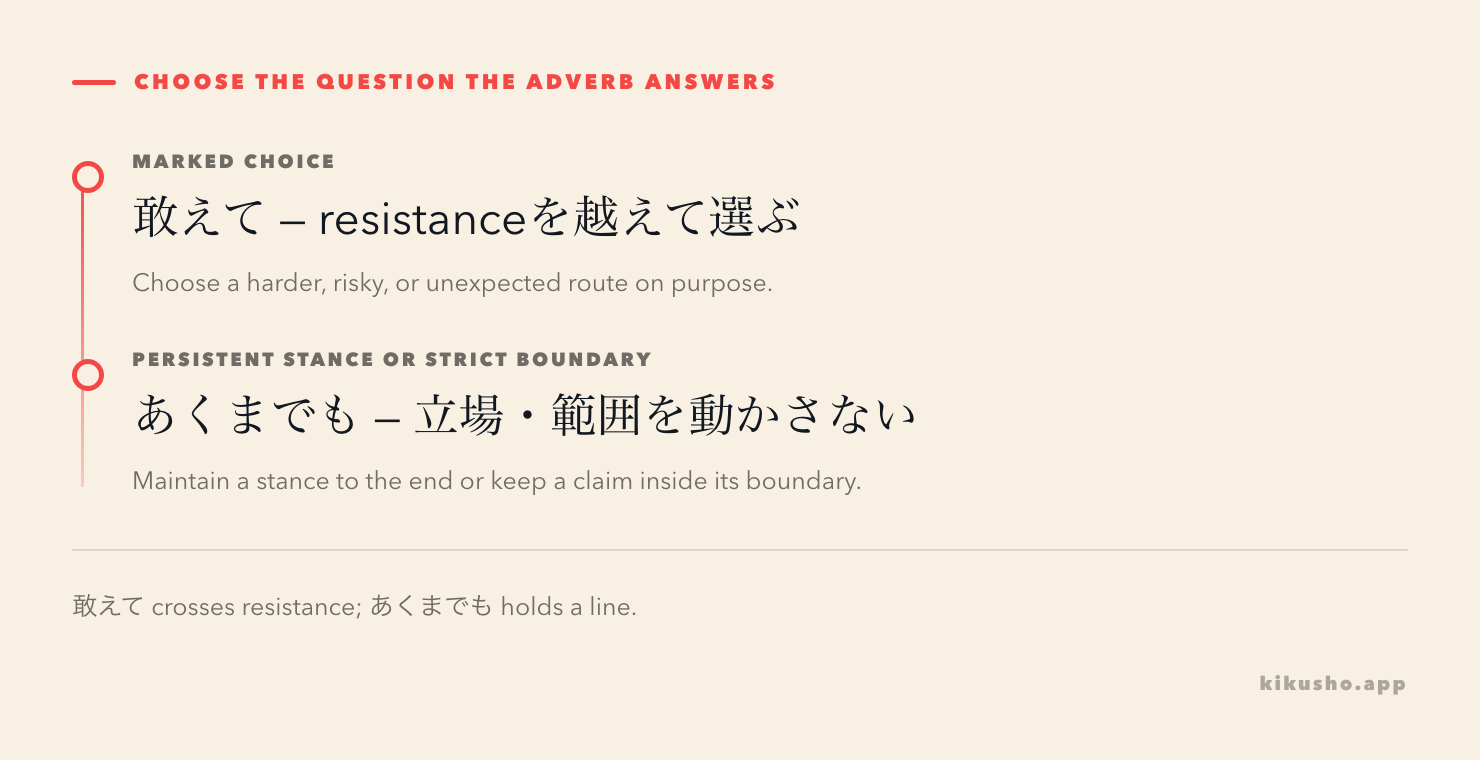
敢えて selects the harder or less expected route
The unmarked course is usually easier, safer, more polite or more predictable. 敢えて tells the reader that the subject recognizes that course and intentionally chooses another.
誤解を恐れず、敢えて率直に言えば、この計画は現実的ではない。
ごかいを おそれず、あえて そっちょくに いえば、この けいかくは げんじつてきでは ない。
At the risk of being misunderstood, if I may speak frankly, this plan is not realistic.
多くの企業が撤退する中で、その会社は敢えて市場に参入した。
おおくの きぎょうが てったいする なかで、その かいしゃは あえて しじょうに さんにゅうした。
While many companies were withdrawing, that company deliberately entered the market.
簡単な方法もあったが、学生に考えてもらうため、教師は敢えて答えを示さなかった。
かんたんな ほうほうも あったが、がくせいに かんがえてもらうため、きょうしは あえて こたえを しめさなかった。
There was an easier method, but the teacher deliberately did not show the answer so that the students would think.
The last example shows why 敢えて~ない does not mean lack of courage. Not showing the answer is the chosen act. The expected alternative, showing it, is present in the background.
The adverb often appears with acts of speech because speaking plainly carries social risk:
- 敢えて言う: dare to say / deliberately say
- 敢えて問う: deliberately raise the question
- 敢えて批判する: knowingly criticize
- 敢えて選ぶ: deliberately choose
- 敢えて~ない: deliberately choose not to
In questions such as 敢えて一つ挙げるなら, the speaker is being pushed to choose even though a single choice may be artificial:
敢えて一つだけ欠点を挙げるなら、説明が少し長いことだ。
あえて ひとつだけ けってんを あげるなら、せつめいが すこし ながいことだ。
If I had to name just one drawback, it would be that the explanation is a little long.
This is closer to “if I must” than to dramatic bravery. The common core is still choosing a marked route despite reluctance or a reason against it.
あくまでも has a persistent use and a limiting use
The first use follows a will, demand or opposition through resistance:
会社側は、あくまでも契約に問題はないと主張した。
かいしゃがわは、あくまでも けいやくに もんだいは ないと しゅちょうした。
The company continued to insist that there was no problem with the contract.
彼女は周囲に反対されても、あくまでも自分の方針を貫いた。
かのじょは しゅういに はんたいされても、あくまでも じぶんの ほうしんを つらぬいた。
Even when those around her objected, she stuck to her policy to the end.
This use often combines with 主張する, 反対する, 否定する, 貫く, 守る and 変えない. The persistence can sound admirable, neutral or stubborn; context supplies the judgment.
The second use limits the status or scope of a claim:
これはあくまでも仮説であり、確認された事実ではない。
これは あくまでも かせつであり、かくにんされた じじつでは ない。
This is only a hypothesis, not a confirmed fact.
私はあくまでも助言する立場で、最終的に決めるのは皆さんです。
わたしは あくまでも じょげんする たちばで、さいしゅうてきに きめるのは みなさんです。
My role is strictly to advise; the final decision is yours.
The speaker protects a boundary: hypothesis, not fact; adviser, not decision-maker. English “merely” can sound dismissive, while Japanese あくまでも may simply define the proper scope.
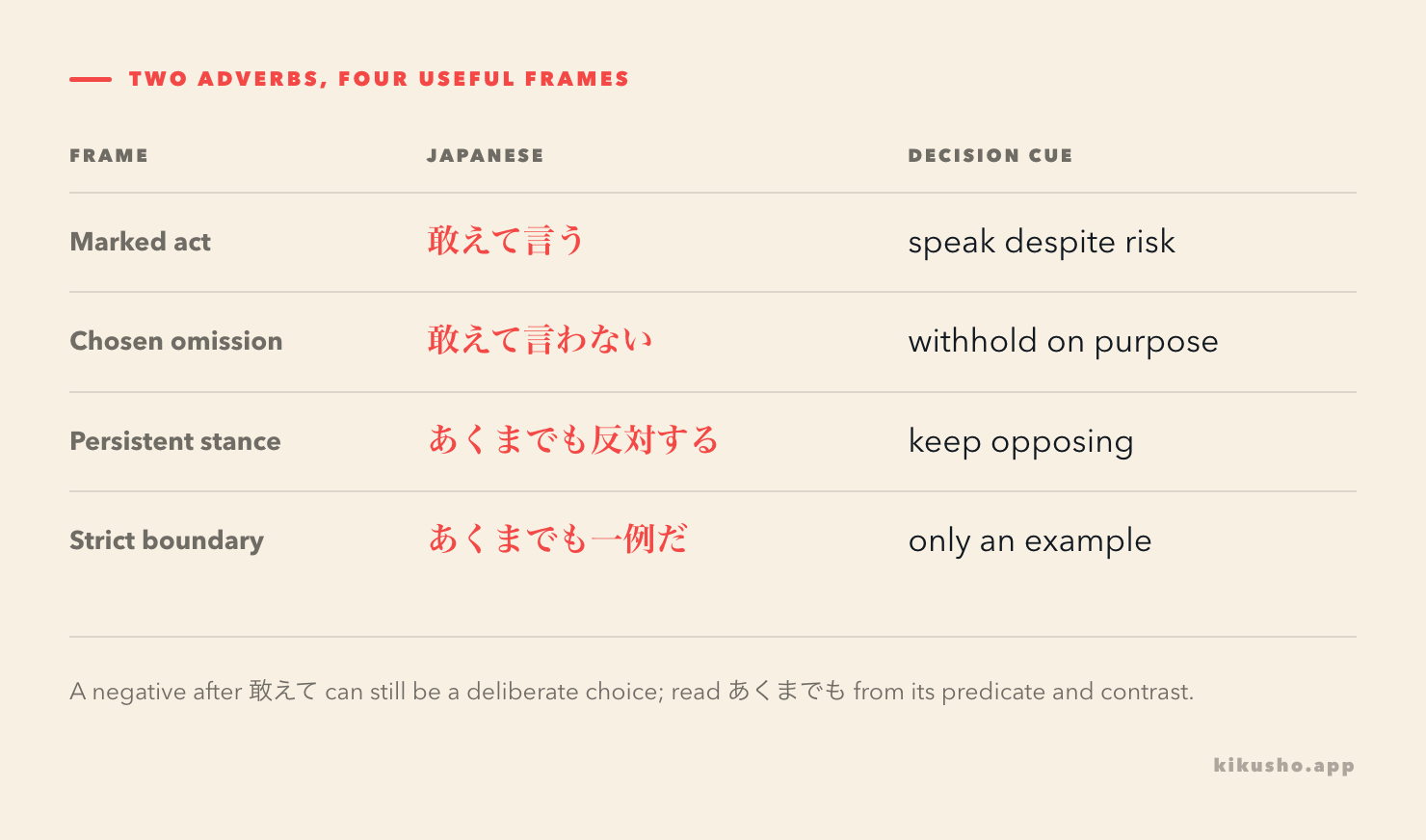
They can share a sentence without repeating each other
Because the adverbs answer different questions, one sentence can use both:
私は敢えて反対意見を述べるが、これはあくまでも個人的な見解だ。
わたしは あえて はんたい いけんを のべるが、これは あくまでも こじんてきな けんかいだ。
I will deliberately voice a contrary opinion, but this is strictly my personal view.
敢えて explains the marked choice to speak. あくまでも limits the status of what is said.
Now compare an apparent overlap:
彼は反対されても、敢えてその案を選んだ。
Even though people objected, he deliberately chose that proposal.
彼は反対されても、あくまでもその案を支持した。
Even though people objected, he continued to support that proposal to the end.
Both involve opposition. The first zooms in on the choice; the second tracks the maintained stance. Replacing one with the other changes the viewpoint.
あくまで and あくまでも belong to the same family
Both forms occur in the persistent and limiting uses:
あくまで自分の考えを貫く。
Maintain one’s own view to the end.
あくまでも参考資料です。
It is strictly reference material.
The added も can reinforce the sense of reaching or preserving the full boundary, but it does not create a dependable grammar split. Do not memorize “あくまで means persistence, あくまでも means limitation.” Actual Japanese uses both in both roles. Read the predicate and the surrounding contrast.
The common spelling is kana. 飽くまで(も) makes the older internal structure visible but is much less common in ordinary modern prose.
Do not reduce 敢えて to わざと
わざと marks an intentional act, often one whose result might otherwise look accidental:
彼はわざと名前を間違えた。
He got the name wrong on purpose.
敢えて adds a reason the act might have been avoided:
彼は議論を促すため、敢えて極端な例を出した。
To stimulate discussion, he deliberately presented an extreme example.
The first answers “accident or intention?” The second answers “why choose that risky or unusual route?” The わざと and わざわざ lesson compares intention with special effort and provides the wider adverb map.
Also keep 無理を押して separate. It foregrounds proceeding despite physical, practical or social constraints. 敢えて foregrounds the conscious selection of the marked course. The 押して and よそに lesson develops that circumstance-based contrast.
Use a two-step test
First, look for the unchosen alternative.
- If the sentence implies “the easier or expected option was X, but the subject chose Y,” use 敢えて.
- If it implies “pressure continued, but the stance did not change,” use persistent あくまでも.
- If it implies “do not interpret this beyond boundary X,” use limiting あくまでも.
Then paraphrase the sentence:
| If this paraphrase works | Choose |
|---|---|
| リスクを承知で、わざわざその道を選ぶ | 敢えて |
| 最後まで、その立場を変えない | あくまでも |
| それ以上の意味ではなく、Xに限った話だ | あくまでも |
Do not choose from English “deliberately” alone. A person can deliberately maintain a stance; Japanese still selects the adverb by which part of the scene the speaker presents.
Practice: choice, persistence or boundary?
Question 1 — marked choice. The manager knows the proposal may be unpopular but decides to present it. Which adverb fits?
部長は反発を受ける可能性を承知で、( )新しい案を提出した。
A. あくまでも
B. 敢えて
C. 決して
D. 別に
Question 2 — persistent stance. Which sentence says the union maintained its demand to the end?
A. 組合は敢えて要求を取り下げた。
B. 組合はあくまでも要求を変えなかった。
C. 組合は別に要求を変えなかった。
D. 組合は決して要求だった。
Question 3 — scope limit. Complete “This is only a provisional calculation, not the final result.”
これは( )暫定的な計算であり、最終結果ではない。
A. 敢えて
B. あくまでも
C. わざと
D. どうしても
Question 4 — deliberate non-action. What does the sentence mean?
司会者は結論を急がせないため、敢えて自分の意見を言わなかった。
A. The moderator accidentally forgot to give an opinion.
B. The moderator lacked the courage to speak.
C. The moderator deliberately withheld an opinion to avoid rushing the conclusion.
D. The moderator maintained the same opinion to the end.
Question 5 — sentence composition. Put all four parts in order. Which part contains ★?
これは ___ ___ ★ ___ 最終的な評価ではありません。
A. 調査段階の
B. あくまでも
C. ものであって
D. 現在の
Question 6 — both adverbs. Choose the line that gives 敢えて the marked act and あくまでも the boundary.
A. 敢えて個人的な見解で、あくまでも反対意見を述べます。
B. あくまでも反対意見を述べますが、敢えて個人的な見解です。
C. 敢えて反対意見を述べますが、これはあくまでも個人的な見解です。
D. あくまでも反対意見を敢えて個人的です。
Question 7 — connected text. Select the best pair.
委員の多くは公表に慎重だった。しかし責任者は、議論に必要だとして( ① )データを公開した。ただし、その数値は( ② )初期段階の推計であると強調した。
A. ①あくまでも ②敢えて
B. ①敢えて ②あくまでも
C. ①敢えて ②決して
D. ①別に ②敢えて
Answers and explanations
1. The marked choice
Choose B, 敢えて. The expected safe choice is not to submit an unpopular proposal. The manager knowingly crosses that resistance. あくまでも would need a stance maintained through time or a scope boundary.
2. The unchanged demand
B. 組合はあくまでも要求を変えなかった. The unchanged demand is a stance maintained under pressure. A describes a deliberate withdrawal, which is grammatical but has the opposite event.
3. The provisional calculation
B. あくまでも. The phrase limits the status of the calculation to “provisional.” It warns the reader not to treat it as a final result.
4. The chosen silence
C. 敢えて can modify a negative verb. The moderator actively chooses not to state an opinion because doing so might push the discussion prematurely.
5. The composed sentence
The order is B → D → A → C, so ★ is A. 調査段階の.
これはあくまでも現在の調査段階のものであって、最終的な評価ではありません。
This belongs strictly to the current investigation stage and is not a final assessment.
あくまでも limits the scope of もの; ものであって then connects that bounded description to the contrast.
6. The two roles
C. Voicing the contrary opinion is the socially marked choice, so it takes 敢えて. Calling it a personal view defines its scope, so that clause takes あくまでも.
7. The connected passage
B: ①敢えて, ②あくまでも. Caution from the other committee members establishes the resistance crossed by publication. The second sentence limits the figures to an early estimate.
Keep the contrast on one card
Store a minimal pair rather than two English glosses:
反対を承知で、敢えて提案した。
I deliberately proposed it despite the opposition.
反対されても、あくまでも提案を変えなかった。
Even when opposed, I maintained the proposal to the end.
On the first card, recall the rejected safer route. On the second, recall the pressure that failed to move the stance. Add a separate limiting example, これはあくまでも一例だ, so the second major use does not disappear behind “persistently.”
Kikusho can schedule those three retrieval cues independently: marked choice, maintained stance and strict boundary. That makes the Japanese distinction retrievable before an English word such as “deliberately” sends both adverbs into the same slot.
Common questions
What is the difference between 敢えて and あくまでも?
敢えて highlights deliberately choosing an action despite risk, difficulty, criticism or an apparent reason not to do it. あくまでも highlights maintaining a position to the end or strictly limiting the scope of a claim.
What does 敢えて mean in Japanese?
敢えて means “dare to,” “deliberately” or “go out of one’s way to.” It marks a conscious choice that goes against the easier, safer or expected course.
What does あくまでも mean in Japanese?
あくまでも can mean “to the very end” or “persistently.” It can also mean “strictly,” “merely” or “only,” as in あくまでも一例です, “this is only an example.”
Can 敢えて be used with a negative verb?
Yes. 敢えて言わない means deliberately choosing not to say something. The negative belongs to the chosen action; 敢えて still marks the choice as intentional.