On this page
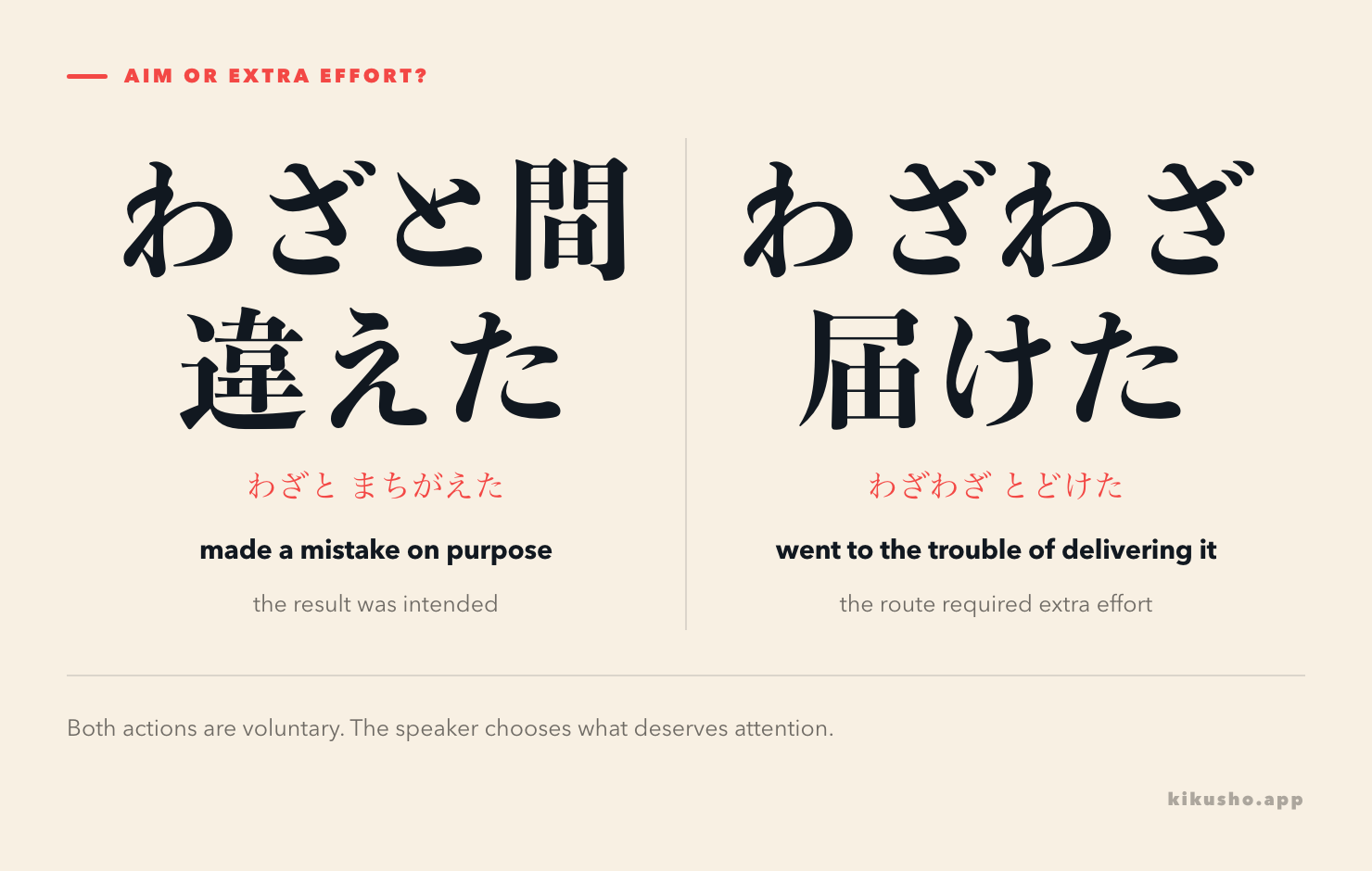
Someone can わざと間違える, make a mistake on purpose, or わざわざ届ける, go to the trouble of delivering something. わざと marks the result as intentional. わざわざ marks the route to that result as more trouble than the ordinary route.
Ask one question before translating either word as “deliberately”: Is the speaker proving intention, or evaluating the effort?
One points to the aim; the other points to the trouble
Both words are adverbs. They usually sit before an action and do not conjugate.
| Form | What the speaker highlights | Useful English cue | Typical evaluation |
|---|---|---|---|
| わざと + action | the action or result was intended | on purpose; intentionally | often blame, but not inherently negative |
| わざわざ + action | the person chose extra effort, time or distance | go out of one's way; take the trouble | gratitude, surprise or criticism |
Compare two short scenes:
子どもがわざと水をこぼしました。
こどもが わざと みずを こぼしました。
The child spilled the water on purpose.
The claim concerns intention. The spill was not an accident.
友達がわざわざ傘を届けてくれました。
ともだちが わざわざ かさを とどけてくれました。
My friend went out of their way to bring me my umbrella.
The delivery was intentional too, but that is not the news. The friend spent time or made a trip that they could have avoided. わざわざ evaluates that added trouble.
This distinction survives when both words could describe a voluntary action. The fact that someone meant to act does not by itself justify わざわざ. A meaningful easier alternative or cost must sit in the background.
わざと denies accident
わざと answers a question about control: did the event happen by chance, through carelessness, or because someone meant it to happen?
彼は答えを知っていたのに、わざと間違えました。
かれは こたえを しっていたのに、わざと まちがえました。
Although he knew the answer, he made a mistake on purpose.
その質問には、わざと答えませんでした。
その しつもんには、わざと こたえませんでした。
I deliberately did not answer that question.
A negative verb does not make the action accidental. In わざと答えなかった, withholding the answer is the intended choice.
The word often appears in accusations because intention changes how blame is assigned: わざと壊した is more serious than うっかり壊した. Still, malice is not part of the grammar. A teacher may わざとゆっくり話す, deliberately speak slowly, so that learners can follow. The aim can be helpful, neutral or harmful.
Kotobank's Daijisen entry for わざと defines the current central sense as doing something consciously or intentionally. JLPT Sensei records the adverb before an action and places this teaching item at N3.
Do not confuse deliberate action with a lapse. In the ふと and つい lesson, つい言ってしまった presents speech that escaped restraint. わざと言った says the speaker chose to say it.
わざわざ evaluates an avoidable effort
With わざわざ, the action required a special trip, extra time, an inconvenient method or some other departure from the easy course. The speaker brings that cost into the sentence.
遠いところを、わざわざ来てくださってありがとうございます。
とおい ところを、わざわざ きてくださって ありがとうございます。
Thank you for coming all this way.
メールで済むのに、彼はわざわざ書類を持ってきました。
メールで すむのに、かれは わざわざ しょるいを もってきました。
Although an email would have been enough, he made a special trip to bring the documents.
The first sentence treats the trouble as generous. The second may express appreciation, surprise or mild puzzlement; the surrounding conversation decides.
Bunpro's わざわざ reference labels the register standard, gives the structure わざわざ + phrase, and documents both positive and negative contexts. JLPT Sensei independently places the adverb at N3 and illustrates gratitude as well as “you need not go to that trouble.”
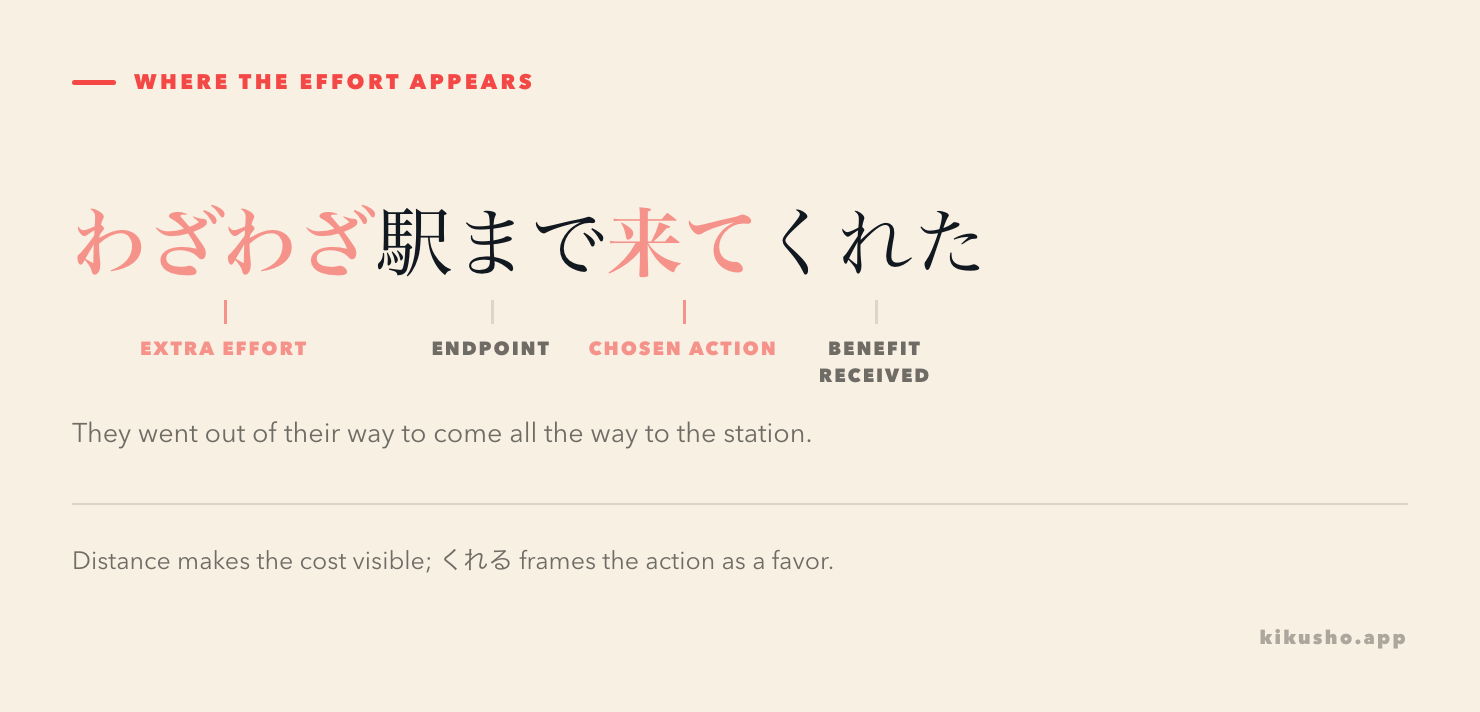
The common ~てくれる and ~てくださる combinations make gratitude explicit. They are useful partners, not part of the form. わざわざ can describe your own effort, another person's effort, or an action that helps nobody.
The same action can reveal two different judgments
The verb alone does not choose the adverb. The speaker's claim does.
彼はわざと難しい質問をしました。
かれは わざと むずかしい しつもんを しました。
He deliberately asked a difficult question.
Perhaps he wanted to test the presenter. The difficult question was part of his aim.
彼はわざわざ難しい質問をしました。
かれは わざわざ むずかしい しつもんを しました。
He went out of his way to ask a difficult question.
Now the speaker judges the choice as unnecessary or unusually effortful. The context may sound critical: he could have asked something simpler and chose not to.
| Contextual test | Better choice |
|---|---|
| “Was it an accident?” | わざと |
| “Why take that much trouble?” | わざわざ |
| The intended result is the point | わざと |
| The cost compared with an easier route is the point | わざわざ |
This is why translating both as “intentionally” can erase the distinction. わざわざ includes intention, but intention is only the starting condition. Its contribution is the speaker's view that the person made a notable effort.
Gratitude and criticism use the same core meaning
Extra effort can be kind, wasteful or intrusive. わざわざ does not settle the evaluation on its own.
わざわざ迎えに来てくれて、助かりました。
わざわざ むかえに きてくれて、たすかりました。
It really helped that you went out of your way to pick me up.
そんなことをわざわざ言わなくてもいいでしょう。
そんな ことを わざわざ いわなくても いいでしょう。
You do not need to go out of your way to say something like that.
In the second sentence, the effort feels unnecessary and possibly unkind. The construction わざわざ + negative necessity is common because it asks why someone would incur the trouble at all. The ことはない and 必要はない lesson develops the no-need patterns themselves.
Keep two neighbouring adverbs separate. あえて highlights choosing a difficult, risky or unpopular course despite a reason not to. せっかく focuses on the value of an effort or opportunity and often asks that it not be wasted. わざわざ keeps attention on the special trouble taken for this action. These areas overlap, but the questions differ: resolve with あえて, value with せっかく, extra trouble with わざわざ.
Both target words are normally written in hiragana. Dictionary spellings such as 態と and the rare 態態 exist, but they are poor defaults for ordinary learner writing. Recognize the readings; produce わざと and わざわざ.
Preserve the reason the effort was noteworthy
A card that says only “わざわざ = specially” does not retain the easier alternative. The contrast becomes durable when the example includes distance, time or a route that was available but rejected.
If you meet メールで済むのに、わざわざ届けてくれた, save the full line in Kikusho. The editable card can keep both the easy route and the chosen effort. For わざと, keep the clue that rules out accident, such as knowing the answer before making the mistake. That context tests the distinction you will need when both adverbs appear as choices.
Practice the speaker's judgment
Question 1 · intention
Ken knew the correct answer but chose a wrong one to make his friend laugh. Complete: 健は答えを知っていたが、( )間違えた。
- A. わざわざ
- B. わざと
- C. つい
- D. せっかく
Question 2 · effort
A colleague crossed town to return the notebook you forgot. Complete your thanks: 遠いところを、( )届けてくださってありがとうございます。
- A. わざと
- B. ふと
- C. わざわざ
- D. うっかり
Question 3 · one verb, two viewpoints
Which sentence says that the speaker considers the difficult question unnecessarily elaborate or troublesome?
- A. 彼はわざと難しい質問をした。
- B. 彼はわざわざ難しい質問をした。
- C. 彼はつい難しい質問をした。
- D. 彼はふと難しい質問をした。
The next item tests word order rather than choosing an adverb.
Question 4 · sentence composition
Arrange the chunks into a natural expression of thanks. Use each once.
- わざわざ
- 来て
- くださって
- ありがとうございます
Question 5 · unnecessary trip
The documents can be sent by email. Choose the sentence that says there is no need to make a special trip to the office.
- A. わざと会社まで来る必要はありません。
- B. わざわざ会社まで来る必要はありません。
- C. つい会社まで来る必要はありません。
- D. ふと会社まで来る必要はありません。
Question 6 · context reading
Use the details in this short account to fill both blanks.
美咲さんは、近くに来る予定がなかったのに、修正した資料を( )家まで届けてくれました。資料を見ると、一か所だけ数字が違っていました。冗談だと言っていたので、そこは( )変えたそうです。
- A. わざと/わざわざ
- B. つい/わざと
- C. わざわざ/わざと
- D. わざわざ/うっかり
Finish the full set before moving to the explanations.
Answers and explanations
Answer 1
B. わざと. Ken knew the answer and selected a wrong one as part of his plan, so the mistake was intentional. わざわざ would evaluate special effort, つい would suggest a lapse, and せっかく would foreground the value of an opportunity or effort.
Answer 2
C. わざわざ. Crossing town makes the delivery an avoidable extra effort, and 届けてくださる frames that effort as a favor. わざと would merely insist that the act was deliberate; ふと and うっかり both undermine the intended gratitude.
Answer 3
B. 彼はわざわざ難しい質問をした. わざわざ presents the choice as more trouble than necessary and can sound critical here. A says only that the question was deliberately difficult. C frames an impulse, while D does not naturally describe formulating the question in this context.
Answer 4
わざわざ来てくださって、ありがとうございます. わざわざ modifies the trip, 来て supplies the て-form before the respectful favor expression くださって, and the thanks follows. No particle belongs between わざわざ and the action phrase.
Answer 5
B. わざわざ会社まで来る必要はありません. Email supplies the easier route, so coming to the office would be needless extra trouble. A says the visit need not be intentional, which misses the comparison. C suggests an uncontrolled lapse, and D suggests a spontaneous moment rather than effort.
Answer 6
C. わざわざ/わざと. Misaki had no nearby errand, so delivering the papers to the house required a special trip. The changed number was part of a joke, so it was altered on purpose. D would contradict the stated explanation by calling the change careless.
Common questions
What is the difference between わざと and わざわざ?
わざと says that an action or result was intentional: someone did it on purpose. わざわざ says that someone made a special, avoidable effort to do something, so the action deserves gratitude, surprise or criticism.
Is わざと always negative?
No. It often appears in accusations because deliberate harm matters, but it can describe any intentional action. Context decides whether the purpose is helpful, neutral or harmful.
Can わざわざ sound negative?
Yes. In thanks, わざわざ praises someone's trouble. In expressions such as わざわざ言わなくてもいい, it judges the effort unnecessary or irritating. The shared idea is effort beyond the easiest course.
Where do わざと and わざわざ go in a sentence?
Both are adverbs and normally appear before the action phrase they modify: わざと間違えた and わざわざ届けてくれた. They do not conjugate and need no particle before the verb.