On this page
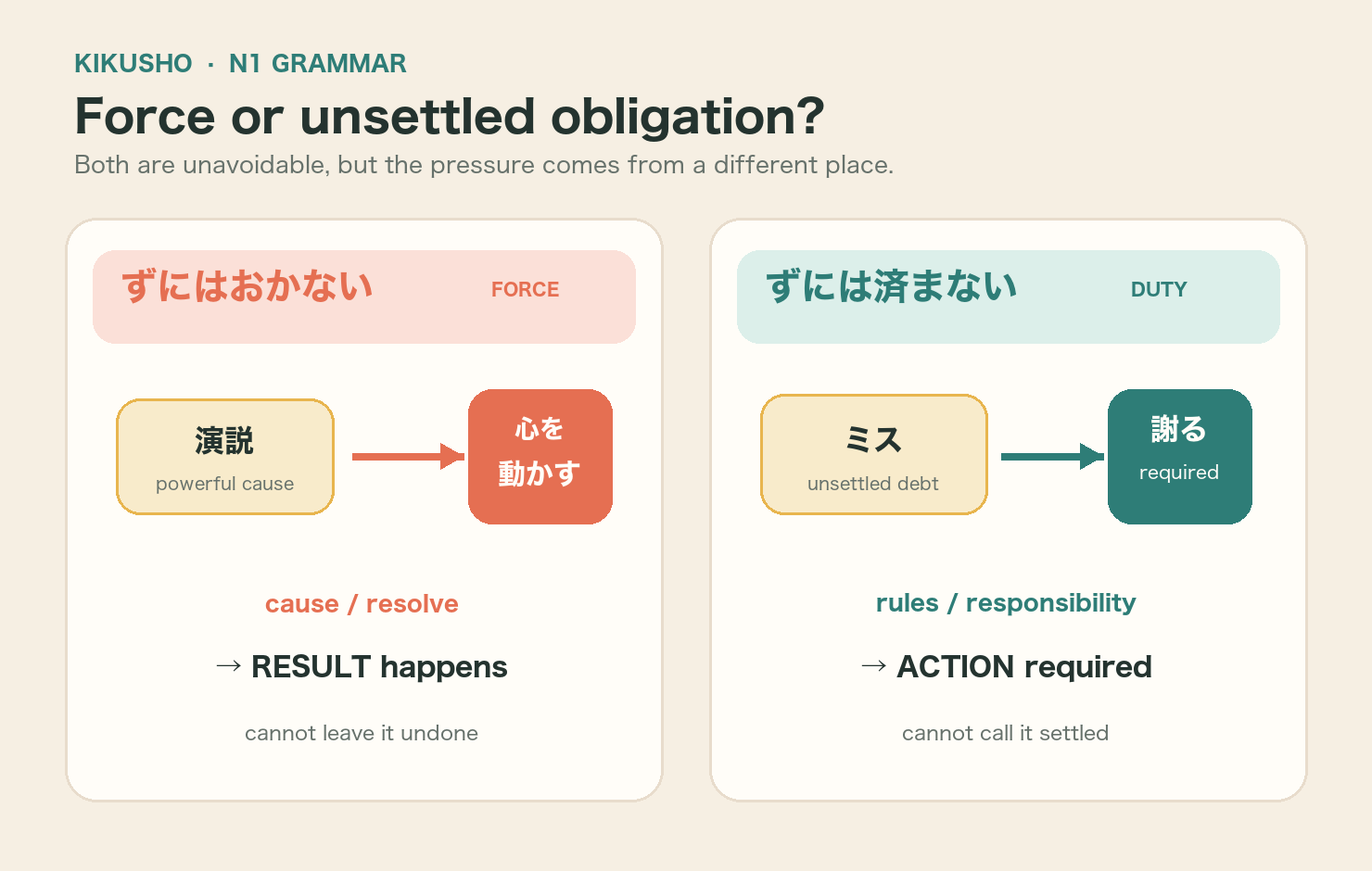
ずにはおかない says that a determined person or a powerful cause will inevitably bring about an action or reaction. ずには済まない says that responsibility, rules or circumstances make an action necessary before the matter can be settled. One pushes toward an effect; the other leaves an obligation unpaid.
この映画は、見る人を感動させずにはおかない。
この えいがは、みる ひとを かんどうさせずには おかない。
This film is bound to move those who watch it.
私のミスで迷惑をかけた以上、謝らずには済まない。
わたしの ミスで めいわくを かけた いじょう、あやまらずには すまない。
Since my mistake caused trouble, I cannot avoid apologizing.
The film exerts enough force to create an emotional effect. The mistake creates a social and moral debt that apology must settle. Translating both as “must” loses who or what supplies the pressure.
This lesson verifies inventory items g-7a38df423067, ずにはおかない/ないではおかない, and g-9f5de300a4c1, ずには済まない/ないでは済まない. 日本語NET and Bunpro support the determined-agent and inevitable-effect uses of おかない. NIHONGO NET explains the situational obligation expressed by 済まない. A Japanese-teacher comparison makes the same distinction between causal or personal force and social compulsion. The opened references consistently teach these forms with N1 material.
Ask where the pressure comes from
| Pattern | Source of pressure | Core result |
|---|---|---|
| Aずにはおかない | an agent’s resolve or A’s causal force | A will definitely be done or cause an effect |
| Aずには済まない | duty, consequences, rules or social judgment | the matter cannot end without A |
犯人を必ず見つけ、責任を取らせずにはおかない。
はんにんを かならず みつけ、せきにんを とらせずには おかない。
I will find the culprit and make them take responsibility, no matter what.
A determined agent refuses to leave the action undone.
これだけの損害を出したのだから、責任者は説明せずには済まない。
これだけの そんがいを だしたのだから、せきにんしゃは せつめいせずには すまない。
Given this much damage, the person responsible cannot avoid explaining it.
The circumstances demand an explanation. Whether the responsible person wants to explain is secondary.
ずにはおかない has two related subjects
The first use expresses determination by a person or organization:
証拠がそろえば、検察は関係者を起訴せずにはおかないだろう。
しょうこが そろえば、けんさつは かんけいしゃを きそせずには おかないだろう。
Once the evidence is assembled, the prosecution will surely indict those involved.
この不正は、徹底的に調査せずにはおかない。
この ふせいは、てっていてきに ちょうさせずには おかない。
I am determined to investigate this misconduct thoroughly.
The agent may be omitted when the speaker’s determination is obvious. The form sounds forceful and formal; it can suggest resolve, warning or threat.
The second use makes an event, work or statement the cause of an inevitable reaction:
彼女の演説は、聞く人の心を動かさずにはおかない。
かのじょの えんぜつは、きく ひとの こころを うごかさずには おかない。
Her speech is bound to move its listeners.
その決定は、地域社会に大きな影響を与えずにはおかない。
その けっていは、ちいき しゃかいに おおきな えいきょうを あたえずには おかない。
That decision is certain to have a major impact on the local community.
Here the grammatical subject is not making a conscious decision. Its inherent force produces the result. Causative verbs such as 感動させる, 考えさせる and 注目させる appear naturally because the subject causes a response.
ずには済まない leaves a debt unresolved
済む(すむ) means that a matter is completed, settled or handled. Aずには済まない says it cannot reach that settled state without A.
借りた物を壊したなら、弁償せずには済まない。
かりた ものを こわしたなら、べんしょうせずには すまない。
If you broke something you borrowed, you cannot avoid compensating for it.
規則に違反した以上、処分を受けずには済まないだろう。
きそくに いはんした いじょう、しょぶんを うけずには すまないだろう。
Having broken the rules, one will probably have to face disciplinary action.
The required action can be voluntary, such as apologizing or explaining, or something imposed on the subject, such as receiving punishment. The common thread is accountability.
The speaker is not necessarily eager to act:
本当は黙っていたいが、事実を報告せずには済まない。
ほんとうは だまっていたいが、じじつを ほうこくせずには すまない。
I would rather remain silent, but I cannot avoid reporting the facts.
That reluctance is compatible with 済まない because the force comes from the situation, not desire.
Both accept ずには and ないでは
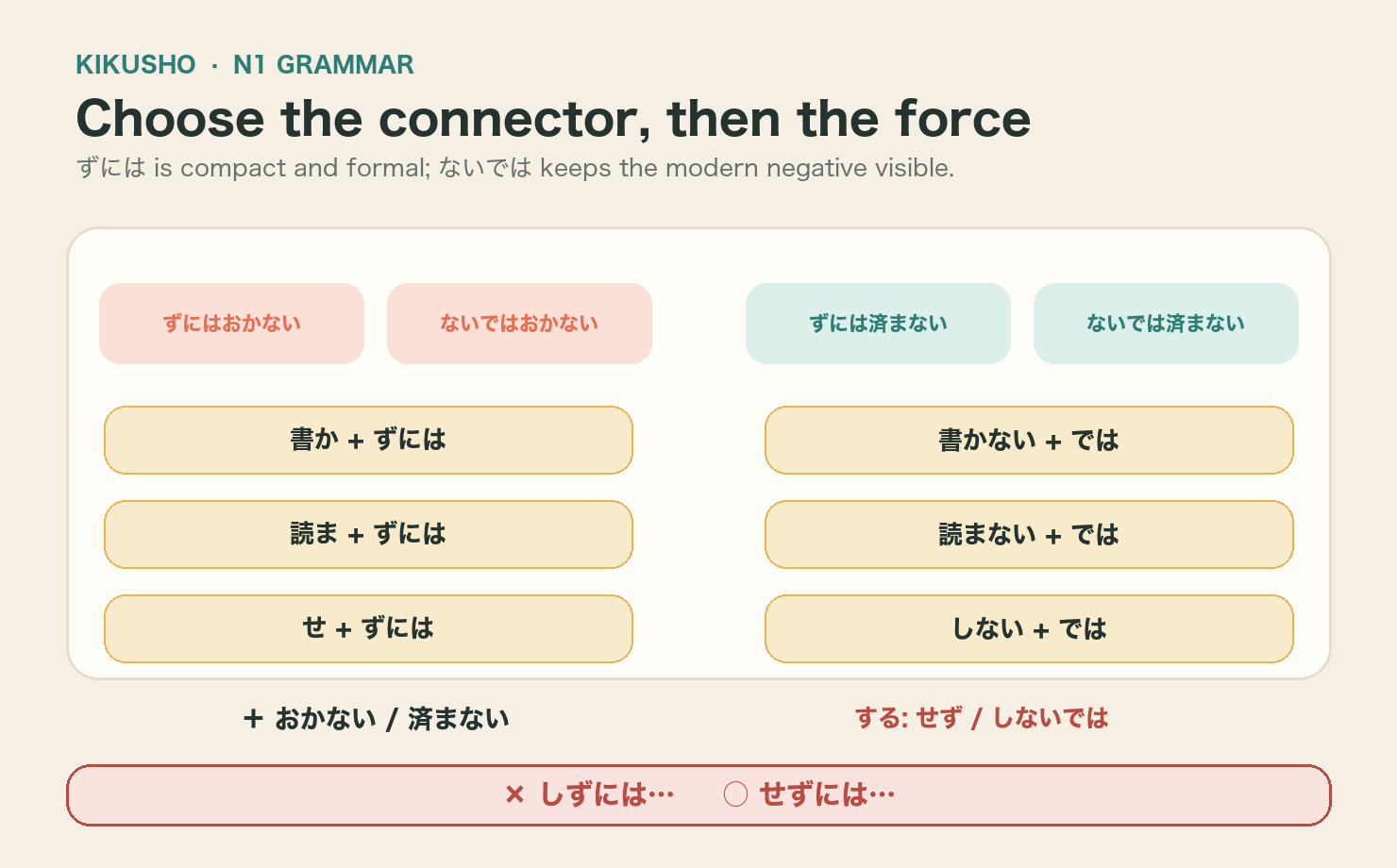
Start from the negative stem plus ず, or retain ない before では:
| Dictionary form | ずにはおかない | ないではおかない | ずには済まない | ないでは済まない |
|---|---|---|---|---|
| 書く | 書かずにはおかない | 書かないではおかない | 書かずには済まない | 書かないでは済まない |
| 読む | 読まずにはおかない | 読まないではおかない | 読まずには済まない | 読まないでは済まない |
| 食べる | 食べずにはおかない | 食べないではおかない | 食べずには済まない | 食べないでは済まない |
| する | せずにはおかない | しないではおかない | せずには済まない | しないでは済まない |
With ず, する becomes せず, never しず. ずには generally sounds more compact and formal; ないでは exposes the modern negative form more clearly. The meaning contrast between おかない and 済まない remains the same.
The final verb supplies the image
おく can mean leaving something in a state. A literal route into ずにはおかない is “will not leave it without doing A.” That supports deliberate resolve:
このまま放置せずにはおかない。
Without context, this sentence is awkward because 放置する itself means “leave unattended”; choose a concrete desired action instead. The pattern does not automatically make any verb natural.
済む asks whether the matter can be considered finished. This gives a useful negative mirror:
説明しなくても済む。
せつめいしなくても すむ。
It can be settled without an explanation.
説明せずには済まない。
せつめいせずには すまない。
It cannot be settled without an explanation.
The なくて済む and ずに済む lesson develops the avoided-action side. Adding は and negating 済む reverses the practical outcome: avoidance is no longer possible.
ずにはいられない describes an internal urge
A third similar-looking form locates the pressure inside the experiencer:
その話を聞いて、笑わずにはいられなかった。
その はなしを きいて、わらわずには いられなかった。
On hearing that story, I could not help laughing.
Compare:
その話は、聞く人を笑わせずにはおかない。
That story is bound to make listeners laugh.
その発言をした以上、本人は説明せずには済まない。
Having made that statement, the person cannot avoid explaining it.
いられない is an uncontrollable urge or reaction felt by the subject. おかない presents a cause that produces an effect or a will that ensures action. 済まない presents a duty required to settle the matter. The strong impulses lesson develops the first relationship.
Test the source of necessity
Use these replacements:
- If 必ずAする/必ずAさせる preserves the point, choose ずにはおかない.
- If Aしなければ、この件は済まされない preserves it, choose ずには済まない.
- If Aする気持ちを抑えられない preserves it, choose ずにはいられない.
この証拠は、世論を変えずにはおかない。
This evidence is bound to change public opinion.
証拠を隠した者は、責任を問われずには済まない。
Anyone who hid the evidence cannot escape being held responsible.
The first predicts an effect of the evidence. The second imposes consequences on the person.
Practice: locate the pressure
Question 1 — inevitable effect. Which ending predicts that a novel is bound to move readers?
この小説は読者を感動させ( )。
A. ずにはおかない
B. ずには済まない
C. ずじまいだ
D. ずにはいられない人だ
Question 2 — accountability. The company caused damage and cannot close the matter without compensation.
会社は被害者に補償せ( )。
A. ずにはおかない
B. ずには済まない
C. ないではいられない
D. まいとしない
Question 3 — irregular する. Select the line that handles する correctly in both frames.
A. しずにはおかない/しずには済まない
B. せずにはおかない/せずには済まない
C. するずにはおかない/するずには済まない
D. しないずにはおかない/しないずには済まない
Question 4 — ないでは variants. Rewrite 調査せずにはおかない and 説明せずには済まない with ないでは.
Question 5 — source of pressure. A detective says, “I will personally make the culprit confess.” Which form best carries that resolve?
A. 犯人に白状させずにはおかない。
B. 犯人に白状させずには済まない。
C. 犯人に白状させずにはいられない。
D. 犯人は白状せずじまいだ。
Question 6 — internal reaction. Which sentence means “I could not help crying” rather than “the situation required me to cry”?
A. 泣かずにはおかなかった。
B. 泣かずには済まなかった。
C. 泣かずにはいられなかった。
D. 泣かずじまいだった。
The final verb tells you whether the pressure is causal, social or internal.
Question 7 — build a contrast. Write one sentence in which a speech inevitably causes a reaction with ずにはおかない, then one in which a mistake creates a duty with ずには済まない.
Answers and explanations
Question 1
A. ずにはおかない. The novel is the cause and emotional impact is the inevitable effect. The reader does not owe an act of being moved.
Question 2
B. ずには済まない. Damage creates an unsettled obligation. Compensation is necessary before the company can put the matter behind it.
Question 3
B. The negative connector ず takes the irregular stem せ with する: せずにはおかない/せずには済まない.
Question 4
調査しないではおかない。
ちょうさしないでは おかない。
Will definitely investigate.
説明しないでは済まない。
せつめいしないでは すまない。
Cannot avoid explaining.
Retain the full しない before では. Do not mix せ with ないでは.
Question 5
A. 犯人に白状させずにはおかない. The detective’s determination supplies the force and the causative 白状させる names the result the detective intends to bring about.
Question 6
C. 泣かずにはいられなかった. いられない describes an internal reaction that could not be suppressed. 済まない would imply some duty or consequence made crying necessary, which is not the intended meaning.
Question 7
彼女の演説は、聴衆に行動を起こさせずにはおかない。
かのじょの えんぜつは、ちょうしゅうに こうどうを おこさせずには おかない。
Her speech is bound to make the audience take action.
私の確認不足で問題を起こした以上、経緯を説明せずには済まない。
わたしの かくにん ぶそくで もんだいを おこした いじょう、けいいを せつめいせずには すまない。
Since my failure to check caused the problem, I cannot avoid explaining what happened.
The first cause produces a reaction. The second mistake creates an obligation.
Name the force before translating “must”
Choose ずにはおかない for a determined agent or a cause bound to produce an effect. Choose ずには済まない when the matter cannot be settled without fulfilling a duty or accepting a consequence. Choose ずにはいられない when the pressure is an internal urge. The shared negative frame matters less than the final verb that identifies the force.
Common questions
What is the difference between ずにはおかない and ずには済まない?
ずにはおかない says a person’s determination or a situation’s force will inevitably produce an action or reaction. ずには済まない says responsibility, rules or circumstances make an action necessary before the matter can end.
What does ずにはおかない mean?
It means “will definitely” or “is bound to.” It can express a determined agent or an event that inevitably causes an effect, as in 人を感動させずにはおかない.
What does ずには済まない mean?
It means “cannot get by without” or “must.” The situation remains unsettled unless the required action is performed, as in 謝らずには済まない.
Can ないでは replace ずには?
Yes. Vない + ではおかない and Vない + では済まない are corresponding variants. With ず, する becomes せず: せずにはおかない and せずには済まない.