On this page
Use Nを押して/Nを押し切って when someone meets resistance and deliberately forces a course of action through it. Use Nをよそに when the subject treats another person's concern, opposition, expectations or the surrounding situation as if it were elsewhere and irrelevant.
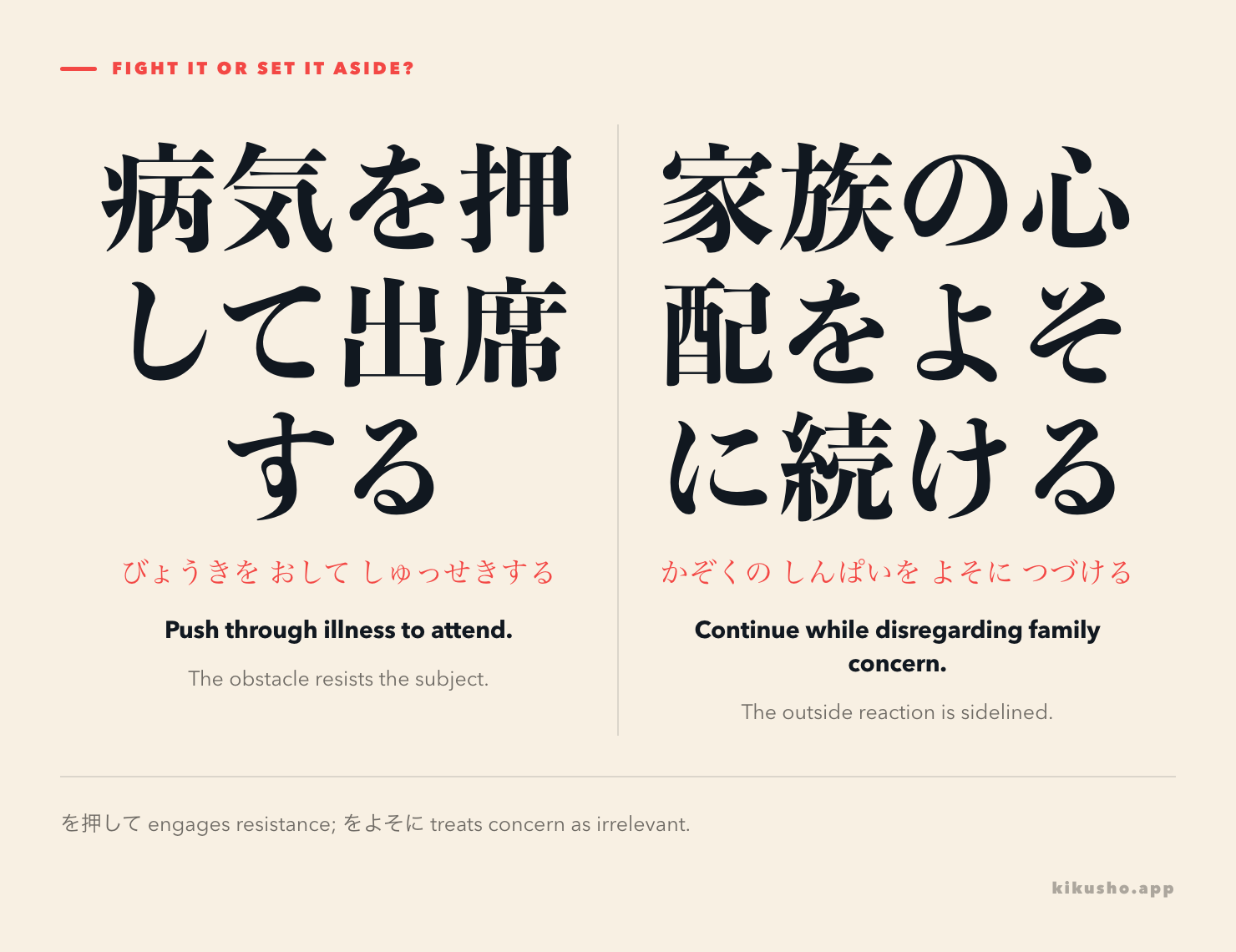
病気を押して、彼女は式典に出席した。
びょうきをおして、かのじょはしきてんにしゅっせきした。
Despite her illness, she pushed herself to attend the ceremony.
家族の心配をよそに、彼は危険な挑戦を続けた。
かぞくのしんぱいをよそに、かれはきけんなちょうせんをつづけた。
Ignoring his family's concern, he continued the dangerous challenge.
The ill person contends with her own physical obstacle. The challenger leaves other people's concern outside his decision. English “despite” can translate both, but Japanese locates the pressure differently.
This lesson teaches を押して/を押し切って (g-35859e1887ed) and をよそに (g-d4fb5d9befb0). Kikusho's inventory and the checked references place both at N1, with no recorded level disagreement. The label is study guidance: the JLPT organizers do not publish an exhaustive current grammar list.
First locate the resistance
The deciding question is whether the subject engages with N or sidelines it.
| Relationship to N | Form | Image |
|---|---|---|
| N blocks the subject, who pushes through it | Nを押して/押し切って | resistance met and overcome |
| N belongs to other people or the surroundings, and is ignored | Nをよそに | concern placed “elsewhere” |
Both forms can imply determination. Only をよそに naturally adds the idea that the subject pays insufficient attention to the reactions around them. That distance often carries disapproval.
を押して means the obstacle exerts pressure back
Attach を押して to one of a limited set of nouns for resistance or burden. Frequent combinations include 病気を押して, 無理を押して and 反対を押して.
無理を押して参加すれば、回復が遅れるかもしれない。
むりをおしてさんかすれば、かいふくがおくれるかもしれない。
If you push yourself to participate, your recovery may take longer.
委員の反対を押して、議長は採決に進んだ。
いいんのはんたいをおして、ぎちょうはさいけつにすすんだ。
Over the committee members' objections, the chair proceeded to a vote.
The noun is not merely an unfavorable circumstance. It must feel like something that resists the action. 雨を押して出かけた is a poor default for ordinary bad weather; 雨にもかかわらず出かけた simply states the concession, while 悪天候をものともせず進んだ presents the weather as a formidable obstacle that fails to deter the subject.
Do not confuse this construction with physically pressing an object. ボタンを押してドアを開ける means “press the button and open the door.” The noun ボタン is the direct object of the ordinary verb 押す, not resistance being overcome.
押し切って carries the struggle through to completion
を押し切って strengthens the same image. The compound verb 押し切る suggests pushing all the way through resistance and completing the intended course.
両親の反対を押し切って、二人は結婚した。
りょうしんのはんたいをおしきって、ふたりはけっこんした。
The two overcame their parents' opposition and married.
慎重論を押し切って、経営陣は新事業への投資を決めた。
しんちょうろんをおしきって、けいえいじんはしんじぎょうへのとうしをきめた。
The management team overrode calls for caution and decided to invest in the new business.
Opposition from people is especially natural with 押し切って because it creates a contest of wills. 病気を押して出席した is the established choice for pushing oneself despite illness; 病気を押し切って sounds less natural because illness is not normally a position or argument defeated in a dispute.
The distinction is a tendency rather than two unrelated rules. 反対を押して計画を進めた and 反対を押し切って計画を進めた can describe the same event. The second more clearly tells you that resistance was carried through to its endpoint.
をよそに makes N someone else's concern
Attach をよそに to a noun phrase. Common nouns name other people's feelings, reactions or demands: 心配, 期待, 反対, 批判, 抗議, 不安 and 関心.
住民の不安をよそに、工事は予定どおり始まった。
じゅうみんのふあんをよそに、こうじはよていどおりはじまった。
Ignoring the residents' anxiety, construction began as scheduled.
周囲の期待をよそに、その選手は突然引退を発表した。
しゅういのきたいをよそに、そのせんしゅはとつぜんいんたいをはっぴょうした。
Contrary to the expectations around him, the athlete suddenly announced his retirement.
The literal noun よそ(余所/他所) points away from one's own place or sphere. In this grammar, the subject behaves as though N belongs elsewhere and need not shape the action. The form is usually written in hiragana.
A verb clause can be nominalized with の:
親が心配するのをよそに、子どもたちは川へ入っていった。
おやがしんぱいするのをよそに、こどもたちはかわへはいっていった。
Ignoring their parents' worry, the children went into the river.
The criticism is easy to hear here: the children know or should know about the concern, yet act without regard for it. Still, をよそに can also set two situations apart without blaming an intentional agent:
都会の騒ぎをよそに、山あいの村では静かな時間が流れていた。
とかいのさわぎをよそに、やまあいのむらではしずかなじかんがながれていた。
Away from the commotion in the city, time passed quietly in the mountain village.
Here the village is not culpably ignoring the city. The construction builds a scene of separation and contrasting conditions.
The same opposition can reveal the speaker's judgement
With 反対, all three target shapes are possible, but they frame the event differently.
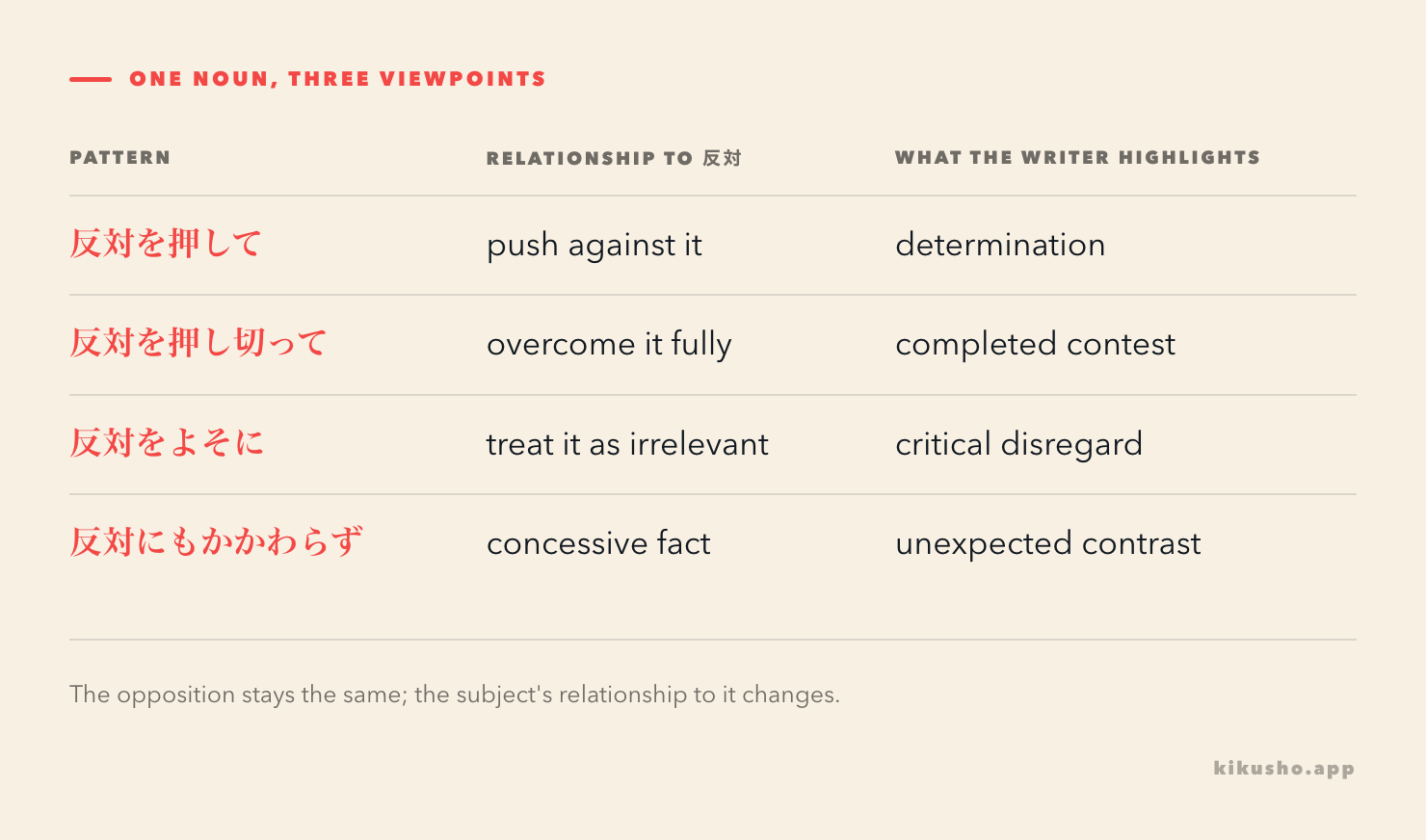
住民の反対を押して、市は計画を進めた。
じゅうみんのはんたいをおして、しはけいかくをすすめた。
The city advanced the plan against the residents' opposition.
The opposition functions as resistance that the city pushes against.
住民の反対を押し切って、市は計画を決定した。
じゅうみんのはんたいをおしきって、しはけいかくをけっていした。
The city overrode the residents' opposition and finalized the plan.
The decision marks the endpoint of the struggle.
住民の反対をよそに、市は計画を発表した。
じゅうみんのはんたいをよそに、しはけいかくをはっぴょうした。
Disregarding the residents' opposition, the city announced the plan.
Now the sentence presents the city as treating the opposition as irrelevant. The speaker's criticism is stronger even though the sentence says less about an actual contest.
The 顧みず and をものともせず lesson adds two more angles: failing to consider consequences, and remaining undaunted by a formidable obstacle. The にかまけて and そっちのけ lesson instead describes attention absorbed by one thing or something neglected and left aside.
にもかかわらず reports contrast without the same stance
にもかかわらず says that the later event holds despite the earlier fact. It does not by itself claim forceful perseverance or disregard.
雨にもかかわらず、試合は予定どおり行われた。
あめにもかかわらず、しあいはよていどおりおこなわれた。
Despite the rain, the match was held as scheduled.
The sentence reports an unexpected contrast. It does not tell us whether anyone pushed through resistance or ignored a person's concern. The にもかかわらず lesson develops that formal concessive relation.
For a Kikusho card, keep the resisted or sidelined noun and the later action together. 反対を押し切って without the decision hides the completed struggle; 心配をよそに without the risky action hides the reason for criticism. A full clause makes the viewpoint recoverable during offline review.
Practice: decide whether N is fought or sidelined
Work through the seven scenes before opening the explanation block.
Question 1 — physical burden. Complete 病気( )、彼女は重要な会議に出席した。
- ア. をよそに
- イ. を押して
- ウ. を押し切って
- エ. にかまけて
Question 2 — completed contest of wills. Complete 家族の反対( )、彼は海外で店を開いた。 The sentence should emphasize that he carried his plan through against their opposition.
- ア. を押し切って
- イ. をよそに
- ウ. を込めて
- エ. を境に
Question 3 — critical disregard. Which sentence most clearly criticizes a company for treating residents' concern as irrelevant?
- ア. 住民の不安を押して、会社は説明会を開いた。
- イ. 住民の不安をよそに、会社は工事を始めた。
- ウ. 住民の不安を込めて、会社は工事を始めた。
- エ. 住民の不安を境に、会社は工事を始めた。
Question 4 — ordinary 押す or grammar. Which sentence contains the target grammar rather than a physical push?
- ア. ボタンを押して、電源を入れた。
- イ. 重いドアを押して、部屋に入った。
- ウ. 無理を押して、式典に参加した。
- エ. カートを押して、店を出た。
Question 5 — neutral concession. You only want to report that the match happened despite rain, without implying determination or disregard. Which form fits best?
- ア. 雨をよそに
- イ. 雨を押し切って
- ウ. 雨にもかかわらず
- エ. 雨をそっちのけで
Question 6 — nominalized clause. Complete 親が止める( )、子どもは川へ入っていった。
- ア. のをよそに
- イ. のを押して
- ウ. ことを押し切る
- エ. ものを境に
Question 7 — sentence composition. Arrange these pieces to say “Overriding the committee's opposition, the chair proceeded to a vote.”
- 採決に進んだ
- 委員の反対を押し切って
- 議長は
Answers and explanations
The explanations track three clues: the kind of noun, the subject's relationship to it, and whether the sentence marks completion.
Answer 1. イ, を押して. 病気を押して is the established combination for pushing oneself to act despite illness. 押し切って is more natural for opposition that is overcome through a contest of wills.
Answer 2. ア, を押し切って. The prompt asks for resistance carried through to completion. をよそに would frame the family opposition as something ignored, with a more critical distance, rather than foregrounding the successful struggle against it.
Answer 3. イ, 住民の不安をよそに、会社は工事を始めた. The residents' anxiety is an external reaction the company treats as irrelevant. The construction often conveys the writer's disapproval of that attitude.
Answer 4. ウ, 無理を押して、式典に参加した. 無理 is the burden pushed through. The other sentences use the ordinary transitive verb 押す with a physical object such as a button, door or cart.
Answer 5. ウ, 雨にもかかわらず. This form reports a concessive contrast without adding a contest of wills or disregard for other people. Ordinary rain is also a poor default noun for the restricted を押して pattern.
Answer 6. ア, のをよそに. の turns 親が止める into a noun-like clause, which then takes をよそに. The children act without regard for the parents' attempt to stop them.
Answer 7. 委員の反対を押し切って、議長は採決に進んだ. The opposition is the resistance overcome, 押し切って marks carrying the decision through, and the following clause gives the completed action.
Common questions
What is the difference between を押して and をよそに?
Nを押して presents N as resistance someone deliberately pushes through. Nをよそに presents N as an outside concern, reaction or circumstance the subject treats as irrelevant, often with the speaker's criticism.
What is the difference between を押して and を押し切って?
Both describe overcoming resistance. を押し切って more strongly suggests that resistance, especially opposition from people, was overcome all the way and the intended action was carried through.
Which nouns commonly come before を押して?
The range is limited. Common combinations include 病気を押して, 無理を押して and 反対を押して or 反対を押し切って. The construction does not freely attach to any inconvenient fact.
Is をよそに always critical?
It often criticizes someone for ignoring concern, opposition, expectations or unrest. It can also create a more neutral contrast when one surrounding situation continues independently of another.