On this page
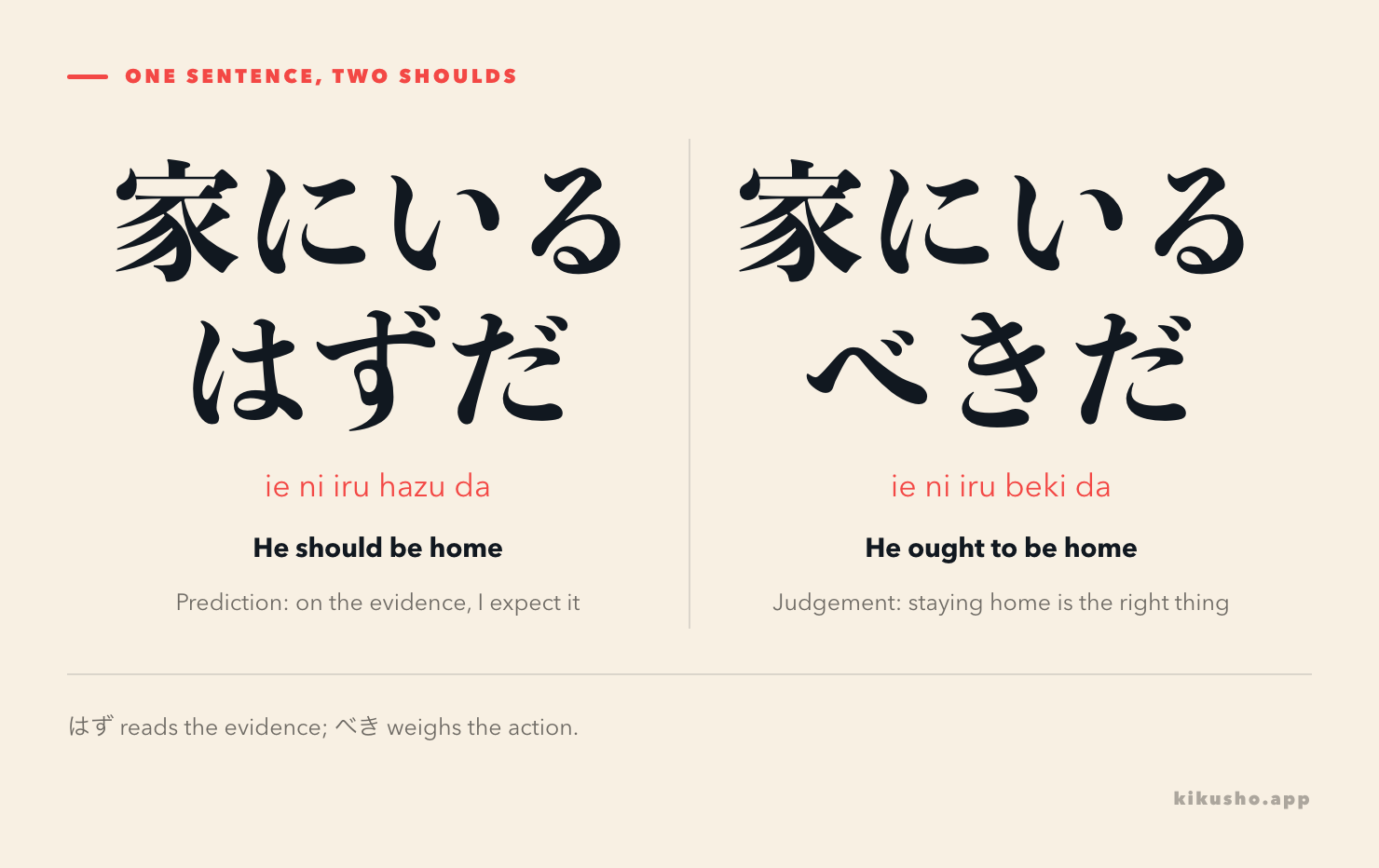
English hands you one word, should, for two jobs that Japanese keeps apart. ~はず is the should of a prediction: on the evidence in front of you, this is what you expect to be true. ~べき is the should of a judgement: whatever the evidence says, this is what ought to be done. Pick the wrong one and a guess about the world comes out as a lecture, or a lecture comes out as a shrug.
The test: swap in "I expect" or "ought to"
When should turns up in your English and you have to choose, run the sentence through two rewrites before you commit.
"He should be home by now" passes the first rewrite (I expect he is home) and fails the second (he is under no obligation to be), so it is 彼は家にいるはずだ. "You should apologise" passes the second (apologising is the right thing) and fails the first (you are not forecasting the apology), so it is 謝るべきだ. The same three English letters, sorted by a question you can ask mid-sentence.
はず reads the evidence and predicts
はず is a formal noun, written 筈 in its rare kanji but almost always in kana. Attached to a clause, it says the speaker has reasoned from something already in hand (a fact just stated, a schedule, a known habit) to what must therefore follow. It reports a conclusion about the world. It never issues an instruction.
電気がついているから、彼はまだ家にいるはずだ。 The light is on, so he should still be home. The lit window is the evidence; いるはず is the conclusion drawn from it. 木曜日に送ったから、荷物はもう着いているはずだ。 I sent it Thursday, so the parcel should have arrived by now. Again a fact, then the prediction it forces.
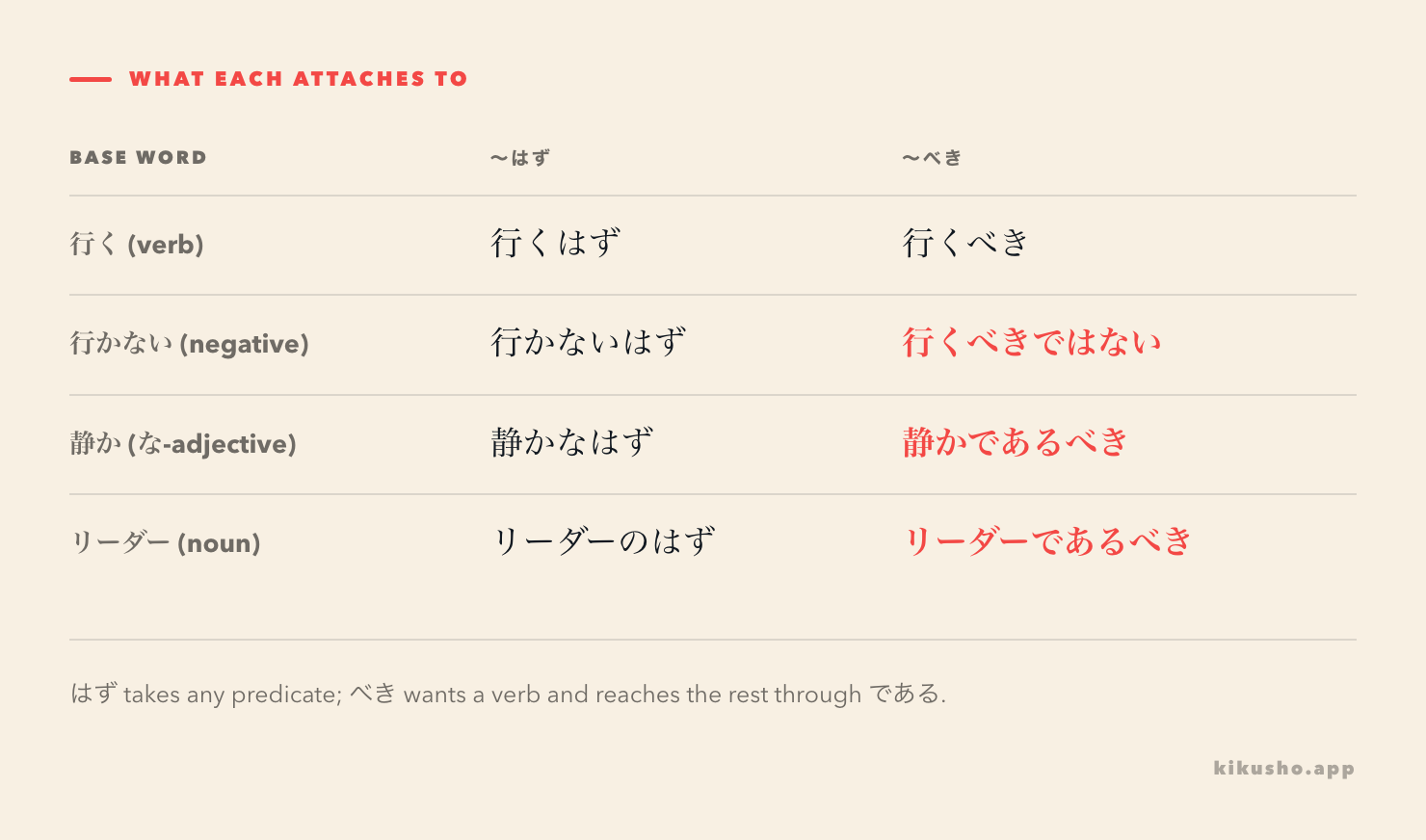
It attaches to a plain form of almost anything: a verb (着くはず, negative 着かないはず), an い-adjective (忙しいはず), a な-adjective through な (静かなはず), a noun through の (休みのはず). And it has a past that carries its own meaning. はずだった is the prediction that reality overruled: 会議は3時に始まるはずだった。 The meeting was supposed to start at three. It carries the shape of a plan, with the implication that it did not.
べき weighs the action and judges
べき comes from the classical auxiliary べし, the same ancestor behind the literary ~べく. べきだ states that an action is right or proper. That is a judgement the speaker is making, not a fact being read off the world, and it attaches to the dictionary form of a verb: 約束したのだから、謝るべきだ。 You made a promise, so you should apologise. 学生は規則を守るべきだ。 Students should follow the rules.
する is the one verb with a choice: するべき is conversational, すべき a shade more formal, and both are correct. The negative is built on the ending, never on the verb: 人の悪口を言うべきではない, you should not speak ill of people. Its past is the register of regret: もっと早く医者に行くべきだった, I should have gone to the doctor sooner.
Two habits keep べき natural. It wants a verb, and reaches an adjective or a noun only through である (静かであるべき, リーダーであるべき); there is no 行かないべき. And for your own present duty it can sound stiff, so everyday Japanese prefers なければいけない there and saves べき for judging what someone ought to do and for looking back at what you ought to have done.
The negatives point in opposite directions
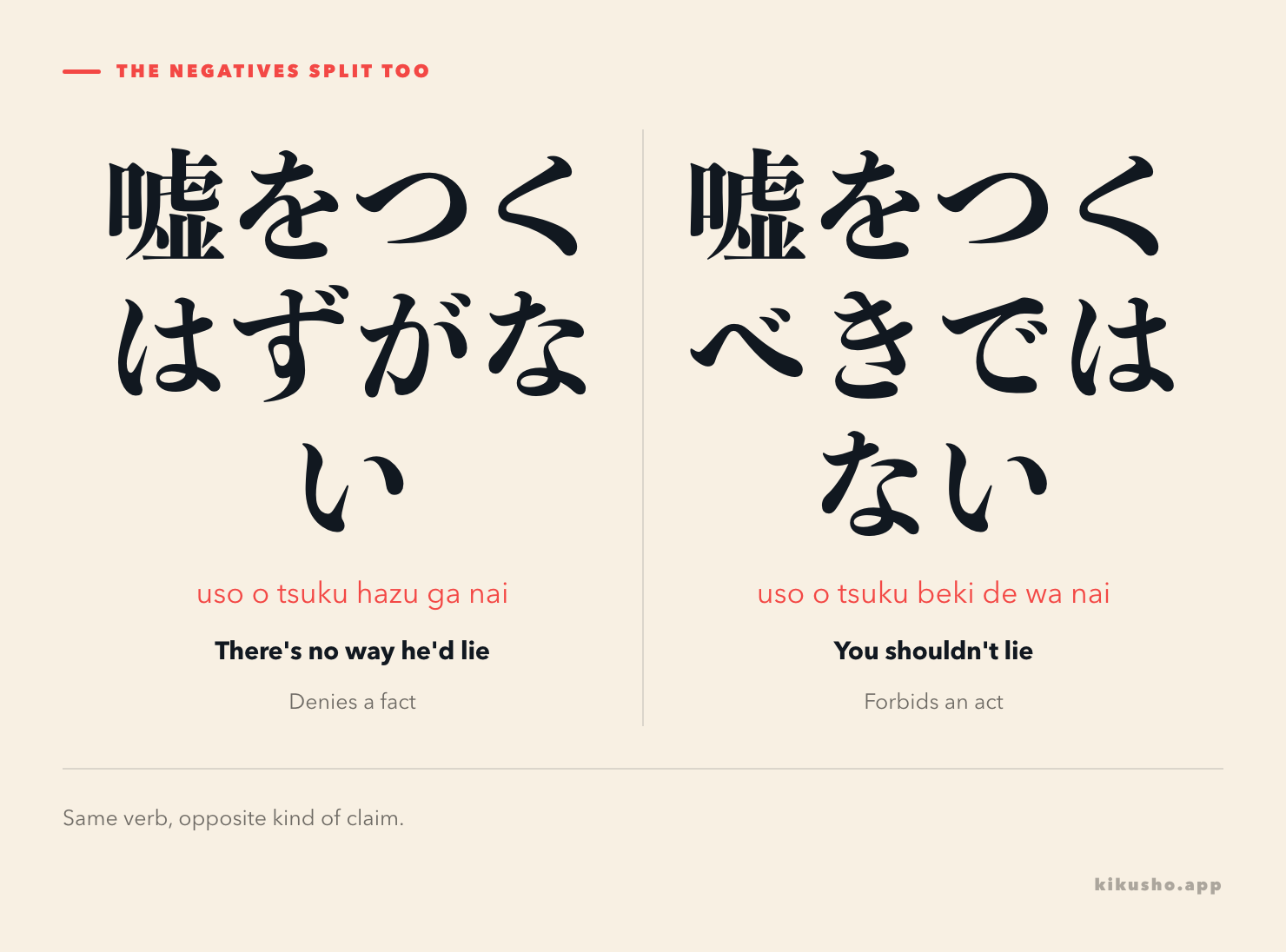
The negatives are where the two forms are furthest apart, and where learners most often blur them into a single "shouldn't." They are not two shades of one meaning. はずがない denies a fact: there is no way. べきではない forbids an act: you must not.
彼が私の名前を忘れるはずがない。 There is no way he would forget my name, a confident prediction about what is true, close in force to はずはない. Set it beside a judgement on the same verb and the gap is plain: 嘘をつくはずがない says there is no way he would lie, a claim about his character, while 嘘をつくべきではない says you should not lie, a claim about right and wrong. Same verb, opposite kind of statement. That がない ending turns up elsewhere too: わけがない rules out a conclusion the same way はずがない rules out a fact.
The choice is easiest to keep once you have met it in a sentence where the situation already settled which should was meant. A line like 来るはずだったのに in a drama, or a colleague's 確認するべきだよ, carries its own disambiguation: the scene around it tells you whether someone forecast an event or judged an action. Kikusho is built for that kind of capture. Speak the line you heard, or photograph the subtitle it sat in, and it drafts a card from the whole sentence: the reading over the kanji, the meaning, and a register note that pins down which should was in play. Reviews and audio then run with no signal, so the contrast comes back to you fixed to a moment you lived rather than to a row in a grammar table.
Swap them and you sound preachy or naive
Because natives will still parse either form, the cost of the wrong one is not a blank stare; it is being heard to mean something you did not. Say 謝るはずだ where 謝るべきだ belonged and you have stopped advising and started forecasting: he is bound to apologise, as though the apology were a weather event and not his duty. That is the naive reading, a person treated like a predictable machine.
Go the other way, 家にいるべきだ where 家にいるはずだ belonged, and a simple guess about where someone is turns into a verdict on where they ought to be. You meant he is probably home; what landed was he has a duty to be home, and now you sound as though you are keeping account of his whereabouts. The forms are close on the page and nowhere near each other in the room.
Four questions to tell them apart
Question 1. Choose the ending: 「もう5時だから、郵便局は閉まっている___だ。」 (a) はず (b) べき
Question 2. Choose the ending: 「約束したのだから、きみは彼に謝る___だ。」 (a) べき (b) はず
Question 3. Put these into a sentence meaning "The meeting was supposed to start at three (but it didn't)": 会議は ・ 3時に ・ 始まる ・ はずだった
Question 4. Fill both blanks: 「今日は祝日だから、市役所は休みの(1)___だ。でも急ぎの用があるなら、電話で確認する(2)___だ。」
Answer 1: (a) はず. "It is already five" is evidence, and "the post office is closed" is the conclusion drawn from it, which is はず's work. (b) べき would claim the post office has a duty to be shut, which nothing in the sentence suggests.
Answer 2: (a) べき. 約束したのだから gives a reason to act, so the sentence is advice: apologising is the right thing to do. (b) 謝るはずだ is grammatical but predicts the listener's behaviour (you are bound to apologise), which is a forecast, not the counsel the setup calls for.
Answer 3: 会議は3時に始まるはずだった。 The topic 会議は leads, the time 3時に sits before the verb, and はずだった carries the "was supposed to, and wasn't" sense. べきだった would instead judge that three was the correct time to begin, which is not what the English means.
Answer 4: (1) はず, (2) べき. A national holiday is evidence and "the office is closed" is the prediction that follows, so 休みのはず. Checking by phone is the sensible action to take, so 確認するべき. The passage moves from reading a situation to recommending an action, which is the whole distinction laid out in two clauses.
Common questions
Is はず N4 or べき N3?
JLPT Sensei and Bunpro list はずだ and はずがない as N4 grammar and べきだ and べきではない as N3. This lesson pairs them at N3 because English "should" hides both, so most learners meet the confusion once they reach べき.
Can べき attach to a negative verb?
No. 行かないべき is not standard Japanese. The negative of a べき sentence is formed on the ending: 行くべきではない ("should not go"), not on the verb.
What is the difference between はずがない and べきではない?
はずがない denies a fact: "there is no way that is true." べきではない forbids an act: "you should not do that." One is a confident prediction, the other a judgement, so they are never interchangeable.
Should I write するべき or すべき?
Both are correct. するべき is the everyday, conversational form; すべき is a little more formal and more common in writing. The meaning is identical.