On this page
かつて looks backward and retrieves a former state or a past experience. もはや looks at the present and says change has already carried the situation beyond its old state, often with little possibility of return. Put them around the change: かつて before it, もはや after it.
この町は、かつて炭鉱で栄えていた。
この まちは、かつて たんこうで さかえていた。
This town once prospered through coal mining.
炭鉱は閉鎖され、当時の活気はもはや残っていない。
たんこうは へいさされ、とうじの かっきは もはや のこっていない。
The mines have closed, and the vitality of those days no longer remains.
The first sentence opens a window onto the town’s past. The second judges its current state against that past and presents the loss as established.
This lesson verifies inventory items g-e5c33ffc3777, かつて, and g-460f44187e5d, もはや. コトバンク and goo’s dictionary support both the affirmative former-time use of かつて and its negative “not once until now” frame. goo’s もはや entry describes a situation approaching realization or having progressed beyond easy change. A Japanese-teacher comparison of もはや and すでに highlights the former’s subjective, hard-to-reverse viewpoint. Research on the contrast with もう likewise identifies 現状不可変性, the sense that the current state cannot readily be changed. JLPT Sensei categorizes both かつて and もはや as N1 study items; no competing level appears in the retained inventory.
Place the viewpoint on the time line
| Adverb | Viewpoint | Main question | Typical result |
|---|---|---|---|
| かつて | looking back from now | What was true at some earlier time? | once, formerly |
| かつて~ない | surveying experience up to now | Has this ever happened even once? | never before |
| もはや | evaluating the present after change | Has the old state already become unavailable? | now, already |
| もはや~ない | denying continuation at the present boundary | Does the old state still hold? | no longer |
彼はかつて、この会社で働いていた。
かれは かつて、この かいしゃで はたらいていた。
He once worked for this company.
彼は退職して十年になり、もはや社員ではない。
かれは たいしょくして じゅうねんに なり、もはや しゃいんでは ない。
It has been ten years since he left, and he is no longer an employee.
Affirmative かつて means once or formerly
かつて usually leaves the exact date unstated. The past period matters because it contrasts with now or supplies historical background.
この建物は、かつて銀行として使われていた。
この たてものは、かつて ぎんこうとして つかわれていた。
This building was once used as a bank.
彼女はかつて世界記録を持っていた。
かのじょは かつて せかい きろくを もっていた。
She once held the world record.
その理論は、かつて広く受け入れられていた。
その りろんは、かつて ひろく うけいれられていた。
That theory was once widely accepted.
The present contrast can remain implicit. Calling someone かつての世界王者 normally suggests that the title belonged to an earlier period rather than now.
This leads to the attributive frame かつての + noun:
- かつての同僚: a former colleague
- かつての姿: its former appearance
- かつての常識: what was once common knowledge
Do not treat かつて as a precise replacement for 三年前に. It frames a former era or experience; an exact date simply locates an event.
Negative かつて means not once until now
When the predicate is negative, かつて can survey the whole relevant past:
これほど大きな変化は、かつて経験したことがない。
これほど おおきな へんかは、かつて けいけんした ことが ない。
I have never experienced a change this great before.
この地域では、かつて見られなかった現象だ。
この ちいきでは、かつて みられなかった げんしょうだ。
This is a phenomenon that had never been seen in this region before.
Adding 一度も makes the experiential denial explicit:
彼は約束をかつて一度も破ったことがない。
かれは やくそくを かつて いちども やぶった ことが ない。
He has never once broken a promise.
The scope is “at no point in the relevant past.” This is different from affirmative かつて, even though English may translate both with “ever” in certain questions or negatives.
もはや marks a changed present
The most familiar frame is もはや~ない:
紙の地図は、日常生活に欠かせない道具ではもはやない。
かみの ちずは、にちじょう せいかつに かかせない どうぐでは もはや ない。
Paper maps are no longer indispensable tools in daily life.
この方法では、増え続ける需要にもはや対応できない。
この ほうほうでは、ふえつづける じゅように もはや たいおうできない。
This method can no longer cope with the continually growing demand.
失われたデータを取り戻すことは、もはや不可能だ。
うしなわれた データを とりもどす ことは、もはや ふかのうだ。
Recovering the lost data is now impossible.
The negative meaning can come from ない, a negative potential such as できない, or a lexical predicate such as 不可能だ. The adverb itself does not conjugate.
Affirmative predicates are also possible:
オンライン会議は、もはや特別なものではなく、日常の一部だ。
オンライン かいぎは、もはや とくべつな ものでは なく、にちじょうの いちぶだ。
Online meetings are no longer exceptional; they are now part of everyday life.
この技術は、もはや世界の標準になった。
この ぎじゅつは、もはや せかいの ひょうじゅんに なった。
This technology has now become a global standard.
What matters is the crossed boundary, not grammatical negation.
もはや is heavier than conversational もう
Both can mean “already” or “no longer”:
もう使えない。
It cannot be used anymore.
もはや使えない。
It can no longer be used.
もう is ordinary in conversation and can simply update timing. もはや is more formal and evaluative. It often suggests that the process has advanced too far, the former condition is irrecoverable, or the speaker is drawing a historical conclusion.
Compare:
もう三時だ。
It is already three.
もはや三時だ。
The second can work in a dramatic context where reaching three o’clock means the opportunity has effectively passed, but it is too heavy as a neutral clock reading.
すでに often reports objective prior completion:
申込期間はすでに終了した。
The application period has already ended.
申込期間はもはや終了しており、変更はできない。
The application period is now over, and changes can no longer be made.
The second presents the closed period as the present boundary constraining action.
The とっくに and time-event lesson further separates an event completed long ago from neutral すでに and changed-state もはや.
A single paragraph can use both
この港は、かつて海外貿易の中心として栄えていた。しかし物流の経路が変わり、大型船はもはや寄港しない。
この みなとは、かつて かいがい ぼうえきの ちゅうしんとして さかえていた。しかし ぶつりゅうの けいろが かわり、おおがたせんは もはや きこうしない。
This port once prospered as a center of overseas trade. But shipping routes changed, and large vessels no longer call there.
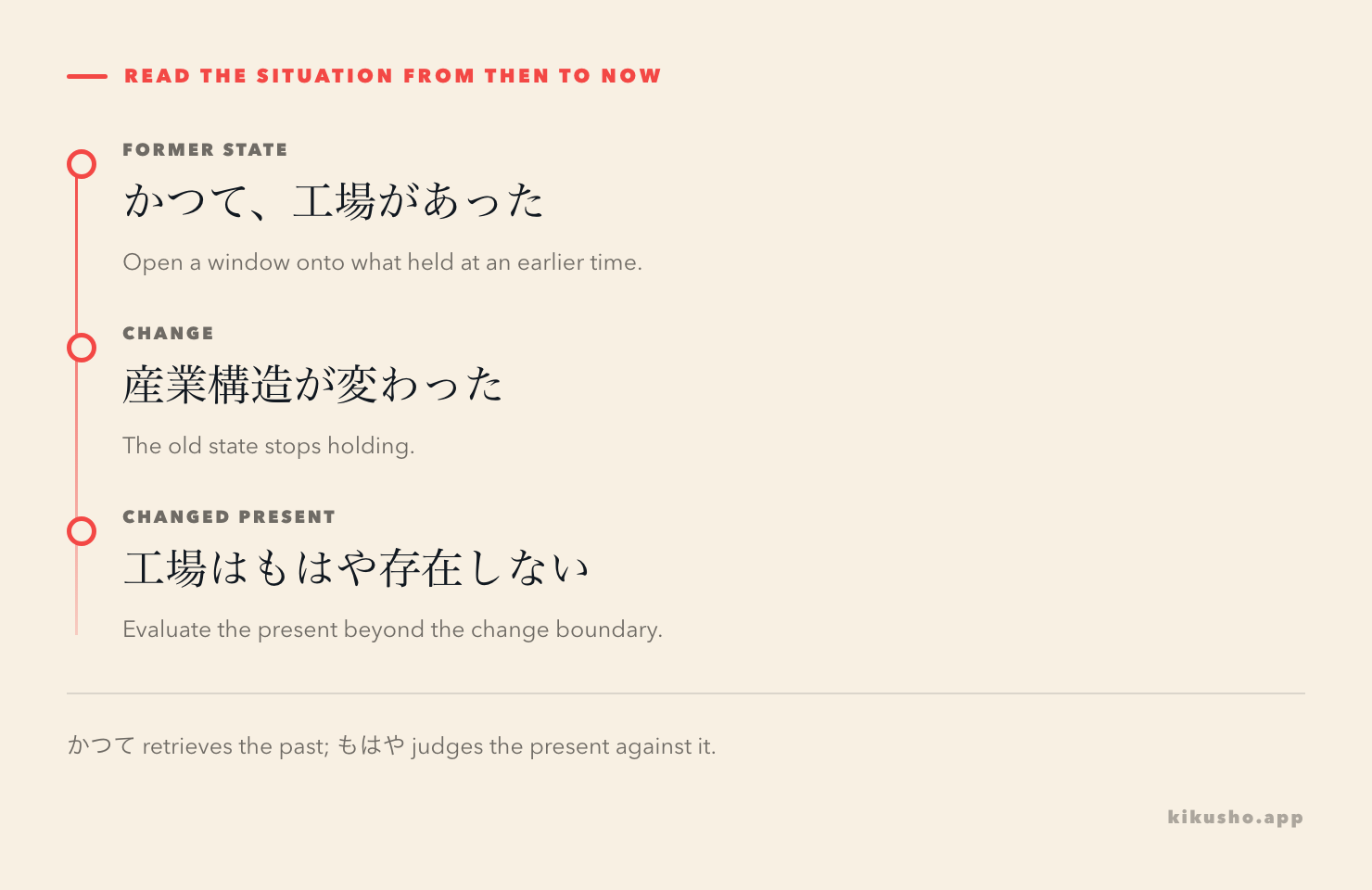
The paragraph has three steps:
- Former state: かつて栄えていた.
- Change: 物流の経路が変わった.
- Changed present: もはや寄港しない.
The てからというもの lesson handles a different timeline: one event starts a continuing state. Here, かつて and もはや compare the two sides of the change without naming how long the new state has lasted.
Avoid two reversed viewpoints
かつて、この制度は廃止された。
This can mean “At some point in the past, this system was abolished,” but it does not mean “the system is no longer active.” It locates the abolition in the past.
この制度はもはや廃止された。
This is awkward if the intended meaning is simply a past event. Natural choices are この制度はすでに廃止された for completed abolition, or この制度はもはや存在しない for the current no-longer-existing state.
Likewise, もはやの同僚 cannot replace かつての同僚. Only かつて naturally forms the common かつての + noun frame for a former identity.
Practice: former past or changed present?
Question 1 — former state. Which adverb retrieves a building’s earlier use?
この建物は( )劇場として使われていた。
A. もはや
B. かつて
C. すでに
D. これから
Question 2 — no longer. The old method cannot meet present demand anymore.
古い方法では( )現在の需要に対応できない。
A. かつて
B. 以前
C. もはや
D. いつか
Question 3 — never before. Complete the experiential sentence.
これほど静かな海を( )見たことがない。
A. もはや
B. かつて
C. やがて
D. もうすぐ
Question 4 — affirmative もはや. Which sentence correctly marks a crossed present boundary without ending in ない?
- このサービスはもはや社会の基盤になった。
- このサービスはもはや十年前に始まった。
- このサービスはかつて社会の基盤になっている。
- このサービスはかつて明日始まる。
Question 5 — choose the lighter clock update. You merely notice that it is already three o’clock, with no dramatic consequence. Which is most natural?
A. かつて三時だ。
B. もはや三時だ。
C. もう三時だ。
D. かつて三時ではない。
Question 6 — connected contrast. Fill both gaps.
この通りは( ① )多くの映画館でにぎわっていたが、再開発が進み、当時の建物は( ② )一つも残っていない。
- ①もはや ②かつて
- ①かつて ②もはや
- ①すでに ②やがて
- ①もはや ②以前
Question 7 — build the change. Write two linked sentences about a former factory: use かつて for what it produced, then もはや~ない for its present state.
Answers and explanations
1. Earlier use
B. かつて. The sentence retrieves a former function of the building. It does not yet make a claim about the current state.
2. Present limit
C. もはや. Rising demand has carried the situation beyond what the old method can handle. The negative potential supplies “no longer.”
3. Entire past experience
B. かつて. With 見たことがない, かつて surveys the speaker’s experience up to now and means “never before.”
4. New normal
1. The service has crossed into the status of social infrastructure. もはや can accompany an affirmative predicate when the sentence presents a settled changed state.
5. Ordinary time update
C. もう三時だ. The sentence only updates the current time. もはや would add a weighty implication that reaching three has closed an opportunity or made some consequence unavoidable.
6. Street before and after
2: ①かつて, ②もはや. The first clause recalls the street’s former prosperity. The second evaluates the present after redevelopment: none of the old buildings remain any longer.
7. One possible contrast
この工場は、かつて自動車の部品を製造していた。
しかし閉鎖され、もはや使われていない。
The first sentence retrieves the factory’s former role. The second places the speaker after closure and denies continuation of that role.
Review the boundary between then and now
Keep a three-part card rather than two English glosses:
かつて、この町には工場があった。
産業構造が変わった。
その工場はもはや存在しない。
When the card returns, identify the old state, the change, and the present consequence. Then add one negative-experience card for かつて見たことがない, since that use asks a different question from “formerly.”
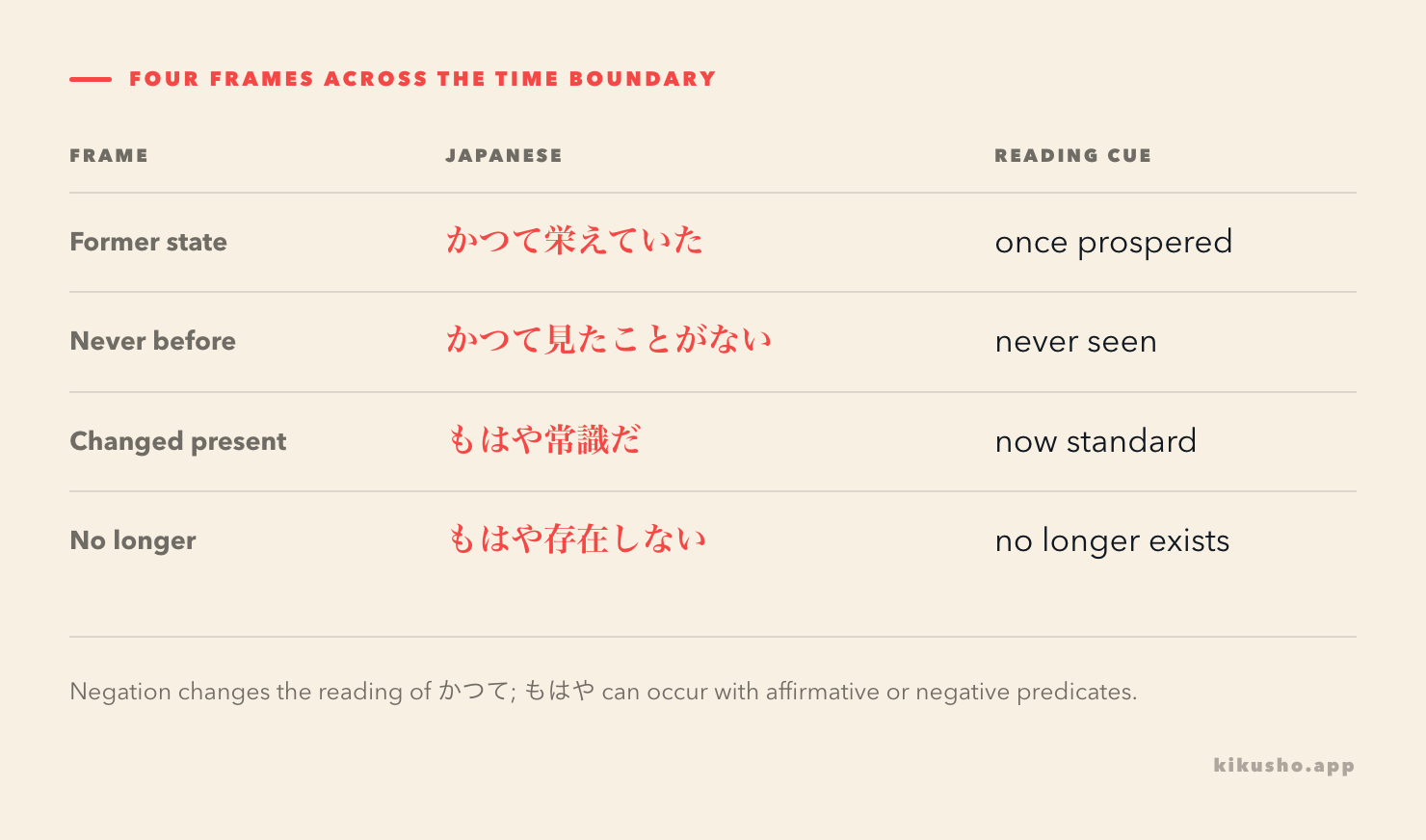
Kikusho can schedule the four frames independently: former state, never-before experience, changed present and no-longer continuation. This keeps かつて from becoming a vague “past” word and もはや from becoming a formal-looking substitute for every use of もう.
Common questions
What is the difference between かつて and もはや?
かつて looks back to a former state or past experience. もはや evaluates the present as already changed, often so far that returning to the old state is difficult or impossible.
What does かつて mean?
In an affirmative sentence, かつて means “once” or “formerly.” With a negative predicate, かつて~ない means “never before” or “not once up to now.”
What does もはや mean?
もはや means “already,” “now” or, with a negative predicate, “no longer.” It stresses that a change has progressed to a settled or difficult-to-reverse present state.
Does もはや require a negative verb?
No. もはや~ない is very common, but affirmative predicates also work: もはや手遅れだ means “it is already too late,” and もはや常識だ means “it is now common knowledge.”