On this page
If a parent says 厳しいことを言う, the action may sound merely harsh. Add 子どもの将来を考えればこそ, and ばこそ presents concern for the child's future as the precise reason for that harshness: “It is exactly because I care that I say this.”
親は子どもの将来を考えればこそ、厳しいことも言うのだ。
おやは こどもの しょうらいを かんがえればこそ、きびしい ことも いうのだ。
It is precisely because parents think about their child's future that they sometimes say strict things.
The pattern is AばこそB. A carries the highlighted cause or motive; B gives the conclusion, action or attitude that this cause explains. The construction is formal and emphatic, so it appears more readily in essays, speeches and deliberate explanations than in ordinary conversation.
This lesson verifies inventory item g-a6410e10e3d7, ばこそ. Bunpro supplies the full attachment pattern, formal register and N1 placement. MLC Japanese Language School independently teaches the same forms and reason-emphasis function. A linguistic discussion of ばこそ and からこそ records an important tendency: ばこそ is less comfortable when A is treated as a simply negative cause, although context can reframe difficult circumstances as a meaningful ground. JLPT Sensei also places the form at N1, while 世界で日本語教師 labels it N2. Kikusho keeps the assigned N1 route and records the teaching-order disagreement; the official JLPT FAQ does not provide an exhaustive item list that could settle it.
The ば-form carries the reason and こそ puts it in focus
The ば morphology may look like an ordinary hypothetical condition, but the target use normally identifies an actual or accepted reason:
彼を信頼していればこそ、大切な仕事を任せたのだ。
かれを しんらいしていればこそ、たいせつな しごとを まかせたのだ。
I entrusted him with important work precisely because I trust him.
The speaker is not saying, “If I happen to trust him.” The completed act 任せた shows that the trust is being offered as its real motive. こそ selects that motive as the point the listener should not overlook.
The second clause often contains のだ/んだ, a firm evaluation, an expression of gratitude or a statement of what becomes possible:
困難な課題であればこそ、挑戦する価値があるのだ。
こんなんな かだいで あればこそ、ちょうせんする かちが あるのだ。
It is precisely because the task is difficult that it is worth attempting.
支えてくれる人がいればこそ、安心して前へ進める。
ささえてくれる ひとが いればこそ、あんしんして まえへ すすめる。
It is precisely because there are people who support us that we can move forward with confidence.
These endings are common partners, not mandatory pieces of the construction. The essential relation is still A as the focused reason for B.
Each word class enters through a different ば-form
| Before ばこそ | Formation | Example | Focused reason |
|---|---|---|---|
| verb | hypothetical ば-form + こそ | 努力すればこそ | precisely because one makes an effort |
| い-adjective | ~い → ~ければこそ | 難しければこそ | precisely because it is difficult |
| な-adjective | ~であればこそ | 健康であればこそ | precisely because one is healthy |
| noun | ~であればこそ | 専門家であればこそ | precisely because one is an expert |
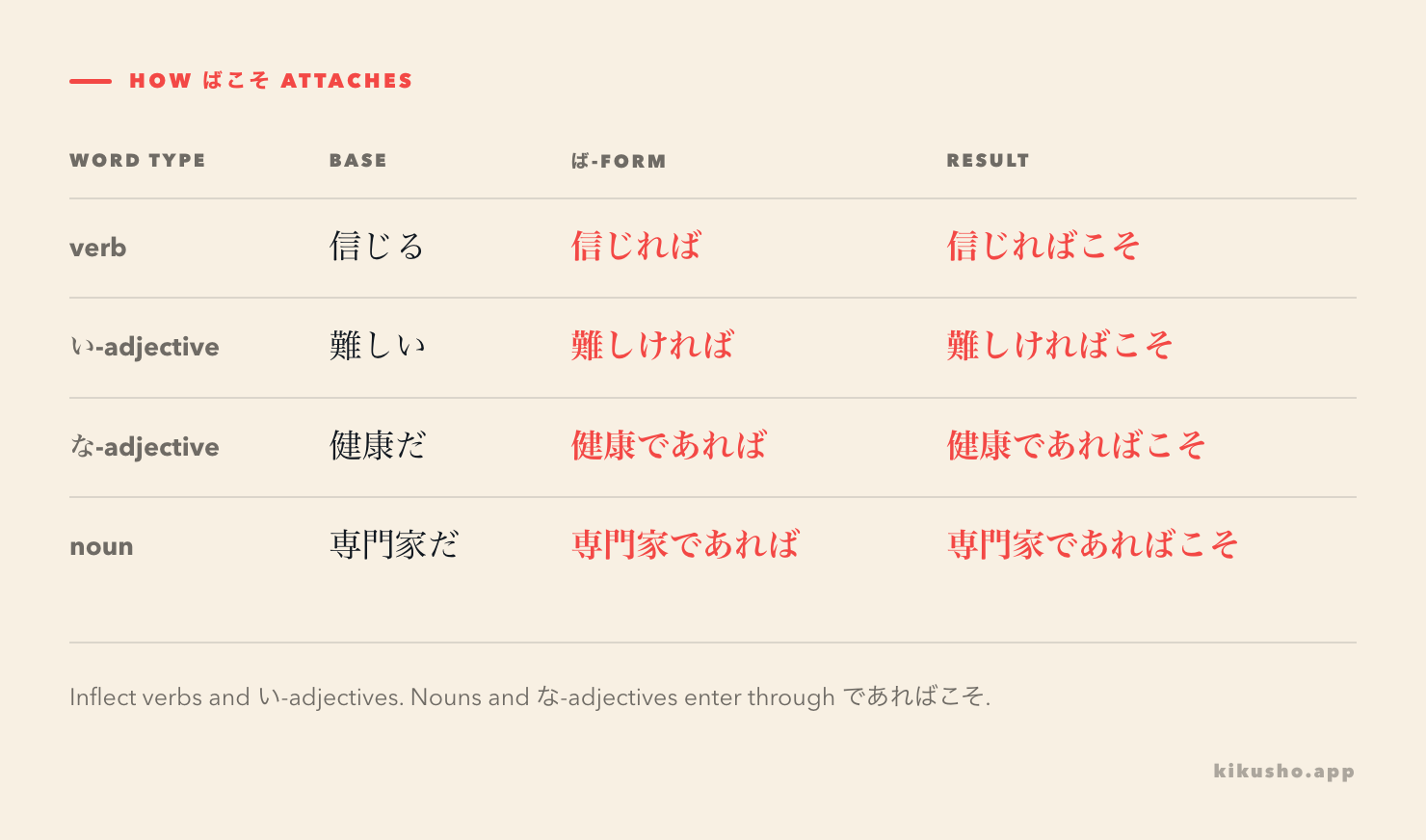
For verbs, make the ordinary hypothetical form:
- 考える → 考えればこそ
- 信じる → 信じればこそ
- 努力する → 努力すればこそ
- ある → あればこそ
- できる → できればこそ
An ongoing state may keep ている before the conditional ending:
相手を大切に思っていればこそ、率直な意見を伝えるのです。
あいてを たいせつに おもっていればこそ、そっちょくな いけんを つたえるのです。
It is precisely because we care about the other person that we offer a frank opinion.
For an い-adjective, replace い with ければ:
難しければこそ、完成したときの喜びも大きい。
むずかしければこそ、かんせいした ときの よろこびも おおきい。
Precisely because it is difficult, the joy when it is completed is also great.
Nouns and な-adjectives use であればこそ:
責任者であればこそ、問題を隠さず説明すべきだ。
せきにんしゃで あればこそ、もんだいを かくさず せつめいすべきだ。
Precisely because one is responsible, one should explain the problem without hiding it.
健康であればこそ、仕事にも集中できる。
けんこうで あればこそ、しごとにも しゅうちゅうできる。
It is precisely because one is healthy that one can concentrate on work.
Do not attach こそ directly to the dictionary form for this pattern. 信じるこそ and 難しいこそ are not substitutions for 信じればこそ and 難しければこそ.
The reason often explains conduct that could be misunderstood
ばこそ is particularly effective when B looks surprising, strict or contrary to a first impression:
親しい友人であればこそ、間違いを黙って見過ごすことはできない。
したしい ゆうじんで あればこそ、まちがいを だまって みすごす ことは できない。
Precisely because you are a close friend, I cannot silently overlook the mistake.
Without the first clause, refusing to stay silent may sound hostile. The focused reason recasts it as loyalty.
この地域を守りたいと思えばこそ、開発計画に反対している。
この ちいきを まもりたいと おもえばこそ、かいはつ けいかくに はんたいしている。
It is precisely because I want to protect this area that I oppose the development plan.
The opposition in B is negative toward the plan, but A expresses a value the speaker endorses. This distinction matters more than whether B itself sounds positive.
The reason may also support an ordinary result:
十分な準備があればこそ、冷静に判断できる。
じゅうぶんな じゅんびが あればこそ、れいせいに はんだんできる。
It is precisely because there is sufficient preparation that a calm decision is possible.
The pattern does not require a paradox. It earns its force whenever the writer deliberately elevates A as the fundamental reason.
A negative circumstance needs a meaningful reframing
Descriptions sometimes reduce ばこそ to “positive reasons only.” Actual use is more flexible. A difficult situation can occur in A when the writer treats it as the very ground for a constructive stance:
厳しい状況にあればこそ、互いに支え合う必要がある。
きびしい じょうきょうに あればこそ、たがいに ささえあう ひつようが ある。
It is precisely because we are in a difficult situation that we need to support one another.
The hardship is not praised. It is reframed as the reason for solidarity. By contrast, a bare unwanted cause with no such stance often favors からこそ or plain から:
体が弱いからこそ、食事には気をつけている。
からだが よわいからこそ、しょくじには きを つけている。
It is precisely because my health is fragile that I watch what I eat.
Here からこそ is the safer everyday emphasis. Treat the difference as a usage tendency, not a mechanical ban: ばこそ favors a reason the speaker can present as fundamental, valued or rhetorically productive.
ばこそ and からこそ emphasize the same link in different registers
Both forms answer “Why B?” by placing special weight on A:
信頼しているからこそ、任せた。
信頼していればこそ、任せた。
Both can mean “I entrusted it precisely because I trust them.” The first is natural in ordinary conversation and modern prose. The second is more formal, deliberate and literary.
Their attachment also differs:
| Base | からこそ | ばこそ |
|---|---|---|
| 信頼している | 信頼しているからこそ | 信頼していればこそ |
| 難しい | 難しいからこそ | 難しければこそ |
| 健康だ | 健康だからこそ | 健康であればこそ |
| 専門家だ | 専門家だからこそ | 専門家であればこそ |
The からこそ lesson develops the everyday reason-emphasis pattern and its contrast with からと言って. In conversation, replacing ばこそ with からこそ often preserves the core meaning and removes the ceremonial weight.
てこそ names an indispensable condition rather than a motive
Compare these two sentences:
相手を信頼していればこそ、重要な情報も共有できる。
Precisely because we trust the other person, we can share important information.
重要な情報を共有してこそ、信頼関係が深まる。
Only by sharing important information can the relationship of trust deepen.
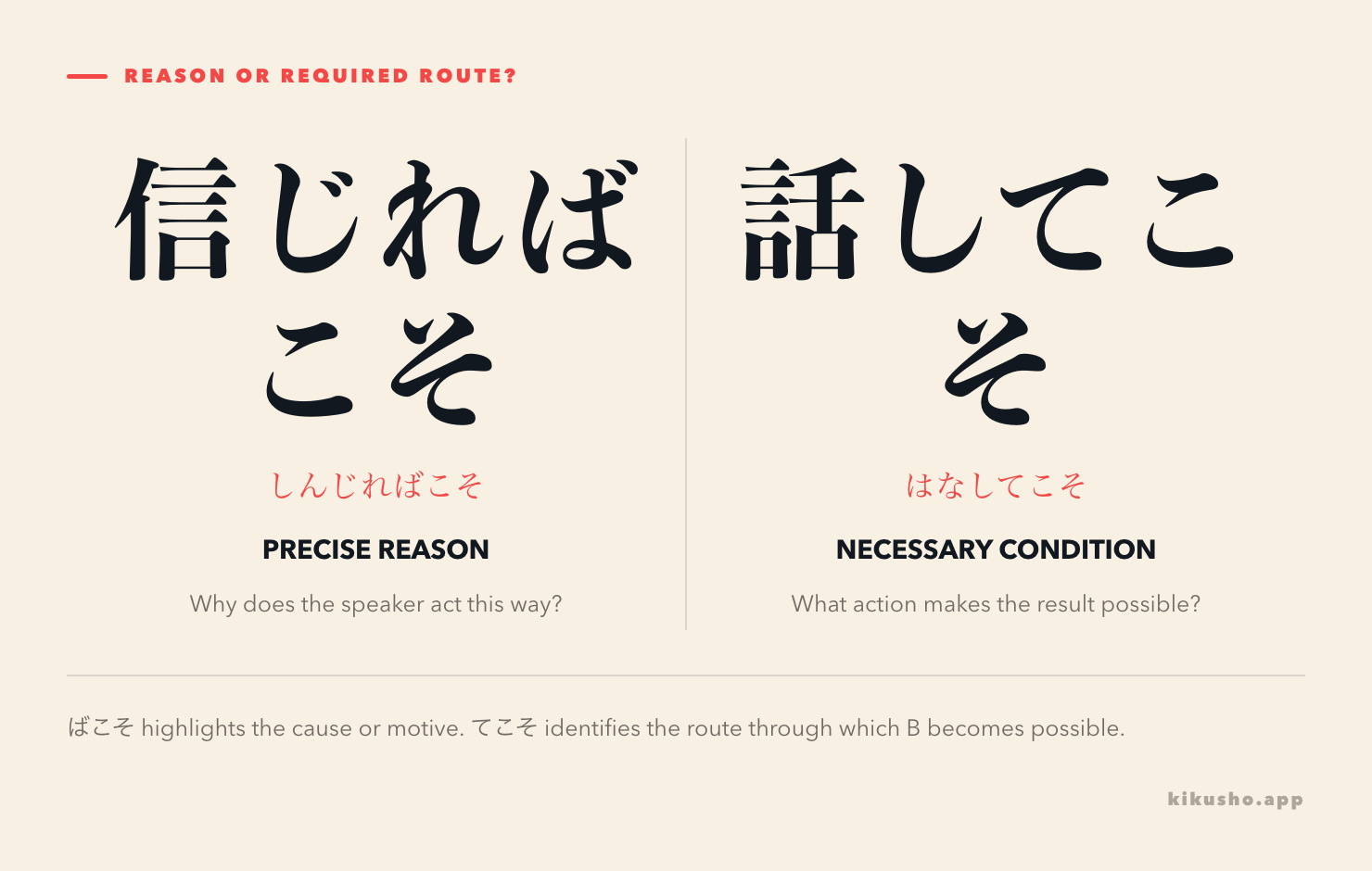
The first gives an existing state, trust, as the reason for sharing. The second makes the act of sharing the condition through which trust deepens. The てこそ comparison explains that indispensable-condition logic in detail.
This is also why changing ば to て does more than simplify the form. It changes the relation between the clauses from focused cause to required route.
ばこそ can complete the explanation before だ or です
The focused reason can appear at the end of a larger explanatory frame:
今の私があるのは、先生の支えがあればこそです。
いまの わたしが あるのは、せんせいの ささえが あればこそです。
I am who I am today precisely because I had my teacher's support.
この計画が実現したのは、地域の協力があればこそだ。
この けいかくが じつげんしたのは、ちいきの きょうりょくが あればこそだ。
This plan was realized precisely because of the community's cooperation.
The frame is Bのは、Aばこそだ/です. It is common in acknowledgements and formal statements because it lets the writer name the result first, then identify the decisive contribution.
Do not confuse this with ばこそあれ, where a following あれ builds an emphatic concessive pattern. The こそあれ and こそすれ lesson covers that separate construction.
Practice: form the reason before you emphasize it
Complete all seven tasks before revealing the solutions.
Question 1. Put 信じる into the ばこそ pattern.
彼を( )、この仕事を任せたのだ。
Option A: 信じるこそ
Option B: 信じればこそ
Option C: 信じてこそ
Option D: 信じたこそ
Question 2. Choose the correct noun attachment.
責任者( )、事実を正確に説明すべきだ。
| Candidate | Form |
|---|---|
| A | だからばこそ |
| B | でこそあれば |
| C | であればこそ |
| D | ならこそで |
Question 3. Which sentence best uses ばこそ to explain conduct that could be misunderstood?
- 友人であればこそ、間違いを率直に指摘するのだ。
- 雨が降ればこそ、道がぬれた。
- 三時になればこそ、会議が始まる予定だ。
- 安ければこそ、昨日その店で買った。
Question 4. Choose the more natural conversational sentence.
友達に「忙しいから時間を大切にしている」と伝える。
A. 忙しければこそ、時間を大切にしているのであります。
B. 忙しいからこそ、時間を大切にしているんだ。
C. 忙しくてこそ、時間を大切にしているんだ。
D. 忙しいであればこそ、時間を大切にしているんだ。
Question 5. Which continuation makes てこそ the better choice?
互いに率直に話し合ってこそ、__。
A. 相手を信頼している
B. 誤解を解くことができる
C. 昨日会議を開いた
D. 友人であればこそだ
Question 6. Select the sequence that preserves a focused reason, then a necessary action.
相手を大切に思って( ① )、厳しい意見も伝える。率直に話し合って( ② )、問題を解決できる。
Pair A: ①いればこそ ②こそ
Pair B: ①いてこそ ②ばこそ
Pair C: ①いるからと言って ②当然だ
Pair D: ①いれば ②からこそ
Question 7. Write a two-sentence formal acknowledgement. Use 協力があればこそ to credit a project's success, then use 支え合ってこそ for the condition that will enable future progress.
Answers and explanations
1. Verb form
Option B: 信じればこそ. 信じる becomes 信じれば in the hypothetical form, then takes こそ. 信じてこそ is grammatical Japanese, but it changes the relation to “only by trusting.”
2. Noun form
C. であればこそ. Nouns and な-adjectives use であれば before こそ. The other choices scramble the copular and conditional elements.
3. Revealed motive
1. Correcting a friend can look unfriendly, so 友人であればこそ reveals friendship as the very reason for speaking frankly. Sentence 4 can be interpreted causally in a deliberate context, but it does not fit the requested task of revealing the motive behind easily misunderstood conduct; ordinary から fits that simple purchase report better.
4. Conversational register
B. からこそ naturally emphasizes the reason in an ordinary conversation. Sentence A is structurally possible, but its formal ending and ばこそ make it mismatched to the stated casual setting.
5. Necessary route
B. 誤解を解くことができる. Talking openly is presented as the action that enables misunderstandings to be resolved. That forward dependence is the core of てこそ.
6. Reason, then condition
Pair A: ①いればこそ, ②こそ. 思っていればこそ identifies caring as the reason for giving a strict opinion. 話し合ってこそ makes open discussion the necessary route to a solution.
7. One possible acknowledgement
このプロジェクトが成功したのは、皆様の協力があればこそです。
これからも互いに支え合ってこそ、さらに前へ進むことができると考えています。
The first sentence credits an existing result to a focused reason. The second states the action required for future progress.
Keep both sides of the causal claim
A review prompt containing only ばこそ = precisely because cannot test whether the reason actually explains the result. Preserve A and B, especially when B initially appears strict or surprising.
The most useful contrast card pairs one motive with one consequence: 信頼していればこそ、率直に話す. It forces recall of the ば-form, the formal register and the logic that gives this N1 construction its weight.
Common questions
What does ばこそ mean in Japanese?
AばこそB presents A as the precise, strongly emphasized reason for B. It often explains a motive, attitude or result that could otherwise be misunderstood: precisely because A, B.
How do you form ばこそ?
Put verbs in the ば-form, change い-adjectives to ければ, and use であれば after nouns and な-adjectives, then add こそ: 信じればこそ, 難しければこそ, 健康であればこそ and 専門家であればこそ.
What is the difference between ばこそ and からこそ?
Both emphasize a reason. からこそ is common in speech and writing and accepts a wider range of causes. ばこそ is formal and literary, and often presents the reason as fundamental, valued or revealing the speaker's true motive.
Is ばこそ N1 or N2 grammar?
JLPT Sensei, Bunpro and MLC teach ばこそ with N1 material, while at least one Japanese-teacher reference places it at N2. These are publisher study orders because the JLPT does not release an exhaustive official grammar list.